欧线集运期货

Search documents
东证期货技术分析周报2026年第13周-20260329
Dong Zheng Qi Huo· 2026-03-29 13:43
1. Report Industry Investment Rating - Not provided in the given content 2. Core Viewpoints of the Report - Based on weekly technical indicator signals, different sectors of commodity and financial futures show various trends. In the commodity futures, precious metals, non - ferrous metals, black and shipping, energy, chemical, and agricultural product sectors have different signals of rising, falling, or oscillation. In the financial futures, stock index futures mostly show bearish signals, while treasury bond futures show an oscillatory trend [1][2] 3. Summary by Directory 3.1有色及贵金属板块 - Precious metals: Gold shows a bearish signal, and silver shows an oscillatory signal. Non - ferrous metals: Zinc, industrial silicon, and lithium carbonate show bullish signals, aluminum shows a bearish signal, and the rest show oscillatory signals. For example, Shanghai Aluminum is expected to oscillate in the short - term, with a weekly "umbrella line" but no reversal, a shrinking MACD red column, and a narrowing Bollinger Band [9][10][13] 3.2黑色及航运板块 - Hot - rolled coil, coking coal, and manganese silicon show bullish signals, and the rest, including European container shipping, show oscillatory signals. For example, rebar is expected to oscillate in the short - term, with a flat weekly line, a MACD death - cross above the zero - axis on the daily line, and the price touching the MA60 [18][19][24] 3.3能源及化工板块 - In the energy sector, crude oil, asphalt, and LPG show bullish signals, while fuel oil and low - sulfur fuel oil show oscillatory signals. In the chemical sector, soda ash, 20 - rubber, methanol, PTA, etc. show bullish signals, and the rest show oscillatory signals. For example, pulp is expected to oscillate in the short - term, with a bearish monthly line, weakening upward momentum on the weekly line, and a MACD running below the zero - axis on the daily line [31][32][35] 3.4农产品板块 - Soybean oil, sugar, soybean No. 2, palm oil, rapeseed oil, eggs, and red dates show bullish signals, soybean No. 1, rapeseed meal, and apples show bearish signals, and the rest show oscillatory signals. For example, corn is expected to oscillate in the short - term, with a bullish weekly line but a shrinking red column and a MACD green column expanding on the daily line [40][41][45] 3.5股指期货板块 - Shanghai 50, CSI 500, CSI 1000, and SSE 300 stock index futures all show bearish signals. For example, IC CSI 500 futures and IF SSE 300 futures are expected to oscillate in the short - term [50][51][53] 3.6国债期货板块 - 2 - year, 5 - year, 10 - year, and 30 - year treasury bond futures all show oscillatory signals. For example, the 10 - year treasury bond futures are expected to oscillate and repair in the short - term, and the 2 - year treasury bond futures are expected to oscillate in the short - term [62][63][66]
宁证期货期现日报-20260302
Ning Zheng Qi Huo· 2026-03-02 11:06
Group 1: Energy and Chemicals - Crude oil: The main contract closed at 527.8, up 43.5 or 8.98% from the previous settlement. The trading volume was 190,029 lots, an increase of 45,717 lots. The open interest was 44,601 lots, with a net increase of 5,628 lots [2]. - PTA: The main contract closed at 5,552, up 336 or 6.44%. The trading volume was 2,276,096 lots, an increase of 1,336,643 lots. The open interest was 1,467,484 lots, with a net increase of 20,629 lots [2]. - PX: The main contract closed at 7,836, up 496 or 6.76%. The trading volume was 514,606 lots, an increase of 259,452 lots. The open interest was 277,536 lots, with a net increase of 5,048 lots [2]. - Rubber: The main contract closed at 17,245, up 155 or 0.91%. The trading volume was 364,042 lots, an increase of 145,215 lots. The open interest was 170,621 lots, with a net decrease of 3,594 lots [2]. - NR: The main contract closed at 13,870, up 85 or 0.62%. The trading volume was 65,365 lots, an increase of 12,794 lots. The open interest was 31,588 lots, with a net decrease of 6,492 lots [2]. Group 2: Metals - Copper: The main contract closed at 103,850, up 1,030 or 1.00%. The trading volume was 175,311 lots, an increase of 17,830 lots. The open interest was 199,587 lots, with a net decrease of 4,212 lots [17]. - Aluminum: The main contract closed at 24,465, up 760 or 3.21%. The trading volume was 483,091 lots, an increase of 164,840 lots. The open interest was 277,833 lots, with a net increase of 19,143 lots [17]. - Zinc: The main contract closed at 24,850, up 275 or 1.12%. The trading volume was 186,884 lots, an increase of 82,336 lots. The open interest was 95,630 lots, with a net increase of 756 lots [17]. - Nickel: The main contract closed at 140,890, up 1,520 or 1.09%. The trading volume was 554,437 lots, an increase of 55,750 lots. The open interest was 219,113 lots, with a net increase of 369 lots [17]. - Tin: The main contract closed at 444,010, up 12,760 or 2.96%. The trading volume was 462,888 lots, an increase of 71,755 lots. The open interest was 49,946 lots, with a net decrease of 5,846 lots [17]. - Alumina: The main contract closed at 2,773, up 16 or 0.58%. The trading volume was 365,789 lots, a decrease of 181,123 lots. The open interest was 344,018 lots, with a net decrease of 33,878 lots [17]. - Industrial silicon: The main contract closed at 8,325, up 20 or 0.24%. The trading volume was 202,748 lots, a decrease of 63,533 lots. The open interest was 334,292 lots, with a net increase of 5,876 lots [17]. - Lithium carbonate: The main contract closed at 172,020, down 1,660 or -0.96%. The trading volume was 227,061 lots, a decrease of 54,919 lots. The open interest was 378,336 lots, with a net decrease of 3,216 lots [17]. Group 3: Agricultural Products - Live hogs: The main contract closed at 11,220, down 220 or -1.92%. The trading volume was 97,976 lots, an increase of 27,200 lots. The open interest was 165,149 lots, with a net increase of 9,894 lots [21]. - Corn: The main contract closed at 2,384, up 37 or 1.58%. The trading volume was 951,555 lots, an increase of 426,449 lots. The open interest was 1,502,061 lots, with a net increase of 26,583 lots [21]. - Soybean meal: The main contract closed at 2,826, down 2 or -0.07%. The trading volume was 905,873 lots, an increase of 185,687 lots. The open interest was 1,942,859 lots, with a net decrease of 85,078 lots [21]. - Rapeseed meal: The main contract closed at 2,295, up 10 or 0.44%. The trading volume was 487,190 lots, an increase of 158,121 lots. The open interest was 909,258 lots, with a net increase of 516 lots [21]. - Soybean oil: The main contract closed at 8,260, up 34 or 0.41%. The trading volume was 328,276 lots, an increase of 86,230 lots. The open interest was 656,400 lots, with a net decrease of 10,210 lots [21]. - Rapeseed oil: The main contract closed at 9,359, up 151 or 1.64%. The trading volume was 248,126 lots, an increase of 102,219 lots. The open interest was 268,810 lots, with a net increase of 10,866 lots [21]. - Palm oil: The main contract closed at 8,898, up 142 or 1.62%. The trading volume was 489,772 lots, an increase of 110,156 lots. The open interest was 387,932 lots, with a net decrease of 5,670 lots [21]. - Eggs: The main contract closed at 3,242, down 16 or -0.49%. The trading volume was 141,502 lots, a decrease of 13,045 lots. The open interest was 122,413 lots, with a net decrease of 11,753 lots [21]. Group 4: Others - Glass: The main contract closed at 1,043, down 9 or -0.86%. The trading volume was 1,624,477 lots, an increase of 942,426 lots. The open interest was 1,365,461 lots, with a net increase of 151,479 lots [12]. - Soda ash: The main contract closed at 1,188, up 3 or 0.25%. The trading volume was 1,270,083 lots, an increase of 512,115 lots. The open interest was 1,141,408 lots, with a net increase of 3,450 lots [12]. - Methanol: The main contract closed at 2,365, up 176 or 8.04%. The trading volume was 2,857,069 lots, an increase of 1,987,533 lots. The open interest was 942,819 lots, with a net decrease of 34,450 lots [12]. - PP: The main contract closed at 6,998, up 396 or 6.00%. The trading volume was 888,436 lots, an increase of 481,027 lots. The open interest was 498,613 lots, with a net increase of 8,140 lots [12]. - Sugar: The main contract closed at 5,345, up 31 or 0.58%. The trading volume was 353,834 lots, a decrease of 23,874 lots. The open interest was 469,987 lots, with a net decrease of 3,352 lots [26]. - Zheng cotton: The main contract closed at 15,225, down 105 or -0.68%. The trading volume was 461,720 lots, an increase of 39,923 lots. The open interest was 794,512 lots, with a net decrease of 43,468 lots [26]. - Cotton yarn: The main contract closed at 21,100, down 125 or -0.59%. The trading volume was 11,204 lots, a decrease of 2,110 lots. The open interest was 14,198 lots, with a net decrease of 296 lots [26]. - Apples: The main contract closed at 9,896, up 108 or 1.10%. The trading volume was 91,817 lots, a decrease of 18,121 lots. The open interest was 130,604 lots, with a net increase of 1,829 lots [26]. - Red dates: The main contract closed at 8,840, up 5 or 0.06%. The trading volume was 71,523 lots, a decrease of 24,143 lots. The open interest was 116,270 lots, with a net decrease of 1,655 lots [26]. - Corn starch: The main contract closed at 2,694, up 35 or 1.32%. The trading volume was 158,988 lots, an increase of 67,317 lots. The open interest was 244,396 lots, with a net increase of 12,884 lots [26]. - European container shipping: The main contract closed at 1,429, up 186 or 15.00%. The trading volume was 81,309 lots, an increase of 49,246 lots. The open interest was 46,243 lots, with a net increase of 8,998 lots [26].
休市前,欧线集运期价忽然“支棱”了一下
Xin Lang Cai Jing· 2026-02-14 02:32
Core Viewpoint - The recent surge in the European shipping index futures prices, which increased by over 6%, is primarily driven by geopolitical tensions and the exit of short-sellers, despite no significant changes in the underlying fundamentals [2][9]. Group 1: Market Dynamics - The European shipping index futures experienced a notable rise due to factors such as geopolitical tensions and the exit of short-sellers, with the market focusing on potential price increases expected in late March [9]. - Analysts indicate that the recent price increase is influenced by the pre-holiday shipping surge and escalating tensions between the U.S. and Iran, although the fundamental market conditions remain largely unchanged [3][9]. - The shipping companies have not yet implemented the previously announced price increases for March, with Maersk maintaining February's pricing, suggesting that earlier price hikes have not materialized [9][11]. Group 2: Future Outlook - Analysts predict that the European shipping index futures prices may face downward pressure in the short term due to the seasonal decline in shipping volumes post-Chinese New Year and the anticipated influx of new ships [10][11]. - The market is expected to experience volatility influenced by short-term capital movements as the holiday approaches, with no significant changes in the fundamental market conditions [3][10]. - The long-term outlook suggests that the influx of new ships and the resumption of Red Sea routes by shipping companies could lead to increased supply, putting further pressure on shipping rates [5][11]. Group 3: Geopolitical and Economic Factors - The ongoing geopolitical tensions, particularly between the U.S. and Iran, are contributing to market instability, which may affect global shipping routes and pricing [9][11]. - The current rise in shipping index futures reflects broader macroeconomic trends, including the restructuring of global trade and regional economic policy adjustments [11]. - Analysts emphasize the need to monitor the pace of global supply chain restructuring and its impact on trade flows, as these factors could significantly influence shipping rates in the future [5][11].


宁证期货期现日报-20260113
Ning Zheng Qi Huo· 2026-01-13 11:15
1. Report Date - The report is the Futures Spot Daily Report on January 13, 2026 [1] 2. Steel and Related Products 2.1 Futures Market Performance - For steel products such as rebar and hot - rolled coil, rebar主力2605 closed at 3158, unchanged from the previous settlement, with a trading volume of 837,879 and a decrease of 119,553; hot - rolled coil主力2605 closed at 3303, down 3 from the previous settlement, with a trading volume of 404,061 and a decrease of 4,668 [2] - Iron ore主力2605 closed at 819.5, down 2 from the previous settlement, with a trading volume of 311,621 and an increase of 39,577; coke主力2605 closed at 1745, down 19 from the previous settlement, with a trading volume of 20,384 and a decrease of 1,868; coking coal主力2605 closed at 1191, down 30.5 from the previous settlement, with a trading volume of 1,292,258 and a decrease of 304,912 [2] 2.2 Spot Market Performance - The spot price of rebar (HRB400 20MM) in Shanghai was 3300, down 10 from the previous day; the spot price of hot - rolled coil (4.75MM) in Shanghai was 3290, unchanged from the previous day; the spot price of iron ore (Rizhao Port PB powder) was 826, down 3 from the previous day; the spot price of coke in Xingtai was 1370, unchanged from the previous day; the spot price of coking coal in Liulin was 1490, up 20 from the previous day [3] 2.3 Basis and Spread - Rebar basis was 142, down 3 from the previous day; hot - rolled coil basis was - 13, up 8 from the previous day; iron ore basis was 6.5, unchanged from the previous day; coke basis was - 375, up 25 from the previous day; coking coal basis was 299, up 67 from the previous day [3] - Rebar 05 - 10 spread was - 44, up 2 from the previous day; hot - rolled coil 05 - 10 spread was - 18, up 1 from the previous day; iron ore 05 - 10 spread was 25.5, up 0.5 from the previous day; coke 05 - 10 spread was - 97, down 27 from the previous day; coking coal 05 - 10 spread was - 90, down 22 from the previous day [4] 3. Chemical Products 3.1 Futures Market Performance - Soda ash主力2605 closed at 1212, down 16 from the previous settlement, with a trading volume of 1,041,362 and a decrease of 210,340; glass主力2605 closed at 1096, down 32 from the previous settlement, with a trading volume of 1,644,156 and a decrease of 138,239; methanol主力2605 closed at 2263, down 4 from the previous settlement, with a trading volume of 1,600,904 and an increase of 137,923; PP主力2605 closed at 6545, up 46 from the previous settlement, with a trading volume of 427,937 and a decrease of 73,189 [8] 3.2 Spot Market Performance - The spot price of soda ash in East China and Chongqing was 1230, unchanged from the previous day; the national average price of float glass was 1097, up from the previous day; the mainstream price of methanol in Jiangsu Taicang was 2263, up 5 from the previous day; the spot price of PP in East China was 6434, up 3 from the previous day [9] 3.3 Basis and Spread - Soda ash basis was 18, up 27 from the previous day; glass basis was 1, up 51 from the previous day; methanol basis was 0, up 6 from the previous day; PP basis was - 111, up 52 from the previous day [9] - Soda ash 05 - 09 spread was - 61, up 2 from the previous day; glass 05 - 09 spread was - 145, down 47 from the previous day; methanol 05 - 09 spread was - 5, down 7 from the previous day; PP 05 - 09 spread was - 40, up from the previous day; glass 2605 - soda ash 2605 spread was - 116, down 20 from the previous day; PP2605 - 3 * methanol 2605 spread was - 244, down 15 from the previous day [10] 4. Financial Futures and Precious Metals 4.1 Futures Market Performance - IF主力 closed at 4758.60, down 20.80 from the previous settlement, with a trading volume of 97,329 and an increase of 8,141; IH主力 closed at 3137.60, down 4.60 from the previous settlement, with a trading volume of 41,076 and an increase of 7,512; IC主力 closed at 8131.20, down 98.80 from the previous settlement, with a trading volume of 120,900 and an increase of 6,310; IM主力 closed at 8160.40, down 145.80 from the previous settlement, with a trading volume of 178,731 and an increase of 5,780 [13] - The two - year Treasury bond主力 closed at 102.33, unchanged from the previous settlement; the five - year Treasury bond主力 closed at 105.63, up 0.04 from the previous settlement; the ten - year Treasury bond主力 closed at 107.85, up 0.06 from the previous settlement; the thirty - year Treasury bond主力 closed at 111.35, up 0.31 from the previous settlement [13] - Shanghai gold主力 closed at 1027.18, up 10.28 from the previous settlement, with a trading volume of 197,421 and a decrease of 40,906; Shanghai silver主力 closed at 21030.00, up 1151.00 from the previous settlement, with a trading volume of 136,532 and a decrease of 29,618 [13] 4.2 Basis and Spread - IF basis was 2.43, down 0.99 from the previous day; IH basis was - 4.67, down 7.34 from the previous day; IC basis was 12.08, down 5.28 from the previous day; IM basis was 42.73, up 19.04 from the previous day; gold basis was - 4.02, down 7.82 from the previous day; silver basis was 5.00, up 134.00 from the previous day [14] - The ratio of Shanghai gold index to Shanghai silver index was 0.05, down 0.03 from the previous day; the spread between 30 - year and 10 - year Treasury bonds was 3.50, down 2.25 from the previous day; the spread between 30 - year and 5 - year Treasury bonds was 5.72, down 1.46 from the previous day; the spread between 10 - year and 5 - year Treasury bonds was 2.22, up 0.79 from the previous day; the spread between 10 - year and 2 - year Treasury bonds was 5.52, up 1.69 from the previous day; the spread between 5 - year and 2 - year Treasury bonds was 3.30, up 0.90 from the previous day [15] 5. Energy and Chemical - Related Products 5.1 Futures Market Performance - Crude oil主力 closed at 445.6, up 9.9 from the previous settlement, with a trading volume of 65,173 and a decrease of 21,400; PTA主力 closed at 5140, down 16 from the previous settlement, with a trading volume of 1,098,411 and a decrease of 483,789; PX主力 closed at 7282, down 36 from the previous settlement, with a trading volume of 296,944 and a decrease of 100,184; rubber主力 closed at 15975, unchanged from the previous settlement, with a trading volume of 380,256 and an increase of 30,564; NR主力 closed at 12840, down 55 from the previous settlement, with a trading volume of 70,227 and an increase of 585 [18] 5.2 Spot Market Performance - The spot price of crude oil (Oman) was 392.0, up 4.0 from the previous day; the spot price of PTA in East China was 5060, down 35 from the previous day; the spot price of PX at Zhenhai Refining & Chemical in Zhejiang was 7500, unchanged from the previous day; the spot price of rubber (SCRWF) in Shanghai was 15800, unchanged from the previous day [19] 5.3 Basis and Spread - Crude oil basis was - 54, up from the previous day; PTA basis was - 80, up 39 from the previous day; PX basis was 218, up 52 from the previous day; rubber basis was - 175, up 1465 from the previous day [19] - Crude oil主力 - far - month spread was - 445.6, down 447.2 from the previous day; PTA主力 - far - month spread was - 60, down 42 from the previous day; PX主力 - far - month spread was - 7320, down 7230 from the previous day; rubber主力 - far - month spread was 25, up 165 from the previous day; PXN was 338, down 1 from the previous day; PTA cash - flow cost was 4948, down 10 from the previous day [20] 6. Non - ferrous Metals 6.1 Futures Market Performance - Shanghai copper主力 closed at 102,290, down 470 from the previous settlement, with a trading volume of 225,437 and an increase of 15,695; Shanghai aluminum主力 closed at 24,375, down 210 from the previous settlement, with a trading volume of 825,553 and an increase of 170,542; Shanghai zinc主力 closed at 24,235, up 205 from the previous settlement, with a trading volume of 152,709 and an increase of 48,147; Shanghai nickel主力 closed at 138,450, down 3,130 from the previous settlement, with a trading volume of 1,277,651 and an increase of 194,449; Shanghai tin主力 closed at 379,330, up 15,010 from the previous settlement, with a trading volume of 470,223 and an increase of 187,240; alumina主力 closed at 2,780, down 59 from the previous settlement, with a trading volume of 964,869 and an increase of 97,851; industrial silicon主力 closed at 8,635, down 145 from the previous settlement, with a trading volume of 270,076 and an increase of 776; lithium carbonate主力 closed at 166,980, up 11,560 from the previous settlement, with a trading volume of 608,177 and an increase of 539,686 [23] 6.2 Basis and Spread - Shanghai copper basis was 220, up 785 from the previous day; Shanghai aluminum basis was - 75, up 235 from the previous day; Shanghai zinc basis was 95, up 80 from the previous day; Shanghai nickel basis was 6,750, up 4100 from the previous day; Shanghai tin basis was 870, up 9240 from the previous day; alumina basis was - 92, up 83 from the previous day; industrial silicon basis was 865, up 120 from the previous day; lithium carbonate basis was - 7,480, down 3420 from the previous day [24] - The nickel - tin ratio was 0.36, down 0.0176 from the previous day; the copper - aluminum ratio was 4.20, down 0.0144 from the previous day; the copper - zinc ratio was 4.22, down 0.0818 from the previous day; the copper - nickel ratio was 0.74, up 0.0190 from the previous day; the copper - tin ratio was 0.27, down 0.0057 from the previous day [25] 7. Agricultural Products 7.1 Basis - The basis of live pigs was 1,205, up 40 from the previous day; the basis of corn was - 34, up 8 from the previous day; the basis of soybean meal was 399, up 19 from the previous day; the basis of fruit boxes was 76, up 6 from the previous day; the basis of soybean oil was 604, up 108 from the previous day; the basis of rapeseed oil was 833, up 113 from the previous day; the basis of palm oil was 122, up 196 from the previous day; the basis of eggs was 560, up 130 from the previous day [27] 7.2 Spread and Ratio - The pig - grain ratio was 5.1642, up 0.04 from the previous day; the spread between the two types of rapeseed oil was 447, down 13 from the previous day; the spread between soybean meal and soybean oil was - 792, down 62 from the previous day; the spread between soybean oil and rapeseed oil was - 1031, down 45 from the previous day; the spread between rapeseed oil and palm oil was 239, down 17 from the previous day; the oil - box ratio (soybean oil/soybean box) was 2.8924, up 0.03 from the previous day; the oil - box ratio (rapeseed oil/rapeseed box) was 3.8967, up 0.04 from the previous day [28] 8. Other Products 8.1 Futures Market Performance - Sugar closed at 5,253, down 33 from the previous settlement, with a trading volume of 221,246 and an increase of 30,716; Zhengzhou cotton closed at 14,760, up 195 from the previous settlement, with a trading volume of 547,023 and a decrease of 68,350; cotton yarn closed at 20,765, up 160 from the previous settlement, with a trading volume of 10,121 and an increase of 864; apples closed at 9,779, up 142 from the previous settlement, with a trading volume of 153,672 and an increase of 86,087; red dates closed at 9,060, down 100 from the previous settlement, with a trading volume of 91,864 and an increase of 11,198; corn starch closed at 2,561, up 8 from the previous settlement, with a trading volume of 89,060 and a decrease of 22,462; European line container shipping closed at 1,200, down 69 from the previous settlement, with a trading volume of 44,098 and a decrease of 20,59
马士基报价调降 欧线集运期货早盘跌近8%
Sou Hu Cai Jing· 2026-01-08 01:52
Group 1 - The core viewpoint of the article indicates a significant decline in the European shipping futures market, with the main contract opening down by 5.56% and experiencing a drop of nearly 8% during the trading session [2] - Maersk has announced a second reduction in its fourth-week pricing for this year, lowering the rate to $3,400 per FEU [4] - According to Haitong Futures, the pricing from Ningbo to Bremerhaven has been adjusted from $2,650 for standard containers and $2,750 for high containers down to $2,400 and $2,500 respectively, reflecting a decrease of $250 [4] Group 2 - The pricing from Shanghai to Gdansk has been reduced to $2,420 for standard containers, indicating a broader trend of price adjustments in the shipping industry [4] - The recent price reductions by Maersk suggest that the spot rates may be nearing their peak, with special-priced vessels expected to dock at Shanghai in the fifth week, indicating potential further price reductions for regular European ports in the following week [4]
集运早报-20251211
Yong An Qi Huo· 2025-12-11 01:59
Report Summary 1. Report Industry Investment Rating - No information provided in the content. 2. Core Viewpoints - The 12 - contract follows the delivery logic. MSK's Tuesday price cut for the last - week freight rate to $2300 may lead to a lower settlement price for the 12 - contract, with a central price of $2300 [3]. - The 02 - contract has a moderately high valuation. In the short - term, it may fluctuate due to the expected peak season in January. In the long - run, the driving force is upward because of the strong and recovering cargo volume. However, the high shipping capacity in January 2026 may suppress the price peak. Currently, it is recommended to wait and see [3]. - The 04 - contract has limited short - term downside space. Pay attention to the short - selling opportunities when the 04 - contract may rise following the near - month contracts [3]. 3. Summary by Related Catalogs Futures Contract Data - **Contract Prices and Changes**: The EC2512 contract closed at 1655.1, down 0.58%; the EC2602 contract closed at 1665.2, up 2.80%; the EC2604 contract closed at 1080.7, up 0.66%; the EC2606 contract closed at 1225.6, up 0.53%; the EC2608 contract closed at 1378.9, down 0.07%; the EC2610 contract closed at 1025.0, up 0.56% [2]. - **Trading Volume and Open Interest**: The trading volume of EC2512 was 321, and the open interest was 3169, down 114; the trading volume of EC2602 was 35894, and the open interest was 31382; the trading volume of EC2604 was 3703, and the open interest was 19219, down 159; the trading volume of EC2606 was 380, and the open interest was 2274, down 69; the trading volume of EC2608 was 170, and the open interest was 1549, down 25; the trading volume of EC2610 was 273, and the open interest was 4207, up 6 [2]. - **Month - to - Month Spreads**: For example, the EC2512 - 2504 spread was 5/4.4, with a day - on - day change of - 16.7 and a week - on - week change of 12.9; the EC2512 - 2602 spread was - 10.1, with a day - on - day change of - 55.0 and a week - on - week change of - 109.5; the EC2502 - 2604 spread was 584.5, with a day - on - day change of 38.3 and a week - on - week change of 1224 [2]. - **Indicator Data**: The forward - looking futures index (frequency: electricity - new, announced on 2025/12/8) was 1509.10, up 1.72% from the previous period and down 0.28% compared to the period before the previous one; the CCFI on 2025/12/5 was 1447.56, down 0.12% from the previous period; the NCFI on 2025/12/5 was 967.55, down 5.57% from the previous period [2]. European Line Spot Freight Situation - **Weekly Spot Freight Rates**: In Week 50, MSK's opening price dropped to $2200, with the central price at $2200, equivalent to 1550 points on the disk; in Week 51, MSK's opening price was $2400; in Week 52, MSK's opening price was $2300 (down $100 from the previous week) [4]. - **Price Adjustments**: YML cut the freight rate for late December to $2650 on Tuesday; MSK announced a price increase for January, with the freight rates for 20 - foot and 40 - foot containers on the European line raised to $2275 and $3500 respectively [4]. Related News - On December 10, 2025, the Israeli army launched air strikes and shelling on parts of Khan Younis in Gaza under its control; Hamas officials stated that disarming the Palestinians was equivalent to taking their lives [5]. - On December 11, 2025, Trump said he planned to announce the members of the "Gaza Peace Committee" early next year. Many world leaders wanted to join this committee established under a Gaza plan that brokered a fragile cease - fire between Israel and Hamas [5].
业内巨头涨价函齐发,欧线集运主力期货大涨近7%,VLCC租金也创下阶段新高
Xuan Gu Bao· 2025-11-17 23:16
Group 1 - The European shipping futures surged by 6.73% on November 17, indicating a strong market response to recent price adjustments by major shipping companies [1] - Maersk announced a price increase for December, raising rates for Far East to Northern Europe routes to $2,800 for small containers and $3,200 for large containers, reflecting a strong pricing strategy [1] - CMA CGM and Hapag-Lloyd also announced price hikes, reinforcing the trend of increasing shipping rates due to seasonal demand and inventory buildup ahead of the Christmas period [1] Group 2 - According to CICC, VLCC (Very Large Crude Carrier) rental rates have rapidly increased since November, with one-year rental rates surpassing the highest levels seen since the Russia-Ukraine conflict began in 2022, indicating a bullish outlook for the oil shipping market [1] - The supply side of VLCC remains tight, with a high proportion of older vessels and new supply primarily replacing these older ships, while demand is bolstered by strict sanctions on Russian and Iranian oil exports [1] - China Merchants Energy Shipping Company reported owning 52 VLCCs with 100% operational rights, and their vessels typically operate around 355 days per year, indicating a strong operational capacity in the VLCC segment [2] - COSCO Shipping Holdings reported a fleet of 557 self-operated container ships with a total capacity exceeding 3.4 million TEUs, maintaining a leading position in the industry [2]
国内期货开盘涨跌不一 白银涨近4%
Zheng Quan Shi Bao Wang· 2025-10-16 01:12
Core Viewpoint - Domestic futures market shows mixed performance with silver rising nearly 4% and gold, butadiene rubber increasing over 1%, while European shipping, live pigs, and styrene dropping over 1% [1] Group 1 - Silver prices increased by nearly 4% in the domestic futures market [1] - Gold and butadiene rubber both saw an increase of over 1% [1] - European shipping, live pigs, and styrene experienced declines of over 1% [1]
国内期货开盘涨多跌少 黄金、原油等涨超1%
Zheng Quan Shi Bao Wang· 2025-09-03 01:20
Group 1 - Domestic futures opened with more gains than losses, with gold, crude oil, and iron ore rising over 1% [1] - Coking coal, coke, and apples experienced slight increases [1] - European shipping indices fell over 3%, while nickel and caustic soda dropped more than 1% [1]
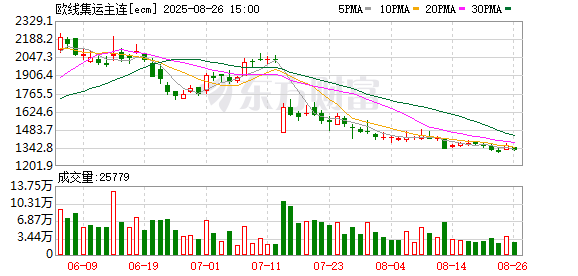
淡季压力逐步显现 欧线集运期货盘面延续跌势
Qi Huo Ri Bao· 2025-08-27 00:18
Core Viewpoint - The European shipping market is experiencing a transition from peak season to off-peak season, with a significant decline in spot freight rates and a competitive pricing environment among shipping companies [2][3][4]. Group 1: Market Performance - As of August 26, the main contract EC2510 closed at 1318.9 points, down 2.76%, reflecting a bearish trend in the futures market [2]. - The SCFIS European line index reported a decrease to 1990.20 points as of August 25, down 8.7% from the previous period [2]. - Spot freight rates have dropped from a peak of $3380/FEU at the end of July to $2160/FEU, with an average weekly decline of $120/FEU [2][3]. Group 2: Supply and Demand Dynamics - In September, the shipping market is expected to enter a seasonal downturn, with marginal weakening in cargo volume while capacity remains relatively high [3]. - Scheduled and pending weekly capacity for September is 284,000 TEU and 10,000 TEU, respectively, while for October it is 263,000 TEU and 25,000 TEU [3]. - Despite a potential surge in shipments before the National Day and Mid-Autumn Festival, shipping companies are likely to prioritize stockpiling, making it difficult to maintain prices [3]. Group 3: Freight Rate Trends - Current average freight rates for early September have fallen to $2160/FEU, with various alliances reporting different average rates: Gemini Alliance at $1920/FEU, OA Alliance at $2230/FEU, PA Alliance at $2170/FEU, and MSC at $2352/FEU [3]. - The decline in spot rates has exceeded $1200/FEU since the peak in late July [3]. Group 4: Futures Market Insights - The current spot market price range is between $2100 and $2200/FEU, with the Gemini Alliance's price dropping to $1900/FEU, prompting other alliances to lower their prices to maintain loading rates [4]. - The main contract EC2510's closing price suggests a freight rate of $1950 to $2000/FEU, indicating potential for further adjustments in the futures market [4]. - The overall trend in the European shipping futures market is expected to remain weak and volatile until signs of stabilization in the fundamentals emerge [4]. Group 5: Contract Analysis - Near-term contracts are closely tied to spot market fundamentals, necessitating close monitoring of freight rate trends and shipping capacity adjustments [5]. - Long-term contracts incorporate seasonal pricing and potential recovery expectations, with 2026 contracts trading at a discount compared to 2025 contracts [5]. - Geopolitical events and changes in U.S.-China tariffs are significant factors influencing long-term contracts and overall shipping volumes [5].