
澳大利亚国债

Search documents
3月至今全球债市市值已蒸发2.5万亿美元
第一财经· 2026-03-24 09:57
Core Viewpoint - The article discusses the impact of geopolitical tensions in the Middle East on the U.S. bond market and investor sentiment, highlighting a cautious outlook amid fluctuating interest rates and inflation concerns [3][4]. Group 1: U.S. Bond Market Dynamics - The yield on the benchmark 10-year U.S. Treasury bond fell to 4.34% on March 23, following concerns that the Federal Reserve may not lower interest rates this year [4] - The 2-year Treasury yield also dropped to 3.84%, marking its largest single-day decline in nearly a month, while the 30-year yield retreated to 4.91% after nearing 5% [4] - Despite a temporary rebound, the bond market has seen significant volatility, with the 2-year Treasury experiencing its highest daily price fluctuations since August of the previous year [6][7] Group 2: Investor Sentiment and Market Reactions - Investors remain cautious, preparing for further volatility in the bond market due to ongoing geopolitical tensions and uncertainty regarding the resolution of conflicts in the region [6] - Analysts suggest that the market is sensitive to developments regarding Iran and the status of the Strait of Hormuz, which remains a critical shipping route [6] - The global bond market has lost over $2.5 trillion in value since March, with total market capitalization dropping from nearly $77 trillion to $74.4 trillion, a decline of 3.1% [9] Group 3: Inflation and Interest Rate Expectations - The article notes that rising energy prices due to Middle Eastern conflicts have heightened inflation concerns, leading traders to prepare for potential interest rate hikes [4][9] - Analysts predict that the Federal Reserve may need to raise rates later in the year to curb demand and control inflation [7] - The UK bond market is facing significant challenges, with expectations of multiple rate hikes by the Bank of England due to its reliance on energy imports [9][10]


澳国债成AI风暴避风港:收益率冠绝发达市场,全球资金涌入创四年新高
智通财经网· 2026-02-26 00:49
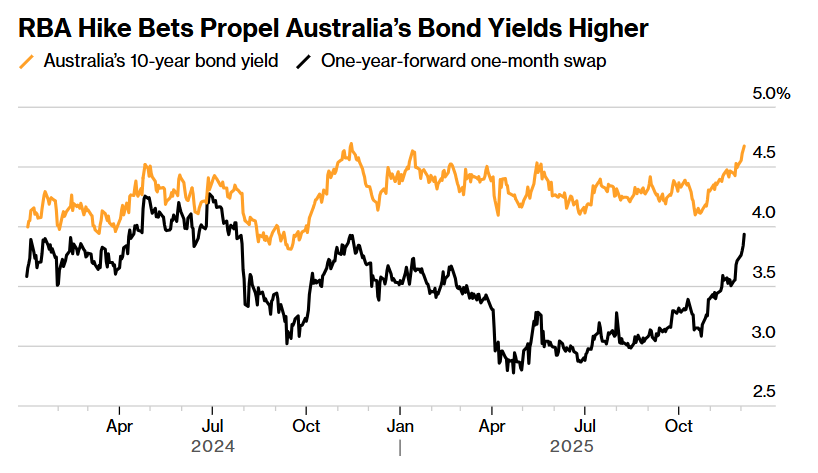
Core Insights - Global investors are flocking to the Australian bond market, seeking refuge in one of the safest and highest-yielding sovereign debt markets as AI trading shows signs of instability [1] - The Australian 10-year benchmark government bond yield stands at 4.72%, the highest among developed markets [1] - The Reserve Bank of Australia is expected to be the first major central bank to raise interest rates by 2026, with traders betting on at least one more hike to curb inflation [1] Group 1 - Over AUD 4 billion (approximately USD 2.8 billion) flowed into Australian bond funds last year, marking the highest level in four years [1] - Vantage Point Asset Management's CIO has significantly reduced stock exposure in macro funds and shifted part of the capital into short-term Australian government bonds, which now account for nearly one-third of the portfolio [1][2] - Multiple factors are attracting investors, including a 60 basis point rise in the Australian 10-year bond yield since mid-October last year, expanding the yield spread relative to U.S. Treasuries to the widest level in over three years [3] Group 2 - The correlation between Australian and U.S. bond yields has strengthened, indicating that investors view Australian bonds as a viable option to diversify away from U.S. Treasuries [3] - QIC Ltd. reported a net inflow of AUD 5.9 billion in its fixed income department over the past 12 months, reaching a record management scale of AUD 28 billion [3] - Schroders has observed a similar trend, attracting approximately AUD 500 million in net new funds to its Australian fixed income business over the past six months, with a notable return of Asian investors favoring high-yield Australian assets [3] Group 3 - Despite moderate returns this year, with one indicator rising about 0.8%, the relative valuation and yield spread make Australian bonds a preferred choice for diversified portfolios [4] - Australia's robust fiscal position supports its attractiveness, being one of only eight sovereign issuers globally with the highest credit ratings from all major agencies [4] - Recent bond auctions have seen strong demand, with a recent auction for AUD 800 million bonds attracting nearly four times the subscription, significantly exceeding the average demand since 2012 [4] Group 4 - High yields, AAA credit ratings, stable government and fiscal outlook, along with a sound legal system, make Australia an attractive investment destination [5]
CPI余波未了!美债收益率直逼4%关口,市场屏息以待就业数据验证降息路径
智通财经网· 2026-02-17 07:09
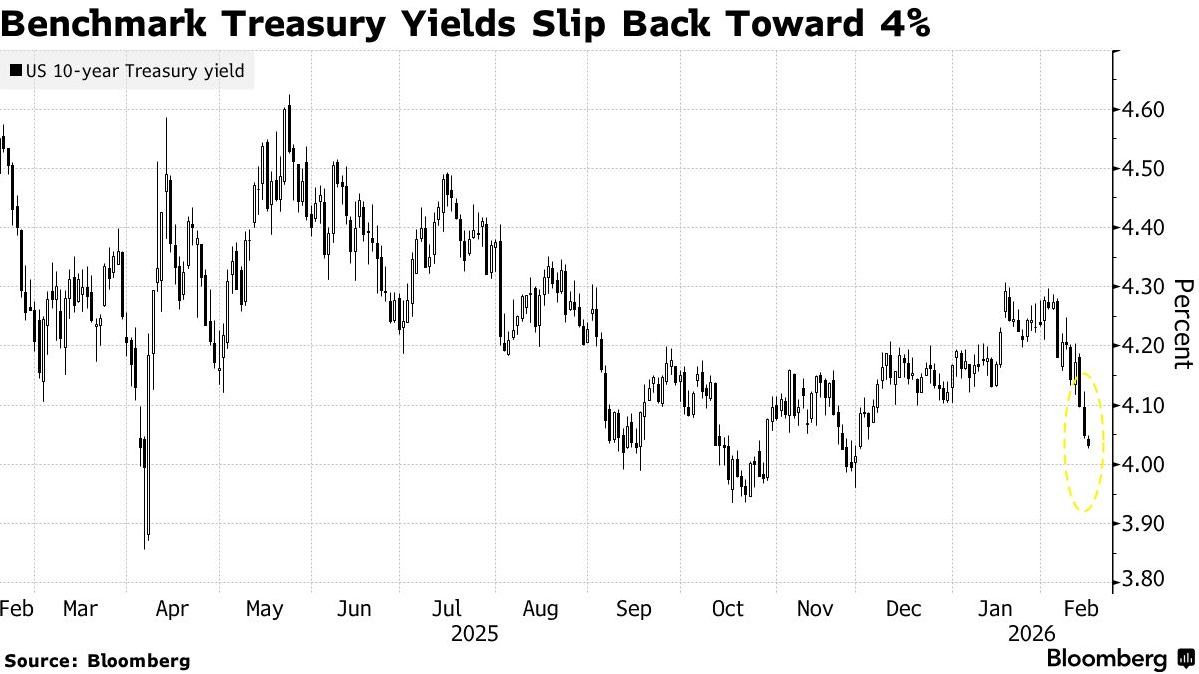
Group 1 - The core viewpoint of the articles indicates that the recent rally in U.S. Treasury bonds is driven by expectations of slowing inflation, which may lead the Federal Reserve to cut interest rates at least twice this year [1][3] - The benchmark 10-year Treasury yield fell by 2 basis points to 4.03%, while the two-year yield approached its lowest level since 2022 during light trading in Asia [1] - The weak U.S. CPI data from last week and ongoing deleveraging by quantitative funds in the stock market are contributing to increased demand for bonds [3] Group 2 - The 4% level for the 10-year Treasury yield is seen as a critical support level; if breached, a significant decline in yields is expected [3] - Bond yields in the region, including Australia and New Zealand, also saw slight declines, indicating a broader trend of falling yields [3] - Traders are closely monitoring upcoming U.S. employment data and the minutes from the Federal Reserve's January meeting for clues on potential interest rate adjustments [3]
通胀“死灰复燃”,澳洲联储打响2026加息第一枪!
Jin Shi Shu Ju· 2026-02-03 04:17
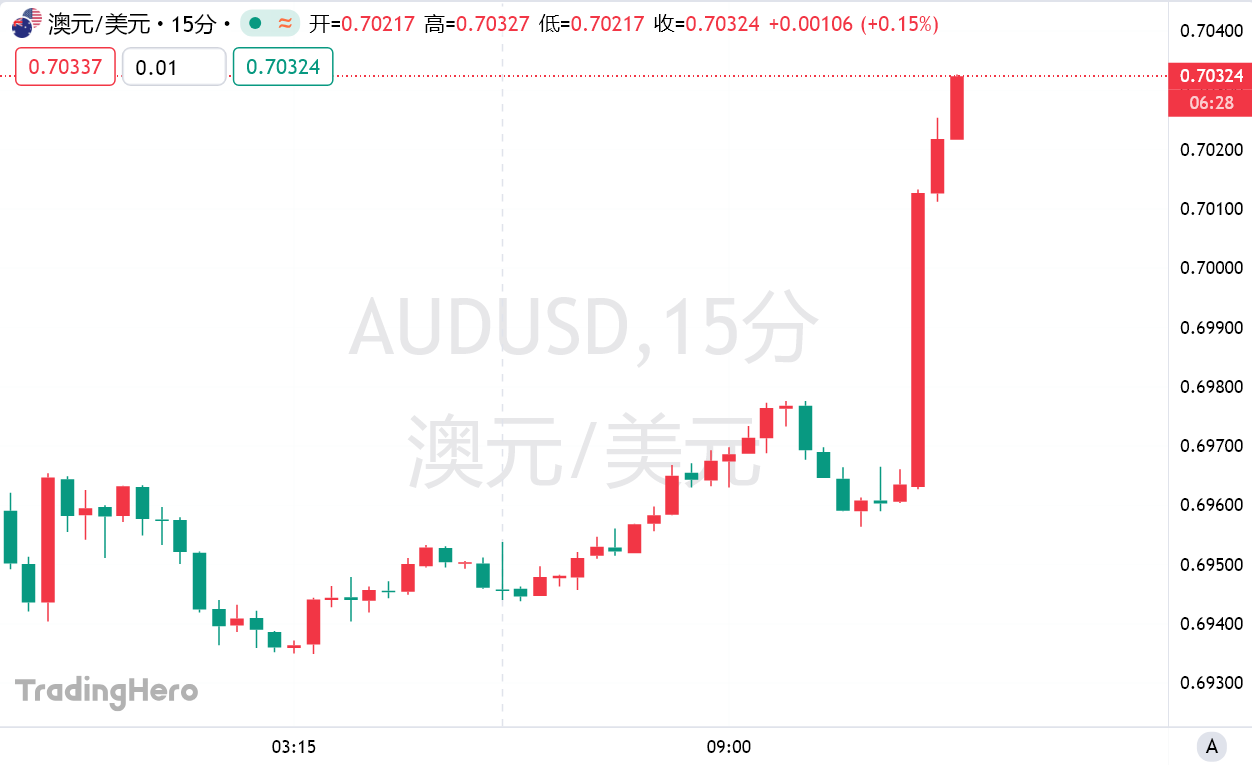
Core Viewpoint - The Reserve Bank of Australia (RBA) has raised the cash rate from 3.6% to 3.85%, marking it as the first major central bank to increase rates this year due to persistent domestic inflation pressures [2][4]. Group 1: Interest Rate Decision - The RBA's decision to increase the cash rate is a response to substantial inflationary pressures, with the committee noting that private demand is growing faster than expected [2]. - This increase effectively reverses one of the three rate cuts made last year, indicating a shift in monetary policy [2]. Group 2: Economic Indicators - Recent data shows that inflation is expected to remain above the target range of 2-3% for this year, with predictions that it will not reach the midpoint of this range until the end of 2027 [4]. - The Australian economy is nearing its capacity limits, with a historically low unemployment rate and a strong monthly growth in job advertisements since February 2022 [4][5]. Group 3: Consumer Behavior and Market Reactions - Despite the rate hike, Australian consumers are cautious, with real per capita spending remaining flat and a slight increase in the savings rate as households rebuild financial buffers [4]. - Following the RBA's announcement, the three-year government bond yield rose by 5 basis points to 4.34%, and the Australian dollar experienced a sharp increase against the US dollar [2].
美债日债领跌!关税担忧与财政压力引发全球债市抛售潮
Hua Er Jie Jian Wen· 2026-01-20 05:58
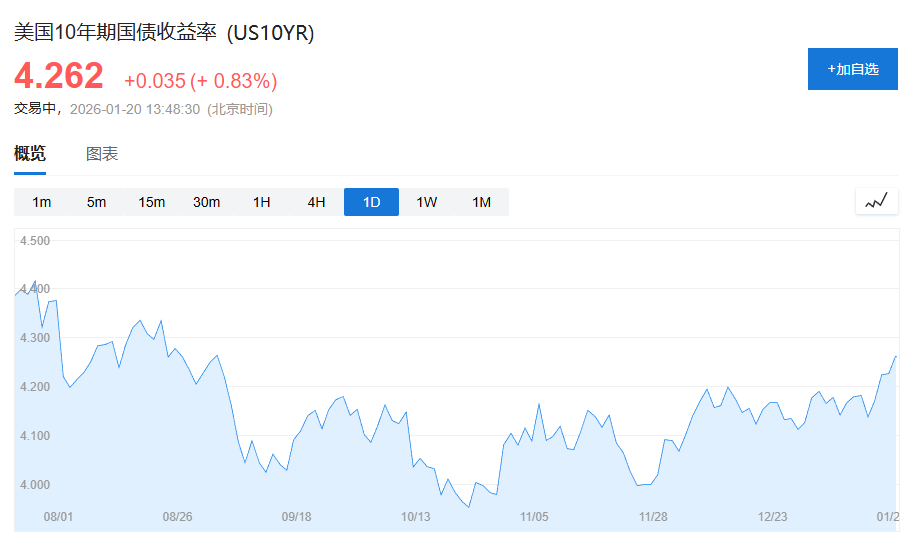
Core Viewpoint - The global bond market is experiencing a significant sell-off, driven by concerns over U.S. fiscal spending, renewed tariff threats, and doubts about the safe-haven status of U.S. Treasuries [1][5]. Group 1: Market Reactions - U.S. 10-year and 30-year Treasury yields have risen by at least 4 basis points, while Japan's 10-year yield increased by 8 basis points [1]. - The sell-off has affected major global bond markets, with Japan's 40-year bond yield reaching 4%, the highest since its introduction in 2007 [2]. - Australian and New Zealand bonds have also seen declines, alongside a drop in German government bond futures [2]. Group 2: Tariff Threats and Policy Uncertainty - President Trump's plan to impose tariffs on certain European countries has reignited concerns about the unpredictability of government policies, potentially exacerbating inflation and fiscal deficit worries [2][6]. - The tariff threats are seen as a catalyst for the current bond market sell-off, leading to a reassessment of policy stability [6]. Group 3: Fiscal Deficit and Investor Sentiment - The expanding U.S. fiscal deficit is diminishing the appeal of Treasuries as a safe haven, with fears that European countries may sell off U.S. bonds in response to the tariff conflict [5][7]. - Japanese investors may withdraw from U.S. debt due to rising domestic yields, further pressuring the U.S. bond market [7][8]. Group 4: Structural Market Pressures - The rise in Japanese bond yields is making U.S. Treasuries less attractive for Japanese investors, who may prefer to repatriate funds for better returns domestically [8]. - This trend could create structural pressures on the U.S. bond market, especially given the reliance on foreign capital for financing deficits [8].
日央行如期加息!10年期日债收益率上破2%创2006年来新高,日元急跌,亚太股市普涨、纳指期货微涨,黄金回落至4330美元
Hua Er Jie Jian Wen· 2025-12-19 06:14
Group 1: Market Overview - The Asia-Pacific stock markets rose, following the overnight gains in US stocks, with the Nikkei 225 index up over 1% and the MSCI Asia-Pacific index increasing by 0.6% [1] - US inflation data cooling has strengthened expectations for a Federal Reserve rate cut, contributing to a 0.8% rise in the S&P 500 index and a 1.5% increase in the Nasdaq 100 index [1][2] - Major contributors to the Asia-Pacific market included technology giants like SoftBank Group and Tencent Holdings [2] Group 2: US Inflation Data - The US consumer price index (CPI) for November rose by 2.7% year-on-year, lower than the 3.1% predicted by economists, marking the lowest growth rate since early 2021 [2] - This data has boosted investor confidence and supported US Treasury bonds amid rising expectations for a Fed rate cut [2] - Concerns were raised regarding the reliability of the inflation data due to a temporary government shutdown affecting data collection [2] Group 3: Japanese Central Bank Actions - The Bank of Japan raised its benchmark interest rate by 25 basis points to 0.75%, the highest level in 30 years, while signaling potential further tightening if economic conditions allow [1][3][4] - Following the announcement, the Japanese yen weakened against the dollar, and the 10-year Japanese government bond yield rose to 2%, the highest since 2006 [1][7] Group 4: Commodity Market Trends - The commodity market faced pressure, with gold prices dropping by 0.1% to below $4,330 due to the stronger dollar and lower inflation expectations reducing gold's appeal as an inflation hedge [1][10] - Silver prices increased by 0.4%, nearing $66, while platinum rose by 0.5% to around $1,925, and palladium fell by 1.1% [10][14] - Oil prices continued to decline amid global oversupply expectations, with Brent crude and WTI both down by 0.3% [1][10]

美债企稳静待联储购债启动 市场聚焦30年期国债拍卖
Zhi Tong Cai Jing· 2025-12-11 12:00
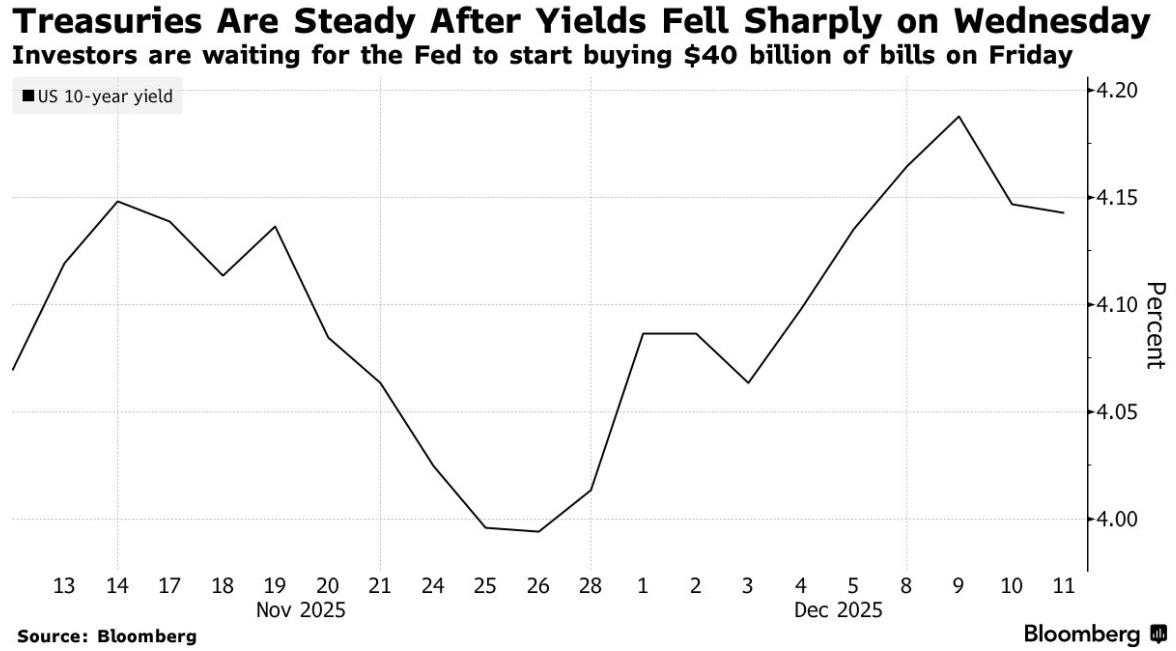
Group 1 - The U.S. Treasury market is stabilizing after experiencing its largest increase in three weeks, with investors preparing for the Federal Reserve's monthly $40 billion Treasury bill purchase program [1] - The yield on the 10-year U.S. Treasury bond remains steady at 4.14%, while the two-year bond yield stabilized after a significant drop, following the Fed's decision to lower interest rates by 25 basis points to a range of 3.5%-3.75% [1] - Jefferies Group's Chief Economist and Strategist Mohit Kumar emphasized the importance of balance sheet expansion, noting that the Fed's purchasing operations will have a stimulative effect as the Treasury shifts its issuance towards Treasury bills and short-term bonds [1] Group 2 - The U.S. Labor Department is set to release initial jobless claims data, with economists expecting an increase from 191,000 to 220,000 [4] - The U.S. Treasury plans to complete its weekly debt issuance by selling $22 billion in 30-year bonds, following a previous auction that saw widening tail spreads, which pushed yields higher [4] - Other markets, including Eurozone and UK bonds, are generally stable, while Japanese bonds rose due to strong demand in a 20-year bond auction, attracting investors with higher yields [4]
三次降息后市场热议澳联储重启加息! 10年期澳大利亚国债收益率创1年来新高
智通财经网· 2025-12-04 06:20
Core Viewpoint - The Australian market is increasingly speculating that the Reserve Bank of Australia (RBA) will shift back to raising interest rates to combat inflation, as evidenced by rising government bond yields [1][4]. Economic Data - Australia's 10-year government bond yield has risen significantly, reaching 4.70%, the highest level since November 2024, while the 3-year yield hit 4.04% [1]. - October household spending growth exceeded economists' expectations, and wage growth indicators unexpectedly expanded, suggesting rising inflationary pressures [1][7]. - Recent economic data indicates resilience in the Australian economy, with rising house prices and better-than-expected business investment [7]. Market Sentiment - Market participants are increasingly betting on RBA rate hikes, with expectations for a 25 basis point increase by the end of 2026 [1][8]. - The sentiment is supported by other central banks, such as the New Zealand Reserve Bank and the European Central Bank, which have also signaled a shift away from easing policies [3]. Inflation Concerns - The rising inflation momentum is intensifying market concerns about Australian inflation, indicating a potential hawkish stance from the RBA in its upcoming monetary policy meeting [7]. - The RBA has already cut rates three times this year, bringing the benchmark rate to 3.6%, but recent data suggests a shift towards a data-dependent approach [8].
政策扩张碰撞及算法交易趋同:日债高波动的逻辑和启示
GUOTAI HAITONG SECURITIES· 2025-12-04 02:00
Group 1 - The report highlights that Japan's bond market experienced its most severe sell-off since 1999, driven by a combination of fiscal expansion, central bank policy shifts, and supply-demand imbalances [6][7][8] - The Japanese government's economic stimulus plan of 21.3 trillion yen (approximately 3.5% of GDP) raised concerns about debt sustainability, leading to increased selling pressure in the bond market [6][7] - The Bank of Japan's reduction in long-term bond purchases exacerbated supply pressures, with the 30-year bond yield reaching a historic high of 3.26% [7][8] Group 2 - The report identifies common characteristics of global bond market volatility, noting that developed markets have also experienced significant adjustments in response to central bank policy signals [11][12] - In the UK, a crisis of fiscal credibility led to a surge in 30-year gilt yields to the highest levels since 1998, reflecting concerns over government debt sustainability [12] - Australia's bond market saw a sharp increase in yields following unexpected inflation data, indicating a shift in market expectations regarding interest rate movements [13][15] Group 3 - The report discusses the vulnerabilities of emerging markets, highlighting that their bond markets are particularly sensitive to changes in central bank policies, leading to amplified volatility [20][21] - Argentina's recent crisis exemplifies this vulnerability, with a significant rise in sovereign debt risk premiums amid concerns over fiscal sustainability [21][22] - The report notes that emerging markets face challenges due to shallow liquidity and reliance on foreign capital, which can lead to rapid capital outflows in response to policy shifts [20][23] Group 4 - The report emphasizes the importance of balancing fiscal expansion, central bank operations, and market absorption capacity in the context of Japan's bond market [28][29] - It suggests that while Japan's experience offers lessons, significant differences exist in capital account management and monetary policy tools between Japan and other countries [28][29] - The report warns that ongoing fiscal stimulus in China could lead to reassessments of long-term interest rate levels, particularly if nominal growth does not meet expectations [28][30] Group 5 - The report outlines potential scenarios for Japan's bond market, particularly in light of the upcoming Bank of Japan policy meeting, where tensions between fiscal stimulus and monetary tightening may influence market reactions [33][34] - It notes that the yield curve could steepen if interest rate hikes materialize, but economic data surprises could limit long-term yield increases [34][35] - The report highlights the differentiated risk profiles of various bond maturities, with longer-duration bonds facing greater price volatility in a low liquidity environment [35][36]

澳大利亚经济增长令人失望 加息预期降温
Xin Lang Cai Jing· 2025-12-03 00:40
Group 1 - Australia's GDP growth unexpectedly slowed to 0.4% for the quarter ending in September, below the expected 0.7% and the revised previous quarter's growth of 0.7% [1][3] - The annual growth rate was recorded at 2.1%, also lower than the anticipated 2.2% [1][3] Group 2 - Following the GDP data release, the Australian dollar depreciated, and the yield on three-year Australian government bonds declined [2][4] - The market now sees over a 50% probability that the Reserve Bank of Australia (RBA) will keep interest rates unchanged until the end of 2026, contrasting with previous expectations of a rate hike by the end of next year [2][4] - The RBA anticipates that economic growth will approach a "potential" rate of nearly 2% by 2026, supported by lower borrowing costs, stable household incomes, and strong population growth, despite ongoing high inflation and a tight labor market [2][4]