谷歌Gemini 3

Search documents
模型能力-算力成本与Agent成熟度共振-迎接AI应用投资元年
2026-01-07 03:05
Summary of Conference Call Records Industry Overview - The conference call discusses the AI application industry, highlighting significant advancements in model capabilities, cost reductions in computing power, and the maturity of AI agents, setting the stage for a major investment year in AI applications in 2026 [1][5][7]. Key Points and Arguments AI Model and Cost Developments - Since 2023, the cost of using tokens has significantly decreased, reducing the expenses for enterprises utilizing large models and enhancing economic returns, which lays the foundation for large-scale AI application launches [1][2]. - The transition from hardware to software in the tech industry is at a critical juncture, with expectations that 2026 will mark the beginning of a new investment era in AI applications [1][5]. Market Dynamics and Growth - The release of OpenAI's Deepseek R1 model in Q1 and Q2 of 2025 has accelerated application development, with notable performance in the domestic inference and computing sectors, particularly in chip and IDC fields [4][8]. - By the end of 2026, it is anticipated that AI business revenue for companies in China and the U.S. will exceed 10%, indicating a critical turning point in product maturity and customer acceptance [7][11]. Competitive Landscape - Chinese companies such as ByteDance, Kuaishou, and Alibaba are gaining global influence, with Alibaba recognized for its open-source model. Startups like Zhipu and Minimax are also performing well, showcasing China's competitive edge in large model technology [1][11][12]. - The gap between China's top large models and leading U.S. models has narrowed to 3 to 6 months, indicating significant progress in the domestic AI landscape [12]. Investment Strategies - The investment strategy for 2026 focuses on AI applications, with a historical context of the tech industry's investment patterns indicating a shift towards software and innovative business models [2][5][17]. - Investors are encouraged to focus on domestic advancements in large models and multi-modal technologies, which are expected to drive substantial growth in downstream inference and training demands [17][18]. Additional Important Insights - The AI application sector is witnessing a diversification of business models, including subscription services and performance-based pricing, which are reshaping the software industry [16]. - The rapid advancements in AI applications are not only limited to established companies but also include significant contributions from startups, indicating a robust ecosystem for innovation [9][10]. Conclusion - The conference call emphasizes the transformative potential of AI applications, driven by advancements in model capabilities, cost efficiencies, and a competitive landscape that is increasingly favorable for Chinese firms. The anticipated investment boom in 2026 is supported by a solid foundation of technological progress and market readiness [1][5][7][17].
甲骨文如何扭转市场叙事?瑞银:OpenAI信仰修复、负债压力证明可控
Hua Er Jie Jian Wen· 2026-01-05 09:41
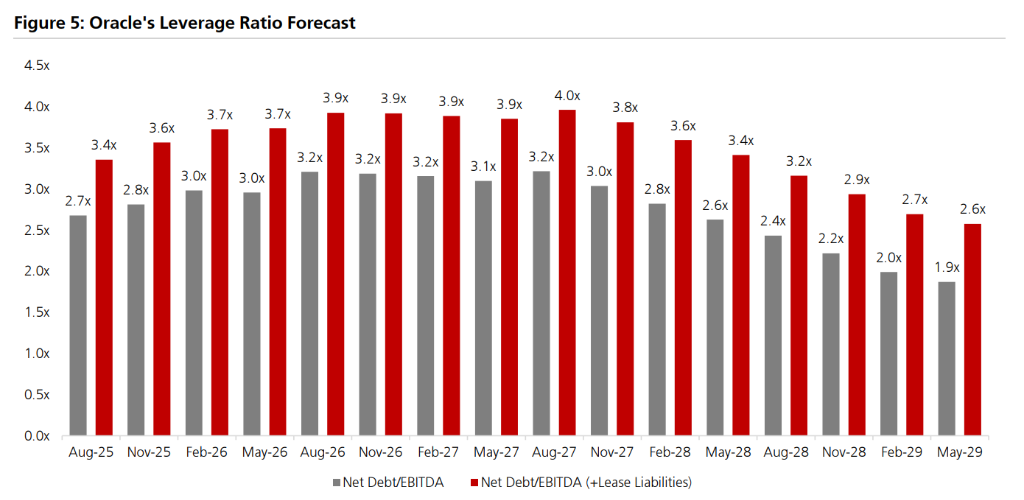
Core Viewpoint - Oracle's stock price has experienced a significant decline of 41% since mid-September, reflecting market concerns about OpenAI's ability to fulfill its trillion-dollar promises and Oracle's substantial net debt of $88 billion [1][4] Group 1: Market Sentiment and Stock Performance - Investors are anxious about OpenAI's ability to meet commitments, which has negatively impacted Oracle as a key supplier [4] - UBS maintains a "Buy" rating, arguing that the market has overestimated the risks associated with OpenAI and Oracle's financing pressures [1][4] - The current price-to-earnings ratio for Oracle based on 2026 earnings expectations is 29 times, and only 11 times for 2030, indicating an attractive risk-reward ratio [1] Group 2: OpenAI's Financial Situation - OpenAI is reportedly raising $100 billion at a valuation of $830 billion, with significant commitments from SoftBank and Amazon, which could alleviate concerns about Oracle's risk exposure [7] - The anticipated release of GPT-6 in Q1 is expected to enhance OpenAI's competitive position and restore investor confidence [7] Group 3: Oracle's Debt and Financing Strategies - Oracle's net debt stands at $883 billion, with a net debt/EBITDA ratio of 2.8 times, raising concerns about its balance sheet [6] - To manage capital expenditures and debt, Oracle is pursuing aggressive financing strategies, including off-balance sheet financing and a "Bring Your Own Chip" (BYOC) model [6][7] - UBS estimates that if 50% of Oracle's funding needs are met through these strategies, direct financing requirements could drop from $80 billion to $40 billion over the next three years [7] Group 4: Market Position and Growth Potential - Despite concerns about competition from Google's Gemini, UBS's enterprise AI survey indicates that OpenAI remains dominant in the enterprise market [5] - Oracle's revenue growth is projected to accelerate from 16% to 46% between FY26 and FY28, suggesting a robust growth narrative [9] - Even in a worst-case scenario where OpenAI's contributions to Oracle's revenue cease, the stock's price-to-earnings ratio would still be relatively low at 12.4 times [9]


2025年AI大模型资料汇编
Sou Hu Cai Jing· 2025-12-24 10:45
Group 1: Core Insights - The AI large model industry is undergoing a structural transformation in 2025, shifting competition from mere capability to sustainability across four dimensions: technological paradigms, market structure, application forms, and global governance [1] - Significant breakthroughs in technology include a shift from RLHF to RLVR training paradigms, enabling models to achieve leaps in reasoning capabilities through self-verification [1] - The mixed expert (MoE) architecture is making a strong comeback, balancing parameter scale and computational costs through sparse activation modes, thus achieving extreme cost-effectiveness [1] Group 2: Market Dynamics - The market is experiencing a dual tension of centralization and democratization, with Google’s Gemini 3 ending OpenAI's long-standing lead, while Chinese models achieve competitive advantages through cost-effectiveness [2] - The market is concentrating towards leading players, with top startups like Anthropic receiving significant funding, while second and third-tier players face elimination [2] - Open-source models, led by Chinese firms, are approaching the performance of closed-source products, creating a counterbalance in the market [2] Group 3: Application Evolution - Applications are evolving into a new stage of deep integration, transitioning from general chat assistants to specialized tools and autonomous agents embedded in professional workflows [2] - The rise of "AI-native application layers" is transforming software development, with developers shifting roles from coders to system designers and AI trainers [2] - Deployment models are trending towards "cloud + edge collaboration," with local deployments gaining traction due to privacy compliance needs [2] Group 4: Global Governance - Global governance is entering a phase of differentiated competition, with the EU prioritizing safety through strict regulations, the US focusing on industry self-regulation, and China advocating a balanced approach to development and safety [3] - The regulatory competition is driven by the struggle for technological standard-setting authority, emerging as a new battleground in tech competition [3] - The societal impact of AI is beginning to show through employment structure adjustments and educational model transformations, with human-AI collaboration becoming a new trend [3] Group 5: Future Outlook - The AI large model industry is transitioning from a scale competition to a new phase emphasizing efficiency, depth, and integration [3] - Future winners will need to navigate the complex interactions of four forces: technological efficiency, scenario integration, ecological positioning, and compliance adaptation [3] - Key opportunities include "cloud + edge collaboration," parallel tracks of open-source and closed-source development, and the evolution of the agent ecosystem [3]


GPT-5.2来了!全球AI大模型竞赛加速,国内算力配套产业链有望受益
Jin Rong Jie· 2025-12-15 00:40
Core Insights - OpenAI officially released the GPT-5.2 series model on December 11, showcasing significant advancements in reasoning, professional knowledge work, financial modeling, and productivity tools like PPT/Excel, surpassing previous generations and leading in multiple reasoning benchmark tests against Google's Gemini 3 [1] - The global AI arms race is intensifying, with OpenAI being pressured by competitors like Google and Anthropic, prompting accelerated development of large models [1] - The recent approval of NVIDIA's H200 chip for export to China, which has nearly six times the performance of the previous H20 chip, is expected to alleviate the domestic high-end computing power shortage and accelerate AI computing infrastructure development in China [1] Industry Implications - The breakthroughs in large model speed and stability will drive increased demand for AI training and inference computing power, impacting the global supply chain for core hardware components such as servers, specialized chips, optical modules, advanced packaging, high-speed interconnects, high-bandwidth storage, liquid cooling, and copper cables [1] - Despite the easing of restrictions on the H200 chip, the U.S. strategy to maintain long-term control over core computing power in China remains unchanged, emphasizing the urgency for domestic self-sufficiency in computing power [2] - The acceleration of AI computing infrastructure in China is expected to benefit various segments related to computing power, including server manufacturing, high-bandwidth memory (HBM), optical modules, PCBs, copper cables, and liquid cooling, highlighting potential investment opportunities in leading companies within these sectors [2]

主题风向标 12 月第 1 期:聚焦国家重大战略,布局科技与能源
GUOTAI HAITONG SECURITIES· 2025-12-14 05:38
Group 1: Core Insights - The report highlights a recovery in trading activity for key themes, particularly in commercial aerospace, energy independence, AI applications, and domestic consumption, driven by improved market risk appetite and supportive macroeconomic policies [2][3][5]. Group 2: Commercial Aerospace - The upcoming launch of the Long March 12 reusable rocket and the completion of ground tests for the Tianlong 3 rocket are significant milestones, with China's StarNet completing a network of 127 low-orbit satellites, accelerating its deployment [3][20][25]. - The National Space Administration's action plan for commercial aerospace emphasizes the development of new technologies and products, predicting a tenfold increase in satellite launch demand by 2030 compared to 2024 [3][20][25]. - Investment recommendations include focusing on rocket manufacturing, satellite communication, and new technologies such as reusable rockets [21][25]. Group 3: Energy Independence - The central government emphasizes accelerating the construction of a new energy system and expanding green electricity applications, with a target of 25% non-fossil energy consumption by 2030 [5][22][35]. - The share of clean energy in total installed capacity has reached 60%, with 84% of new capacity in the first ten months of 2025 coming from clean sources [22][35][39]. - Investment directions include smart grids, new energy storage solutions, and nuclear fusion energy [22][35]. Group 4: AI Applications - The report notes significant growth in AI applications, with Alibaba's Qianwen app experiencing a 149.03% increase in monthly active users, leading globally [23][41]. - The government aims for over 70% penetration of new-generation intelligent terminals and systems by 2027, with a target of over 90% by 2030 [23][41]. - Investment opportunities are identified in internet applications across various sectors, including finance, gaming, and government services, as well as in data center power equipment [23][41]. Group 5: Domestic Consumption - The central government is focused on boosting domestic consumption through various initiatives, including enhancing the supply of quality goods and services [5][47]. - New consumption scenarios, such as sports events and winter tourism, are emerging, with the ice and snow sports market projected to exceed 187.5 billion yuan in the 2024-2025 season, reflecting a 25% year-on-year growth [47][48]. - Investment recommendations include sectors benefiting from consumption promotion measures, such as tourism, hotels, and sports equipment [47][48].
为AI巨头“松绑”!特朗普签署行政令限制各州监管权,力推联邦“单一规则”
智通财经网· 2025-12-12 03:11
Group 1 - The executive order signed by President Trump aims to limit state regulations on artificial intelligence (AI) and establish a national framework to maintain the U.S.'s leadership in the global AI sector [1][2] - The order directs the formation of an "AI Litigation Task Force" to challenge state laws that conflict with the administration's vision for light regulation of AI [1][2] - The order also requires the identification of state laws that impose burdensome requirements on AI models, which aligns with previous efforts to prevent what the administration terms "woke AI" [1][2] Group 2 - The executive order follows the failure of Congress to pass similar policies, highlighting the administration's push for a unified federal standard over state regulations [2][3] - Critics argue that the order may hinder meaningful AI regulation and express skepticism about Congress's ability to replace existing state laws with national standards [3][4] - The political debate surrounding AI regulation has intensified, with calls for effective laws addressing various concerns, including corporate power and consumer protection [4][5] Group 3 - The order reflects a broader trend among Republicans to prioritize federal AI legislation, especially as states like California and New York implement their own regulations [6][7] - Key figures in Silicon Valley, including Nvidia's CEO Jensen Huang, have expressed concerns that disparate state regulations threaten U.S. technological advancement [7][8] - The executive order is part of a series of initiatives by the Trump administration aimed at reducing regulatory burdens and enhancing investment in AI [8][9] Group 4 - The "Genesis Plan," launched by the Trump administration, aims to significantly enhance U.S. scientific research capabilities in AI, drawing comparisons to historical initiatives like the Manhattan Project [8][9] - The implementation of the executive order could lower compliance costs for tech companies and accelerate their expansion in the AI sector, potentially benefiting stocks of companies like Nvidia and Google [9]


AI会消灭搜索吗?
创业邦· 2025-12-11 10:15
Core Insights - The article discusses the evolution of AI search engines, highlighting the shift from traditional link-based search to AI-driven solutions that provide direct answers and enhance user experience [3][4][6][12]. Group 1: Strategic Shift - Traditional search engines are experiencing a decline, with Google's global market share dropping below 90% for the first time in a decade [8]. - AI applications like ChatGPT and Perplexity are gaining traction, with ChatGPT reaching over 700 million weekly active users and covering about 10% of the adult population globally [8][12]. Group 2: Product Form - AI search engines are redefining user interaction through conversational interfaces, allowing for multi-turn dialogues and direct answers, which enhances the efficiency of information retrieval [14][15]. - The integration of multimodal capabilities enables AI search to process voice, images, and videos, expanding its application across various devices and contexts [15]. Group 3: Market Dynamics - The AI search market is diversifying into four evolutionary paths: traditional search engine upgrades, native AI search engines, ecosystem integration, and vertical service-driven solutions [20][21][23][24]. - The global search engine market is projected to grow from $204.76 billion in 2024 to $421.42 billion by 2031, indicating a compound annual growth rate (CAGR) of 11.0% [37]. Group 4: Value Chain Transformation - The demand for high-quality, structured data is increasing, leading to a revaluation of first-party data as a critical asset for AI training [27]. - Marketing strategies are shifting from Search Engine Optimization (SEO) to Answer Engine Optimization (AEO), focusing on making content more suitable for AI consumption [29][30]. Group 5: Future Outlook - The article emphasizes the need for a sustainable value distribution mechanism among platforms, brands, creators, and users to ensure long-term ecosystem prosperity [36]. - The transformation in search capabilities is driven by the necessity to address user needs more effectively, moving from mere information retrieval to actionable insights and solutions [35][37].

OpenAI计划推出GPT-5.2,通信ETF(159695)布局AI竞赛下的光通信投资机遇
Xin Lang Cai Jing· 2025-12-08 03:31
Group 1 - The core viewpoint of the articles highlights a significant rise in the A-share market, particularly in the communication sector, driven by advancements in AI technology and the upcoming release of OpenAI's GPT-5.2 [1] - The National Communication Index surged by 4.30%, with notable increases in constituent stocks such as Tianfu Communication (up 17.29%), Guangku Technology (up 14.91%), and Zhishang Technology (up 13.21%) [1] - According to CICC's forecast, the demand for optical modules is expected to maintain high growth in 2026, with anticipated demand for 800G/1.6T reaching over 40 million and 20 million units, respectively [1] Group 2 - The Communication ETF (159695) closely tracks the National Communication Index, providing a convenient way for investors to access the optical communication industry [2] - Investors can also consider the Communication ETF linked fund (019072) to capitalize on investment opportunities arising from the AI transformation in the optical communication sector [2]

音频 | 格隆汇12.8盘前要点—港A美股你需要关注的大事都在这
Ge Long Hui A P P· 2025-12-07 23:00
Group 1 - The U.S. Federal Reserve is expected to lower interest rates by 25 basis points in December with a probability of 86.2% [1] - Citigroup forecasts that copper prices will rise to $13,000 per ton in the next 6 to 12 months [1] - UBS plans to cut 10,000 jobs by 2027 as part of its restructuring efforts [1] Group 2 - The China Securities Regulatory Commission (CSRC) emphasizes the need to strengthen information disclosure regulation and protect investors [1] - The CSRC chairman stated that there will be a cautious approach towards new asset classes like cryptocurrencies [1] - The fund industry is undergoing a salary reform where fund managers' compensation will be tied to performance, with a potential 30% salary cut for those underperforming [1]
周末大利好!证监会主席重磅发声,美国将调整对华经济关系,商业航天发酵
Xin Lang Cai Jing· 2025-12-07 15:05
Group 1 - The Financial Regulatory Administration has lowered the stock investment risk factors for insurance companies to support a stable and active capital market, with specific adjustments for different holding periods of stocks [1][9] - The China Securities Regulatory Commission (CSRC) plans to relax regulations for quality institutions, optimizing risk control indicators and moderately increasing capital space and leverage limits [1][3] - The first domestic GPU company, Moore Threads, has been listed on the Sci-Tech Innovation Board [1][9] Group 2 - The CSRC Chairman emphasized the need for A-shares to achieve reasonable growth in quantity and effective improvement in quality, advocating for a shift from price competition to value competition [3][10] - A draft for the "Performance Assessment Management Guidelines for Fund Management Companies" has been released, requiring higher investment ratios from executives and fund managers, with performance pay linked to fund performance [4][10] Group 3 - The new U.S. National Security Strategy indicates a shift in the economic relationship between the U.S. and China towards a more reciprocal and equitable basis, aiming to restore U.S. economic autonomy [5][11] - The technology sector is positioned as a core engine for high-quality development, focusing on innovation in artificial intelligence and new productive forces, indicating long-term growth potential in this field [6][12] Group 4 - A new drug directory will be implemented starting January 1, 2026, which will replace the current directory and aims to include innovative drugs in commercial health insurance coverage [8][13] - SpaceX is initiating a new round of stock sales for existing investors and employees, with a target valuation of $800 billion (approximately 5.65 trillion RMB) [8][13]