
20年期美债

Search documents
美债专题跟踪(2025.12.1-2025.12.5):日央行释放加息信号触发美债抛售,10年期美债收益率大幅上行
Dong Fang Jin Cheng· 2025-12-10 09:21
Report Industry Investment Rating No relevant content provided. Core Viewpoints - The 10-year US Treasury yield is expected to continue to rise slightly this week due to factors such as the risk of a "hawkish rate cut" by the Fed, market concerns about inflation control under a potential radical rate cut scenario, and the ongoing fermentation of the Bank of Japan's December rate hike expectation [7][8]. Summary by Directory 1. Last Week's US Treasury Yield Trend Review - In the week of December 1, 2025, the 10-year US Treasury yield increased significantly. On Monday, the Bank of Japan's clear rate hike signal and a large number of corporate bond issuances led to a 7bp increase to 4.09%. On Tuesday, it remained unchanged at 4.09%. On Wednesday, the unexpected decrease in US private sector employment in November pushed it down 3bp to 4.06%. On Thursday, factors like low initial jobless claims and a record high in US government debt led to a 6bp increase to 4.11%. On Friday, a rebound in the December Michigan consumer confidence index caused a 3bp increase to 4.14%, a 12bp increase compared to November 28 [1]. 2. Short-Term Trend Outlook - This week, the 10-year US Treasury yield may continue to rise slightly. The market has fully priced in a 25bp rate cut by the Fed in the December meeting, but the risk of a "hawkish rate cut" is high. Concerns about inflation control under a potential radical rate cut by "shadow chairman" Hassett and the Bank of Japan's rate hike expectation will also push up the yield [7][8]. 3. 10Y - 2Y Yield Spread - As of December 5, compared with November 28, all maturities of US Treasury yields except the 1-year yield increased. The 10Y - 2Y US Treasury term spread widened 3bp to 58bp [9]. 4. Sino-US Yield Spread - As of December 5, compared with November 28, the inversion of the Sino-US 10-year Treasury yield spread widened 11bp to 229bp. In the short term, the 10-year US Treasury yield will continue to rise slightly, while the 10-year Chinese Treasury yield is expected to fluctuate within a narrow range, so the deep inversion will continue [12].
美债价格连涨五天,特朗普的财长贝森特支持鲍威尔
news flash· 2025-07-22 22:06
Group 1 - The yield on the 10-year U.S. Treasury bond decreased by 3.37 basis points, closing at 4.3440%, with intraday trading between 4.3957% and 4.3262% [1] - The 2-year Treasury yield fell by 2.74 basis points, ending at 3.8334%, with a trading range of 3.8693% to 3.8207% [1] - The yields on other maturities also declined, with the 20-year yield down by 3.33 basis points and the 30-year yield down by 2.67 basis points [2] Group 2 - The 10-year Treasury Inflation-Protected Securities (TIPS) yield decreased by 0.99 basis points, settling at 1.9320% [2] - U.S. Treasury Secretary Yellen stated that there is no reason for Federal Reserve Chairman Powell to step down, as his term runs until May 2026 [3]
政治重压之下鲍威尔即将发表讲话 美债终结四连涨
智通财经网· 2025-07-22 10:46
Group 1 - The U.S. Treasury yields are expected to end a four-day rise, with the 10-year yield increasing nearly 1 basis point to 4.39%, partially reversing a 10 basis point decline since the weak June PPI data was released [1] - The 20-year and 30-year Treasury yields rose by approximately 2 basis points, reaching 4.95% and 4.96% respectively [1] Group 2 - Federal Reserve Chairman Jerome Powell is set to speak at a regulatory meeting focused on large bank capital frameworks, with his remarks likely to address Basel III final rules, stress tests, and capital requirements [4] - Powell faces increasing pressure from former President Trump and Republican lawmakers regarding the Fed's renovation costs, which has drawn significant attention from traders and investors [4] - The potential for Powell's removal has led investors to bet on a steepening yield curve, with Deutsche Bank strategists predicting that if Trump moves to dismiss Powell, the 30-year Treasury yield could rise by over 50 basis points [5] Group 3 - Following reports of Trump's potential dismissal of Powell, a macro trading alert was issued, suggesting a strategy of buying 2-year Treasuries while selling 10-year Treasuries, based on expectations of a more dovish new Fed chair [5] - This trading strategy is seen as a hedge against the risk of Trump attempting to remove Powell, with expectations that a weakened Fed independence could raise long-term inflation expectations and thus long-term bond yields [5]

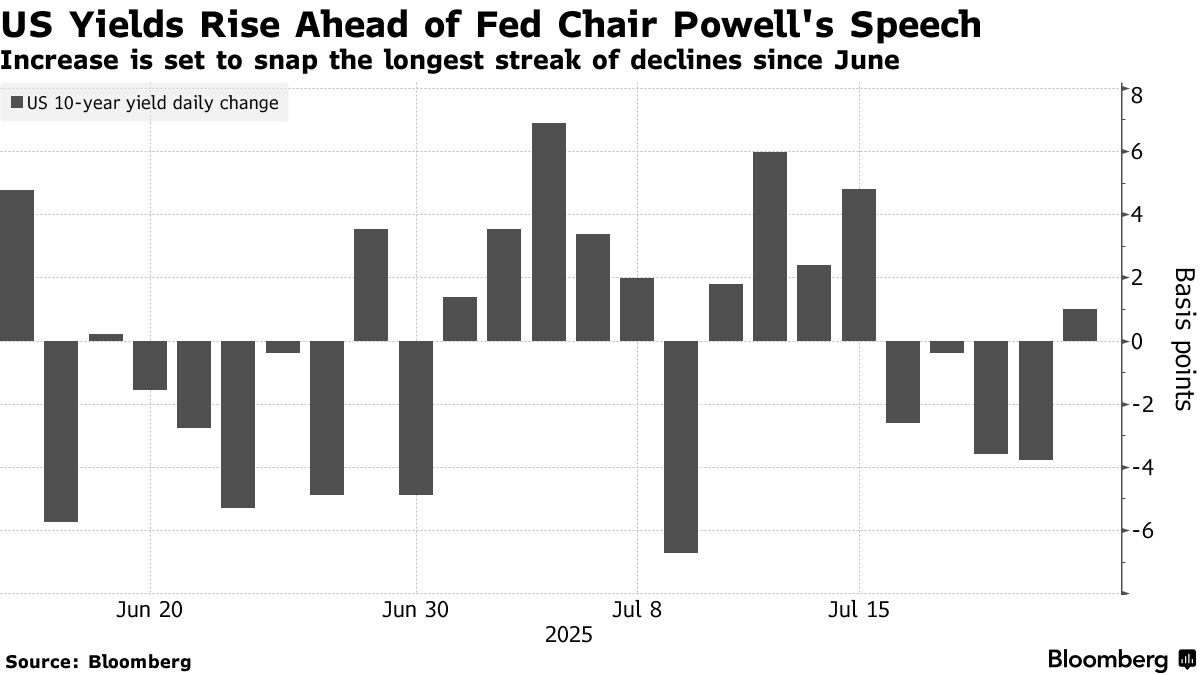
2/10年期美债收益率周五跌超3.5个基点,本周长端美债收益率至少涨3.6个基点
news flash· 2025-07-18 21:55
Core Viewpoint - The U.S. Treasury yields showed mixed movements with the 10-year yield declining slightly while the 20-year and 30-year yields increased, indicating fluctuations in investor sentiment and market dynamics [1] Summary by Relevant Categories 10-Year Treasury Yield - The 10-year benchmark Treasury yield fell by 3.58 basis points to 4.4155% on July 18, with a weekly increase of 0.62 basis points [1] - The yield traded within a range of 4.3915% to 4.4933% during the week, experiencing a notable short-term rally on Tuesday before gradually retreating [1] 2-Year Treasury Yield - The 2-year Treasury yield decreased by 3.54 basis points to 3.8691%, with a cumulative decline of 1.59 basis points for the week [1] - The yield fluctuated between 3.9587% and 3.8564% during the week, showing a significant "n-shaped" movement on Tuesday and Wednesday [1] 20-Year and 30-Year Treasury Yields - The 20-year Treasury yield increased by 3.60 basis points, reaching 4.9807% [1] - The 30-year Treasury yield rose by 3.84 basis points, closing at 4.9875% [1]
美国CPI+十年期美债拍卖,今晚的美债备受关注
Hua Er Jie Jian Wen· 2025-06-11 01:23
Core Viewpoint - The simultaneous release of the $39 billion 10-year Treasury auction and the Consumer Price Index (CPI) report is expected to disrupt the current calm in the U.S. bond market, potentially leading to significant volatility [1] Group 1: Auction Demand and Market Sentiment - Investor focus is on the demand for upcoming auctions, particularly due to concerns that trade policies may deter foreign buyers, who are typically significant holders of U.S. Treasuries [2] - The recent poor performance of the 20-year Treasury auction, with a bid-to-cover ratio of 2.46 and a yield of 5.047%, reflects growing investor anxiety [2] - Recent 10-year Treasury auctions have shown robust performance, with foreign investor participation above average, indicating that inflation concerns may outweigh trade worries [2] Group 2: Inflation Expectations - Economists predict a 0.2% month-over-month increase in CPI and a 2.4% year-over-year increase, with core CPI expected to rise by 0.3% month-over-month and 2.9% year-over-year [3] - There are concerns that any unexpected rise in inflation could unsettle investors, posing risks to the labor market and economic growth [3] Group 3: Potential Risks from Auction Performance - A poor performance in the bond auction combined with higher-than-expected inflation could lead to a sharp increase in bond yields, representing a dual threat to the market [4] - The upcoming auction of long-term bonds is crucial for gauging investor interest in U.S. Treasuries amid rising debt and deficit concerns [5] - Experts warn that continued poor auction results could signal deeper issues in the market, with rising yields being a significant concern [5]
三大风险事件接踵而至,全球金融市场高度紧张
Sou Hu Cai Jing· 2025-06-10 07:02
Group 1 - Global financial markets are in a rare "triple risk" waiting mode, with investors closely monitoring the outcomes of the US-China trade talks, the US May CPI data, and the US Treasury auctions [1][2] - The performance of the upcoming US Treasury auctions is critical, especially after the previous 20-year Treasury auction faced a "failed bid," leading to heightened sensitivity regarding long-term Treasury demand [2] - The 10-year Treasury yield is a key anchor rate for global financial assets, and a poor auction performance could push the yield above the critical threshold of 4.5%, potentially triggering a systemic sell-off in risk assets [2] Group 2 - The market expects the CPI data to rebound, and any significant increase could prompt investors to reassess the Federal Reserve's interest rate cut timeline, making CPI a crucial indicator for global markets [1] - The upcoming Treasury auction results will not only impact the bond market but also serve as a barometer for global financial stability, especially in the context of concurrent US-China trade negotiations and CPI data releases [2] - Various asset classes are exhibiting signs of unease, with the A-share market showing strong caution, increased volatility in US stock futures, and a renewed appeal for gold as a safe-haven asset [2]
“能做空就做空”,30年期美债惨成弃儿,明星机构唯恐避之不及
华尔街见闻· 2025-06-03 03:12
Core Viewpoint - The article discusses the shift in investment strategies among major financial institutions, led by DoubleLine Capital, towards short-term bonds due to concerns over the expanding U.S. federal budget deficit and debt burden, while long-term U.S. Treasury bonds are being avoided due to rising yield risks [1][2][5]. Group 1: Investment Strategies - DoubleLine Capital and other institutions are avoiding long-term U.S. Treasury bonds, opting instead for short-term bonds which present lower interest rate risks and decent yields [1]. - The investment strategy includes "steepening" trades, focusing on bonds in the mid-yield curve rather than long-term bonds [4]. - PIMCO has maintained a cautious stance on 30-year bonds since late last year, favoring bonds in the 5 to 10-year range [11][12]. Group 2: Market Trends - The 30-year U.S. Treasury bond has shown particularly weak performance this year, with yields rising while shorter-term bonds (2-year, 5-year, and 10-year) have seen declining yields [2]. - The yield on the 30-year bond reached 5.15%, close to its highest point since 2007, with a yield spread between the 30-year and 5-year bonds exceeding 1 percentage point for the first time since 2021 [9]. - Recent auction results indicate a preference for shorter-term bonds, with 2-year, 5-year, and 7-year bonds performing well, while the 30-year bond auction slightly underperformed expectations [13]. Group 3: Government Debt Issuance - Discussions about potentially reducing or pausing the issuance of 30-year bonds have emerged, which is unusual given the Treasury's efforts to maintain a stable debt issuance plan [5][6]. - The U.S. Treasury has committed to maintaining its auction scale, including long-term bonds, despite market pressures [7]. - The upcoming auction of 30-year bonds on June 12 is viewed as a critical test for market demand [7]. Group 4: Economic Concerns - Concerns over inflation due to tariff policies and the potential for increased government borrowing to cover deficits have contributed to the negative sentiment surrounding long-term bonds [8]. - The Congressional Budget Office projects that by 2035, the U.S. debt-to-GDP ratio could rise to 118%, surpassing historical highs, which raises further concerns about long-term bond investments [13].
美债30年期收益率破5%创17年新高 华尔街机构集体抛售长债
Sou Hu Cai Jing· 2025-06-03 02:00
Group 1 - The U.S. bond market is experiencing an unprecedented crisis of confidence, with the 30-year Treasury yield surpassing 5%, nearing the highest level since the 2007 financial crisis [1] - Concerns about the long-term fiscal situation of the U.S. are deepening, as the total federal debt has exceeded $36 trillion, with a debt-to-GDP ratio over 124%, significantly above international warning levels [1] - Interest payments on the debt are projected to exceed $1 trillion in the fiscal year 2024, becoming the third-largest government expenditure, surpassing defense spending [1] Group 2 - Major Wall Street investment firms are shifting to risk-averse strategies, systematically avoiding 30-year U.S. Treasury bonds and reallocating funds to mid-term bonds (5 to 10 years) [3] - These mid-term bonds offer relatively attractive returns while effectively reducing interest rate risk exposure, as firms like Pacific Investment Management Company adopt similar defensive strategies [3] - This collective adjustment in investment portfolios has yielded positive risk control outcomes this year, with investors seeking higher risk compensation for long-term lending to the U.S. government in the current fiscal environment [3] Group 3 - The U.S. Treasury yield curve is exhibiting a rare steepening trend, with the 30-year yield rising significantly while short-term yields (2-year, 5-year) are declining [4] - The difference between the 30-year and 5-year yields has surpassed 100 basis points for the first time since 2021, indicating substantial selling pressure on long-term bonds [4] - Recent bond auctions from major economies, including the U.S. and Japan, have faced weak demand, raising concerns about the future demand for long-term government bonds [4]

长期美债持续承压!20年期美债收益率罕见低于30年期美债收益率
智通财经网· 2025-06-03 01:49
Group 1 - The 20-year U.S. Treasury yield briefly fell below the 30-year yield, nearing a four-year high, indicating a significant shift in the yield curve [1][3] - The recent trend shows an overall steepening of the U.S. Treasury yield curve, as traders demand higher returns for holding long-term bonds, making the 20-year bond more attractive [3] - Concerns over potential tax cuts and increasing deficits under Trump's policies are putting pressure on long-term Treasury bonds [3] Group 2 - Historically, the 20-year Treasury bond has been less favored by investors, trailing behind other Treasury securities since its reintroduction five years ago [3] - The U.S. Treasury has reduced the quarterly issuance of 20-year bonds from a peak of $75 billion in 2021 to $42 billion currently, aiming to rebalance supply and demand [3] - There is ongoing debate about the continuation of 20-year bond issuance, with former Treasury Secretary Mnuchin suggesting it should be halted to save taxpayer money due to its relatively high issuance costs [3][4]
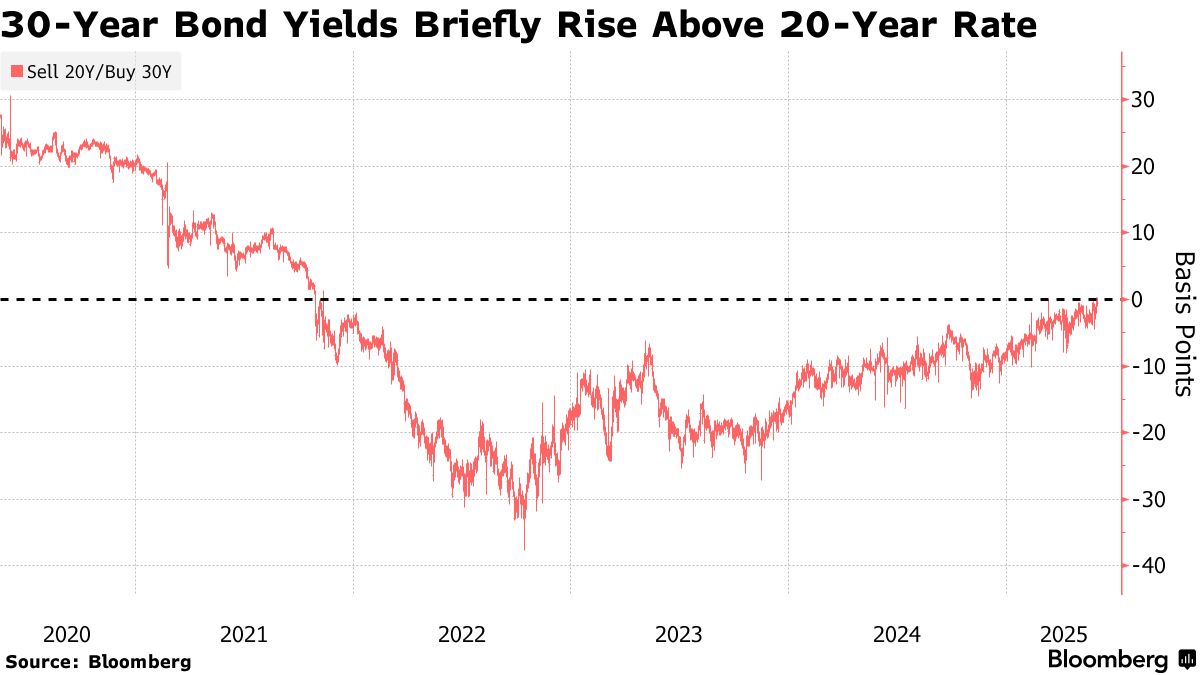
20年期美债收益率跌至30年期美债收益率下方的幅度创2021年以来最大
news flash· 2025-06-02 17:35
Core Viewpoint - The yield on the 20-year U.S. Treasury bond briefly fell below that of the 30-year bond, marking the largest yield spread since 2021 [1] Group 1: Yield Movements - The 20-year U.S. Treasury yield increased by approximately 7 basis points to 5.0035% [1] - The 30-year U.S. Treasury yield rose by 6.8 basis points to 4.9997% [1] Group 2: Market Concerns - Ongoing negotiations in Congress regarding tax cuts have raised concerns among traders [1] - There are fears that President Trump's policies may exacerbate the already high deficit issue, increasing pressure on long-term U.S. Treasuries [1]