Guan Cha Zhe Wang

Search documents
格局改变,中国汽车全球销量首超日本
Guan Cha Zhe Wang· 2025-12-30 05:50
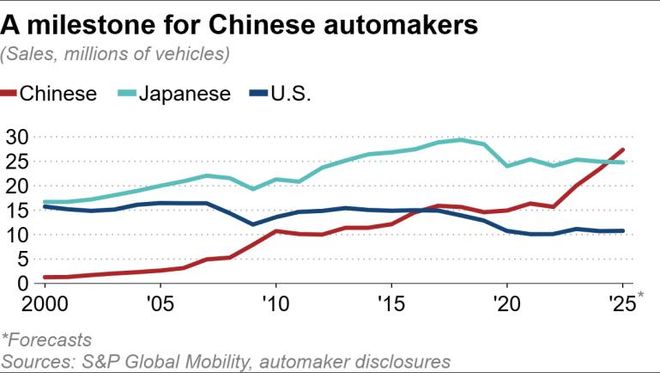
这意味着,在2023年正式确立汽车出口首位的地位后,中国汽车制造业在规模层面已经站上世界之巅。 (文/观察者网 张家栋 编辑/高莘) 据《日经新闻》等多家外媒12月30日报道,中国汽车制造商有望在2025年首次超越日本同行,占据全球 新车销量榜首。而20多年来一直位居首位的日本汽车制造商则将降至第2位。 《日经新闻》根据2025年1—11月各企业发布的资料,以及标普全球汽车(S&P Global Mobility)的数 据推测,中国汽车的全球销量预计同比增长17%,增至约2700万辆;日本车企合计销量约为2500万辆, 与上年持平。 中、美、日全球汽车销量变化趋势 日经新闻 统计数据显示,日本汽车在2018年左右达到销量巅峰时期,其在全球销量约3000万辆,截至2022年,日 本车企与中国车企的年销量差值仍有800万辆,但这份领先仅3年就被后者实现反超。 外媒将中国汽车销量的反超归结于以下三个方面,一是本土市场的高占比,二是中国市场对于新能源的 大力推广,三是在海外市场中国车企的强竞争力带来的销量激增。 首先是中国市场的高占比,今年以来,中国汽车制造商在本土的销量占据70%,展现出强烈的汽车强国 特征。 此外 ...

中国有望登顶,终结日企20余年霸主地位
Guan Cha Zhe Wang· 2025-12-30 04:07
Core Insights - In 2023, China's automobile exports surpassed Japan for the first time, positioning China as the world's largest automobile exporter and setting the stage for potential leadership in global new car sales by 2025 [1][3] - Chinese automakers are expected to achieve a 17% year-on-year increase in global sales, reaching approximately 27 million vehicles in 2023, with local sales contributing about 70% of this figure [1][3] - The competitive landscape in the Chinese automotive market is intensifying, particularly in the electric vehicle (EV) segment, where nearly 60% of passenger car sales are now comprised of new energy vehicles [1][4] Sales Performance - Japan's automotive sales are projected to remain stable at just under 25 million units in 2023, a significant decline from its peak of nearly 30 million units in 2018 [3] - In Southeast Asia, Chinese automobile sales are expected to surge by 49% to around 500,000 units, while European sales are anticipated to grow by 7% to approximately 2.3 million units despite additional tariffs [4][6] - Emerging markets are also seeing growth, with sales in Africa expected to rise by 32% to 230,000 units and in Latin America by 33% to 540,000 units [4] Market Dynamics - The price competition in the Chinese automotive market is fierce, with the most popular new energy vehicles priced between 100,000 to 150,000 yuan, accounting for 23% of total sales [3] - Japanese automakers are beginning to adopt Chinese production models to enhance competitiveness, with Nissan exporting low-cost EVs developed in China and Toyota increasing procurement of Chinese components [7][8] - Trade tensions are escalating globally, with countries like the U.S. and Canada imposing significant tariffs on Chinese-made EVs, which could impact China's export strategies [6][8]
国家大基金等新投资中芯南方78亿美元,中芯控股仍是第一大股东
Guan Cha Zhe Wang· 2025-12-30 03:47
Core Viewpoint - SMIC is progressing with the acquisition of 49% equity in SMIC North from five shareholders for a total transaction price of 40.601 billion RMB, which will make SMIC North a wholly-owned subsidiary of SMIC [1][4] Group 1: Acquisition Details - SMIC plans to issue 547 million shares to acquire the 49% stake in SMIC North, with a share price of 74.20 RMB, representing a discount of over 39% compared to the closing price of 122.50 RMB on December 29 [1][2] - The valuation of SMIC North is assessed at 82.8 billion RMB, with an increase in value of 41 billion RMB, resulting in a premium rate of 98.19% [1][2] Group 2: Financial Performance - In 2024, SMIC North achieved a revenue of 12.979 billion RMB and a net profit of 1.682 billion RMB, reflecting year-on-year growth of 12% and 187% respectively [4] - The net asset value of SMIC South is reported to be 57.462 billion RMB as of September 30, 2025 [6] Group 3: Capital Increase and Shareholding Structure - SMIC South will receive a total cash injection of approximately 77.78 billion USD, with 35.773 billion USD allocated to registered capital and the remainder to capital reserves [5] - After the capital increase, SMIC's holding in SMIC South will rise from 38.515% to 41.561%, maintaining its position as the largest shareholder [5][6] Group 4: Market Performance - As of December 29, SMIC's A-shares have increased nearly 30% year-to-date, with a market capitalization of 622.6 billion RMB, while its Hong Kong shares have surged nearly 120% [7]

鸿蒙版“山大v卡通”全新升级,山大校园生活步入鸿蒙智慧新时代
Guan Cha Zhe Wang· 2025-12-30 03:40
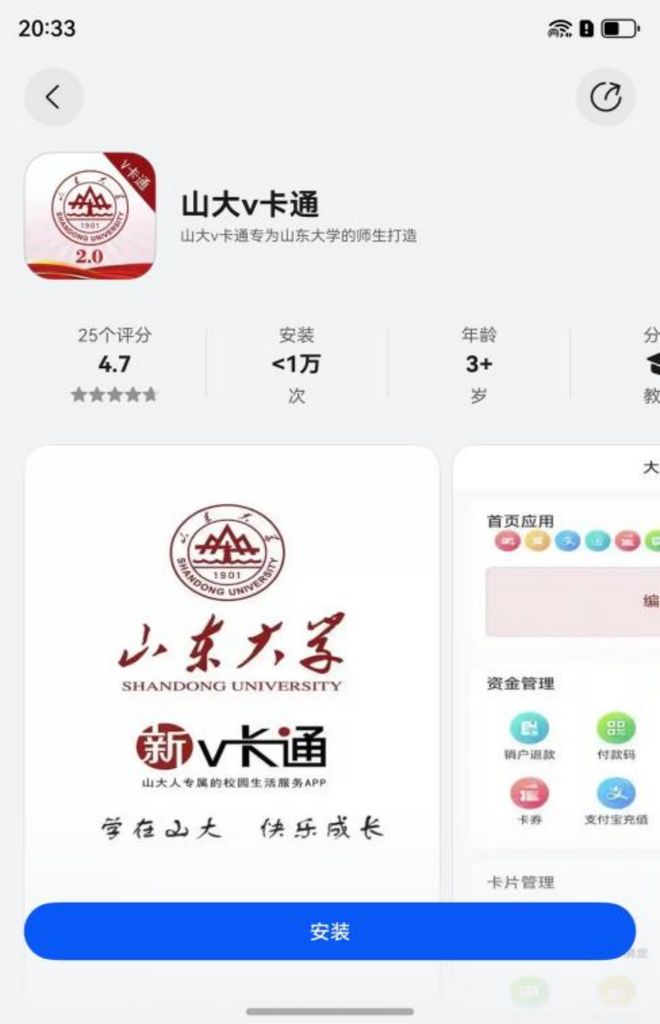
Core Insights - The launch of the NFC-enabled "Shanda v Card" marks a significant upgrade in digital campus services at Shandong University, transitioning from a basic service model to a more proactive and user-centric experience [1][9] Group 1: Product Features - The "Shanda v Card" integrates various core capabilities of the HarmonyOS, enhancing the interaction logic of campus services beyond just NFC card usage [3] - Key features include service cards for quick access to payment codes, a unified scanning service for consistent performance in various lighting conditions, and multiple security protections to safeguard user privacy [3] Group 2: User Experience - User feedback on the Huawei App Store indicates high satisfaction, with comments highlighting the app's strong scanning capabilities and overall usability [7] - The upgrade exemplifies how cutting-edge technology can be transformed into accessible experiences for students, positioning top universities as innovators in defining future lifestyles [7][9]
两岸圆桌派|汪涛、陈凤馨:大陆过去对台湾是“溺爱”,可惜台湾人没有意识到
Guan Cha Zhe Wang· 2025-12-30 03:23
Core Viewpoint - The ongoing US-China technology war has reached a critical stage, with China making significant advancements in various technology sectors, raising questions about Taiwan's position and future opportunities in this context [1][17]. Group 1: China's Technological Advancements - According to the Australian Strategic Policy Institute's report, China has established a leading position in over 60 out of 70 key technology areas, significantly surpassing the US [5]. - The "14th Five-Year Plan" emphasizes six key areas for technological breakthroughs, including integrated circuits and advanced materials, while also identifying new economic growth points such as quantum technology and hydrogen energy [2][3]. - China's approach to technology development is characterized by a broad exploration of all available technologies rather than a selective focus, allowing for a diverse range of innovations [10][16]. Group 2: Market Dynamics and Investment - The success of Chinese tech companies like Cambricon and Moore Threads is attributed to market-driven investments rather than government funding, highlighting the importance of private capital in fostering innovation [7][21]. - The shift from government-selected winners to market-selected winners has led to a more dynamic and competitive tech landscape in China, enhancing the conversion of research into commercial applications [8][9]. Group 3: Implications for Taiwan - Taiwan's reliance on TSMC raises concerns about its long-term economic sustainability, as the island lacks other significant industries to support its economy if TSMC were to relocate [24][25]. - The historical investment in the semiconductor industry has created a strong foundation, but there is a pressing need for Taiwan to diversify its economic base beyond TSMC to avoid becoming overly dependent [22][26]. Group 4: Future Outlook - The ongoing technological competition suggests that the US's strategy of containment may be ineffective, as China's advancements continue to challenge the status quo [17][20]. - The potential for collaboration between the US and China is acknowledged, but the technology war is expected to persist, influencing global market dynamics and investment strategies [3][18].

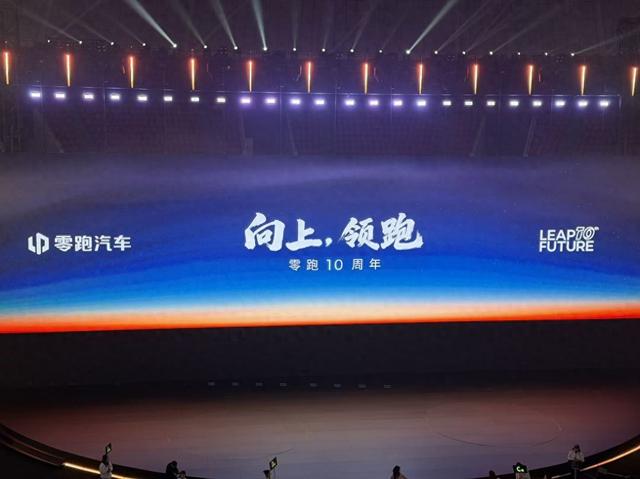
从“找到感觉”到冲击百万销量,零跑能否走稳“向上”新周期
Guan Cha Zhe Wang· 2025-12-30 03:16
Core Insights - The article discusses Leap Motor's ten-year journey and future strategic planning, emphasizing its transition from survival to aiming for a world-class smart electric vehicle company [1][3][24] Group 1: Company Overview - Leap Motor was founded by an engineer with a background in security and electronics, lacking the typical advantages of internet companies or traditional automakers [5] - The company initially struggled with its first model, S01, but found success with the T03, establishing a stable sales trajectory [7][9] Group 2: Sales and Growth - Leap Motor's sales have shown significant growth, delivering approximately 44,000 vehicles in 2021, over 100,000 in 2022, and reaching 140,000 in 2023, with projections nearing 300,000 in 2024 and close to 600,000 by 2025 [9][24] - The company aims to achieve annual sales of 4 million vehicles by 2033, with a target of 1 million units by 2026 [18][20] Group 3: Technological Development - Leap Motor has invested heavily in core technologies, focusing on battery, electric drive, and electronic architecture, which are seen as essential for electric vehicles [10][12] - The company has developed a self-research and manufacturing system, with self-produced components accounting for about 65% of vehicle costs [12] Group 4: Market Positioning and Strategy - The new slogan "Upward, Lead" reflects Leap Motor's shift in focus from survival to establishing its position in the industry [3][24] - The company is enhancing its product lineup with the introduction of the D series, which features advanced technologies and aims to elevate the brand's market presence [23][26] Group 5: Future Challenges and Opportunities - Leap Motor acknowledges the challenges ahead, including price competition and the complexities of globalization, as it transitions into a more competitive environment [24][26] - The partnership with Stellantis is part of its strategy to strengthen its global presence, with expectations of significant overseas sales by 2025 [18][26]
宇树首店将在京东MALL开业
Guan Cha Zhe Wang· 2025-12-30 03:13
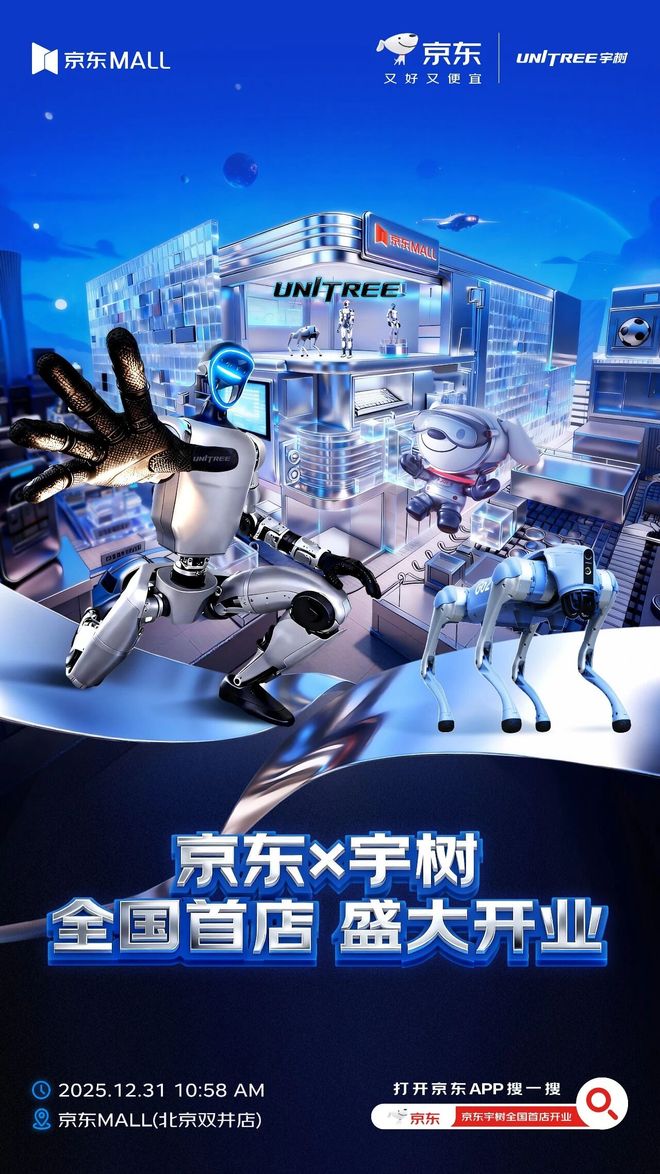
Group 1 - The first offline experience store of Yushu Technology, in collaboration with JD.com, is set to open on December 31, 2025, in Beijing's JD MALL [1] - The store will showcase various products including the G1 humanoid robot and the Go2 quadruped robot, allowing consumers to experience and purchase them on-site or order online for pickup or delivery [4] - Yushu Technology has launched multiple robots, with the G1 priced from 99,000 RMB, the R1 from 39,900 RMB, and the H1 at 650,000 RMB [4] Group 2 - The company introduced a new generation of bionic humanoid robot, the Unitree H2, in October 2025, which stands 180 cm tall and weighs 70 kg, resembling a human more closely [4] - Yushu Technology launched a humanoid robot application store named "App Store" on December 13, 2025, allowing users to download and deploy skills without programming [6] - The founder revealed that Yushu Technology's revenue exceeded 1 billion RMB in 2024, achieving continuous profitability, with its quadruped robots capturing approximately 69.75% of the global market share in sales [7] Group 3 - The company's IPO guidance work was completed on November 15, 2025, with plans to apply for a domestic listing [7]
孟晚舟新年致辞:这些是华为2026年的主战场
Guan Cha Zhe Wang· 2025-12-30 03:07
Core Insights - Huawei's rotating chairman Meng Wanzhou highlighted the company's achievements in 2025, including advancements in 5G-A, HarmonyOS ecosystem, autonomous driving technologies, and AI applications in various industries [1][3] - The company aims to leverage long-term strategic opportunities presented by the wave of intelligent transformation, focusing on vertical industry operations and enhancing its ecosystem [1][3] Group 1: Achievements in 2025 - Huawei made significant progress in 5G-A construction and the HarmonyOS ecosystem, enhancing user experience and industry applications [1] - The company developed key technologies such as Kunpeng, openEuler, Ascend, and super nodes, contributing to AI implementation and green energy solutions [1] - Notable efforts included overcoming challenges in extreme environments, such as high temperatures and high altitudes, to ensure network reliability and service delivery [3][4] Group 2: Strategic Focus for 2026 - Huawei's 2026 strategy emphasizes strengthening vertical industry operations and leveraging its diverse capabilities to facilitate intelligent transformation across various sectors [1] - The company plans to build an open-source ecosystem around Kunpeng and Ascend, enabling partners to develop products that meet diverse industry needs [1] - Initiatives include integrating AI into communication networks, enhancing consumer experiences through the HarmonyOS ecosystem, and improving AI data center efficiency [1][3]

大陆过去对台湾是“溺爱”,可惜台湾人没有意识到
Guan Cha Zhe Wang· 2025-12-30 02:39
Core Insights - The ongoing US-China tech war has reached a critical stage, with China making significant advancements in various technology sectors, indicating a shift in global power dynamics [1][9][26] Group 1: China's Technological Advancements - China has established a leading position in over 60 out of 70 key technology areas, significantly surpassing the US in many fields [5][21] - The "14th Five-Year Plan" emphasizes six key areas for technological breakthroughs, including integrated circuits and advanced materials, while also identifying new economic growth points such as quantum technology and hydrogen energy [2][4] - The focus on artificial intelligence application is expected to accelerate, leveraging China's extensive supply chain and market size [4][12] Group 2: Market Dynamics and Innovation - The shift from government-led to market-driven selection of technology winners is crucial for fostering innovation in China, allowing for a more dynamic and competitive environment [8][10] - Young tech entrepreneurs are emerging as key players, with their success contributing to a cycle of investment and innovation within the tech sector [9][21] - The ability to convert academic research into commercial applications remains a critical factor for China's technological success [5][21] Group 3: Implications for Taiwan - Taiwan's reliance on TSMC as its primary technological asset raises concerns about its long-term economic sustainability, especially if TSMC's operations are relocated [22][24] - The historical investment in the semiconductor industry has positioned Taiwan well, but there is a need for diversification to avoid over-dependence on a single entity [24][25] - The changing geopolitical landscape necessitates a reevaluation of Taiwan's role in the tech ecosystem, as it faces competition from mainland China's rapid advancements [22][26]
“中国蓝箭航天,挑战马斯克”
Guan Cha Zhe Wang· 2025-12-30 02:22
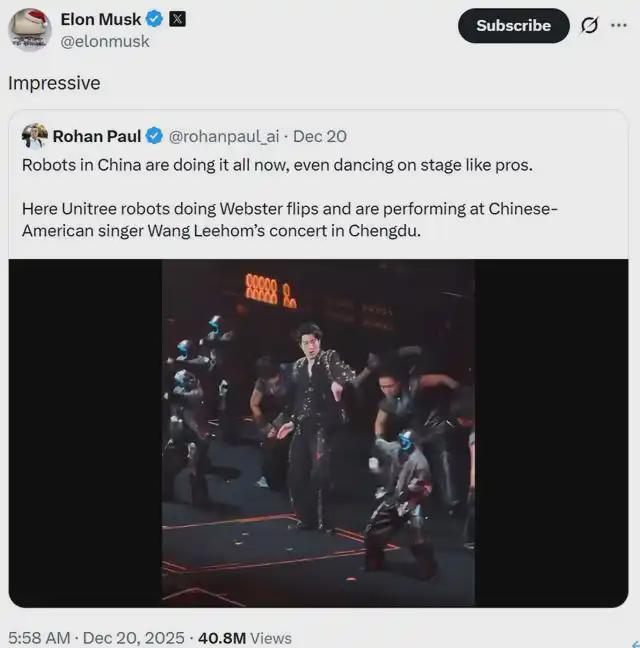
Core Viewpoint - Chinese commercial aerospace companies, particularly Blue Arrow Aerospace, are rapidly advancing in the reusable rocket sector, traditionally dominated by SpaceX, drawing attention from Elon Musk and international media [1][2]. Group 1: Company Developments - Blue Arrow Aerospace became the first Chinese company to conduct reusable rocket tests, aiming to become the second-largest player in this field after SpaceX [1]. - The company’s Zhuque-3 rocket experienced a setback during the first stage recovery but is viewed as a significant step in China's space exploration efforts [1][6]. - The CEO of Blue Arrow, Dai Zheng, emphasized that the failure was part of a learning process and not a definitive setback, highlighting the experimental nature of the launch [1][7]. Group 2: Market Position and Strategy - Blue Arrow aims to provide low-cost launch solutions similar to SpaceX's Falcon 9, which is crucial for China's plan to deploy up to 10,000 satellites in the coming decades [2][6]. - The company is reportedly preparing for an IPO on the Sci-Tech Innovation Board, potentially ahead of SpaceX, which is still speculated to be preparing for its own IPO [5][6]. Group 3: Industry Context and Future Outlook - The Chinese commercial space market is projected to grow by 8.3% in 2024, reaching approximately 713.32 billion yuan, indicating a robust industry outlook [6]. - Government initiatives, including the establishment of the National Venture Capital Guidance Fund, are expected to provide significant support to the aerospace sector, enhancing investment in early-stage projects [6]. - Despite setbacks, the Zhuque-3 rocket's second stage successfully completed a 1400-second glide, laying the groundwork for future improvements in payload capacity [7].