Zhong Guo Qi Che Bao Wang

Search documents
重汽先锋官V商旅车族的佼佼者
Zhong Guo Qi Che Bao Wang· 2025-10-11 09:15
Core Viewpoint - The China National Heavy Duty Truck Group's Pioneer V Business Travel Edition stands out in the competitive light commercial vehicle market due to its aesthetic design, efficiency, safety, and comfort, making it an ideal choice for business travel [1] Design and Interior Features - The Pioneer V Business Travel Edition features a unique "Starry Navigation" aesthetic design, with a large "star column" front grille and stylish 7-shaped headlights, receiving unanimous praise from evaluators [3] - Inside, it boasts a 12.3-inch display that supports smart voice interaction and mobile connectivity, enhancing driving convenience [3] - The vehicle offers 23 storage spaces, accommodating personal items and business documents, and provides multiple seating configurations, including 7-seat and 9-seat options [3] Performance and Efficiency - The vehicle is equipped with a Weichai WP2H 2.0T diesel engine, delivering a maximum power of 115 kW and a peak torque of 400 N·m, ensuring excellent performance in various driving conditions [5] - It achieves a fuel consumption of only 6.77 liters per 100 kilometers under mixed road conditions, making it cost-effective for long-distance travel [5] - The vehicle adheres to European safety collision design standards, with over 55% high-strength steel in its structure, providing robust passenger protection [5] Safety Features - The Pioneer V Business Travel Edition includes advanced active safety features such as AEB automatic braking and ESP stability control, enhancing driving safety by detecting potential hazards [6] - It is the first in the domestic market to adopt a rear multi-link independent suspension system, significantly improving ride comfort on bumpy roads [6] - The vehicle incorporates 16 noise reduction designs, achieving a cabin noise level of only 46 decibels at idle, comparable to mainstream family SUVs [6] Versatility and Market Position - The Pioneer V Business Travel Edition is recognized as a versatile light commercial vehicle, excelling in power, safety, comfort, and storage capabilities [8] - Its unique design, powerful diesel engine, extensive safety features, and independent suspension system make it a standout choice for business travelers, ensuring a comfortable and safe travel experience while reducing operational costs [8]


赛力斯携火山引擎入局具身智能:三年布局落地,车企竞逐万亿新赛道
Zhong Guo Qi Che Bao Wang· 2025-10-11 08:55
Core Insights - The announcement highlights a strategic partnership between Seres Group and Volcano Engine to advance embodied intelligence technology, reflecting a broader trend among domestic automakers competing in a trillion-yuan market [1][3][9] Group 1: Partnership Details - Seres' wholly-owned subsidiary, Chongqing Phoenix Technology, signed a framework agreement with Volcano Engine to collaborate on intelligent robot decision-making and human-machine enhancement technologies [1] - The partnership aims to create a closed-loop mechanism for technology research and scene validation, aligning with the national initiative to integrate AI with the real economy [3][6] Group 2: Responsibilities and Capabilities - Volcano Engine will leverage its strengths in language, vision, and multimodal AI models to provide intelligent algorithms and computational support for the collaboration [5] - Seres will utilize its experience in smart vehicle manufacturing to drive the industrialization of AI technologies in the embodied intelligence sector [5] Group 3: Strategic Preparation - The partnership is part of a systematic preparation that began in 2023, including the establishment of a joint venture for robot development and the registration of the "ROBOREX" trademark for future products [6][7] - Seres has been actively recruiting talent in embodied intelligence, indicating a commitment to building a specialized technical team [7] Group 4: Industry Trends - The move by Seres reflects a broader trend among major automakers entering the embodied intelligence field, with various companies pursuing either independent R&D or collaborative investments [8][9] - The convergence of technology between smart vehicles and humanoid robots allows automakers to leverage existing capabilities, while the demand for new growth avenues drives this industry shift [9] Group 5: Regional Impact - Seres' initiatives contribute to the development of a "vehicle-robot-intelligent service" industry chain in Chongqing, linking local resources with academic and technological entities [9] - The collaboration signifies a transition for automakers from traditional manufacturing to becoming builders of intelligent ecosystems, marking the beginning of competition in the trillion-yuan embodied intelligence market [9]


上汽跃进超越H500大咖尽显王者之气
Zhong Guo Qi Che Bao Wang· 2025-10-11 08:53
Core Viewpoint - The logistics industry in China is undergoing a transformation, with efficient, intelligent, and green transportation tools becoming increasingly popular. SAIC Yuejin has responded to this change by launching the Chao Yue H500 Daka, a wide-body light truck that redefines logistics transportation standards with its performance and innovative technology [1][8]. Group 1: Performance and Efficiency - The Chao Yue H500 Daka is equipped with the SAIC πPlus power engine, delivering a maximum horsepower of 170 and a peak torque of 500 N·m, showcasing exceptional power performance [3]. - The vehicle features advanced technologies such as Bosch's fifth-generation high-pressure common rail system, achieving a minimum injection precision of 0.5 microliters and an injection interval as low as 0.2 milliseconds, which effectively reduces fuel consumption and noise [3]. - Compared to competitors, the fuel consumption is reduced by 6.8% per 100 kilometers, meeting the National VI emission standards, thus balancing environmental protection and economic efficiency [3]. Group 2: Load Capacity and Reliability - The Chao Yue H500 Daka utilizes high-strength steel beams and a large cargo box design, enhancing transport efficiency and load capacity, allowing it to carry an additional 3 tons compared to similar models [5]. - The vehicle's rear axle has a torsional capacity of 11,000 N·m, and it has undergone rigorous testing to ensure reliability across various environments, including extreme temperatures and high altitudes [5]. - Maintenance costs are minimized with a 40,000-kilometer oil change interval for the engine and an 80,000-kilometer interval for the rear axle [5]. Group 3: Comfort and Safety - The Chao Yue H500 Daka is designed with a focus on driver comfort, featuring a low-noise environment and airbag shock absorption, which significantly reduces fatigue during long-distance driving [6][8]. - Safety features include dual airbags and an advanced braking system, providing enhanced safety for drivers [5][6]. Group 4: Intelligent Features - The intelligent cockpit of the Chao Yue H500 Daka integrates advanced interactive systems, allowing for voice control, navigation, and entertainment functions, enhancing convenience and driving enjoyment [8]. - The precision and responsiveness of the voice control and navigation systems were highlighted during the test drive, contributing to a more relaxed driving experience [8]. Group 5: Future Outlook - The company is expected to continue its user-centric and technology-driven development philosophy, launching more high-quality models that meet market demands, whether in diesel or new energy sectors [8].


武汉无人驾驶出租车的成绩单
Zhong Guo Qi Che Bao Wang· 2025-10-11 08:39
Core Insights - Wuhan is a pioneer in China's autonomous taxi industry, having started testing operations on June 30, 2022, and officially launched commercial operations in September 2022. As of May 15, 2024, the company "Luo Bo Kuaipao" has deployed 1,000 sixth-generation autonomous vehicles for large-scale commercial operations [1][2]. Group 1: Operational Performance - Wuhan has over 1,000 autonomous taxis, with more than 700 actively carrying passengers and over 300 in testing. The average daily orders exceed 20, with an average daily driving distance of approximately 200 kilometers, covering major urban areas [1][2]. - The maximum speed of Wuhan's autonomous taxis is 51 km/h, with an average speed of about 13 km/h, which has not caused significant traffic issues. Overall, the safety performance of these autonomous taxis surpasses that of human-driven vehicles [2]. Group 2: Safety and Comfort - The autonomous taxis have recorded zero collision incidents and zero active thefts, with over 30 passive conflicts and three traffic rule violations. The longest recovery time after a failure is 48 seconds, with a 100% recovery success rate [1][2]. - However, there are comfort issues, such as sudden acceleration at startup and abrupt deceleration during conflict avoidance, which can create a noisy environment for passengers [2]. Group 3: Challenges and Improvements - Despite good overall performance, there are still shortcomings, such as failures in lane-changing maneuvers and overly cautious behavior in complex scenarios, which can lead to traffic congestion and discomfort compared to human driving [3][4]. - The "long-tail problem" in unconventional scenarios is identified as a bottleneck for the large-scale application of autonomous driving technology. This includes issues with sudden failures and the need for improved comfort levels [4]. Group 4: Future Directions - The transition to Level 3 (L3) autonomous driving, which allows conditional autonomous driving while still requiring driver intervention, is a key focus. Research is ongoing regarding the dynamic allocation of driving rights between human drivers and autonomous systems [4][5]. - The development of AI models is expected to accelerate the iteration of end-to-end autonomous driving technology, with a significant increase in traffic data enabling a closed-loop for all scenarios. The industry is encouraged to pursue a collaborative approach involving government, research institutions, and industry leaders to promote the large-scale application of autonomous vehicles [5].
鑫铂股份双赛道突破:新能源镁铝件月产2万套稳产,机器人结构件11月底送样头部客户
Zhong Guo Qi Che Bao Wang· 2025-10-11 08:36
Core Insights - The company has achieved significant breakthroughs in magnesium-aluminum alloy products for the high-growth sectors of electric vehicles (EVs) and robotics, with a stable production capacity of 20,000 sets per month for EV components and plans to send samples to key clients in the robotics sector by the end of November 2025 [1][4]. Electric Vehicle Sector - The company entered the EV supply chain in August 2025 and has ramped up production to a stable output of 20,000 sets per month within two months, primarily for lightweight structural components such as vehicle body frames and battery housings [1][2]. - The domestic EV sales reached 3.89 million units in the first half of 2025, a year-on-year increase of 27%, highlighting the growing demand for lightweight materials to reduce energy consumption and enhance range [2]. - The penetration rate of magnesium-aluminum alloys in EVs is expected to increase from 8.5% in 2024 to 12% in 2025, with the company's annual supply capacity of 240,000 sets capable of meeting the lightweight component needs of approximately 120,000 EVs [2]. Robotics Sector - The company focuses on material innovation for core structural components in robotics, collaborating with leading clients to develop high-strength 7-series aluminum alloy components, which offer over 30% improvement in tensile strength and a 25% weight reduction compared to conventional 6-series alloys [3][4]. - The product has completed the mold development phase, with plans to send samples to key clients by the end of November 2025, followed by a performance testing period of 3-6 months [4]. Capacity Expansion and Investment - To meet the growth demands in both sectors, the company plans to invest 500 million yuan in a high-end aluminum processing expansion project, which will add 100,000 tons per year of aluminum processing capacity, with 30% allocated for EV and robotics components [4][6]. - The company has a strong foundation for its dual-track strategy, with R&D investment of 120 million yuan in 2024, accounting for 4.2% of revenue, and a total of 58 patents related to aluminum processing [5][6]. Industry Trends - The domestic market for lightweight materials in EVs is expected to exceed 200 billion yuan in 2025, with a compound annual growth rate (CAGR) of 18%, while the market for core structural components in robotics is projected to reach 32 billion yuan by 2029, with a CAGR exceeding 60% from 2025 to 2029 [6].

卫星物联网将进入商用试验期!汽车业迎来重大利好?
Zhong Guo Qi Che Bao Wang· 2025-10-11 08:17
Core Viewpoint - The introduction of satellite IoT technology is expected to significantly benefit the automotive industry by enhancing connectivity and data collection capabilities for smart vehicles, thereby promoting the overall intelligence of the automotive sector [4][5]. Group 1: Policy and Industry Direction - The new policy outlines the satellite IoT as a wide-area low-speed data service aimed at providing comprehensive connectivity for vehicles, filling gaps in terrestrial network coverage [5]. - The commercial trial of satellite IoT is seen as a foundational step for the development of commercial aerospace and low-altitude economies, fostering innovation and expanding the satellite communication market [5][6]. Group 2: Addressing Connectivity Challenges - The emergence of low Earth orbit satellite constellations offers solutions to connectivity issues in remote areas, ensuring that smart vehicles can maintain communication even in regions lacking public network coverage [6]. - Satellite communication modules in vehicles can provide emergency communication capabilities, allowing for real-time location and status updates in critical situations, thus enhancing safety for users in isolated areas [6][10]. Group 3: Enhancing Urban Connectivity - Satellite IoT serves as a complementary solution to 5G networks, particularly during natural disasters or network congestion, ensuring continuous communication for autonomous vehicles and smart traffic systems [7]. - The integration of satellite communication into urban traffic systems creates a dual-layer communication architecture, enhancing the resilience and safety of urban transportation [7]. Group 4: Driving Automotive Innovation - The demand for satellite communication in the automotive sector is projected to grow significantly, with an expected compound annual growth rate exceeding 40% over the next three years, highlighting its potential in supporting autonomous driving technologies [8]. - Automotive brands are increasingly investing in satellite communication technologies, aiming to differentiate their offerings and enhance vehicle appeal through innovative hardware solutions [8]. Group 5: Safety and Emergency Applications - Satellite IoT provides critical safety features for commercial vehicles, enabling real-time monitoring and alerts for abnormal conditions during transport, thus ensuring safety in logistics [9]. - In consumer markets, the emergency communication capabilities of satellite IoT can be life-saving, allowing vehicles to send distress signals in remote areas, effectively acting as a safety net for drivers [10]. Group 6: Future of Transportation - The convergence of satellite IoT with emerging transportation technologies, such as flying cars and drones, is expected to create a comprehensive communication network that integrates ground and aerial vehicles [10][11]. - This cross-dimensional collaboration is anticipated to transform the transportation ecosystem, facilitating a shift from vehicle-road coordination to a more integrated vehicle-satellite communication model, enhancing urban mobility and efficiency [11].

4000余万人口有1500万辆汽车!这一地的汽车产业是如何实现逆袭的?
Zhong Guo Qi Che Bao Wang· 2025-10-11 08:10
Core Viewpoint - Argentina's automotive industry is experiencing significant growth driven by a combination of unique environmental factors, government policies, and foreign investment, positioning the country as a key player in the Latin American automotive market [4][6][12]. Group 1: Market Characteristics - Argentina has a population of over 40 million and an automobile ownership rate of approximately 15 million vehicles, averaging one car for every three people, which is relatively high globally [4]. - The automotive market is characterized by a strong presence of imported brands, with a historical foundation established by multinational companies like Ford and General Motors [6]. - The average age of vehicles in Argentina is around 12 years, indicating a robust second-hand car market, with many classic models still in use [5]. Group 2: Historical Development - The automotive industry in Argentina has evolved from simple assembly to more complex manufacturing processes, with production peaking at over 300,000 vehicles annually by the 1970s [6]. - Economic crises in the 1990s led to a decline in production and investment, but recovery began in 2003, attracting foreign companies back to the market [7]. - By 2006, a treaty with Brazil significantly boosted Argentina's automotive exports, leading to a 40% increase in production that year [7]. Group 3: Recent Trends and Investments - Despite the pandemic's impact, major automotive companies like Volkswagen and PSA have accelerated their investments in Argentina, with Fiat investing $50 million to restart a factory [8]. - Chinese automotive brands are entering the market, leveraging advantages in new energy technology and cost control, thereby reshaping the competitive landscape [8]. Group 4: Future Prospects - The Argentine government plans to allow the import of 50,000 electric and hybrid vehicles starting in 2026, exempting them from import duties, which is expected to enhance the adoption of electric vehicles [10]. - Argentina is projected to become a significant player in lithium production, with forecasts indicating a 77% increase in lithium carbonate output by 2025, supporting the electric vehicle supply chain [11]. - The automotive industry's growth is attributed to a combination of policy support, geographical advantages, and market resilience, providing valuable lessons for emerging markets [12].

持续进化,2026款吉利星愿“全系升级”
Zhong Guo Qi Che Bao Wang· 2025-10-11 07:27
Core Insights - The 2026 Geely Star Wish was officially launched at the Geely Automotive User Conference in Hangzhou, with six variants offering different ranges from 310 km to 410 km, priced between 65,800 to 95,800 yuan [1][14] - The Star Wish has achieved cumulative sales of over 400,000 units since its launch, with a record monthly delivery of over 50,000 units in September, making it the best-selling model across all categories [3][14] - The new model features a "high configuration from the start" philosophy, with standard equipment including CATL battery cells, an 11-in-1 intelligent electric drive, and a large front trunk, which are rare in the A0 segment [4][12] Product Features - The 2026 Geely Star Wish has undergone targeted upgrades in appearance and range, introducing new colors and a complete range of versions to alleviate range anxiety for users [6][14] - Specific configurations have been optimized, such as the addition of LED headlights and a 14.6-inch central control screen in the 310 km version, and advanced safety features in the 410 km versions [6][12] - The model emphasizes both emotional and practical value, with the STAR limited edition unveiled by brand ambassadors, enhancing the emotional connection with consumers [7][9] Technological Advancements - The vehicle is equipped with the industry's first 11-in-1 intelligent electric drive, achieving an energy efficiency of 89.2% under CLTC conditions, and has undergone extensive reliability testing [12][14] - The battery system supports fast charging from 30% to 80% in just 21 minutes and has passed rigorous testing to ensure stable performance in extreme conditions [12] - The intelligent cockpit system will receive updates to enhance user experience, including new features like a pet mode and high-definition 360° views [12][14] Market Positioning - The launch of the 2026 Geely Star Wish represents a significant refresh of the product matrix and reaffirms Geely's commitment to a user-oriented philosophy [14] - In an increasingly competitive electric vehicle market, the Star Wish aims to elevate the value standards of A0-class products, supported by Geely's strong user base and comprehensive system capabilities [14] - The competition in the market is shifting from mere configuration to experience and value, with the Star Wish positioned as a leader in this new paradigm [14]


冯长军升任东风汽车集团有限公司董事、总经理、党委副书记
Zhong Guo Qi Che Bao Wang· 2025-10-11 06:38
Group 1 - Dongfeng Motor Group Co., Ltd. appointed Feng Changjun as the new General Manager and Deputy Secretary of the Party Committee, replacing his previous role as Chief Accountant [1] - Feng Changjun, born in May 1978, has extensive experience in financial and operational management within large state-owned enterprises and the automotive industry, holding a master's degree in accounting [1] - Since joining Dongfeng in June 2020, Feng has made significant contributions in corporate governance, financial management, capital operations, risk prevention, and reform initiatives, including leading the Hong Kong listing of Lantu Motors [1] Group 2 - Dongfeng Motor is deepening corporate governance and accelerating its transformation towards new energy and intelligent upgrades, maintaining a stable financial condition despite industry challenges [2] - The automotive industry is entering a phase of integrated development involving technology, management, and capital, and the recent personnel changes are expected to inject new momentum into Dongfeng's reform and competitive strategies [2]

航盛电子与奥托立夫正式签约 共筑汽车电子安全领域新未来
Zhong Guo Qi Che Bao Wang· 2025-10-11 06:02
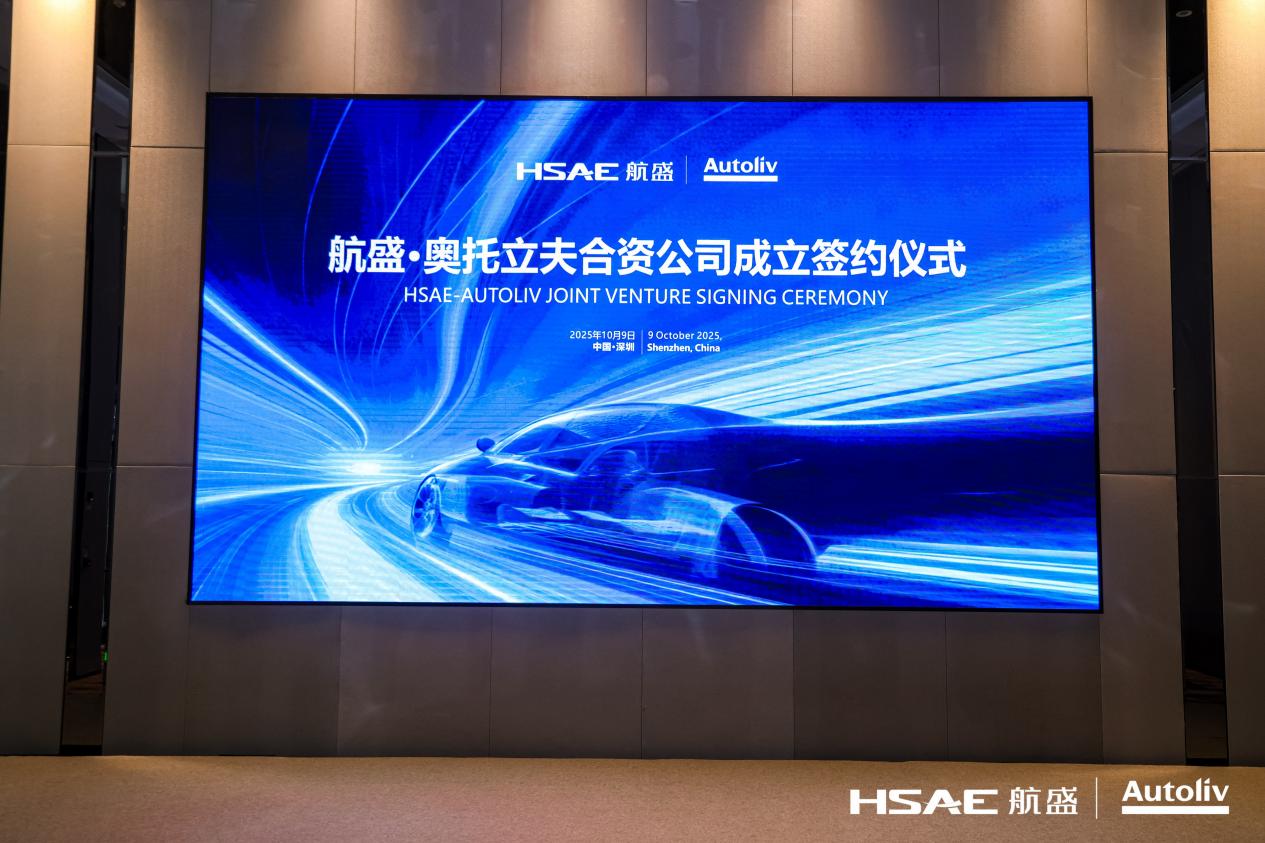
Core Insights - A strategic partnership focused on automotive electronic safety has been established between Shenzhen Hangseng Electronics and global safety systems leader Autoliv, marking a significant milestone in the integration of China's automotive electronics sector with global safety systems [1][3][4] Group 1: Partnership Details - The joint venture aims to develop and manufacture products in the automotive electronic safety field, with an expected establishment date in Q1 2026, located in the Yangtze River Delta region [3][4] - Initial focus areas for the new company include hands-free detection systems, pre-tensioner safety belt controllers, and electronic applications for safety belt systems [3][4] - This partnership is seen as a critical step in Hangseng's globalization strategy, enhancing Autoliv's ability to provide advanced safety solutions in the global market [3][4] Group 2: Historical Context - The collaboration follows a strategic memorandum signed in 2024, with the recent agreement being the fastest joint venture established by Autoliv in China in nearly 20 years, taking less than 12 months from negotiation to signing [4][5] - The rapid progress reflects a deep mutual trust and efficiency between the two companies [4][5] Group 3: Strategic Values - The partnership is characterized by three strategic values: acting as a bridge connecting global market resources with China's supply chain, fostering dual empowerment through cultural integration, and amplifying resources through technological collaboration [6][7] - The emphasis on quality and long-term sustainable development is a shared principle that underpins the partnership [5][9] Group 4: Innovation and Market Strategy - The joint venture aims to address the challenges of the automotive industry, particularly the need for innovation and quality amidst fierce competition [10][12] - The companies plan to explore global markets, including potential manufacturing and R&D centers in Europe, to leverage high-quality resources [10][12] - A focus on differentiated development is intended to avoid homogenization and low-price competition, enhancing value for customers [12]