
Zhong Guo Zheng Quan Bao

Search documents
西部利得基金吴海健:紧跟AI端侧浪潮 把握“戴维斯双击”
Zhong Guo Zheng Quan Bao· 2026-02-02 00:35
Group 1 - The AI application sector is beginning to show performance as the domestic AI computing infrastructure is becoming more established, shifting focus towards downstream applications and terminals, with blockbuster AI products expected to emerge [1][2] - Historical technology innovation cycles indicate that core companies often achieve a "Davis Double" in performance and valuation, highlighting the importance of identifying key players in the AI application field [1][2] - The investment strategy involves focusing on core segments of the AI industry chain, identifying companies with favorable competitive positions, governance, and industry status, which are likely to bind with leading customers and occupy critical roles [3] Group 2 - The AI investment trend is shifting from upstream computing power to downstream applications, with expectations of rapid growth in AI hardware products, such as AI glasses, which may follow a development path similar to TWS earphones [2] - Major global companies like Apple, Meta, OpenAI, and ByteDance are expected to launch new products between 2026 and 2027, potentially acting as catalysts for the market [2] - The investment team at the company has established a dedicated AI task force to systematically track key variables such as policies, product launches, and technological breakthroughs, aiming to capture non-linear changes in the AI industry [3][4]
ETF龙虎榜 | 这些方向 资金大幅流入
Zhong Guo Zheng Quan Bao· 2026-02-01 23:20
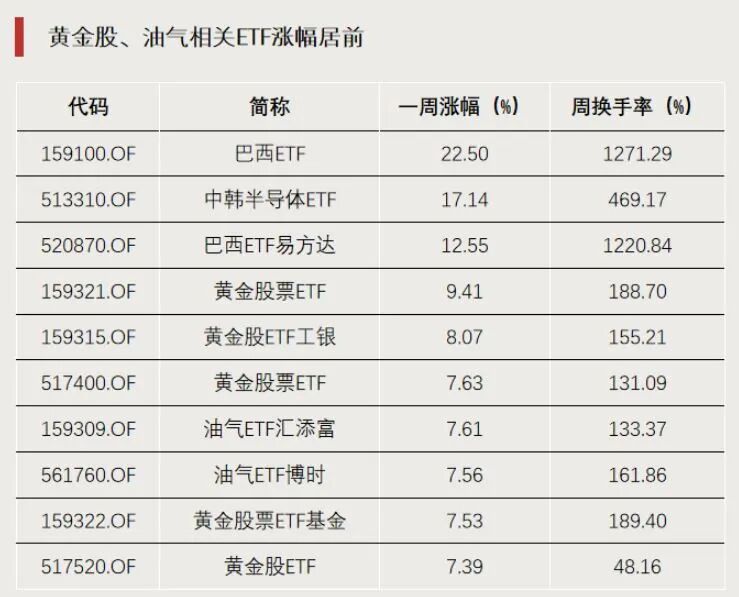
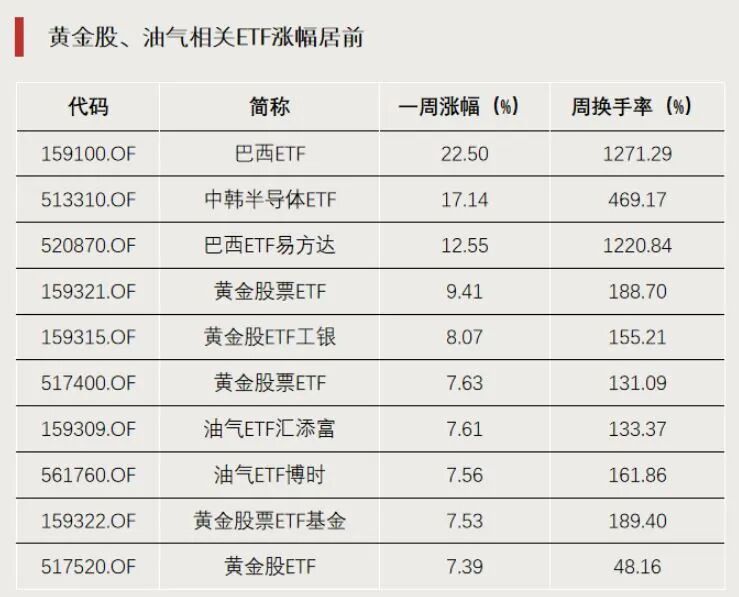
Core Viewpoint - The recent performance of ETFs indicates a strong interest in gold and energy-related sectors, with significant inflows into these areas despite an overall market outflow in ETF funds [1][9]. Fund Flows - Overall, the ETF market experienced a net outflow of 2984.22 billion yuan from January 26 to January 30 [1][8]. - Gold and non-ferrous related ETFs were the main beneficiaries, with gold ETFs linked to Shanghai Gold Exchange Au99.99 contracts receiving over 200 billion yuan in net inflows [9]. - ETFs tracking the SSH gold stock index saw a total net inflow of 75.25 billion yuan, while those tracking various non-ferrous metal indices had a combined net inflow of 170.49 billion yuan [9][10]. ETF Performance - A total of 541 ETFs recorded positive returns, accounting for over 35% of the market [3]. - Gold and energy-related ETFs led the gains, with several gold stock ETFs increasing by over 7% [3][6]. - The Brazilian ETF (159100) had the highest weekly gain at 22.5%, while the A500 ETF (159361) saw a trading volume exceeding 2200 billion yuan [2][4]. Trading Activity - The trading activity for ETFs tracking major indices such as the CSI 300 and SGE Gold 9999 remained robust, with significant weekly trading volumes [11][12]. - The CSI 300 ETF saw the largest net outflow, with over 700 billion yuan withdrawn from the Huatai-PineBridge CSI 300 ETF [13]. Sector Insights - The commercial aerospace sector faced adjustments, with satellite and general aviation-related ETFs experiencing declines of over 10% [3]. - The semiconductor sector also saw notable performance, with the Korea-China Semiconductor ETF (513310) showing a year-to-date decline of 45.09% [8][7]. Market Outlook - Analysts suggest focusing on cyclical resources supported by global demand and the AI industry, while also being cautious of potential short-term cooling risks in the market [14].

这些方向,资金大幅流入
Zhong Guo Zheng Quan Bao· 2026-02-01 23:17
Group 1 - The core viewpoint of the article highlights the significant fluctuations in the ETF market, particularly the strong performance of gold and oil-related ETFs, followed by a sharp decline in gold stock ETFs on January 30 [1][3][6] - During the week of January 26 to January 30, the overall ETF market experienced a net outflow of 298.22 billion yuan, with gold and non-ferrous metal ETFs being the main beneficiaries of capital inflow [1][9] - Gold ETFs, particularly those linked to the Shanghai Gold Exchange Au99.99 spot contracts, saw a net inflow exceeding 20 billion yuan, while ETFs tracking the SSH gold stock index had a net inflow of 7.525 billion yuan [1][9] Group 2 - The trading volume for ETFs tracking major indices such as the CSI 300 and CSI 500 remained active, with the A500 ETF from E Fund exceeding a trading volume of 220 billion yuan [2][11] - A total of 541 ETFs recorded positive returns, with gold and oil-related ETFs leading the gains, some exceeding 7% [3][6] - The Brazilian ETF (159100) had the highest weekly gain at 22.5%, while several gold stock ETFs also showed significant increases [3][4] Group 3 - Year-to-date, gold stock ETFs have shown remarkable performance, with the gold stock ETF (159321) increasing over 40%, and others like the gold stock ETF from ICBC and (517520) rising over 30% [6][7] - The semiconductor-related ETFs and Brazilian ETFs also ranked among the top performers year-to-date [7][8] - The net inflow for the gold stock ETF (517520) was notably high at 3.228 billion yuan, indicating strong investor interest [8] Group 4 - The article notes that the overall market sentiment is shifting towards focusing on economic trends rather than speculative trading, with an emphasis on cyclical resources and AI-related sectors [14] - Analysts suggest a balanced investment strategy that includes high-growth sectors like technology while also considering undervalued dividend assets to mitigate potential market volatility [14]
短视频“刷刷刷” 散户“冲冲冲” 机构投资对战互联网“吸睛大法”
Zhong Guo Zheng Quan Bao· 2026-02-01 23:16
Core Viewpoint - The rise of "Internet trading strategies" has led to significant speculation in the stock market, particularly among retail investors influenced by social media algorithms and prominent financial influencers [1][2][3] Group 1: Internet Trading Strategies - "Internet trading strategies" leverage the influence of individual accounts or matrix accounts to attract attention and create momentum for specific stocks [2] - The commercial aerospace sector has exemplified this mechanism, with significant trading activity observed in stocks like "航天发展" driven by retail investor interest and social media hype [2][3] - The phenomenon of "algorithmic recommendation" creates a feedback loop where stock prices rise in tandem with online popularity, leading to a cycle of speculation [3] Group 2: Regulatory Actions - Recent regulatory actions have targeted the operations of influencers like "金永荣," who engaged in illegal stock promotion and profited from subsequent sell-offs, resulting in penalties and market scrutiny [4] - Regulatory bodies are increasingly focused on curbing the influence of financial influencers and ensuring compliance within social media platforms to protect retail investors [9][10] Group 3: Institutional Investor Response - Institutional investors, particularly quantitative funds, are incorporating social media data into their investment strategies, often using it as a contrarian indicator rather than a signal to follow retail trends [5][6] - The reliance on traditional market data over social media sentiment reflects a cautious approach among institutional investors, who view retail-driven market movements as potentially misleading [6][8] Group 4: Market Dynamics and Investor Behavior - The rise of social trading has intensified the "herding effect" among retail investors, creating opportunities for professional investors to capitalize on mispriced assets resulting from collective retail actions [7][8] - The rapid fluctuations in market sentiment driven by social media can lead to significant price volatility, often disadvantaging retail investors who may not react as swiftly as institutional players [8] Group 5: Future Considerations for Professional Institutions - Professional institutions are encouraged to adapt their strategies to engage with retail investors more effectively, focusing on educational content and transparent communication to build trust [10] - The challenge remains for institutions to balance compliance with the need to provide relevant and timely investment advice in a rapidly changing market environment influenced by social media [10]
兴证全球基金刘琦:把“固收+”做成好生意
Zhong Guo Zheng Quan Bao· 2026-02-01 23:16
在利率下行与权益回暖的推动下,国内"固收+"投资近年迎来蓬勃发展。兴证全球基金"固收+"团队以产 品定位、大类资产配置、自下而上选品、风险管理四大维度为主要抓手,深化"固收+"投资核心竞争 力。 日前,兴证全球基金固定收益部副总监、基金经理刘琦在接受中国证券报记者采访时表示,"固收+"管 理本质上就是要理解客户到底需要什么,发挥自身的竞争力,建立客户黏性。团队希望做好精细化管 理,形成模块化、体系化优势,力争为投资者提供可持续的差异化收益以及安心的投资体验。 打造安心的持有体验 利率持续下行以及权益市场回暖的市场环境下,股债搭配的"固收+"组合成为近年来稳健资金的重点配 置方向。 如何打理好"固收+"组合,给投资者提供安心的持有体验,刘琦希望能把它做成一门"好生意":"好生意 的本质就是了解客户需要什么、如何打造自身的竞争优势和产品矩阵以及如何提高客户体验、建立客户 黏性,这其实和'固收+'的管理思路是一致的。" 尽管目前市场上"固收+"竞争激烈,但刘琦和团队坚持从产品定位、大类资产配置、自下而上选品、风 险管理四大维度入手,扎实修炼内功,打造丰富的"固收+"产品矩阵,力争为投资者提供可持续的差异 化收益。 ...
存储“超级周期”来了, 涨价持续到何时?
Zhong Guo Zheng Quan Bao· 2026-02-01 23:14
Core Viewpoint - The global storage market is expected to enter a price increase phase starting from Q3 2025, driven by structural supply-demand imbalances due to the AI wave, with significant price hikes projected for NAND flash and DRAM products [1][2]. Group 1: Price Increase Drivers - The primary driver of the price increase is a structural supply-demand imbalance caused by AI, leading to a surge in memory demand for AI servers, which is 8-10 times that of regular servers, thereby squeezing supply for consumer products [1]. - Major manufacturers like Samsung and SK Hynix are shifting over 80% of their advanced production capacity to high-margin HBM, resulting in a reduction of mature capacity [1]. - TrendForce predicts that by 2025, the average inventory cycle for the DRAM industry will drop to 10 weeks, with original factory inventory at a critically low level of 2-4 weeks [1]. Group 2: Duration of Price Trends - The storage industry is anticipated to experience a "super cycle" lasting 2-3 years, as capacity release lags behind demand growth [2]. - TrendForce forecasts that in Q1 2026, contract prices for general DRAM will increase by 55%-60%, while NAND flash products will see a rise of 33%-38% [2]. - Citigroup expects average selling prices for DRAM and flash products to rise by 88% and 74%, respectively, surpassing previous estimates [2]. Group 3: Impact on Downstream Industries - The consumer electronics, automotive electronics, and cloud computing sectors will be significantly affected by the storage price increases [3]. - In consumer electronics, the proportion of storage costs in the BOM is expected to rise from 20% to over 30%, leading to price increases for laptops by 500-1500 yuan [3]. - The automotive sector anticipates a 50% price increase for automotive-grade DDR4, with companies like Xiaomi and NIO highlighting the substantial cost pressures from rising memory prices [3]. Group 4: Opportunities for Domestic Storage Companies - Domestic storage companies such as Changxin Technology and Yangtze Memory are expected to benefit from the market space left by overseas manufacturers focusing on high-end products [5]. - Companies involved in equipment and materials are also likely to gain from the expansion needs of storage manufacturers, with firms like Baiwei Storage and Demingli projecting significant performance improvements in 2025 [5]. Group 5: Recommendations for Consumers and Investors - For consumers with rigid demand, early purchases are advised to avoid further cost increases, while non-essential purchases can be delayed [6]. - Investors should focus on core segments of the storage industry chain, including upstream equipment materials and midstream IDM manufacturers, considering the technological strength and capacity release pace of companies [6].
【财经早报】停牌核查完成!两只大牛股 今日复牌
Zhong Guo Zheng Quan Bao· 2026-02-01 23:13
Company News - Geely Automobile reported total sales of 270,167 vehicles in January, representing a year-on-year growth of approximately 1% [3] - BYD's sales of new energy vehicles reached 210,051 units in January, with passenger car sales at 205,518 units [4] - Xpeng Motors delivered 20,011 new vehicles in January [5] - GAC Group produced 110,795 vehicles in January, a year-on-year decrease of 4.77%, while sales increased by 18.47% to 116,622 vehicles [6] - Seres achieved sales of 45,900 vehicles in January, marking a year-on-year increase of 104.85%, with new energy vehicle sales up 140.33% to 43,000 units [7] - NIO delivered 27,182 new vehicles in January, reflecting a year-on-year growth of 96.1% [8] - AITO delivered 40,016 new vehicles in January, a year-on-year increase of 83% [9] - Lantu delivered 10,515 vehicles in January, up 31% year-on-year [10] - Li Auto delivered 27,668 new vehicles in January [11] - Leap Motor delivered 32,059 vehicles in January, representing a year-on-year growth of 27% [12] - Hongmeng Zhixing delivered a total of 57,915 vehicles in January, with a year-on-year increase of 65.6% [13] - Xiaomi Auto delivered over 39,000 vehicles in January [14] Stock and Financial Updates - Jiamei Packaging announced that its stock price increased by 408.11% from December 17, 2025, to January 23, 2026, which diverged from the company's fundamentals. The company expects a net profit of 85.44 million to 104.42 million yuan for 2025, a decline of 53.38% to 43.02% year-on-year. The stock will resume trading on February 2 [14] - Fenglong Co. completed its stock trading suspension review and will resume trading on February 2 [14] - Aoshikang plans to issue convertible bonds to raise up to 1 billion yuan for a high-end printed circuit board project, which aims to enhance product competitiveness and meet growing market demand [14] - China Mobile, China Unicom, and China Telecom announced that the VAT rate for certain telecommunications services will increase from 6% to 9% starting January 1, 2026, which will impact their revenue and profits [15] - Jerry Holdings signed a gas turbine generator sales contract worth 182 million USD (approximately 1.26 billion yuan) with a U.S. client, marking the fourth such contract since November 2025 [15] - Yanzhou Coal Mining announced the public transfer of 100% equity in Inner Mongolia Xintai Coal Co., with a starting price of 670 million yuan, which may significantly impact the company's net profit for 2026 [15]
存储“超级周期”来了 涨价持续到何时?
Zhong Guo Zheng Quan Bao· 2026-02-01 23:11
Group 1 - The global storage market is expected to experience a price increase starting from Q3 2025, driven by the AI wave and industry restructuring, with NAND flash prices projected to rise by 33%-38% and general DRAM prices by 55%-60% by Q1 2026 [1][3] - The core driver of this price increase is a structural supply-demand imbalance caused by AI, with AI servers requiring 8-10 times more memory than regular servers, leading to a squeeze on consumer-grade product supply [2] - The storage industry is anticipated to enter a "super cycle" lasting 2-3 years, as capacity release lags behind demand growth, with Citigroup predicting average price increases of 88% for DRAM and 74% for flash products by 2026 [3] Group 2 - The consumer electronics, automotive electronics, and cloud computing industries will be significantly impacted by the storage price increases, with storage costs in consumer electronics expected to rise from 20% to over 30% of BOM costs [4] - Major PC manufacturers like Lenovo, HP, and Dell are expected to raise laptop prices by 500-1500 yuan due to increased memory costs, while automotive companies face significant cost pressures from rising memory prices [4] - Domestic storage companies such as Changxin Technology and Yangtze Memory are likely to benefit from increased market opportunities as overseas manufacturers shift capacity towards high-end products [6] Group 3 - Consumers are advised to purchase storage products early if they have urgent needs to avoid further cost increases, while investors should focus on key segments of the storage industry chain, including upstream equipment and materials, as well as IDM manufacturers [7]
以文化为魂 以科技为翼 太湖雪:织就新国货丝绸发展新图景
Zhong Guo Zheng Quan Bao· 2026-02-01 22:56
Core Insights - The company emphasizes the integration of cultural heritage and modern design to revitalize traditional silk products, aiming to create a unique brand identity that resonates with contemporary consumers [1][3] - The brand's strategy focuses on leveraging intellectual property (IP) to expand its market reach, particularly through collaborations with high-profile cultural events like the Spring Festival Gala [2][3] - The company is committed to technological innovation, addressing industry challenges such as low efficiency and quality standardization through a robust patent system and smart manufacturing [4][5] Cultural Foundation - The company highlights its deep-rooted connection to silk production, with a focus on storytelling and craftsmanship to engage consumers [1][3] - The transformation of traditional silk techniques into modern consumer experiences is a key aspect of the brand's strategy, aiming to make silk products accessible and desirable [1][2] Technological Innovation - The company has accumulated nearly 100 patents, creating an innovation loop that enhances production efficiency and product quality [4] - The introduction of AI technology is seen as essential for improving design and marketing processes, allowing for more efficient operations and better customer targeting [5] Market Strategy - The company aims to connect directly with consumers through a multi-channel approach, emphasizing the importance of both online and offline experiences [6][7] - Significant growth in online sales has been noted, particularly through live-streaming platforms, with a reported revenue increase of 117.23% in the first three quarters of 2025 [6][7] Global Expansion - The brand is actively pursuing international markets, positioning itself as a representative of Chinese culture and aesthetics through its overseas brand "THXSILK" [7][8] - Cross-border e-commerce sales have seen a year-on-year growth of 25.20%, indicating a successful strategy in reaching global consumers [7] Community Engagement - The company is dedicated to supporting local farmers and enhancing the silk production ecosystem, contributing to the local economy and community development [8] - The establishment of standardized silkworm breeding bases aims to improve the quality and efficiency of silk production, benefiting local farmers [8] Future Outlook - The company plans to continue its growth trajectory by focusing on digital transformation and global branding, with a clear strategy for the next 3-5 years [8]
多只LOF,今日停牌1小时!套利热潮藏隐忧
Zhong Guo Zheng Quan Bao· 2026-02-01 22:45
Core Viewpoint - The recent surge in LOF (Listed Open-Ended Fund) products has attracted significant attention from investors, with 16 LOFs experiencing a rare collective price surge, leading to a heightened interest in arbitrage opportunities [1][2]. Group 1: LOF Market Dynamics - The LOF arbitrage trend was ignited by the popularity of the Guotou Silver LOF, which saw its price soar due to its unique focus on silver futures, resulting in a premium rate exceeding 60% [2]. - Following the suspension of subscriptions for Guotou Silver LOF, oil-related LOFs gained traction, with several experiencing price increases and premium rates surpassing 20% due to rising international oil prices [2]. Group 2: Investor Behavior and Sentiment - Many investors, like Xiao Lin, have been drawn to arbitrage strategies through social media platforms, reporting significant short-term gains, which reflects a broader trend of retail investors seeking quick profits [3]. - The excitement around LOF arbitrage has led to a proliferation of "how-to" guides and live demonstrations by financial influencers, further fueling the interest in these investment strategies [2]. Group 3: Risks and Challenges - LOF arbitrage is not without its risks; the time lag in transactions (T+2 for LOFs and T+3 for cross-border products) can lead to potential losses if market conditions change rapidly during the waiting period [4]. - Liquidity risks are significant, as some LOF products have low trading volumes, which can result in sudden price drops and difficulties in selling during market downturns [4]. - There is a concern that some LOFs are experiencing price premiums without solid underlying asset support, leading to potential losses for investors who chase high premiums without due diligence [4]. - The influence of social media on investment decisions has created a "herd effect," where investors may follow trends without fully understanding the associated risks, increasing the likelihood of poor investment outcomes [4].