Xin Lang Ji Jin

Search documents
摩根资产管理三季度经济数据快评:国内经济展现韧性,刺激政策加码概率上升
Xin Lang Ji Jin· 2025-10-20 09:02
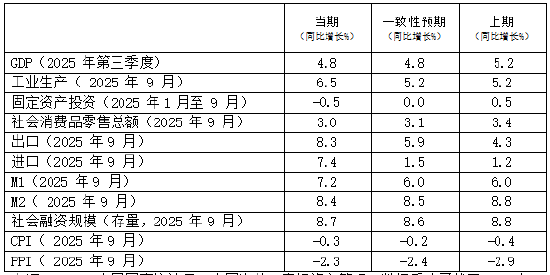
Core Insights - China's GDP growth in Q3 2025 was 4.8%, slightly below Q2's 5.2%, indicating a slowdown in domestic demand and investment [1][3] - Despite a significant drop in exports to the US, overall exports remained strong, particularly to ASEAN and Europe, suggesting resilience in external demand [1][4][5] - The likelihood of new stimulus measures is increasing due to weakening domestic demand and pressures on employment and consumption [6][8] Economic Indicators - Q3 2025 GDP growth: 4.8% (Q2: 5.2%) [1] - Industrial production growth in September 2025: 6.5% [1] - Fixed asset investment from January to September 2025: -0.5% [1] - Retail sales growth in September 2025: 3.0% [1] - Export growth in September 2025: 8.3% [1] - Import growth in September 2025: 7.4% [1] - CPI in September 2025: -0.3% [1] - PPI in September 2025: -2.3% [1] Domestic Demand and Investment - Domestic consumption showed signs of weakness, with retail sales growth declining from 6.4% in June to 3.0% in September [3][4] - Fixed asset investment continued to slow, with real estate development investment down 13.9% year-on-year [3] - The "anti-involution" policy has put pressure on manufacturing investment, which was previously supported by export growth and consumption recovery [3][6] Export Performance - Exports to the US fell by 27.0% in September, but exports to the EU, Japan, and ASEAN grew by 14.2%, 1.8%, and 15.6% respectively [4][5] - The shift in supply chains towards ASEAN reflects ongoing changes in trade dynamics [4][5] Policy Outlook - The urgency for new policy stimulus is rising as Q3 data indicates challenges in achieving the 5% growth target for the year [6] - Potential measures include interest rate cuts and increased liquidity to support domestic demand and stabilize the real estate market [6][8] - Upcoming meetings, including the "15th Five-Year Plan" and the Central Economic Work Conference, are expected to provide further guidance on policy direction [8] Market Sentiment - The stock market has shown resilience, supported by liquidity measures and governance reforms aimed at attracting long-term investment [7] - High-growth sectors such as semiconductors, AI infrastructure, and new energy have performed well, although the market is currently in a consolidation phase [7] - Anticipation of corporate earnings reports and policy guidance is influencing investor sentiment [7][8]

金信基金三季报出炉:押注科技主线,金信精选成长A、金信稳健策略A年内收益超60%
Xin Lang Ji Jin· 2025-10-20 08:40
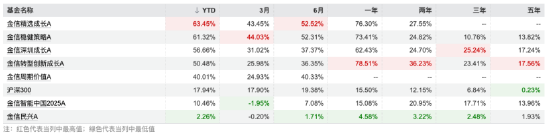
Core Insights - The third-quarter reports of the 2025 funds show a significant divergence in performance, with equity products focused on technology innovation outperforming bond and diversified industry products, indicating a concentrated market interest in technology innovation [1][3] Fund Performance - Jin Xin Selected Growth A leads with a year-to-date return of 63.45%, managed by veteran Kong Xuebing, with a scale of 427 million yuan and a quarterly growth of 31.8 million yuan, achieving a one-year return of 76.30% [3] - Jin Xin Steady Strategy A follows with a year-to-date return of 61.32% [3] - Jin Xin Shenzhen Growth A, managed by Huang Biao and Yang Chao, achieved a year-to-date return of 58.66%, with its scale increasing to 988 million yuan [3] - Jin Xin Transformation Innovation Growth A also performed well with a year-to-date return of 50.48% and a one-year return of 78.51% [3] - These four equity products significantly outperformed the CSI 300 index, highlighting the strong momentum in the technology sector [3] Portfolio Composition - Jin Xin Fund's concentrated investment in the semiconductor equipment sector has been a key driver of performance, with Jin Xin Steady Strategy A's top ten holdings including Chip Source Micro, which accounts for 9.90% and has risen 39.13% in the last three months [3] - Other significant holdings include Zhongwei Company and Tuo Jing Technology, with respective holdings of 9.70% and 9.56%, both seeing increases of over 64% in the last three months [3] Diverse Strategies - Jin Xin Cycle Value A, established in February, achieved a return of 40.01% in eight months, showcasing a more diversified portfolio beyond semiconductor stocks [8] - Jin Xin Intelligent China 2025 A, a flexible allocation fund, recorded a year-to-date return of 10.46% and a one-year return of 15.08%, indicating steady growth despite not matching the technology-focused products [10] Market Outlook - The fund managers express optimism about the semiconductor domestic substitution trend, driven by high R&D, accelerated product validation, and AI sovereignty demands, suggesting a long-term positive outlook [12] - The focus remains on identifying high-growth potential companies within the technology sector while managing risks associated with valuation pressures as tech stocks rise [13]
“新时代·新基金·新价值” | 公募机构携手走进商圈,筑牢市民财富安全防线
Xin Lang Ji Jin· 2025-10-20 08:36
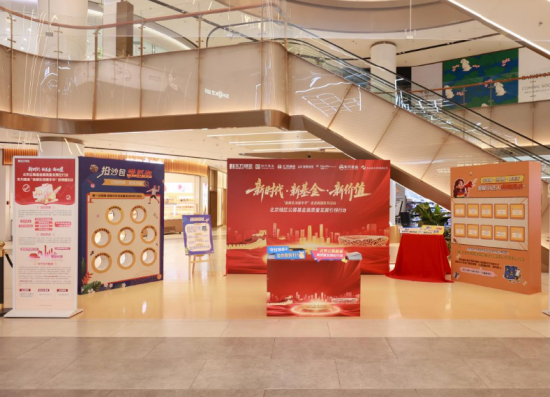
Core Insights - The event "Financial Life Carnival" was organized by Dongfang Fund in collaboration with several other funds to promote high-quality development in public funds in Beijing [1] - The initiative aims to enhance public financial literacy and encourage rational investment practices through interactive activities and professional guidance [1][5] Group 1: Event Overview - The event took place on October 17 and focused on addressing citizens' daily financial management needs [1] - Activities included interactive checkpoints and financial knowledge dissemination to engage participants in understanding common financial scams and proper investment channels [3][4] Group 2: Educational Approach - The event featured a shift from passive learning to active participation, encouraging attendees to engage in learning about financial safety and investment strategies [4] - Participants learned about typical scams and investment principles, fostering a better understanding of wealth management [4][5] Group 3: Community Engagement - Dongfang Fund emphasizes a user-centered approach, integrating financial education into everyday consumer experiences to enhance investor engagement [5][6] - The event was well-received, with many participants expressing enjoyment in learning financial knowledge in a relaxed atmosphere [5]
泓德基金:上周权益市场调整缩量,投资者风险偏好未明显降低
Xin Lang Ji Jin· 2025-10-20 08:36
Group 1 - The recent escalation of US-China tensions has increased market uncertainty, leading to a decline in A-share indices, particularly in small-cap and innovation sectors [1] - The ChiNext and STAR Market indices experienced significant drops, while the dividend sector showed defensive characteristics with a slight increase in the China Dividend Index [1] - The banking, coal, food and beverage, and transportation sectors saw gains, while the automotive, media, and electronics sectors faced notable declines [1] Group 2 - China's import and export growth has accelerated for eight consecutive quarters, with a 54.9% increase in industrial robot exports and a 23.9% increase in wind turbine exports in the first three quarters [2] - Despite the impact of high tariffs from the US, trade with Belt and Road countries grew by 6.2%, and trade with ASEAN, Latin America, Africa, and Central Asia increased by 9.6%, 3.9%, 19.5%, and 16.7% respectively, highlighting the strength of Chinese manufacturing [2] - The domestic equity market showed a slight adjustment, but investor risk appetite remained stable, with a net increase of approximately 150 billion yuan in financing balances from Monday to Thursday [2] Group 3 - In the bond market, interest rate bond yields generally rose while credit bond yields fell, indicating a shift in market dynamics since mid-September [3] - The bond market adjustment began in late June, influenced by fluctuating risk preferences and expectations regarding "anti-involution" policies [3] - The analysis suggests a return to a neutral outlook for bond operations, with ongoing observation of risk sentiment changes and policy developments [3]
北信瑞丰优选成长三季报:坚守大消费今年来跌3.26%,规模业绩双重承压
Xin Lang Ji Jin· 2025-10-20 08:36
Core Insights - The report highlights that the North Trust Ruifeng Fund's performance remains weak despite a generally positive economic outlook in China, with a year-to-date return of -3.26%, making it the only fund among those disclosed to record negative returns [4][5] - The fund's assets under management stood at 0.23 billion yuan as of September 30, 2023, remaining unchanged from the mid-year report, placing it at the lower end among disclosed equity funds [1][5] Fund Performance - The fund has consistently underperformed, with negative returns over various time frames: -1.43% over the last six months, 0.48% over the past year, -21.04% over two years, and -21.86% over three years, ranking poorly among peers [5] - Since taking over in April 2021, the fund manager has achieved a total return of -11.53% and an annualized return of -2.66%, ranking 367 out of 557 similar products [5] Portfolio Composition - The fund continues to focus on the consumer sector, particularly in food and beverage, with significant holdings in leading brands such as Kweichow Moutai and China National Pharmaceutical Group [6][11] - As of the end of Q3, the top ten holdings were concentrated in the food and beverage sector, with a total market value of approximately 16.95 million yuan, and notable reductions in positions for several key stocks [7][8] Market Outlook - The fund manager anticipates that the upcoming "14th Five-Year Plan" will provide direction for domestic consumption and technological development, with expectations for a recovery in the consumer sector driven by foreign capital inflows and domestic demand [11] - The report suggests that the consumer sector, particularly in liquor and food and beverage, may benefit from a narrowing of the US-China interest rate differential and economic recovery, potentially leading to valuation corrections [11]
博时市场点评10月20日:三大指数上涨,创业板涨近2%
Xin Lang Ji Jin· 2025-10-20 08:36
Economic Overview - The GDP for the first three quarters of 2025 is reported at 10,150.36 billion yuan, with a year-on-year growth of 5.2% [2] - In September, the industrial added value for large-scale enterprises increased by 6.5% year-on-year and 0.64% month-on-month [2] - The total retail sales of consumer goods in September reached 41,971 billion yuan, showing a year-on-year growth of 3.0% [2] - Fixed asset investment (excluding rural households) for the first three quarters was 3,715.35 billion yuan, down 0.5% year-on-year, with real estate development investment decreasing by 13.9% [2] Market Performance - The A-share market saw an increase, with the Shanghai Composite Index closing at 3,863.89 points, up 0.63%, and the ChiNext Index rising by 1.98% to 2,993.45 points [5] - The communication, coal, and electric equipment sectors led the gains, with increases of 3.21%, 3.04%, and 1.54% respectively [5] - The market turnover was 17,514.91 billion yuan, showing a decline compared to the previous trading day [6] Real Estate Sector - In September, the housing prices in 70 large and medium-sized cities showed a mixed trend, with first-tier cities experiencing a month-on-month decline of 0.3% [3][4] - The year-on-year decline in new residential prices in first-tier cities was 0.7%, indicating a narrowing of the decline compared to the previous month [3][4] - The real estate market remains under pressure, with buyer sentiment still cautious, although there are signs of price stabilization due to ongoing policy support [4] Monetary Policy - The Loan Prime Rate (LPR) for one year remains at 3.0% and for five years or more at 3.5%, unchanged since May [2] - The current low interest rates for both corporate and personal loans are expected to support economic stability [3] Future Outlook - The upcoming 20th Central Committee's Fourth Plenary Session is anticipated to provide insights into the 14th Five-Year Plan, which may influence market sentiment [1] - The ongoing U.S.-China trade tensions are expected to impact global trade and China's exports, necessitating continued efforts for economic stability and job security [3]

北信瑞丰首批基金三季报:旗下基金业绩首尾相差超87%,北信瑞丰优势行业年内收益逾84%领跑
Xin Lang Ji Jin· 2025-10-20 08:36
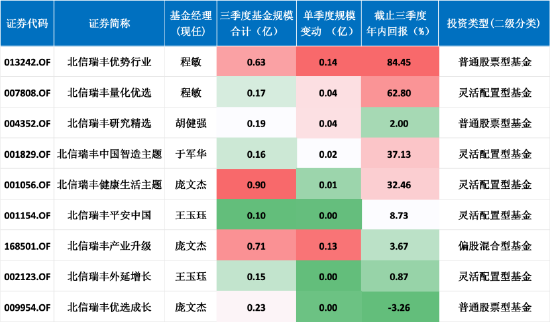
Core Insights - The report highlights a significant performance divergence among the funds managed by Beixin Ruifeng, with some equity products achieving returns exceeding 80% while others recorded negative returns, reflecting varying strategies and styles in the current market environment [1][3]. Fund Performance - The top-performing fund, Beixin Ruifeng Advantage Industry (013242.OF), achieved an annual return of 84.45%, with a quarterly scale increase of 0.14 billion, reaching a total of 0.63 billion [2][3]. - Another notable fund, Beixin Ruifeng Quantitative Selection (007808.OF), delivered a 62.80% return, growing its scale to 0.17 billion [3]. - Funds managed by Hu Jianqiang and Yu Junhua, focusing on high-end manufacturing and industry research, also performed well with annual returns of 46.88% and 37.13%, respectively [3]. Consumer Sector Performance - In contrast, the Beixin Ruifeng Preferred Growth Fund (009954.OF) focused on consumer sectors, recorded a negative return of -3.26%, remaining stagnant at a scale of 0.23 billion [4]. - The Beixin Ruifeng Health Life Theme Fund (001056.OF) achieved a positive return of 32.46%, but its scale only increased by 0.01 billion, indicating a disparity in performance among products managed by the same fund manager [4]. Fund Scale and Market Position - The total scale of the nine disclosed products is approximately 3.24 billion, with an average scale of less than 0.4 billion per product, indicating a predominance of small funds [5][6]. - The Beixin Ruifeng Health Life Theme Fund stands out with a scale of 0.90 billion, while several other products remain below 0.7 billion [5]. Strategic Outlook - The report suggests that the performance divergence among funds is linked to the varying success of different asset styles in the current market [7]. - With the upcoming policy window for the "14th Five-Year Plan," there may be new opportunities for investment in domestic consumption and technological innovation, which are critical for Beixin Ruifeng to enhance its overall performance and scale [7].
从锂电到AI,泉果旭源三年持有A三季报规模突破190亿,赵诣“两端配置”策略成效显著
Xin Lang Ji Jin· 2025-10-20 08:29
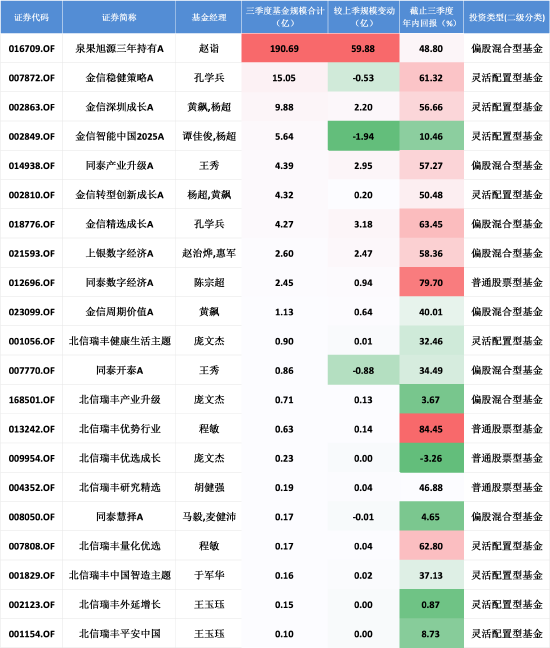
Core Insights - The core viewpoint of the article highlights the significant growth of the "Quanguo Xuyuan Three-Year Holding A" fund, which reached a scale of 19.069 billion yuan as of September 30, 2025, marking a quarterly increase of nearly 6 billion yuan, making it the largest among disclosed equity funds for the third quarter [1][2]. Fund Performance - The fund achieved a return of 43.10% over the past six months and 41.61% over the past year, ranking favorably among its peers, with a notable quarterly increase of 45.58% in Q3, outperforming the average of similar products and the CSI 300 index [2]. - Since its inception on October 18, 2022, the fund has delivered a total return of 1.80% and an annualized return of 0.60%, ranking 1980 out of 3209 in its category [4]. Investment Strategy - The fund manager, Zhao Yi, emphasized a "dual-end allocation" strategy to adapt to market changes, focusing on technology AI and sectors in recovery, particularly in new energy (especially the lithium battery supply chain) and military industry [5]. - In the AI sector, the fund is concentrated on three main lines: efficiency-enhancing internet companies like Meta, companies driven by new application scenarios such as Palantir, and cloud service providers like Microsoft [6]. - In the new energy sector, the fund is particularly focused on the lithium battery supply chain, noting a slowdown in fixed asset investment while demand remains high, leading to an improving supply-demand structure [6]. Portfolio Adjustments - The fund's top ten holdings include major companies such as Ningde Times, Tencent Holdings, and Enjie Co., with a total market value exceeding 12.877 billion yuan [9]. - Significant adjustments were made in the portfolio, with a notable reduction of 37.52% in holdings of Keda Li, while new additions included Tianqi Lithium and SMIC, indicating a continued focus on lithium materials and domestic semiconductor sectors [9]. Market Outlook - Zhao Yi expressed optimism about the long-term positive trend of the Chinese equity market, citing signs of easing in U.S. tariff policies and potential liquidity improvements, which could inject more momentum into the A-share market [9].




债市扰动因素逐步弱化,看好四季度债券市场表现
Xin Lang Ji Jin· 2025-10-20 08:19
Core Insights - The financial market is experiencing a marginal easing, with significant fluctuations in the 7-day funding rates and net liquidity operations by the central bank [2] - The Eurozone and Germany's economic sentiment indices have shown a decline, indicating potential economic challenges ahead [3] - Domestic financial data for September 2025 reflects weaker demand, with a notable decrease in both RMB loans and social financing [4] Group 1: Financial Market Overview - The central bank conducted a net withdrawal of 191 billion yuan on October 10, followed by a net injection of 137.8 billion yuan on October 13, indicating a shift towards a more accommodative monetary policy [2] - The DR001 rate remained stable at 1.31% while DR007 increased by 3 basis points to 1.42% as of October 16 [2] Group 2: Economic Indicators - The Eurozone's ZEW economic sentiment index fell to 22.7 in October from 26.1 previously, while Germany's index decreased to 39.3 from 37.3, suggesting a decline in economic optimism [3] - The current situation index for Germany dropped to -80, worse than the expected -74.8, indicating deteriorating economic conditions [3] Group 3: Domestic Financial Data - In September 2025, RMB loans increased by 1.29 trillion yuan, down 300 billion yuan year-on-year, while social financing rose by 3.53 trillion yuan, a decrease of 229.7 billion yuan year-on-year [4] - The M1 growth rate increased to 7.2% from 6.0%, while M2 growth rate decreased to 8.4% from 8.8%, reflecting a mixed picture of liquidity and demand [4] - The bond market is expected to perform well in the fourth quarter, with a potential downward trend in bond yields due to ongoing economic pressures and a low inflation environment [4]
金价跳水,是倒车接人吗?后市怎么看?中美贸易摩擦缓和+俄乌地缘局势进展,避险情绪减弱!
Xin Lang Ji Jin· 2025-10-20 06:53
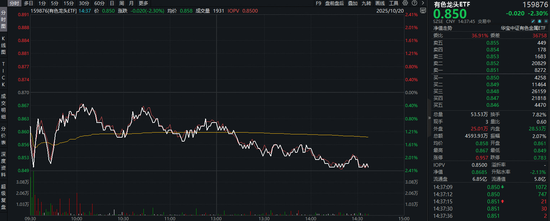
Core Viewpoint - The easing of US-China trade tensions and progress in the Russia-Ukraine situation have led to a decline in gold prices, which fell below $4,300 per ounce, impacting the A-share market and causing significant losses in gold stocks [1][3]. Group 1: Market Reactions - Gold stocks led the decline in the A-share market, with the ETF tracking leading non-ferrous metal companies dropping 2.3% [1]. - Major gold companies such as Western Gold and Chifeng Jilong Gold experienced declines exceeding 9% and 7%, respectively [1]. - Conversely, companies like Chuangjiang New Material and Yahua Group saw gains of over 6% and 1%, respectively [1]. Group 2: Economic Indicators - A video call between US and Chinese trade representatives on October 18 indicated a willingness to resume trade negotiations, contributing to the easing of market tensions [3]. - Ukrainian President Zelensky expressed readiness to participate in a meeting with US President Trump and Russian President Putin, signaling potential diplomatic progress [3]. Group 3: Gold Market Analysis - Despite the recent drop, Bank of America noted that gold assets still represent a low percentage of global investment portfolios, at 2.3% for institutions and 0.5% for private clients, indicating a lack of overcrowding in the market [3]. - The World Gold Council reported that retail gold investment accounts for less than 2% of global assets, and central bank gold reserves are below 30% of total foreign reserves, both far from historical highs [3]. Group 4: Non-Ferrous Metals Outlook - Analysts suggest focusing on the entire non-ferrous metals sector rather than solely on gold, as sectors like rare earths, lithium, and copper show promising growth potential [3][4]. - Rare earth companies are expected to report significant profit increases, with North Rare Earth projecting a net profit growth of 272.54%-287.34% for Q3 [3]. - In lithium, advancements in solid-state battery technology are anticipated to boost demand, with leading companies maintaining a self-sufficiency rate of over 50% in lithium salt production [4]. - Copper prices are expected to rise due to supply disruptions, particularly from the Grasberg mine in Indonesia, which is crucial for energy transition and new production capabilities [4]. Group 5: Investment Strategy - The non-ferrous metals sector is viewed as a key player in the current commodity bull market, driven by long-term capital expenditure cycles and increasing demand for strategic metal resources [4][6]. - The non-ferrous metal ETF (159876) offers a diversified investment approach, tracking an index with significant weightings in copper, gold, aluminum, rare earths, and lithium, thus reducing risk compared to investing in a single metal [6].