半导体行业观察

Search documents
硅光和CPO,下一件大事
半导体行业观察· 2025-09-03 01:17
Core Viewpoint - The article emphasizes the critical role of silicon photonics in meeting the increasing demands of data centers, particularly for artificial intelligence and machine learning applications, highlighting the advancements in high-speed communication and the growing bandwidth requirements driving the development of silicon photonics and lithium niobate technologies [2][5]. Group 1: Industry Landscape - The silicon photonics industry is characterized by a diverse range of participants, including major vertically integrated players like Innolight, Cisco, and Marvell, as well as startups, research institutions, foundries, and equipment suppliers, all contributing to significant growth and diversification [5]. - China is making notable progress in the silicon photonics sector, aiming to establish global leadership by narrowing the gap with Western companies through government support and a focus on domestic innovation [5]. Group 2: Technological Advancements - Higher single-channel rates can achieve Ethernet speeds of 3.2 Tbps or more, while also reducing power consumption and the number of lasers required, leading to lower capital expenditures and simplified supply chains [8]. - The demand for scalable, energy-efficient optical solutions in data centers and networks is intensifying competition among SOI, LNOI, and InP platforms, each with unique advantages and challenges shaping the future of optical communication [8]. Group 3: Co-Packaged Optics (CPO) Development - The explosive growth of artificial intelligence, particularly large language models, is driving the adoption of co-packaged optical modules (CPO), which are essential for high bandwidth, low latency, and energy-efficient connections in large-scale data centers [12][20]. - NVIDIA's introduction of Spectrum-X and Quantum-X silicon photonic switches at GTC 2025 marks a significant milestone for CPO in AI infrastructure, with the CPO market projected to grow from $46 million in 2024 to $8.1 billion by 2030, reflecting a compound annual growth rate of 137% [13][20]. Group 4: Supply Chain Dynamics - The CPO supply chain encompasses semiconductor foundries, photonics manufacturers, packaging suppliers, and fiber experts, with key players like Nvidia, TSMC, and Broadcom driving demand in response to AI workloads [16][20]. - The supply chain includes materials such as silicon wafers, SOI, indium phosphide, and glass, supporting the integration of ASICs and photonic circuits for both horizontal and vertical scaling networks [17].


芯片初创公司,攻破内存墙
半导体行业观察· 2025-09-03 01:17
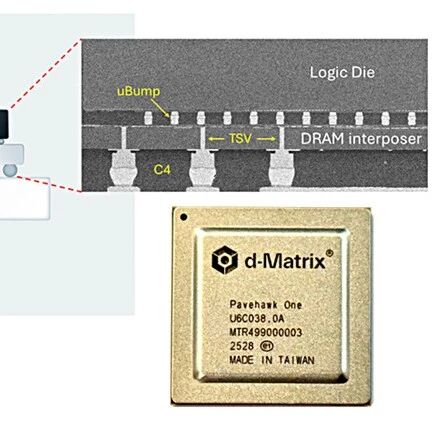
Core Viewpoint - The article discusses the significant demand for memory bandwidth and capacity in AI inference workloads, highlighting d-Matrix's innovative 3D Stacked In-Memory Compute (3DIMC) architecture as a solution to address these challenges [2][5][8]. Group 1: Company Overview - d-Matrix was founded in 2019 by Sid Sheth and Sudeep Bhoja, both former executives at Inphi Corp, which was acquired by Marvell for $10 billion in 2020 [2]. - The company aims to develop memory compute chip-level technology that offers greater bandwidth than traditional DRAM at a lower cost compared to High Bandwidth Memory (HBM) [2]. Group 2: Technology and Innovation - The 3DIMC architecture integrates 3D stacked memory with computing capabilities, significantly reducing latency and enhancing bandwidth while improving efficiency [3][8]. - d-Matrix's technology utilizes LPDDR5 memory and connects Digital In-Memory Compute (DIMC) hardware to memory via an intermediary layer, optimizing for matrix-vector multiplication, a key operation in transformer-based models [3][5]. Group 3: Performance Expectations - d-Matrix anticipates that 3DIMC will enhance memory bandwidth and capacity for AI inference workloads by several orders of magnitude, enabling efficient and cost-effective large-scale operations as new models and applications emerge [5][9]. - The next-generation architecture, Raptor, is expected to incorporate 3DIMC, aiming for a tenfold increase in memory bandwidth and energy efficiency compared to HBM4 when running AI inference workloads [5][9]. Group 4: Market Trends and Predictions - The article notes a significant shift from AI training to AI inference, with d-Matrix positioned to meet the growing demand for faster and larger memory solutions driven by large language models (LLMs) [6][7]. - Sheth predicts that the reliance on transformer models will dominate AI computing for the next 5 to 10 years, leading to a surge in AI inference workloads [6].
全频6G芯片,全球首颗,中国造!
半导体行业观察· 2025-09-03 01:17
Core Viewpoint - The development of the world's first "full-frequency" 6G chip by Chinese researchers marks a significant step towards the realization of 6G technology, promising ultra-high-speed connectivity and AI integration for real-time network management [2][4][5]. Group 1: Chip Development and Features - The new chip measures 11mm x 1.7mm and operates across a wide frequency range from 0.5 GHz to 115 GHz, which traditionally required nine separate radio systems [4][5]. - The chip integrates all essential components into a single thin-film lithium niobate (TFLN) microchip, enhancing bandwidth, data rates, and system functionality [4][5][6]. - The system achieves a peak data rate of over 100 Gbps and demonstrates real-time reconfigurability for adaptive frequency allocation [8][15]. Group 2: Technical Innovations - The chip employs an innovative signal generation and transmission method, converting radio signals to optical signals and generating stable RF signals using photonic oscillators [5][6]. - The TFLN platform allows for unprecedented integration of basic functional elements, including baseband modulation and broadband wireless-photonic conversion [7][14]. - The system's architecture supports dynamic spectrum management, enabling it to adaptively use full-spectrum resources across various applications [8][11]. Group 3: Future Implications - The anticipated commercial rollout of 6G networks is expected around 2030, with the technology poised to revolutionize internet usage and power smart cities [5][6]. - The integration of AI algorithms is projected to enhance the hardware's adaptability to changing environments and network dynamics [41]. - The proposed system could serve as a universal solution for integrated sensing and communication, facilitating real-time data transmission and environmental awareness [41].

美国撤销台积电南京厂豁免权
半导体行业观察· 2025-09-03 01:17
Core Viewpoint - The U.S. government has revoked TSMC's authorization to freely ship necessary equipment to its Nanjing plant in mainland China, potentially limiting the production capacity of this mature process chip factory [2][3] Group 1: Impact on TSMC - TSMC confirmed it received notification from the U.S. government that its "Verified End Use" (VEU) authorization for the Nanjing plant will be revoked by December 31 of this year, and the company is assessing the situation and taking appropriate measures [2][3] - The Nanjing plant, which initially focused on 16 to 12nm processes, has shifted to expanding 28nm capacity due to tightening U.S. export controls, with a monthly capacity of 20,000 wafers for 16/12nm and 40,000 wafers for 28/22nm [3][5] - The Nanjing plant generated approximately NT$26 billion in profit for TSMC last year, making it an important source of revenue despite its relatively low contribution percentage [3] Group 2: Broader Industry Implications - The U.S. actions highlight its influence over the electronic component supply chain, even affecting non-U.S. companies operating overseas [4][5] - The shift from blanket approvals to individual license applications creates uncertainty regarding the timeline for obtaining necessary permits for semiconductor operations in mainland China [5] - U.S. officials are reportedly working on solutions to alleviate bureaucratic burdens and expedite the processing of license applications, which have accumulated significantly [5]
背面供电,巨头争霸
半导体行业观察· 2025-09-03 01:17
Core Viewpoint - The introduction of Backside Power Delivery Network (BSPDN) by major semiconductor companies like Intel and TSMC is a significant advancement in semiconductor technology, aimed at addressing the limitations of traditional chip designs and extending Moore's Law [2][4]. Group 1: What is Backside Power Delivery? - BSPDN is considered a breakthrough that continues Moore's Law, improving heat dissipation, reducing IR drop, and increasing chip density [4]. - Traditional chip designs concentrate power and signal lines on the front of the wafer, which becomes problematic as advanced processes approach 2nm and below [5]. Group 2: Importance of Backside Power Delivery - Reduces voltage drop and power loss, ensuring stable power supply during high-speed AI computations and server applications [6]. - Addresses thermal bottlenecks and IR drop issues caused by lengthy circuits, which can lead to operational errors or performance degradation [7]. - Enhances performance by separating power and signal, thereby reducing interference [8]. Group 3: Global Strategies for Backside Power Delivery - Three main solutions are currently being developed: imec's Buried Power Rail, Intel's PowerVia, and TSMC's Super Power Rail [10]. - imec is a leader in BSPDN technology, having published its findings in collaboration with Arm in 2022, utilizing BPR and nTSV architecture [11]. - Intel plans to implement BSPDN in its 18A process, expected to enter mass production in late 2025, focusing on complete separation of power and signal [11]. - Samsung will introduce BSPDN technology in its SF2Z process, with mass production anticipated in 2027 [12]. - TSMC's approach involves using Super Power Rail to direct power to the front transistors, which is crucial for maintaining its competitive edge in advanced processes [13]. Group 4: Implications for the Semiconductor Industry - BSPDN is seen as a key technology for extending Moore's Law, especially as traditional methods of shrinking transistors face limitations [15]. - The competition among major players to mature and commercialize this technology will determine their influence in the semiconductor industry over the next decade [13].

美国迎来一座大型封装厂
半导体行业观察· 2025-09-03 01:17
Core Viewpoint - Amkor Technology is set to build a $2 billion advanced packaging and testing facility in Peoria, Arizona, expected to begin production in early 2028, marking a significant step in the U.S. semiconductor supply chain [2][3] Group 1: Facility and Investment - The new facility will occupy 104 acres and aims to address the bottleneck in semiconductor packaging, which has been a limiting factor for companies like Nvidia in producing AI chips [2] - The project received approval from the Peoria City Council on August 29, with plans modified to utilize a larger site in the city's innovation core [2] Group 2: Industry Context - The facility represents a major shift in the U.S. semiconductor landscape, as it aims to catch up with the advanced packaging capabilities predominantly held by Taiwan and South Korea [2] - Amkor's new plant will support high-performance packaging platforms, including TSMC's CoWoS and InFO technologies, which are critical for Nvidia's data center GPUs and Apple's latest chips [3] Group 3: Strategic Partnerships and Support - TSMC has signed a memorandum to transfer its packaging operations from its Phoenix fab to Amkor, reducing the turnaround time for wafers that currently takes weeks to return from Asia [3] - The expansion is partially funded by the CHIPS Act, which includes $407 million and federal tax incentives, aimed at maintaining the U.S. position in the increasingly complex chip industry [3] Group 4: Challenges Ahead - Despite the progress, the opening date in 2028 indicates that the industry may continue to face challenges, particularly in alleviating GPU shortages and AI server bottlenecks, which still rely on established Asian packaging lines [3] - Amkor faces a significant workforce challenge, with an estimated shortage of 70,000 to 90,000 workers needed for all planned U.S. fabs, highlighting the ongoing talent crisis in the semiconductor sector [3]


泰国PCB行业,强势崛起
半导体行业观察· 2025-09-03 01:17
Core Viewpoint - Thailand is rapidly becoming a significant hub for PCB manufacturing, driven by the demand from the AI supply chain and investments from major companies, particularly from China and Taiwan [5][6][7]. Group 1: Industry Expansion - Victory Giant Technology (VGT) is expected to order approximately 100 new machines to expand its capacity in Thailand and Vietnam [2]. - Nearly 60 PCB manufacturers from mainland China and Taiwan have established new production bases in Thailand within three years, including major players like Unimicron and Zhen Ding [6][7]. - The Thai PCB industry is projected to grow from $3.5 billion in 2024 to $5.62 billion by 2030, with a compound annual growth rate of 7.6%, surpassing the global average [12]. Group 2: Investment and Market Dynamics - Nvidia's acquisition of a PCB factory in Thailand marks a significant investment in the region, with the factory set to begin operations soon [2]. - The geopolitical tensions between Washington and Beijing are accelerating the trend of supply chain diversification, prompting global tech giants to look beyond China for assembly and key components [6][7]. - Despite the influx of new investments, the Thai PCB ecosystem remains immature, with many necessary materials and equipment still needing to be imported [14]. Group 3: Challenges and Workforce Issues - There is a significant cultural gap between local Thai workers and incoming PCB manufacturers from China and Taiwan, affecting operational efficiency [10]. - The demand for engineers in the PCB sector is high, particularly for those who can speak Chinese, leading to a competitive talent market [11]. - Experienced production line managers' salaries have doubled in the past two to three years, reflecting the intense competition for skilled labor [11]. Group 4: Future Outlook - The expansion of PCB manufacturing in Thailand is seen as a critical component of companies' capital expenditures aimed at capturing the growing demand related to AI [9]. - However, uncertainties in non-AI market demand and potential impacts from U.S. tariff policies pose risks to the sustainability of this growth [15].

9.15-16,杭州,EDA年度盛会!2场主论坛,12场分论坛,IDAS2025 设计自动化产业峰会诚邀您共襄盛举!
半导体行业观察· 2025-09-03 01:17
Core Viewpoint - The third Intelligent Design Automation Summit 2025 (IDAS 2025) will be held on September 15-16, 2025, at the Hangzhou International Expo Center, focusing on the semiconductor industry's development and innovation [90][91]. Event Overview - The summit will feature a main forum, 12 specialized forums, and related enterprise user conferences, expecting over 500 leading companies from the semiconductor industry, 2500+ professional attendees, and 200+ experts and scholars [90][91]. - More than 100 guests will deliver keynote speeches, and over 100 exhibition booths will be set up to showcase the latest EDA technologies and applications [90][91]. Key Themes and Topics - The summit will cover various topics, including AI for EDA, 3D IC, and the development of the Hanqing PDK, aiming to foster deep collaboration between industry, academia, and research [91]. - Specific forums will address areas such as Custom Design, Memory Design and Manufacturing, Chiplet and Advanced Packaging, and Digital Chip Design [83][84]. Notable Speakers and Sessions - Keynote speakers include Wang Runsheng, Liu Sheng, and Zheng Yongjun, discussing topics like chip integration, yield challenges for domestic high-end chips, and the development trends of AI cluster network chips [9][10][12]. - The agenda includes sessions on AI-enabled chip design, reliability screening for IC design, and the challenges and opportunities presented by Chiplet technology [12][20][26]. Registration and Participation - Registration for the summit is currently open, with multiple ways to sign up, including through the EDA² official website and the "EDA Square" WeChat account [1][3][5].


韩国芯片出口,创新高
半导体行业观察· 2025-09-02 01:11
Core Viewpoint - Despite increasing pressure from US tariffs and restrictions, South Korea's semiconductor exports reached a record high in August, driven by strong demand from China and tariff exemptions [2][3]. Group 1: Semiconductor Exports - In August, South Korea's semiconductor exports exceeded $15 billion, marking a nearly one-third increase compared to August 2024 [2]. - The strong performance in semiconductor exports contributed to an overall export figure of $58.4 billion for the month, also a record high [2]. Group 2: Other Export Products - Other major export products, including automobiles and ships, also performed well, with automobile exports rising to $5.5 billion and ship exports reaching $3.14 billion, both setting records for August [2]. Group 3: Impact of US Tariffs - South Korea's exports to the US fell by 12% year-on-year to $8.74 billion, primarily due to tariffs on steel, automobiles, and machinery [3]. - The initial 25% tariff on South Korean goods was negotiated down to 15%, but key products like steel and aluminum still face a 50% tariff [3]. Group 4: Government Response - The South Korean government plans to announce a three-pronged support plan in early September to mitigate the impact of US tariffs on small and medium-sized enterprises [3]. Group 5: Market Reaction - Despite strong export data, stock prices of major South Korean tech companies fell, with Samsung Electronics dropping over 2% and SK Hynix declining more than 4% [3]. - The US Department of Commerce announced the withdrawal of exemptions that allowed these companies to use US technology in their Chinese operations, which could restrict their production capabilities to older generation chips after a 120-day grace period [4].
杰华特收购新港海岸,国产芯片并购频发
半导体行业观察· 2025-09-02 01:11
Group 1: Recent Mergers and Acquisitions in the Semiconductor Industry - Domestic chip companies are actively pursuing mergers and acquisitions, with notable transactions including Jiewa's acquisition of a stake in New Port Coast (Beijing) Technology Co., Ltd. for a total price of 418 million yuan, resulting in a 35.3677% ownership stake [2] - Jiewa aims to enhance its product portfolio and competitiveness in the analog integrated circuit sector through this investment, particularly in power management and signal chain chips [2] - Starry Technology announced the acquisition of 53.3087% of Shanghai Furui Kun Microelectronics Co., Ltd. for approximately 210 million yuan, marking a strategic move in the AI SoC chip design field [4][5] Group 2: Company Profiles and Strategic Goals - New Port Coast specializes in high-speed mixed-signal IC design and is recognized for its core competencies in clock chip design, with applications in communication infrastructure and consumer electronics [2] - Furui Kun, established in 2014, focuses on Bluetooth chip design and has been recognized as a national-level "little giant" enterprise, boasting a strong technical team and a comprehensive R&D capability [5][6] - Starry Technology's acquisition of Furui Kun is expected to synergize existing technologies and enhance capabilities in low-power and reliable connectivity, aiming to transition from a chip supplier to a smart IoT solution provider [7] Group 3: Industry Consolidation and Future Prospects - Huahong and SMIC are also engaging in significant acquisitions, with Huahong planning to acquire 97.4988% of Shanghai Huali Microelectronics Co., Ltd. to enhance its wafer foundry capacity and product offerings [9][10] - SMIC is in the process of acquiring a 49% minority stake in SMIC North, which is expected to consolidate its operations and improve profitability by bringing previously held assets back under its control [11][12] - The consolidation efforts in the semiconductor industry are aimed at enhancing technological capabilities, optimizing production processes, and increasing market share [10][12]