
GEELY AUTO(00175)

Search documents
金发科技,与中石化、吉利汽车新合作
DT新材料· 2025-11-05 16:04
Core Insights - Jinfa Technology has recently established collaborations with major industry players, including Sinopec and Geely Automobile, to enhance talent development and sustainable materials research in the automotive sector [2][3]. Group 1: Collaboration with Sinopec - Jinfa Technology signed a talent training cooperation agreement with Sinopec Chemical Sales Co., Ltd. in Guangzhou, establishing a chemical product processing technology practice base [2]. - This base aims to provide practical training for employees, allowing them to gain insights into customer needs and industry trends, thereby strengthening the expert marketing team to support high-quality development [2]. - The partnership focuses on optimizing the "theory + practice" talent training model, creating a comprehensive talent development system covering production practice, marketing theory, end-product application, and market research [2]. Group 2: Joint Research Laboratory with Geely - Jinfa Technology, Geely Automobile, and China Automotive Data Co., Ltd. have launched the "Automotive Sustainable Materials Joint Research Laboratory" [3]. - The laboratory aims to integrate resources from automotive data services, vehicle R&D, and polymer material innovation, focusing on breakthroughs in sustainable materials technology and establishing a management system [3]. - Key areas of focus include: - Tackling core technologies for sustainable automotive materials, such as recycled materials, lightweight materials, and low-carbon applications [3]. - Building a closed-loop ecosystem for automotive materials, enhancing resource recycling efficiency through a comprehensive design and recycling system [3]. - Establishing a traceability and management system for sustainable materials, creating a quality traceability platform and shared database to support data-driven decision-making for automotive companies [3]. Group 3: Future Directions - The joint research laboratory will continue to promote the transformation and industrialization of sustainable materials technology, strengthen collaborative mechanisms, and enhance domestic and international exchanges in the automotive industry [3]. - The initiative aims to elevate the application level of sustainable materials in China's automotive industry and contribute to the global green and low-carbon development of the automotive sector [3].





比亚迪秦PLUS迎来又一对手 吉利银河星耀6猛攻A级混动轿车市场
Jing Ji Guan Cha Bao· 2025-11-05 11:48
Core Viewpoint - Geely Galaxy's Xingyao 6 adopts a "low price, high configuration" strategy to aggressively target the A-class hybrid sedan market, challenging the market leader BYD Qin PLUS DM-i with a competitive pricing range of 68,800 to 99,800 yuan [1][2]. Group 1: Product Launch and Market Strategy - The Xingyao 6 is positioned as a "new generation national electric hybrid family sedan," highlighting Geely's commitment to penetrate the A-class sedan market, which is the largest segment in China's automotive market [1][2]. - The model offers seven variants with two pure electric range options of 60 km and 125 km, and its starting price is nearly 20,000 yuan lower than the pre-sale price, breaking the 80,000 yuan price barrier for similar hybrid models [1][3]. - The Xingyao 6 is equipped with advanced features such as the Galaxy Flyme Auto intelligent cockpit system and the Shield battery safety system, defying the industry norm of reduced features at lower prices [1][3]. Group 2: Competitive Landscape - The A-class sedan market has been dominated by joint venture fuel models like Nissan Sylphy and Toyota Corolla, with BYD Qin PLUS breaking this dominance by becoming the best-selling A-class sedan in 2022 and maintaining its lead in 2023 with sales of 230,600 units from January to August [2][3]. - Geely's previous attempts to enter this market with the Galaxy L6 did not meet expectations, making the launch of Xingyao 6 a critical move to establish a foothold in this competitive segment [4]. Group 3: Financial and Sales Goals - Geely Auto Group reported a quarterly net profit of 5.67 billion yuan, with a year-on-year growth of 264%, enabling cost control that supports the "low price, high configuration" strategy of the Xingyao 6 [1][4]. - Following strong sales performance in the first half of the year, Geely has raised its annual sales target from 2.71 million to 3 million units, with the Xingyao 6 positioned as a key tool to achieve this goal [4][5]. - Geely aims to achieve an annual sales target of 5 million units by 2027, with the Xingyao 6 expected to play a significant role in the hybrid sedan market [4].

乘联分会:10月全国乘用车市场零售238.7万辆 同比增长6%
智通财经网· 2025-11-05 07:52
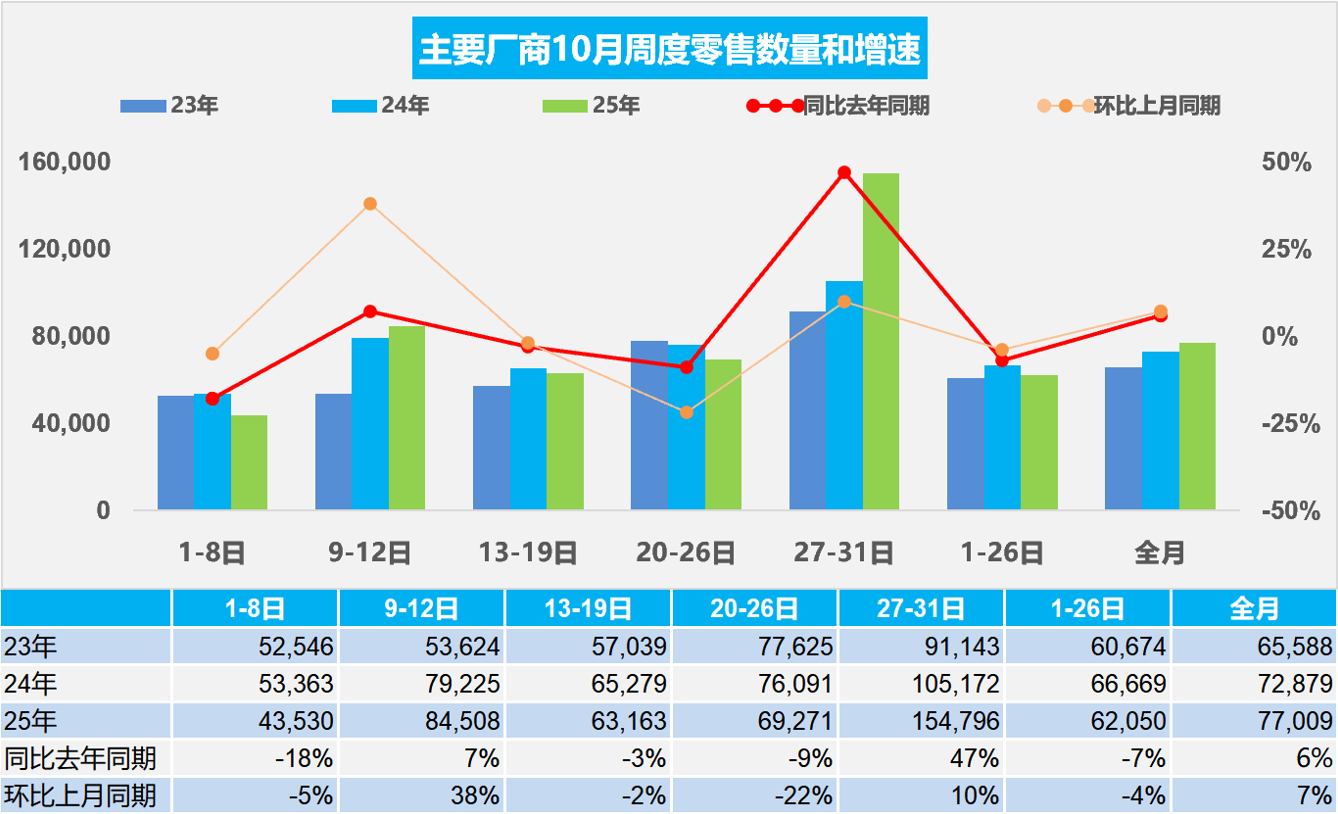
Core Insights - The retail sales of passenger cars in China for October 2023 reached 2.387 million units, representing a year-on-year increase of 6% and a month-on-month increase of 7% [1] - The wholesale volume for passenger cars in October 2023 was 2.922 million units, showing a year-on-year growth of 7% and a month-on-month growth of 4% [1] - The penetration rate of new energy vehicles (NEVs) in the passenger car market reached 58.7% in October 2023, with NEV retail sales totaling 1.4 million units, a year-on-year increase of 17% [1] Retail Market Performance - The average daily retail sales for the first week of October were 44,000 units, down 18% year-on-year and down 5% month-on-month [4] - The second week saw an increase to 85,000 units, up 7% year-on-year and up 38% month-on-month [4] - The average daily retail sales for the last week of October were 69,000 units, down 9% year-on-year and down 22% month-on-month [5] Wholesale Market Performance - The average daily wholesale volume for the first week of October was 30,000 units, down 21% year-on-year and down 36% month-on-month [8] - The second week recorded 76,000 units, with a year-on-year decrease of 1% but a month-on-month increase of 15% [8] - The average daily wholesale volume for the last week of October was 102,000 units, up 8% year-on-year and down 12% month-on-month [9] New Energy Vehicle Market - Cumulative retail sales of NEVs reached 10.27 million units in 2023, with a year-on-year growth of 23% [1] - Cumulative wholesale volume for NEVs was 12.061 million units, reflecting a year-on-year increase of 30% [1] - The NEV market is experiencing significant growth, with a penetration rate of 55.2% for wholesale [1] Market Trends and Influences - The "Golden September, Silver October" trend is evident, with October's retail performance affected by the holiday season and previous month’s strong sales [5] - The government's policy to promote vehicle trade-ins has positively impacted sales in September, leading to a strong performance that influenced October's figures [5] - The automotive export market is showing positive trends, particularly for domestic brands in overseas markets, indicating a shift in competitive dynamics [9]
乘联分会预估:10月全国新能源乘用车厂商批发销量161万辆
Huan Qiu Wang· 2025-11-05 04:27
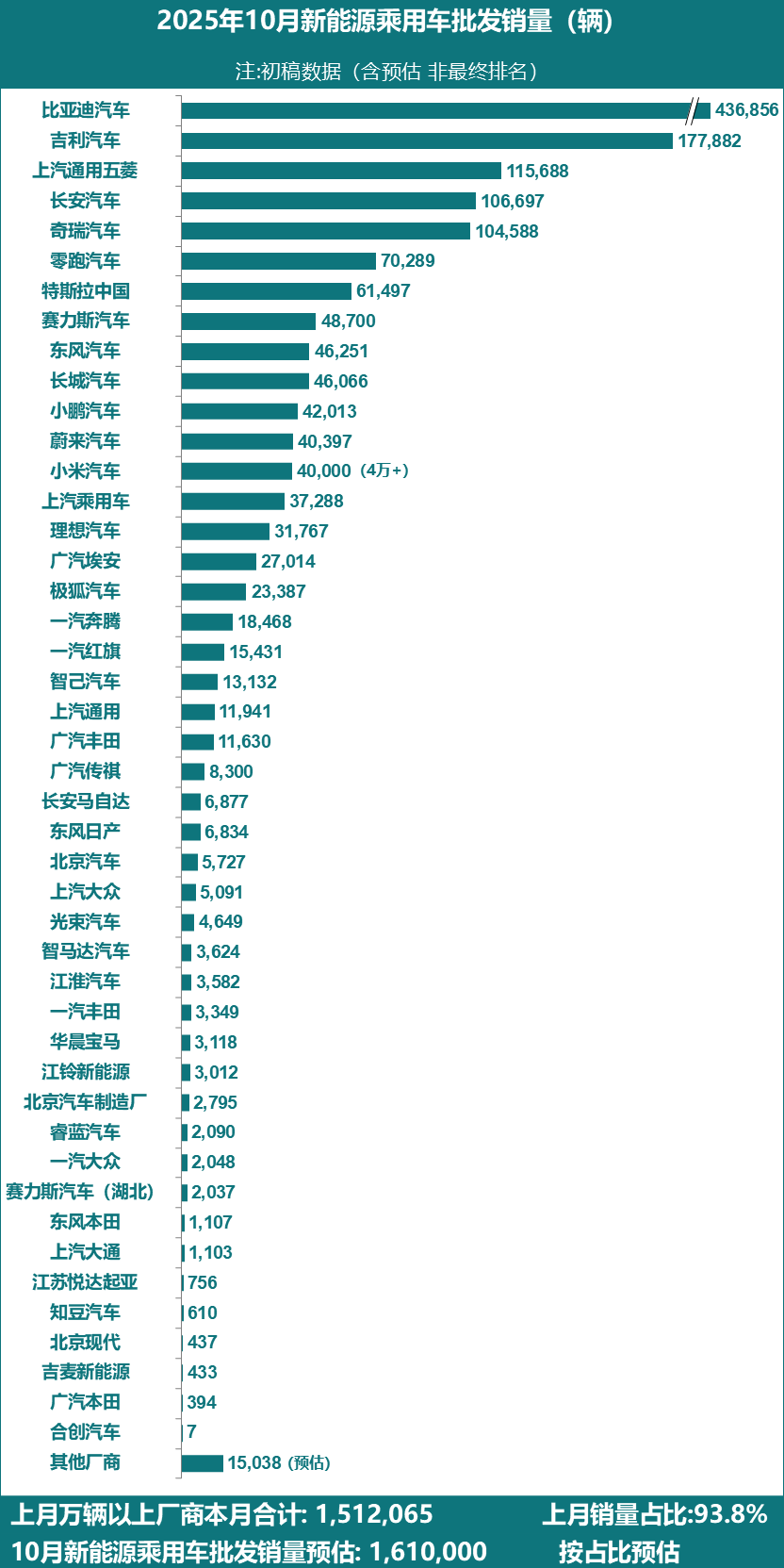
Core Insights - The wholesale sales of new energy passenger vehicles in China reached 1.61 million units in October, marking a year-on-year increase of 16% and a month-on-month increase of 7% [1] - Cumulatively, from January to October, the total wholesale sales amounted to 12.054 million units, reflecting a year-on-year growth of 30% [1] Industry Performance - October is traditionally a peak sales month, benefiting from the "Golden September and Silver October" sales season, with the National Day holiday boosting consumer demand [4] - The anticipated adjustment of the tax exemption policy for new energy vehicles at year-end has also contributed to increased consumer urgency in purchasing [4] - The strong retail performance and continuous growth in exports have led to a sustained upward trend in wholesale sales of new energy vehicles [4] Manufacturer Highlights - Major manufacturers such as Geely, Changan, Chery, Leap Motor, and others achieved record high wholesale sales of new energy vehicles in October [4] - Companies like SAIC-GM-Wuling, SAIC Passenger Cars, and Beijing Hyundai also reported their second-highest monthly sales figures historically [4] - The overall sales of new energy passenger vehicles have been significantly boosted by strong export performance and excellent results from many second-tier manufacturers [4]





吉利汽车回应改造原上汽通用北盛工厂(三期);“深圳造”智能戒指全球销量第二丨智能制造日报
创业邦· 2025-11-05 03:18
Group 1 - Geely Auto is actively exploring various capacity expansion plans to meet the increased demand for Geely Galaxy, without building new factories or expanding existing ones [2] - Japanese auto parts suppliers are seeking to integrate into China's automotive supply chain as the market share of Japanese cars declines, highlighting the urgency for collaboration with Chinese automakers [2][3] - Shenzhen-based JiuZhi Technology's RingConn smart ring has achieved global sales of over 150,000 units, ranking second in the smart ring market, with a user growth rate exceeding 100% year-on-year [3] Group 2 - The robotics industry has seen a revenue growth of 29.5% year-on-year in the first three quarters, with industrial robot production reaching 595,000 units and service robot production at 13.5 million units, surpassing the total expected for 2024 [3] - The performance and quality of robotic products have significantly improved, with successful development of high-performance industrial robots filling gaps in the high-end market [3] - Key components for robots, such as precision reducers and high-performance servo systems, are continuously achieving breakthroughs, enhancing the overall capability of the robotics sector [3]

招商证券国际:料内地汽车行业全年实现高单位数增长
Zhi Tong Cai Jing· 2025-11-05 03:07
Core Insights - The domestic automotive industry in China has seen positive effects from the vehicle trade-in policy this year, with expectations of high single-digit growth, surpassing initial market and official forecasts [1] - The necessity to further stimulate vehicle sales in the fourth quarter is reduced due to stable cross-year growth [1] - Although there may be disruptions in early next year due to subsidy reductions, flexible adjustments to trade-in policies can still support growth in the automotive sector [1] Company Recommendations - The report recommends several companies for investment, including XPeng Motors (09868), Geely Automobile (00175), Minth Group (00425), BYD Company (01211), and Li Auto (02015) [1]

吉利出海:后发而先至
3 6 Ke· 2025-11-05 02:30
Core Insights - In October, Geely's passenger car sales reached 307,100 units, marking a year-on-year increase of 35% and a month-on-month increase of 12%, maintaining a dual growth trend for eight consecutive months [1] - Geely's cumulative sales of new energy vehicles from January to October reached 1.345 million units, achieving 89% of its annual target of 1.5 million units [1] - Geely's Galaxy brand, launched this year, saw sales of 127,476 units in October, a year-on-year increase of 101%, contributing to a 58% share of new energy vehicles in Geely's total sales [1] Sales Performance - Geely's total sales in October were 307,100 units, with a year-on-year growth of 35% and a month-on-month growth of 12% [1] - The Galaxy brand achieved cumulative sales of 1,002,000 units in the first ten months, a year-on-year increase of 187%, surpassing its annual target ahead of schedule [1] New Energy Vehicle Strategy - The overall completion rate of sales targets for new energy vehicle companies is generally low, with most brands achieving less than 80% [1] - Geely's new energy vehicle sales accounted for 58% of its total sales, indicating a strong focus on this segment [1] International Expansion - Geely exported 41,000 vehicles in October, a year-on-year increase of 27.73%, marking the highest growth rate in a year [3] - The company aims to replicate its domestic success in overseas markets, having launched the Geely International EX5 in London, which is positioned as a competitive electric vehicle [3][4] - Geely plans to introduce 15 new models in the European market over the next five years and establish over 1,000 sales outlets [5] Efficiency and Cost Management - Geely is integrating resources across its brands, including Zeekr, Lynk & Co, and Galaxy, to enhance efficiency and reduce costs [6] - The company is leveraging external production capacity to minimize capital expenditures and avoid industry overcapacity risks [7] - Geely announced a share repurchase plan of HKD 2.3 billion to improve capital management efficiency [7]
汽车风向标:整车行业近期跟踪
2025-11-05 01:29
Summary of Automotive Industry Conference Call Industry Overview - The automotive industry is experiencing significant changes due to the cessation of subsidy policies in late October 2025, impacting sales dynamics for brands like BYD and Geely, which continue to launch new products to stimulate demand [1][2] - The transition to a new subsidy framework is expected to create a policy vacuum until after the Chinese New Year in 2026, with potential negative growth in the automotive market projected between 4% to 15% in Q1 2026 [1][7] Key Points and Arguments Subsidy Policies - The 2024 vehicle replacement policy is expected to generate approximately 3 million scrapped vehicles, with total subsidies nearing 100 billion yuan [1] - By 2025, applications for new subsidies have reached 10 million vehicles, with total subsidies estimated at 150 billion yuan, but a 30% reduction in subsidies is anticipated for 2026 [1][6] - The maximum subsidy per vehicle is expected to decrease to below 12,000 yuan in 2026 [6] Market Dynamics - The automotive market is currently in a "high open low walk" phase, with a surge in demand during the National Day holiday, followed by a decline in orders due to the end of national subsidies [2] - New energy vehicles (NEVs) are expected to face pressure in the sub-150,000 yuan segment, necessitating improvements in product lines and dealership efficiency [3][11] Sales Projections - Q1 2026 is projected to require a year-on-year growth rate of over 15% to compensate for January's sales gap, with a monthly growth rate of 10% needed [9][10] - The overall market is expected to face significant pressure in the first half of 2026, requiring a strategic focus on product supply and policy support to avoid year-on-year declines [10] Competitive Landscape - The competition in the automotive market is expected to remain intense, influenced by factors such as channel efficiency and the timing of new product launches [13] - Domestic brands like Geely and BYD are expected to maintain a strong position, particularly in the high-end market, leveraging their technological and supply chain advantages [13][19] New Energy Vehicle Trends - The penetration rate of NEVs is projected to slow down, with an expected increase of around 5 percentage points in 2026, while electric vehicles will begin to incur purchase taxes [22] - The overall price range of vehicles is likely to increase, with a significant impact on the economy segment due to reduced subsidies and increased purchase taxes [22][23] Brand-Specific Insights - Geely's new models, including the Galaxy series, are set to launch in 2026, with plans to expand sales channels from 1,300 to 2,500 stores, aiming for a 20% or higher year-on-year growth [20] - Great Wall Motors is focusing on expanding its dealer network and launching new models, including the Ora brand, to enhance competitiveness and achieve steady growth [22][24] Additional Important Insights - The high-end market for NEVs is facing pressure from economic uncertainties, with a potential decline in market share for high-end brands [14] - The automotive industry is expected to see a shift in focus from price competition to enhancing product quality and operational capabilities [15][16] This summary encapsulates the key insights and projections regarding the automotive industry, highlighting the impact of subsidy policies, market dynamics, competitive landscape, and brand-specific strategies.
山东枣庄高新区持续提升锂电产业集群能级
Zhong Guo Chan Ye Jing Ji Xin Xi Wang· 2025-11-05 00:39
Core Insights - The Zaozhuang High-tech Zone is enhancing the lithium battery industry cluster through a dual-driven approach of major project leadership and high-end platform empowerment, aiming to strengthen its reputation as "China's New Energy Battery City" [1] Group 1: Project Overview - The Geely and Xinwanda power battery project is a significant initiative for high-quality development in the lithium battery sector, with a total investment of 5 billion yuan [1] - The project focuses on the production lines for battery cells, modules, and PACK, catering to the diverse needs of the new energy vehicle battery market [1] Group 2: Industry Collaboration - The project effectively connects upstream and downstream enterprises in the industry chain, fostering a collaborative innovation ecosystem through the establishment of the Shandong Lithium Battery Industry Innovation and Entrepreneurship Community [1] - This community has attracted multiple research institutions and companies, promoting resource sharing and complementary advantages to overcome technological bottlenecks in industry development [1] Group 3: Quality Assurance - The National Lithium Battery Product Quality Inspection and Testing Center, located near the Geely and Xinwanda project, is the only national-level legal inspection agency in the lithium battery field [2] - The center has established four types of laboratories and is equipped with 360 sets of international first-class instruments, covering over a thousand inspection parameters [2] - It has provided testing services for more than 15,000 batches for well-known companies such as Xinwanda, BYD, and Mercedes-Benz, supporting the high-quality development of the lithium battery industry [2]

10月车企销量:增长、创新高成关键词,上汽蝉联第一、吉利跃居第三
Hua Xia Shi Bao· 2025-11-05 00:34
Core Insights - October saw significant growth in automobile sales, particularly in the new energy vehicle (NEV) sector, with several companies achieving record sales figures [2][4][6] Group 1: Overall Market Performance - In October, five out of eight traditional car manufacturers reported a year-on-year sales growth exceeding 10% [2] - SAIC Motor Corporation sold 454,000 vehicles in October, marking a 13% increase year-on-year, maintaining its position as the top-selling domestic automaker for two consecutive months [4][5] - Geely Automobile achieved a record monthly sales of over 307,000 units, with a remarkable year-on-year growth of 35%, moving up two ranks to third place [6] Group 2: Company-Specific Performance - BYD sold 442,000 vehicles in October, a new high for the year, but experienced a 12% decline year-on-year [4] - China FAW Group sold 305,000 vehicles in October, reflecting an 8.1% increase year-on-year, with a total of 2.688 million vehicles sold from January to October [7] - Chery Group's sales reached 281,000 vehicles in October, up 3.3% year-on-year, with NEV sales growing by 54.7% [8] Group 3: New Energy Vehicle Sales - SAIC's NEV sales reached 207,000 units in October, a 31.6% increase year-on-year, contributing to its overall sales success [4] - Geely's NEV sales in October hit 178,000 units, a 64% increase year-on-year, with NEVs accounting for 58% of its total sales [6] - Chery's NEV sales for the first ten months totaled 698,000 units, a 73.1% increase year-on-year, solidifying its position among the top five in the industry [8] Group 4: Export Performance - BYD exported 83,904 NEVs in October, marking it as one of the fastest-growing exporters in the automotive sector [4] - Geely's overseas sales reached 41,568 units in October, reflecting a 23% year-on-year increase [6] - Chery's exports for October were 126,000 units, a 13% increase, continuing a trend of strong export performance [8] Group 5: Year-to-Date Performance and Targets - As of October, SAIC's cumulative sales reached 3.647 million units, achieving an 81% target completion rate against its annual goal of 4.5 million units [5] - Geely's cumulative sales for the year stood at 2.477 million units, with an 83% target completion rate against its revised goal of 3 million units [6] - Chery's cumulative sales reached 2.289 million units, with a target completion rate estimated between 71% and 77% based on industry growth projections [8]

