CHINA RES BEER(00291)

Search documents
华润啤酒上半年营收239.42亿元,赵春武出席业绩说明会
Bei Ke Cai Jing· 2025-08-20 03:45
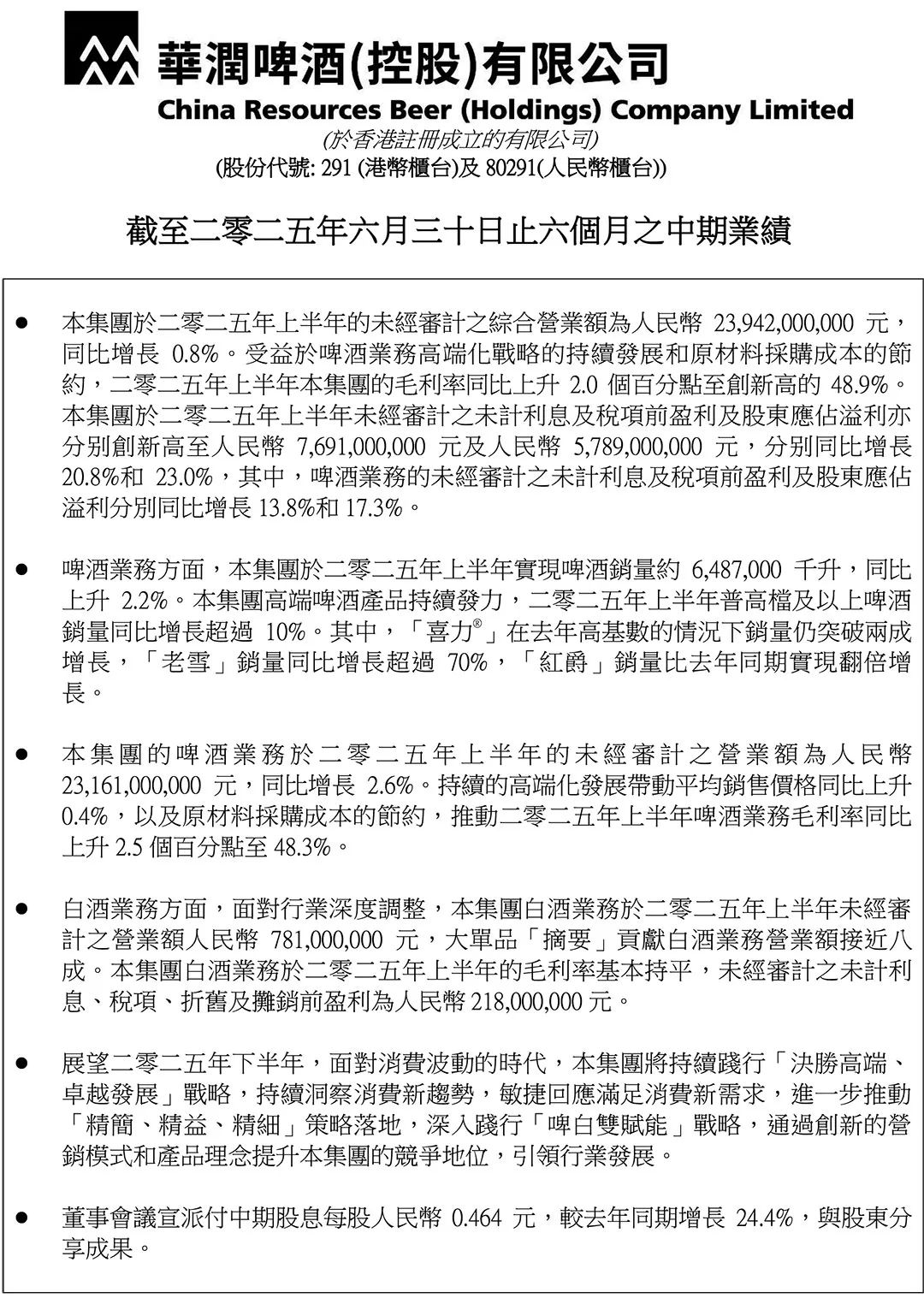
Group 1: Financial Performance - In the first half of 2025, China Resources Beer (控股) Limited reported revenue of 23.942 billion yuan, a year-on-year increase of 0.8% [1] - The gross profit margin rose by 2 percentage points to 48.9% due to the high-end beer strategy and cost savings in raw material procurement [1] - Shareholder profit attributable to the company was 5.789 billion yuan, reflecting a year-on-year growth of 23% [1] Group 2: Beer Business - The beer segment achieved an unaudited revenue of 23.161 billion yuan, up 2.6% year-on-year, with sales volume reaching approximately 6.487 million kiloliters, an increase of 2.2% [1] - High-end beer products saw significant growth, with sales of premium and above beer increasing by over 10% year-on-year; "Heineken" sales grew by over 20%, while "Snow" beer sales surged by over 70% [1] Group 3: White Spirit Business - The white spirit segment reported an unaudited revenue of 0.781 billion yuan, down from 1.178 billion yuan in the same period last year, with the major product "Abstract" contributing nearly 80% of the revenue [2] - The white spirit industry is undergoing a deep adjustment, and future improvements depend on the performance during the peak seasons of Mid-Autumn and Spring Festival [2] Group 4: Management and Strategy - Following the departure of former chairman Hou Xiaohai, the current management led by Zhao Chunwu aims to continue the existing strategic direction without major changes [3] - The company is focusing on developing online business channels, which have seen significant growth, with overall GMV increasing by nearly 40% and instant retail business by nearly 50% year-on-year [3] - The company is exploring new business models, including customization and contract manufacturing, and sees instant retail as a crucial channel for future growth and consumer engagement [3] Group 5: Market Trends - Competitors like Yanjing Beer and Chongqing Beer are diversifying into beverage products to meet consumer demands across various consumption scenarios [4]

大摩:华润啤酒持续推进高端化策略 微升目标价至35港元
Zhi Tong Cai Jing· 2025-08-20 03:19
Core Viewpoint - Morgan Stanley has raised its net profit forecast for China Resources Beer (00291) by 10% for 2025 due to a one-time gain from land sales to joint ventures in the first half of the year, while maintaining an "Overweight" rating and increasing the target price from HKD 34 to HKD 35 [1] Group 1: Financial Performance - The EBIT of China Resources Beer recorded a 14% growth in the first half of the year, outperforming peers despite a challenging industry environment [1] - The recurring profit forecasts for 2025 to 2027 have been adjusted upwards by 1% to 2% [1] Group 2: Strategic Outlook - The company is expected to continue its profit growth through a high-end strategy and enhanced penetration in non-immediate consumption channels, alongside ongoing improvements in profit margins [1] - Management has indicated a commitment to advancing the high-end strategy, leveraging core brands such as Heineken and Snow Beer, as well as other premium and sub-premium brands to increase market share [1]
华润啤酒上半年股东应占溢利57.89亿元 同比增长超两成
Zheng Quan Ri Bao Wang· 2025-08-20 03:19
Core Viewpoint - China Resources Beer Holdings Company Limited (CR Beer) reported strong revenue and net profit growth in its 2025 interim results, showcasing the success of its "3+3+3" nine-year strategy despite a slight decline in the overall beer industry [1][2]. Financial Performance - In the first half of 2025, CR Beer achieved revenue of 23.94 billion yuan, a year-on-year increase of 0.8% [2] - The profit attributable to shareholders was 5.789 billion yuan, up 23% year-on-year [2] - The company's EBITDA was 7.691 billion yuan, reflecting a 20.8% increase [2] - The gross profit margin improved to 48.9%, an increase of 2 percentage points compared to the previous year [2] - The board declared an interim dividend of 0.464 yuan per share, a 24.4% increase from the same period last year [2] Beer Business Performance - CR Beer sold approximately 6.487 million kiloliters of beer in the first half of 2025, a 2.2% increase year-on-year [2] - The beer business generated an unaudited revenue of 23.161 billion yuan, up 2.6% year-on-year [2] - The average selling price of beer increased by 0.4% due to ongoing premiumization efforts [2] - The gross profit margin for the beer business rose by 2.5 percentage points to 48.3% [2] - Premium beer products saw sales growth of over 10% year-on-year, with brands like "Heineken" and "Snow" achieving significant increases [2] Strategic Focus - The company is committed to a high-end development strategy, which has been a key driver of its performance amid a challenging market environment [3][4] - The management team expressed confidence in continuing the established strategies, including the focus on high-end products and growth as the primary strategy [4] - The company plans to adapt to market changes while maintaining strategic consistency [4] White Wine Business Challenges - The white wine segment faced significant challenges due to industry adjustments and policy impacts, with revenue of 781 million yuan and EBITDA of 218 million yuan reported [2][5] - The company is adjusting its product structure to address market changes, including launching new products at competitive price points [5] Market Position and Future Outlook - CR Beer is recognized for its dual-brand strategy in both beer and white wine, which is expected to enhance its market position [6] - Analysts predict that the company's focus on premiumization and cost advantages will continue to yield positive results [7] - The stock price of CR Beer increased by 6.24% following the release of the interim report, closing at 28.28 HKD per share [6]
大摩:华润啤酒(00291)持续推进高端化策略 微升目标价至35港元
智通财经网· 2025-08-20 03:17
Group 1 - Morgan Stanley has raised the net profit forecast for China Resources Beer (00291) by 10% for 2025 due to a one-time gain from land sales to a joint venture in the first half of the year [1] - The recurring profit forecast for 2025 to 2027 has been increased by 1% to 2%, maintaining a "Buy" rating for the company, with the target price raised from HKD 34 to HKD 35 [1] - Despite a challenging industry environment, the company's EBIT grew by 14% in the first half of the year, outperforming peers, and is expected to continue benefiting from a premiumization strategy and improved penetration in non-immediate consumption channels [1] Group 2 - The management has indicated a commitment to advancing the premiumization strategy, leveraging core brands such as Heineken and Snow Beer, along with other premium and sub-premium brands to enhance market share [1] - The outlook for the second half of the year and the full year remains unchanged according to Morgan Stanley [1]
华润啤酒上半年营收239.42亿元,白酒业务营收7.81亿元
Qi Lu Wan Bao· 2025-08-20 02:47
Core Insights - China Resources Beer (00291.HK) reported a comprehensive revenue of RMB 23.942 billion for the first half of 2025, representing a year-on-year growth of 0.8% [1][4] - The company's profit before interest and tax increased by 20.8% to RMB 7.691 billion, while the profit attributable to shareholders rose by 23.0% to RMB 5.789 billion [1][4] - The board declared an interim dividend of RMB 0.464 per share, up 24.4% from the previous year [1][4] Beer Business Performance - Beer sales reached 6.487 million kiloliters, marking a 2.2% increase year-on-year [1][4] - Sales of premium and above beer grew by over 10%, with key brands performing exceptionally: "Heineken" sales increased by over 20%, "Snow" by over 70%, and "Red Duke" sales doubled [1][4] - The average selling price of beer rose by 0.4%, and the gross margin for the beer business improved by 2.5 percentage points to 48.3% due to cost optimization in raw material procurement [1][4] Baijiu Business Performance - The baijiu business reported an unaudited revenue of RMB 781 million, with the major product "Abstract" contributing nearly 80% of this revenue [1][4] - The gross margin for the baijiu business remained stable, with profit before interest, tax, depreciation, and amortization at RMB 218 million [1][4] Future Outlook - For the second half of 2025, the company plans to continue its strategy of "winning high-end and excellent development," focusing on consumer trends and agile responses to new demands [2][4] - The company aims to implement a "streamlined, lean, and refined" strategy and enhance its competitive position through innovative marketing and product concepts [2][4]

港股异动丨啤酒股逆势上涨 业绩利好发酵华润啤酒续涨超2%
Ge Long Hui· 2025-08-20 02:25
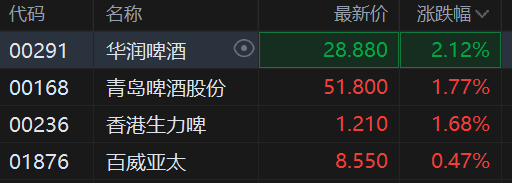
Group 1 - The core viewpoint of the article highlights the resilience of Hong Kong beer stocks, particularly the continued rise of China Resources Beer, which saw a 2.12% increase following a previous day’s surge of over 6% [1] - China Resources Beer announced a revenue of 23.942 billion RMB for the first half of 2025, reflecting a year-on-year increase of 0.8%, while net profit reached a record high of 5.789 billion RMB, up 23% [1] - Nomura's research report indicates that China Resources Beer's overall performance in the first half of the year was stable, with revenue growth of 1%, sales up by 2.2%, and an average price increase of 0.4%, demonstrating the effectiveness of its premiumization strategy [1] Group 2 - The China Alcoholic Drinks Association reports that the craft beer market in China surpassed 80 billion RMB in 2024, with a year-on-year growth rate exceeding 30% [1] - Products incorporating Chinese innovative elements have increased their market share from 5% to 18%, becoming a significant driver of industry growth [1]
中金:维持华润啤酒跑赢行业评级 目标价32.4港元
Zhi Tong Cai Jing· 2025-08-20 02:24
Group 1 - The core viewpoint of the report maintains the 2025/26 core net profit estimates for China Resources Beer at 5.31/5.75 billion HKD, with a target price of 32.4 HKD, indicating a 15% upside potential from the current stock price [1] - The beer segment's performance in 1H25 slightly exceeded expectations, with revenue of 23.94 billion HKD, a year-on-year increase of 0.8%, and core EBIT of 7.11 billion HKD, a year-on-year increase of 11.3% [2] - The beer business outperformed the overall industry, benefiting from a decrease in raw material costs, with a year-on-year decline in ton cost of 4.2% and an increase in gross margin by 2.5 percentage points to 48.3% [3] Group 2 - The white liquor business faced greater pressure than market expectations, with a revenue decline of 34% in 1H25 and EBITDA down by 47.2% [4] - The company plans to launch products priced between 100-300 HKD to strengthen the brand and adjust the pricing system to ensure channel profitability [4] - The outlook for the beer business in the second half of the year remains stable, with expectations of maintaining low growth in both sales volume and ton price, while the gross margin is projected to increase by over 1 percentage point [4]
中金:维持华润啤酒(00291)跑赢行业评级 目标价32.4港元
智通财经网· 2025-08-20 02:14
Core Viewpoint - Company maintains core net profit estimates for China Resources Beer at 5.31 billion and 5.75 billion yuan for 2025 and 2026 respectively, with a target price of 32.4 HKD, indicating a 15% upside potential from the current price [1] Group 1: Financial Performance - In 1H25, the company's revenue reached 23.94 billion yuan, a year-on-year increase of 0.8%, with core EBIT at 7.11 billion yuan, up 11.3% year-on-year [2] - Beer revenue was 23.16 billion yuan, reflecting a 2.6% year-on-year growth, with sales volume increasing by 2.2% and average selling price (ASP) rising by 0.4% [2] - The beer business slightly exceeded expectations due to improved gross margins and reduced selling expenses, leading to a core EBIT of 7.28 billion yuan, up 14% year-on-year [2][3] Group 2: Beer Business Trends - The beer business outperformed the overall industry in 1H25, with sales volume up 2.2% and ton price increasing by 0.4%, benefiting from a 4.2% decrease in ton cost and a 2.5 percentage point increase in gross margin to 48.3% [3] - The company noted a significant growth in online and instant retail channels, with GMV increasing by 40% and 50% respectively, although these channels still represent a small proportion of total sales [3] Group 3: White Spirit Business Challenges - The white spirit business faced a more significant decline than market expectations, with revenue down 34% year-on-year and EBITDA dropping by 47.2% [4] - The company plans to launch products priced between 100-300 yuan to strengthen its brand and aims to restructure its pricing system to ensure channel profitability [4] - The company anticipates that the white spirit industry will gradually release accumulated pressure in the second half of the year, which may support the healthy development of its white spirit business [4]
华润啤酒(00291):高端化+降本增效,2025H1业绩超预期
ZHONGTAI SECURITIES· 2025-08-20 01:22
Investment Rating - The report maintains a "Buy" rating for the company, expecting a relative performance increase of over 15% compared to the benchmark index within the next 6 to 12 months [4][9]. Core Insights - The company achieved a revenue of 239.42 billion yuan in H1 2025, representing a year-on-year growth of 0.8%. The adjusted EBITDA was 83.36 billion yuan, up 10.7% year-on-year, while the net profit attributable to shareholders reached 57.89 billion yuan, marking a 23.0% increase [5]. - The high-end product strategy continues to yield significant results, with the beer business revenue growing by 2.6% year-on-year to 231.61 billion yuan in H1 2025. The company has seen strong sales growth in premium products, with Heineken sales increasing by over 20% and Snow beer by over 70% [6][5]. - The company is actively embracing new consumption trends, launching various specialty beers and expanding online sales channels, resulting in nearly 40% growth in online business and 50% in instant retail [6]. Financial Performance Summary - Revenue projections for 2025-2027 are adjusted to 410.65 billion yuan, 419.55 billion yuan, and 427.91 billion yuan respectively, with net profits expected to be 60.77 billion yuan, 58.74 billion yuan, and 62.78 billion yuan [6]. - The company’s gross margin improved by 2.0 percentage points to 48.9% in H1 2025, driven by the implementation of cost-saving strategies [6]. - The beer segment's EBITDA margin increased by 3.4 percentage points to 35.1%, reflecting enhanced operational efficiency [6]. Earnings Forecast - The earnings per share (EPS) for 2025-2027 are projected to be 1.87 yuan, 1.81 yuan, and 1.94 yuan respectively, with corresponding P/E ratios of 15.3, 14.3, and 13.3 [6][8].
华润啤酒“半年考”:豪掷123亿,为何换不来白酒的“醇香”?
Zhong Guo Ji Jin Bao· 2025-08-20 01:20
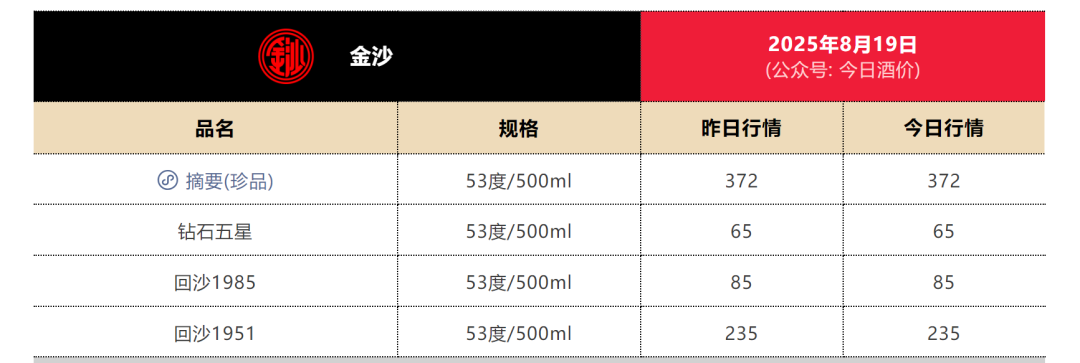
Core Insights - The acquisition of Jinsha Liquor by China Resources Beer for over 12.3 billion yuan in 2022 has faced significant scrutiny as the expected growth has not materialized [1][2] - In the first half of 2025, the revenue from the liquor business was only 7.81 billion yuan, with a pre-tax loss of 1.52 billion yuan, indicating a stark decline in performance [1][6] Financial Performance - For the first half of 2025, China Resources Beer reported a revenue increase of 0.8% to 23.942 billion yuan and a net profit increase of 23.0% to 5.789 billion yuan [1] - Jinsha Liquor's revenue for 2023 was 20.83 billion yuan, with a pre-tax profit of 1.3 billion yuan [3] - In 2024, Jinsha Liquor's revenue slightly increased by 3.7% to 21.61 billion yuan, but pre-tax profit decreased by 6.9% to 1.21 billion yuan [5] Market Challenges - The liquor business has been adversely affected by declining consumer demand and increased competition due to excessive production capacity in the sauce liquor segment [6] - The core product "Zhai Yao" has seen a significant price drop, with wholesale prices falling over 800 yuan per bottle since the beginning of the year [7] Strategic Misalignment - The attempt to replicate the fast-moving consumer goods model from the beer industry to the liquor sector has been criticized for overlooking fundamental differences in consumer behavior and market dynamics [11] - The acquisition of Jinsha Liquor and investment in other liquor companies occurred at a peak in the market, leading to challenges as the industry faced a downturn post-2021 [12] Recommendations for Future Strategy - To address the ongoing challenges, it is suggested that China Resources Beer may need to divest from consistently underperforming assets and focus on building a specialized team for Jinsha Liquor to enhance brand culture and consumer engagement [12]