
TENCENT(00700)

Search documents
微信:2025年全球跨境与境外用户使用小程序次数突破50亿次
Xin Lang Cai Jing· 2026-01-20 11:38
Core Insights - WeChat's official account announced that by 2025, global cross-border and overseas users will exceed 5 billion uses of mini-programs [1][3] - WeChat mini-program services have expanded to cover 100 countries and regions globally, with cross-border payments available in 78 countries and supporting 36 currencies [1][3] - The transaction amount completed through mini-programs in the second half of 2025 is expected to grow by over 70% year-on-year [1][3] User Growth and Demographics - Chinese outbound users' transaction amounts via mini-programs have increased by 60% year-on-year, with significant potential seen in the 35-55 age group [1][3] - Monthly transaction counts for transportation mini-programs have surged by over 140%, while restaurant services have seen a growth of over 50% [1][3] - Mini-program services now span across 108 different industry segments [1][3] Regional Performance - Rapid growth has been observed in regions such as Malaysia, Singapore, Italy, and France, with Malaysia's monthly transaction counts increasing by over 90% and Singapore by 80% [1][3] - Italy has experienced an explosive growth in monthly transaction amounts, achieving over 300% increase [1][3] Local User Engagement - Local users overseas have shown a 70% year-on-year increase in transaction amounts, while inbound users have seen a 50% increase [1][3] Payment Features - WeChat has introduced features allowing overseas users to make payments directly within mini-programs using international credit cards like Visa and Mastercard, as well as local e-wallets such as PayNow and Bank of China Macau [1][3] New Marketing Initiatives - WeChat Pay has launched a "Social Rebates" feature, which helps merchants convert each transaction into new traffic growth points, significantly enhancing new customer acquisition efficiency [2][4]

北水动向|北水成交净买入36.63亿 泡泡玛特时隔两年回购 北水抢筹超3亿港元
智通财经网· 2026-01-20 11:07
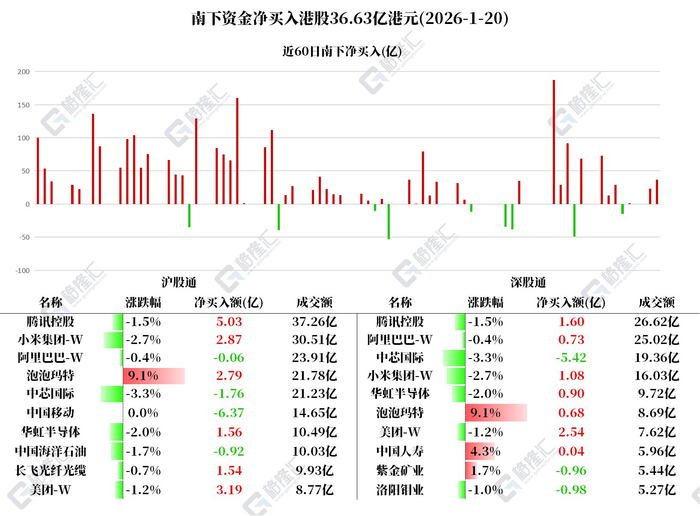
Group 1 - The core point of the news is that the Hong Kong stock market saw significant net buying from northbound capital, totaling HKD 36.63 billion, with Tencent, Meituan, and Xiaomi being the most purchased stocks [2][6] - Tencent Holdings (00700) had a net inflow of HKD 5.03 billion, with total buy and sell amounts of HKD 21.15 billion and HKD 16.12 billion respectively [3][5] - Meituan (03690) recorded a net inflow of HKD 3.19 billion, with total buy and sell amounts of HKD 5.98 billion and HKD 2.79 billion respectively [3][6] Group 2 - Semiconductor stocks showed divergence, with Hua Hong Semiconductor (01347) receiving a net inflow of HKD 2.45 billion, while SMIC (00981) faced a net outflow of HKD 7.17 billion [7] - The report from Open Source Securities indicated that TSMC raised its capital expenditure forecast significantly, reflecting strong long-term demand driven by AI [7] - Long-distance fiber optic cable stocks like Changfei Optical Fiber (06869) saw a net inflow of HKD 1.54 billion, supported by rising prices in the G.652.D fiber market [7] Group 3 - Xiaomi Group-W (01810) received a net inflow of HKD 3.95 billion, while China Mobile (00941) faced a net outflow of HKD 6.37 billion [8] - The report from Bank of America noted that the growth in metal demand is no longer cyclical, as economies are restructuring their energy infrastructure [8] - The sentiment around resource competition is affecting copper prices, which may remain volatile in the short term [8]





智通港股通活跃成交|1月20日
智通财经网· 2026-01-20 11:01
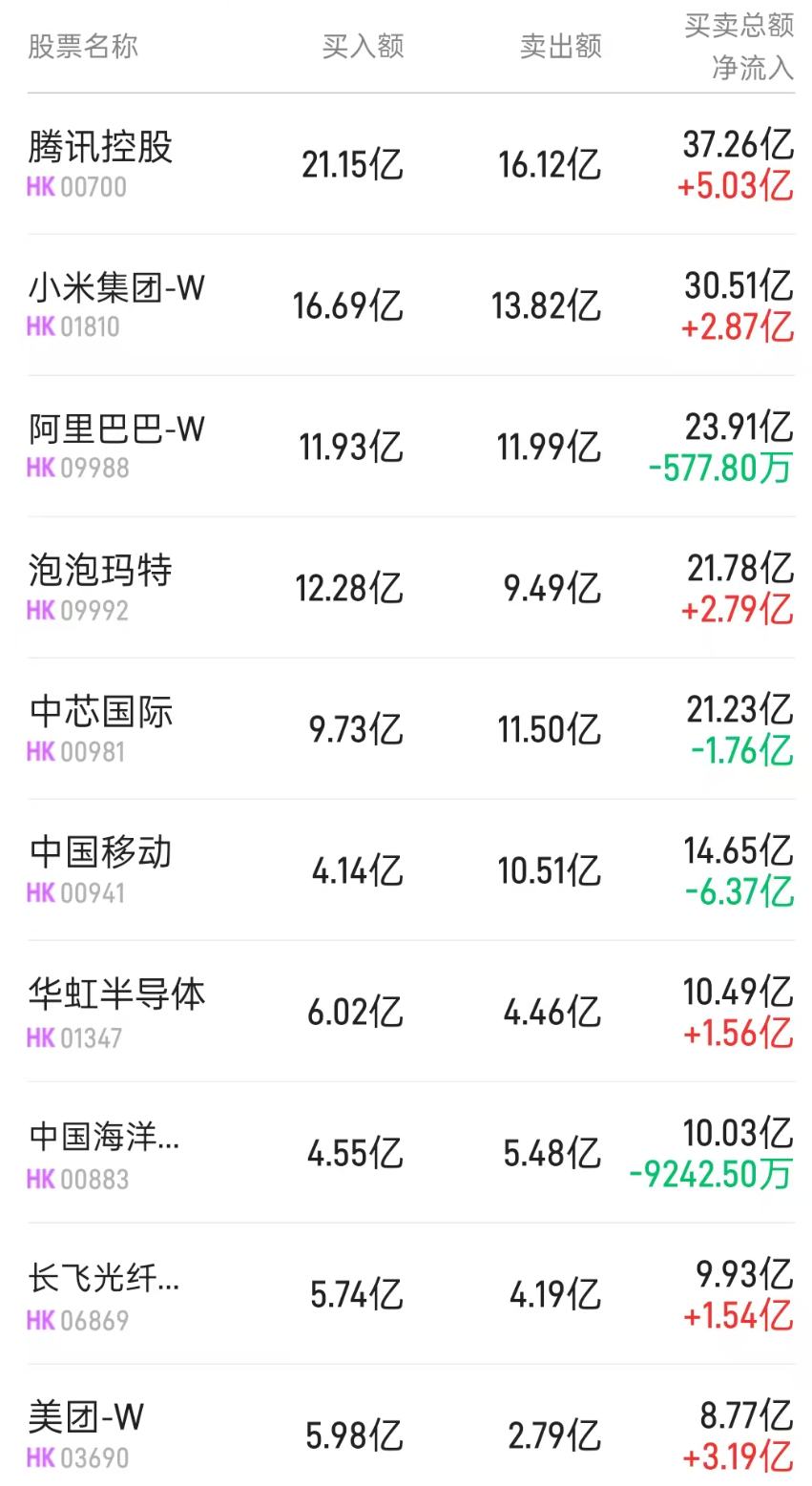
Core Insights - On January 20, 2026, Tencent Holdings (00700), Xiaomi Group-W (01810), and Alibaba-W (09988) were the top three companies by trading volume in the Southbound Stock Connect, with trading amounts of 3.726 billion, 3.051 billion, and 2.391 billion respectively [1] - In the Shenzhen-Hong Kong Stock Connect, Tencent Holdings (00700), Alibaba-W (09988), and SMIC (00981) led the trading volume, with amounts of 2.662 billion, 2.502 billion, and 1.936 billion respectively [1] Southbound Stock Connect Trading Activity - The top active companies in the Southbound Stock Connect included: - Tencent Holdings (00700) with a trading amount of 3.726 billion and a net buying amount of +0.503 billion [2] - Xiaomi Group-W (01810) with a trading amount of 3.051 billion and a net buying amount of +0.287 billion [2] - Alibaba-W (09988) with a trading amount of 2.391 billion and a net selling amount of -5.778 million [2] - Other notable companies included Pop Mart (09992) and SMIC (00981) with trading amounts of 2.178 billion and 2.123 billion respectively [2] Shenzhen-Hong Kong Stock Connect Trading Activity - The top active companies in the Shenzhen-Hong Kong Stock Connect included: - Tencent Holdings (00700) with a trading amount of 2.662 billion and a net buying amount of +0.160 billion [2] - Alibaba-W (09988) with a trading amount of 2.502 billion and a net buying amount of +7.257 million [2] - SMIC (00981) with a trading amount of 1.936 billion and a net selling amount of -5.420 billion [2] - Other notable companies included Xiaomi Group-W (01810) with a trading amount of 1.603 billion and a net buying amount of +0.108 billion [2]



中国互联网大厂的AI时代船票争夺战已经开始了
创业邦· 2026-01-20 10:46
Core Viewpoint - The article discusses the intense competition among major tech companies for "entry points" in the AI era, highlighting the need for a new type of "ticket" that encompasses model capabilities, infrastructure, and user interaction [6][7]. Group 1: ByteDance - ByteDance is identified as the first company to understand and implement the new structure of the "ticket," effectively becoming a "First Mover" in the AI era [9]. - ByteDance's model capabilities are underestimated; its models are primarily used internally and have undergone extensive real-world testing, processing over 50 trillion tokens daily [9][10]. - The company's "All-in-One" model strategy integrates various capabilities into a single foundational model, enhancing cross-modal understanding [9][10]. - The success of Doubao, which recently surpassed 100 million daily active users, indicates that chat remains a key entry point for super applications in the AI era [11]. Group 2: Alibaba - Alibaba possesses strong foundational capabilities in models and cloud services, holding over 35% of the AI cloud service market share in China [14][15]. - However, Alibaba lacks a compelling consumer-facing entry point akin to Doubao, which limits its ability to capture user engagement in the new interaction paradigm [14][15]. - The company aims to capture 80% of the future AI market, focusing on both traditional enterprise transformations and new AI-native businesses [15][16]. - Alibaba's challenge lies in breaking away from traditional business models to create a new, integrated commercial model that delivers user value effectively [16]. Group 3: Tencent - Tencent's position is more complex, as it holds the influential WeChat platform but struggles to adapt to the AI era's demands [18][21]. - The company is currently in a catch-up position regarding model capabilities and infrastructure, which limits its competitive edge [21][22]. - WeChat, while a significant asset, may not serve as an effective AI-native entry point due to its inherent privacy and user expectation constraints [21][22]. - Tencent's approach appears cautious, focusing on cost reduction and efficiency rather than groundbreaking innovation, raising questions about its future adaptability in the AI landscape [21][22]. Group 4: Industry Dynamics - The competition has evolved from merely possessing large models to understanding how to deliver user value in the AI era [24]. - The market potential driven by AI is projected to exceed ten times the existing IT budget, indicating a significant shift in productivity and resource allocation [24]. - The article emphasizes that the battle is no longer about individual apps but rather about interaction paradigms, fulfillment capabilities, and system integration [24].

图解丨南下资金连续10日净买入腾讯,连续12日净卖出中国移动
Ge Long Hui A P P· 2026-01-20 10:07
Group 1 - Southbound funds net bought Hong Kong stocks worth HKD 3.663 billion today [1] - The top net purchases included Tencent Holdings at HKD 663 million, Meituan-W at HKD 573 million, and Xiaomi Group-W at HKD 395 million [1] - Continuous net buying trends were observed for Tencent over 10 days totaling HKD 10.62116 billion and Alibaba over 7 days totaling HKD 4.75655 billion [1] Group 2 - Southbound funds net sold shares of SMIC at HKD 717 million and China Mobile at HKD 637 million [1] - China Mobile has seen continuous net selling for 12 days, amounting to HKD 9.29936 billion [1] - Hua Hong Semiconductor and Xiaomi also experienced net buying trends over multiple days, with Hua Hong totaling HKD 1.33901 billion over 4 days and Xiaomi HKD 1.42914 billion over 3 days [1]
北水动向|北水成交净买入36.63亿 泡泡玛特(09992)时隔两年回购 北水抢筹超3亿港元
智通财经网· 2026-01-20 10:01
Core Viewpoint - The Hong Kong stock market experienced significant net inflows from northbound trading, with a total net buy of HKD 36.63 billion on January 20, 2023, indicating strong investor interest in certain stocks [1]. Group 1: Net Buying and Selling Activities - Tencent (00700) received the highest net buy of HKD 21.15 billion, with a total trading volume of HKD 37.26 billion, reflecting a net inflow of HKD 5.03 billion [2]. - Meituan-W (03690) saw a net buy of HKD 16.69 billion, with a total trading volume of HKD 30.51 billion, resulting in a net inflow of HKD 2.87 billion [2]. - Xiaomi Group-W (01810) had a net buy of HKD 3.95 billion, contributing to the overall positive sentiment in the tech sector [7]. - Conversely, SMIC (00981) faced the largest net sell of HKD 9.73 billion, with a total trading volume of HKD 21.23 billion, indicating a net outflow of HKD 1.76 billion [2]. - China Mobile (00941) also experienced significant net selling, with a net outflow of HKD 6.37 billion [7]. Group 2: Sector Insights and Market Trends - The technology sector, particularly companies like Tencent, Meituan, and Alibaba, is seeing increased investment interest, driven by expectations of growth in AI and cloud computing [4]. - The semiconductor sector showed divergence, with Hua Hong Semiconductor (01347) receiving a net buy of HKD 2.45 billion, while SMIC faced a net sell of HKD 7.17 billion, reflecting varying investor confidence [5]. - The optical fiber and cable industry is experiencing a price recovery, with Longi Optical Fiber (06869) receiving a net buy of HKD 1.54 billion, supported by rising market prices for G.652.D optical fibers [5]. - The mining sector, particularly Zijin Mining (02899) and Luoyang Molybdenum (03993), faced net selling pressures, attributed to changing market sentiments regarding metal demand and supply dynamics [6].
【全球招募】用AI唤醒千年文明!探元计划NextGen数智活化赛道:五大文化场景等您“揭榜挂帅”
腾讯研究院· 2026-01-20 09:53
Core Viewpoint - The article emphasizes the integration of advanced technologies like AI to revitalize cultural heritage and enhance public engagement with historical narratives and experiences [2][56]. Group 1: Cultural Revitalization through Technology - The initiative aims to create immersive experiences that allow users to interact with cultural heritage, such as AI-generated historical narratives and personalized experiences [2][5]. - The "NextGen" plan by Tencent focuses on leveraging cutting-edge technologies to address the challenges of cultural heritage revitalization, aiming to create new forms of expression and engagement [5][56]. Group 2: Specific Topics and Challenges - The program identifies three main topics for innovation: 1. Development of multi-modal intelligent agents for cultural content generation [5]. 2. Creation of immersive interactive experiences that combine sensory data and emotional computing [6]. 3. Human-machine collaboration for the transmission and development of traditional crafts through digital means [7]. Group 3: Specific Cultural Scenarios - Five specific cultural scenarios have been outlined for technological application: 1. "Cloud Residence Intelligent Companion" for enhancing public understanding of historical texts [8][9]. 2. "Hangzhou West Lake Experience" focusing on personalized immersive tourism experiences [15][16]. 3. "Dawenkou Culture Interactive Experience" to facilitate understanding of ancient pottery techniques [19]. 4. "Bridge Wisdom Transmission" for teaching traditional wooden bridge construction techniques [29]. 5. "Cantonese Lion Dance Digital Activation" to enhance interaction and experience in traditional performances [36]. Group 4: Collaboration and Support - The initiative invites global technology teams to collaborate with cultural institutions to propose innovative solutions, with funding and resources available for selected projects [43][52]. - The project will undergo a structured process from proposal submission to implementation, ensuring thorough evaluation and support [48][50].

港股20日跌0.29% 收报26487.51点
Xin Hua Wang· 2026-01-20 09:51
Market Overview - The Hang Seng Index fell by 76.39 points, a decrease of 0.29%, closing at 26,487.51 points [1] - The total turnover on the main board was HKD 2,377.66 million [1] - The National Enterprises Index dropped by 39.69 points, closing at 9,094.76 points, a decline of 0.43% [1] - The Hang Seng Tech Index decreased by 66.54 points, closing at 5,683.44 points, a drop of 1.16% [1] Blue-Chip Stocks - Tencent Holdings decreased by 1.48%, closing at HKD 601 [1] - Hong Kong Exchanges and Clearing fell by 1.11%, closing at HKD 427 [1] - China Mobile remained unchanged, closing at HKD 79.3 [1] - HSBC Holdings increased by 1.1%, closing at HKD 128.4 [1] Local Hong Kong Stocks - Cheung Kong Holdings rose by 0.74%, closing at HKD 43.34 [1] - Sun Hung Kai Properties decreased by 0.99%, closing at HKD 110.2 [1] - Henderson Land Development increased by 0.52%, closing at HKD 31.12 [1] Chinese Financial Stocks - Bank of China fell by 0.45%, closing at HKD 4.47 [1] - China Construction Bank decreased by 0.51%, closing at HKD 7.76 [1] - Industrial and Commercial Bank of China dropped by 0.47%, closing at HKD 6.31 [1] - Ping An Insurance rose by 0.88%, closing at HKD 69 [1] - China Life Insurance increased by 4.31%, closing at HKD 33.4 [1] Oil and Petrochemical Stocks - China Petroleum & Chemical Corporation fell by 0.61%, closing at HKD 4.92 [1] - China National Petroleum Corporation decreased by 0.12%, closing at HKD 8.21 [1] - CNOOC Limited dropped by 1.74%, closing at HKD 21.52 [1]




腾讯控股(00700):4Q广告预期稳健增长,AI小程序加码布局
HTSC· 2026-01-20 06:42
Investment Rating - The report maintains a "Buy" rating for Tencent with a target price of 792 HKD [6][5][28] Core Insights - Tencent's revenue for Q4 2025 is expected to grow by 13% year-on-year, with adjusted net profit projected to increase by 16% to 643 billion RMB [1] - Key growth drivers include the launch of multiple new games, improved advertising efficiency through AI, and enhanced support for AI mini-programs on WeChat [1][3][4] - The gaming segment is anticipated to see a 16% increase in revenue, while advertising revenue is expected to rise by 20% [2][4] Summary by Relevant Sections Gaming Business - Tencent's gaming revenue for Q4 is projected to grow by 16%, with the new game "Counter-Strike: Future" expected to generate 35-70 billion RMB in its first year [2][12] - The game fills a gap in Tencent's PVE shooting game offerings and has already achieved over 10 million players shortly after launch [2][12][16] Financial Technology - Financial technology revenue is expected to grow by 9%, driven by a slowdown in social retail growth [3] - AI mini-programs are anticipated to enhance e-commerce and local services, with significant growth expected in 2026 [3][19] Advertising Revenue - Advertising revenue is projected to increase by 20%, driven by budget increases from long-tail advertisers and efficiency improvements from AI [4] - WeChat's advertising capabilities are evolving, with new features aimed at enhancing social commerce [4][19] Profit Forecast and Valuation - Revenue forecasts for Tencent have been slightly adjusted downwards for 2025-2027, with adjusted net profit estimates also revised [5][24] - The target price of 792 HKD corresponds to a PE ratio of 21.6 for 2026, reflecting a slight decrease from previous estimates [5][28][30]
高盛:腾讯控股、网易-S及快手-W等为内地游戏与娱乐股核心
Zhi Tong Cai Jing· 2026-01-20 06:38
Core Insights - Goldman Sachs reports that the Chinese gaming and entertainment sector experienced significant stock price increases in 2025, with large and mid-cap stocks rising by 50% to 80% compared to the Hang Seng China Enterprises Index's 26% [1] - The report indicates that the strong performance is driven equally by valuation expansion and earnings per share growth [1] - Looking ahead to 2026, the firm believes the risk-reward profile remains attractive, with a focus on "alpha" driven opportunities [1] Group 1: Market Trends - Chinese gaming publishers and content platforms, represented by Tencent Holdings and NetEase, are accelerating their overseas expansion, leveraging capital, talent, and technological capabilities [2] - The global market share of Chinese game manufacturers is expected to increase from the current level of approximately 15% [2] Group 2: AI Impact - AI is seen as a transformative force, reducing production and labor costs while enhancing efficiency and revenue potential, particularly in gaming and advertising sectors [2] - The total addressable market (TAM) for AI-generated film tools is projected to expand tenfold by 2028 [2] Group 3: Investment Recommendations - Goldman Sachs identifies key buy stocks including Tencent, NetEase, Kuaishou, Bilibili, and Tencent Music, with Tencent's core business expected to maintain low to mid-double-digit growth annually [2] - The firm maintains a "buy" rating on Tencent, lowering the target price from HKD 770 to HKD 752 [2]



