
KUAISHOU(01024)

Search documents
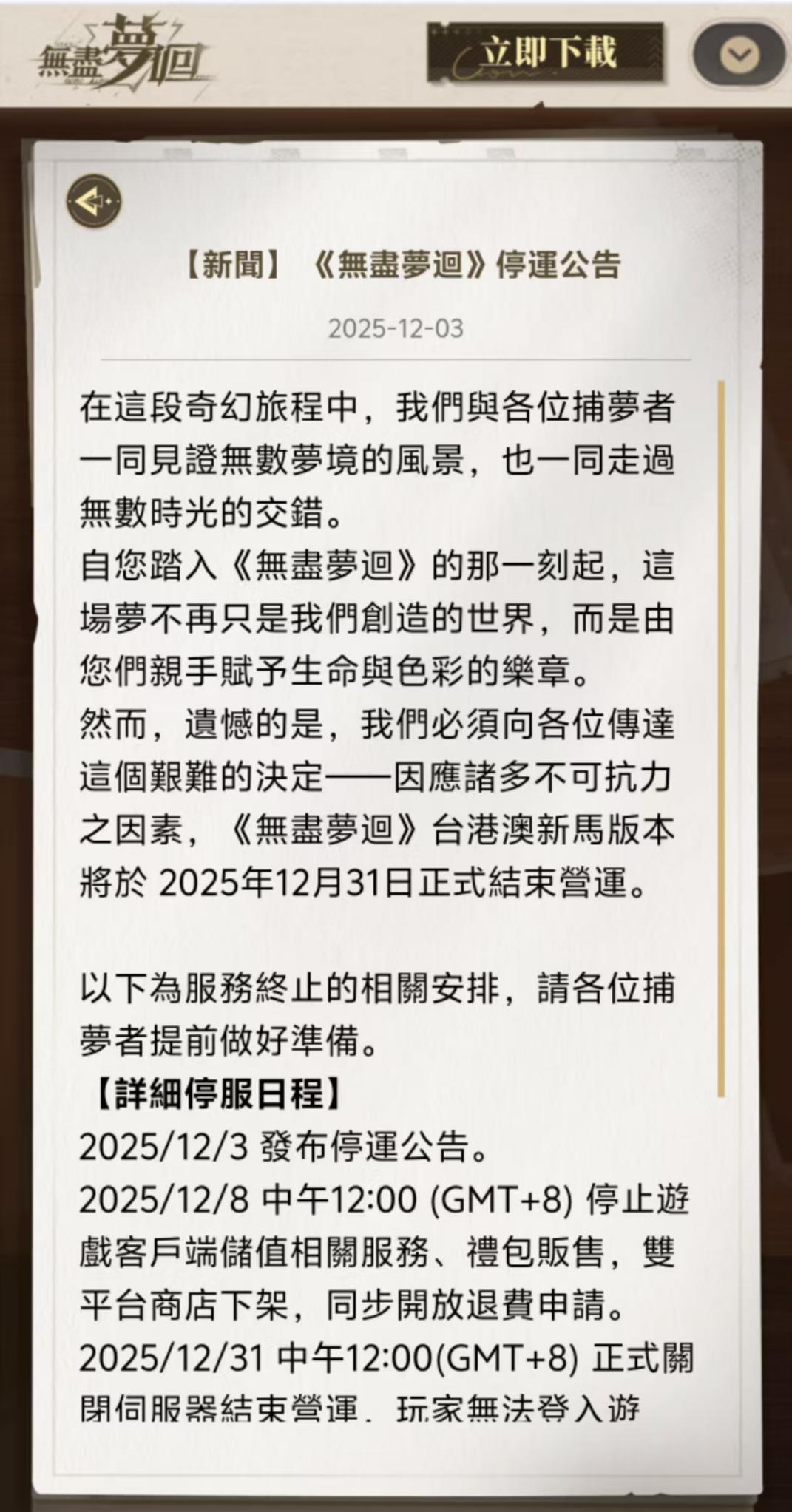
《无尽梦回》外服上线半年停运,快手游戏可打的牌不多了
Xin Lang Cai Jing· 2025-12-10 02:44
Core Insights - The game "Endless Dream Return" will officially shut down its servers on December 31, 2025, just six months after its launch on May 8, 2025 [3] - The game, developed by Kuaishou's self-developed game brand, received significant attention upon its release but faced mixed reviews due to gameplay and gacha mechanics [5][7] - The game struggled to find a balance between long-term character development and the immediate satisfaction typically associated with roguelike gameplay, leading to a decline in player engagement [7][8] Company Performance - Kuaishou's self-developed game brand, Danzhi Universe, launched "Endless Dream Return" on November 21, 2024, reaching a peak of 33rd on the iOS sales chart within two days [5] - The last content update for the game occurred on April 17, 2025, prior to the launch of the Taiwan, Hong Kong, Macau, and Singapore version, indicating a lack of ongoing support [10] - The company has faced challenges with other titles, such as "Super Time Run," which also experienced a lack of updates and engagement similar to "Endless Dream Return" [14][16] Industry Context - The game industry is witnessing a shift where long-term mobile games must balance character development with immediate gameplay satisfaction, a challenge highlighted by "Endless Dream Return" [7][8] - The upcoming title "The Secret Master," based on a popular web novel, is seen as a critical project for Kuaishou, with significant resources allocated to its development [20][22] - The company has undergone layoffs and resource reallocation, focusing on "The Secret Master" as a potential turnaround project amidst declining performance of other titles [22]


智通港股沽空统计|12月10日
智通财经网· 2025-12-10 00:25
Group 1 - The top short-selling stocks include Sun Hung Kai Properties-R (80016), China Resources Beer-R (80291), and AIA Group-R (81299), all with a short-selling ratio of 100.00% [1][2] - The highest short-selling amounts are from Xiaomi Group-W (01810) at 2.161 billion, Alibaba-SW (09988) at 793 million, and Tencent Holdings (00700) at 733 million [1][2] - The highest deviation values are from China Resources Beer-R (80291) at 39.83%, followed by Jianfa Property (02156) at 37.09%, and AIA Group-R (81299) at 35.65% [1][2] Group 2 - The top ten short-selling ratio rankings show that all stocks listed have significant short-selling activity, with Anta Sports-R (82020) also at 100.00% [2] - The top ten short-selling amounts highlight Xiaomi Group-W leading significantly, with a short-selling ratio of 28.48% [2] - The top ten deviation values indicate that China Resources Beer-R (80291) has the highest deviation, suggesting a notable difference from its historical short-selling average [2]



“短剧+电商” 开启消费新场景
Mei Ri Shang Bao· 2025-12-09 23:11
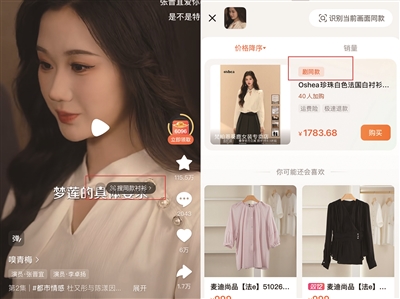
Core Insights - The integration of "short dramas + e-commerce" is creating a new commercial ecosystem, driven by emotional resonance and instant consumption models, which is becoming a new engine for platform economic growth [2][3] Group 1: Short Drama and E-commerce Integration - The "search for similar items" feature allows viewers to purchase clothing worn by characters in short dramas, enhancing the shopping experience [2] - Major platforms like Kuaishou and Taobao are increasingly collaborating with e-commerce to create immersive shopping experiences during short drama viewings [3] - The unique advantages of short dramas for product promotion include higher user acceptance compared to traditional live-streaming sales, leveraging the existing fan base of actors [3] Group 2: Market Trends and Consumer Behavior - The current market environment is pushing e-commerce platforms to seek new traffic sources and consumption scenarios due to more rational consumer behavior during events like Double Eleven [4] - The average daily usage time for micro-short dramas has increased by 25.9% to 120.5 minutes in the first eight months of this year, indicating high engagement [4] - The "short drama + e-commerce" model is seen as a necessary evolution for both industries, with e-commerce needing quality content to drive demand and short dramas seeking to expand beyond traditional revenue models [4] Group 3: Challenges Ahead - Despite the promising integration, short drama e-commerce is still in its early stages, facing challenges such as content adaptation and the degree of integration between content and commerce [5]


智通ADR统计 | 12月10日





智通财经网· 2025-12-09 22:27
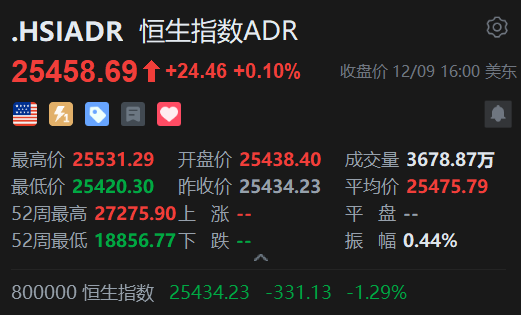
Market Overview - The Hang Seng Index (HSI) closed at 25,458.69, up by 24.46 points or 0.10% from the previous close [1] - The index experienced a trading range with a high of 25,531.29 and a low of 25,420.30, with a trading volume of 36.788 million shares [1] Major Blue-Chip Stocks Performance - HSBC Holdings closed at HKD 110.181, reflecting an increase of 0.62% compared to the Hong Kong close [2] - Tencent Holdings closed at HKD 601.643, showing a slight decline of 0.14% from the Hong Kong close [2] Stock Price Movements - Tencent Holdings: Latest price HKD 602.500, down by HKD 2.500 or 0.41% [3] - Alibaba Group: Latest price HKD 150.900, down by HKD 2.500 or 1.63% [3] - HSBC Holdings: Latest price HKD 109.500, up by HKD 0.400 or 0.37% [3] - China Construction Bank: Latest price HKD 7.610, down by HKD 0.050 or 0.65% [3] - Xiaomi Group: Latest price HKD 41.260, down by HKD 1.320 or 3.10% [3] - AIA Group: Latest price HKD 77.250, down by HKD 0.650 or 0.83% [3] - Meituan: Latest price HKD 97.350, down by HKD 2.150 or 2.16% [3] - Industrial and Commercial Bank of China: Latest price HKD 6.120, up by HKD 0.010 or 0.16% [3] - Hong Kong Exchanges and Clearing: Latest price HKD 401.200, down by HKD 3.400 or 0.84% [3] - Ping An Insurance: Latest price HKD 60.750, down by HKD 1.000 or 1.62% [3] - Ctrip Group: Latest price HKD 539.500, down by HKD 5.000 or 0.92% [3] - Baidu Group: Latest price HKD 121.400, down by HKD 4.400 or 3.50% [3] - JD Group: Latest price HKD 114.900, down by HKD 1.300 or 1.12% [3]
AI趋势下,互联网龙头攻防兼备!高“含BA量”港股互联网ETF(513770)、香港大盘30ETF(520560)获资金关注
Xin Lang Cai Jing· 2025-12-09 11:37
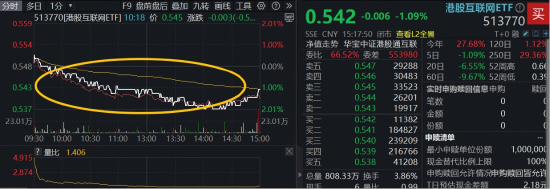
Market Overview - On December 9, Hong Kong stocks experienced volatility, with the Hang Seng Index and Hang Seng Tech Index falling by 1.29% and 1.9% respectively [1][8] - Major tech stocks saw collective declines, with Xiaomi Group-W down over 3%, Kuaishou-W and Meituan-W down over 2%, Alibaba-W down over 1%, and Tencent Holdings stabilizing at a 0.41% drop [1][8] ETF Performance - The Hong Kong Internet ETF (513770), a key tool for AI investment, saw a price drop of 1.09%, while the Hong Kong Large Cap 30 ETF (520560) fell by 1.37% [1][8] - Both ETFs experienced significant premium trading, indicating active buying interest during price dips [1][8] Investment Insights - The approval by Trump for Nvidia to deliver H200 to Chinese clients is expected to enhance China's overall computing power supply, benefiting domestic cloud service providers and promoting AI applications among companies like Tencent and Alibaba [3][10] - Analysts remain optimistic about the internet sector's cyclical properties combined with the upward trend in AI, suggesting that major players will likely lead any technological advancements [3][10] - The upcoming Federal Reserve interest rate decision is anticipated to be a "hawkish rate cut," which may temporarily suppress Hong Kong stock rebounds but could enhance the long-term investment appeal of the tech sector [3][10] Fund Inflows - Recent data indicates significant capital inflows into the Hong Kong Internet ETF (513770) and the Hong Kong Large Cap 30 ETF (520560), with net inflows of 164 million and 35.16 million respectively [4][11] - The top holdings in these ETFs include Alibaba-W and Tencent Holdings, with respective weights of 18.74% and 14.84% for the Internet ETF, and 16.74% and 14.89% for the Large Cap ETF [4][11] ETF Characteristics - The Hong Kong Internet ETF (513770) tracks the CSI Hong Kong Internet Index, which heavily invests in leading internet companies, with over 73% of its top 10 holdings focused on AI cloud computing and applications [6][13] - The fund has a scale exceeding 10 billion, with an average daily trading volume of over 600 million, providing good liquidity and supporting T+0 trading without QDII restrictions [6][14] - The Hong Kong Large Cap 30 ETF (520560) employs a "technology + dividend" strategy, balancing high-growth tech stocks with stable dividend-paying companies, making it an ideal long-term investment tool [6][14]


大华继显:料快手-W可灵AI 2026年的收入贡献将高于预期 维持“买入”评级
Zhi Tong Cai Jing· 2025-12-09 08:43
报告表示,快手目前拥有充足的GPU资源及公司预期2025年资本支出将同比增至中高双位数,至140亿 元人民币。大华继续又预测,可灵2025及2026年收入分别为1.4亿及2.4亿美元。对于在线营销内容生 成,可灵AI的大模型显著降低了客户的视频制作成本。 大华继显发布研报称,预计快手-W(01024)可灵AI 2026年的收入贡献将高于预期,因其仍专注于用户量 增长而非盈利能力。该行认为快手在变现进展上的强劲表现将在竞争环境中形成护城河。维持快手"买 入"评级,及目标价88港元。 ...
大华继显:料快手-W(01024)可灵AI 2026年的收入贡献将高于预期 维持“买入”评级
智通财经网· 2025-12-09 08:37
智通财经APP获悉,大华继显发布研报称,预计快手-W(01024)可灵AI 2026年的收入贡献将高于预期, 因其仍专注于用户量增长而非盈利能力。该行认为快手在变现进展上的强劲表现将在竞争环境中形成护 城河。维持快手"买入"评级,及目标价88港元。 报告表示,快手目前拥有充足的GPU资源及公司预期2025年资本支出将同比增至中高双位数,至140亿 元人民币。大华继续又预测,可灵2025及2026年收入分别为1.4亿及2.4亿美元。对于在线营销内容生 成,可灵AI的大模型显著降低了客户的视频制作成本。 ...
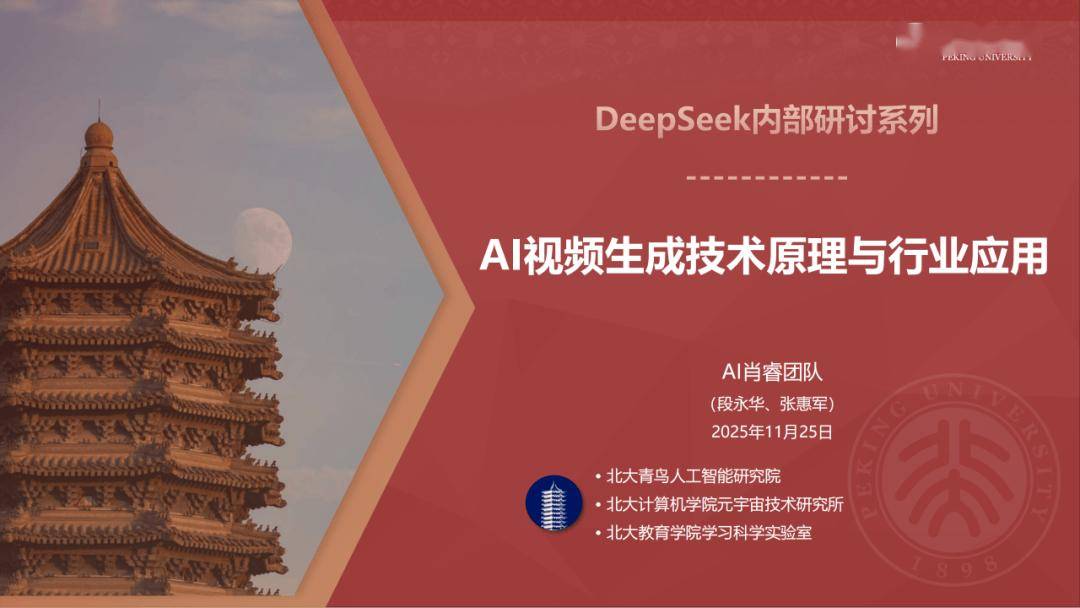
北京大学:AI视频生成技术原理与行业应用 2025
Sou Hu Cai Jing· 2025-12-09 06:48
Group 1: AI Video Technology Overview - AI video technology is a subset of narrow AI focused on generative tasks such as video generation, editing, and understanding, with typical methods including text-to-video and image-to-video [1] - The evolution of technology spans from the exploration of GANs before 2016 to the commercialization of diffusion models from 2020 to 2024, culminating in the release of Sora in 2024, marking the "AI Video Year" [1] Group 2: Main Tools and Platforms - Key platforms include OpenAI Sora, Kuaishou Keling AI, ByteDance Jimeng AI, Runway, and Pika, each offering unique features in terms of duration, quality, and style [2] Group 3: Technical Principles and Architecture - The mainstream paradigm is the diffusion model, which is stable in training and offers strong generation diversity, with architectures categorized into U-Net and DiT [3] - Key components include the self-attention mechanism of Transformers for temporal consistency, VAE for compression, and CLIP for semantic alignment between text and visuals [3] Group 4: Data Value and Training - The scale, quality, and diversity of training data determine the model's upper limits, with prominent datasets including WebVid-10M and UCF-101 [4] Group 5: Technological Advancements and Breakthroughs - Mainstream models can generate videos at 1080p/4K resolution and up to 2 minutes in length, with some models supporting native audio-visual synchronization [5] - Existing challenges include temporal consistency, physical logic, and emotional detail expression, alongside computational cost constraints [5] - Evaluation frameworks like VBench and SuperCLUE have been established, focusing on "intrinsic authenticity" [5] Group 6: Industry Applications and Value - In the film and entertainment sector, AI is involved in the entire production process, leading to cost reductions and efficiency improvements [6] - The short video and marketing sectors utilize AI for rapid content generation, exemplified by Xiaomi's AI glasses advertisement [6] - In the cultural tourism industry, AI is used for city promotional videos and immersive experiences [7] - In education, AI facilitates the bulk generation of micro-course videos and personalized learning content [8] - In news media, AI virtual anchors enable 24-hour reporting, though ethical challenges regarding content authenticity persist [9] Group 7: Tool Selection Recommendations - Recommendations for tool selection include using Runway or Keling AI for professional film, Jimeng AI or Pika for short video operations, and Vidu for traditional Chinese content [10] - Domestic tools like Keling and Jimeng have low barriers to entry, while overseas tools require VPN and foreign currency payments [11] - A multi-tool collaborative workflow is advised, emphasizing a "director's mindset" rather than reliance on a single platform [12] Group 8: Future Outlook - The report concludes that AI video will evolve towards a "human-machine co-creation" model, becoming a foundational infrastructure akin to the internet, with a focus on creativity and judgment [13]


研报掘金丨大华继显:料快手可灵AI2026年收入贡献将高于预期
Ge Long Hui· 2025-12-09 05:29
大华继显发报告指,预计快手(1024.HK)可灵AI2026年的收入贡献将高于预期,因其仍专注于用户量增 长而非盈利能力。该行认为快手在变现进展上的强劲表现将在竞争环境中形成护城河。报告表示,快手 目前拥有充足的GPU资源及公司预期2025年资本支出将同比增至中高双位数,至140亿元人民币。大华 继续又预测,可灵2025及2026年收入分别为1.4亿及2.4亿美元。对于在线营销内容生成,可灵AI的大模 型显著降低了客户的视频制作成本。维持快手"买入"评级,及目标价88港元。 ...
午评:港股恒指跌0.84% 科指跌1.32% 科网股普跌 黄金股承压 泡泡玛特跌超4%
Xin Lang Cai Jing· 2025-12-09 04:04
Market Overview - The Hong Kong stock market indices experienced a decline, with the Hang Seng Index falling by 0.84% to 25,549.90 points, the Hang Seng Tech Index down by 1.32%, and the National Enterprises Index decreasing by 1.12% [1][8]. Sector Performance - Technology stocks saw a broad decline, with notable drops including Xiaomi, Kuaishou, Bilibili, and Baidu, each falling over 2%, while Meituan and NetEase dropped more than 1% [1][8]. - Gold and non-ferrous metal stocks faced pressure, with Zijin Mining declining over 4% [1][8]. - The real estate sector weakened significantly, highlighted by China Jinmao's drop of over 11% [1][8]. - New consumption concept stocks continued their downward trend, with Pop Mart falling over 4% [1][8]. Economic Indicators - Market expectations indicate potential adjustments in interest rate policies by the Bank of Japan and the European Central Bank, with hawkish comments from ECB Executive Schnabel influencing market sentiment towards anticipated rate hikes next year [2][9]. - Analysts noted that the market has largely priced in the Federal Reserve's expected rate cuts, but there are indications that the threshold for further cuts may be raised [2][9]. Investment Insights - Morgan Stanley suggests a selective investment strategy, highlighting a clear risk differentiation in China's credit market: the TMT sector shows strong quality, while state-owned enterprises are stable but have tight valuations, and the real estate sector remains challenging [5][11]. - The real estate market is not expected to stabilize until 2025, with ongoing declines in sales and investment [5][11]. - Vanke's efforts to extend domestic bond maturities have led to significant drops in both offshore and onshore bond prices, raising concerns about the financing environment for private developers [5][11].



