KUAISHOU(01024)

Search documents
智通港股通资金流向统计(T+2)|8月28日
智通财经网· 2025-08-27 23:32
Key Points - The top three companies with net inflows of southbound funds are Alibaba-W (09988) with 581 million, Kangfang Biotech (09926) with 541 million, and Hong Kong Stock Exchange (00388) with 434 million [1] - The top three companies with net outflows of southbound funds are Yingfu Fund (02800) with -2.396 billion, Xiaomi Group-W (01810) with -1.524 billion, and SMIC (00981) with -845 million [1] - In terms of net inflow ratios, the top three companies are Quan Feng Holdings (02285) at 51.60%, Sen Song International (02155) at 49.91%, and GX China (03040) at 43.94% [1] - The top three companies with the highest net outflow ratios are Yihai International (01579) at -51.63%, Zhou Hei Ya (01458) at -49.54%, and Kangji Medical (09997) at -46.09% [1] Net Inflow Rankings - Alibaba-W (09988) had a net inflow of 581 million, representing a 2.88% increase in closing price to 124.500 [2] - Kangfang Biotech (09926) saw a net inflow of 541 million, with a closing price of 169.500, down 4.18% [2] - Hong Kong Stock Exchange (00388) experienced a net inflow of 434 million, closing at 462.800, up 3.30% [2] - Kuaishou-W (01024) had a net inflow of 428 million, closing at 78.750, up 5.14% [2] - Horizon Robotics-W (09660) recorded a net inflow of 401 million, closing at 7.760, up 1.31% [2] Net Outflow Rankings - Yingfu Fund (02800) had the largest net outflow of -2.396 billion, with a closing price of 26.360, up 2.01% [2] - Xiaomi Group-W (01810) experienced a net outflow of -1.524 billion, closing at 53.500, up 1.81% [2] - SMIC (00981) saw a net outflow of -845 million, with a closing price of 57.800, up 1.58% [2] - CNOOC (00883) had a net outflow of -708 million, closing at 18.830, up 0.53% [2] - Pop Mart (09992) recorded a net outflow of -418 million, closing at 326.600, up 1.94% [2] Net Inflow Ratio Rankings - Quan Feng Holdings (02285) had a net inflow ratio of 51.60%, with a net inflow of 24.33 million, closing at 24.300, up 5.29% [3] - Sen Song International (02155) recorded a net inflow ratio of 49.91%, with a net inflow of 54.68 million, closing at 10.900, up 1.68% [3] - GX China (03040) had a net inflow ratio of 43.94%, with a net inflow of 1.29 million, closing at 37.820, up 2.55% [3] Net Outflow Ratio Rankings - Yihai International (01579) had a net outflow ratio of -51.63%, with a net outflow of -69.47 million, closing at 14.780, up 4.23% [3] - Zhou Hei Ya (01458) recorded a net outflow ratio of -49.54%, with a net outflow of -20.12 million, closing at 2.570, up 2.80% [3] - Kangji Medical (09997) had a net outflow ratio of -46.09%, with a net outflow of -30.83 million, closing at 8.680, up 0.35% [3]





快手游戏《三国望神州》开启新一轮测试;英雄游戏《二重螺旋》开启App Store预订|游戏早参
Mei Ri Jing Ji Xin Wen· 2025-08-27 23:12
Group 1 - The core viewpoint of the news is that game companies are actively addressing player concerns and optimizing their game mechanics to enhance user engagement and trust [1][2][3] Group 2 - "Honor of Kings" has clarified its matchmaking mechanism, stating that historical win-loss distribution and other external honors are not considered in matchmaking, which may help improve player trust and community activity [1] - Kuaishou's game "Three Kingdoms: Looking at the World" is set to begin a new round of testing on September 4, indicating ongoing optimization in strategy and commercialization, potentially enhancing user engagement and market competitiveness [2] - Hero Game's RPG "Double Helix" has opened pre-orders on the App Store and will launch on October 28, featuring a no-gacha system and no stamina limits, which may attract player interest and strengthen the company's competitive edge [3]

智通ADR统计 | 8月28日
智通财经网· 2025-08-27 22:38
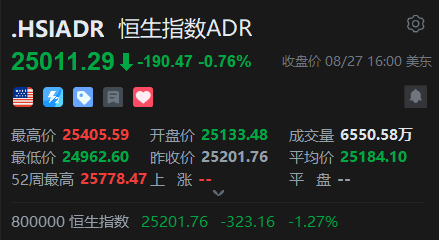
Market Overview - Major blue-chip stocks mostly declined, with HSBC Holdings closing at HKD 100.610, up 0.51% from the previous close, while Tencent Holdings closed at HKD 592.833, down 1.03% [1] Stock Performance Summary - Tencent Holdings: Decreased by HKD 10.500, or 1.72%, with an ADR price of HKD 592.833, showing a decline of HKD 6.167 or 1.03% compared to the Hong Kong stock price [2] - Alibaba Group: Increased by HKD 0.200, or 0.16%, with an ADR price of HKD 118.977, down HKD 2.523 or 2.08% compared to the Hong Kong stock price [2] - HSBC Holdings: Decreased by HKD 0.100, or 0.10%, with an ADR price of HKD 100.610, up HKD 0.510 or 0.51% compared to the Hong Kong stock price [2] - AIA Group: Decreased by HKD 1.050, or 1.43%, with an ADR price of HKD 72.011, down HKD 0.389 or 0.54% compared to the Hong Kong stock price [2] - BYD Company: Decreased by HKD 2.500, or 2.13%, with an ADR price of HKD 114.159, down HKD 0.941 or 0.82% compared to the Hong Kong stock price [2] - JD.com: Decreased by HKD 3.100, or 2.49%, with an ADR price of HKD 120.000, down HKD 1.300 or 1.07% compared to the Hong Kong stock price [2]




程一笑,还不能笑太早
Sou Hu Cai Jing· 2025-08-27 11:01
Core Insights - Kuaishou reported a 13.1% year-on-year revenue growth to 35 billion RMB in Q2 2025, with adjusted net profit increasing by 20.1% to 5.6 billion RMB, both achieving double-digit growth [2][3] - The company announced a special dividend of 0.46 HKD per share, totaling approximately 2 billion HKD, marking the first dividend distribution since its IPO, signaling confidence in profitability [2] - Kuaishou's AI business, Keling AI, generated over 250 million RMB in revenue in Q2, up from 150 million RMB in Q1, indicating accelerated commercialization [2][12] Revenue and Profit Performance - Kuaishou's average daily active users reached 409 million, a 3.4% increase year-on-year, while monthly active users grew by 3.3% to 715 million [3] - The revenue structure shows online marketing services contributed 19.8 billion RMB, live streaming 10 billion RMB, and other services (including e-commerce and Keling) 5.2 billion RMB, with respective shares of 56.4%, 28.7%, and 14.9% [6] - Live streaming revenue grew by 8.0% year-on-year to 10 billion RMB, but the growth rate slowed from 14.4% in Q1 [6][10] E-commerce Insights - Kuaishou's e-commerce GMV reached 358.9 billion RMB in Q2, a 17.6% year-on-year increase, up from 15.4% in Q1 [6][9] - The average monthly buyers in e-commerce were 134 million, showing a slight decline from 135 million in Q1 [9] - Kuaishou faces intense competition from rivals like Douyin and Alibaba, with significant gaps in GMV compared to competitors [9] AI Business Development - Keling AI's revenue in Q2 exceeded 250 million RMB, with user growth doubling from 22 million in April to 45 million by July [12][14] - The AI technology is being integrated into Kuaishou's ecosystem, enhancing operational efficiency for merchants and creators [13] - Despite the promising growth of Keling AI, its contribution to overall revenue remains minimal at 0.7%, highlighting the need for a clearer path to monetization [14] Future Outlook - Kuaishou's transition from a traffic-driven model to a technology and efficiency-driven approach is evident, with AI opening new monetization avenues [14][15] - The company's ability to enhance efficiency in its core business while scaling AI monetization will be crucial for sustainable growth [15]

把握港股通恒生科技ETF投资机遇,业绩增速显著
Xin Lang Cai Jing· 2025-08-27 10:46
Group 1: Market Fundamentals - The Hong Kong stock market is significantly influenced by the economic fluctuations in mainland China, with mainland enterprises accounting for 75% of the total market capitalization on the Hong Kong Stock Exchange [1] - Current domestic policies are focused on counter-cyclical adjustments, with expectations for increased monetary and fiscal measures to stimulate economic growth and domestic demand [1] - The emphasis on fiscal policy as a tool for stabilizing economic growth and expanding domestic demand indicates a broad space for fiscal expansion, including subsidies and tax reductions to boost consumption [1] Group 2: AI Technology Development - The rapid development of AI technology is driving performance growth in Hong Kong's tech stocks, with the AI industry in China expected to exceed 1 trillion yuan by 2029, growing at an annual rate of 32.1% [2] - Hong Kong's stock market offers a unique platform for investors to capitalize on AI opportunities, with AI-related stocks expected to account for over 30% of the Hang Seng Composite Index [2] - The Hong Kong market encompasses a full industry chain for AI, covering hardware, technology, and application layers, allowing for comprehensive investment in AI's upstream and downstream [2] Group 3: Performance of Tech Giants - Hong Kong's tech giants are showing strong growth in the commercialization of AI technology, with the Hang Seng Tech Index constituents experiencing significant profit growth, outperforming the overall Hong Kong market [3] - In 2024, the cumulative year-on-year growth of net profit for Hong Kong companies is projected at 11.1%, contrasting with a decline of 2.5% in A-share companies [3] - The regulatory environment in China is shifting towards promoting the sustainable development of platform economies, creating greater growth opportunities for related enterprises [3] Group 4: Investment Opportunities - Selecting appropriate investment tools is crucial for capturing the benefits of AI technology development, with index investments being more stable and comprehensive compared to individual stock selection [4] - The Hong Kong Stock Connect Hang Seng Tech ETF (520840) closely tracks the Hang Seng Stock Connect Technology Theme Index, focusing on core technology sectors and excluding industries like pharmaceuticals and automobiles [4] - The top ten constituents of the ETF include leading Chinese tech companies, collectively accounting for 73.24% of the weight, with significant involvement in the AI industry across various levels [4] Group 5: Future Outlook - The Hong Kong stock market is entering an investment opportunity period driven by fundamentals, supported by positive macro policies that enhance the profitability of listed companies [6] - The intersection of macroeconomic recovery and technological growth highlights the investment value of the Hang Seng Stock Connect Technology Index [6] - For investors looking towards the future, the current environment presents a favorable opportunity to capture robust fundamentals and growth prospects in the market [6]


可灵AI二季度又多赚了一个亿,2025年收入预计比年初目标翻倍
3 6 Ke· 2025-08-27 10:00
Core Insights - Kuaishou's Keling AI generated over 250 million yuan in revenue in Q2, up from 150 million yuan in Q1, indicating a significant growth of 100 million yuan in just one quarter [1][2] - The primary users of Keling AI are professional creators, including those interested in AIGC, self-media users, designers, artists, e-commerce advertisers, and film production workers [2] - Keling AI aims to become a specialized large model for B-end applications, with aspirations to enhance its capabilities in game and professional film production [2] Revenue and Market Position - Keling AI is seen as a new hope for Kuaishou amid slowing growth in its core business, impacting its attractiveness in the capital market [5] - Kuaishou's R&D spending increased by 21.2% year-on-year to 3.4 billion yuan, primarily due to investments in AI [6] - Kuaishou's CFO projected that Keling AI's total revenue for 2025 is expected to double compared to initial targets set at the beginning of the year [8] Product Development and Competition - The AI short drama "New World Loading" produced by Keling AI showcases its capabilities, with improvements in character and scene consistency compared to previous works [3] - Keling AI's new feature, Ling Animation Canvas, allows for real-time collaboration and intelligent assistance, further attracting B-end users [3] - The competition in the AI short drama space is intense, with many teams integrating multiple large models to enhance their creative processes [3][4] Strategic Adjustments - Kuaishou appointed its senior vice president, Gai Kun, as the head of Keling AI's technology department, reinforcing the strategic importance of Keling AI within the company [6] - The additional investment in Keling AI's reasoning capabilities is expected to double compared to initial budget estimates, with a manageable impact on the group's profit margins [9]
AI生成的猫狗短剧,重演“回家的诱惑”
3 6 Ke· 2025-08-27 09:55
Core Insights - The integration of AI technology into short drama production is creating new opportunities and attracting investment in the industry [1][2][12] - Traditional short drama companies are shifting towards AI short dramas to find new growth avenues as competition intensifies [2][14] - The production costs for AI short dramas have significantly decreased, allowing for higher output and efficiency compared to traditional methods [5][6][12] Industry Trends - AI short dramas are gaining popularity, with some productions achieving high viewership, such as "The Nine-Tailed Fox Male Demon Loves Me" with 180 million views [11] - Major platforms like Kuaishou and Douyin are actively promoting AI short dramas through various initiatives and competitions [1][3] - The establishment of dedicated teams and tools for AI short drama production is becoming common, enhancing the quality and efficiency of content creation [13] Financial Aspects - Kuaishou's AI division reported a revenue of 150 million yuan in Q1, with a significant portion coming from professional users [3] - The average production cost for traditional short dramas has risen to 500,000-800,000 yuan, while AI short dramas can be produced for 100,000-150,000 yuan [5][6] - The industry is witnessing a rapid increase in daily consumption, reaching approximately 5 million yuan, indicating strong market demand [13]

快手-W(01024):25Q2业绩超预期,可灵AI商业化加速,AI赋能提效快手生态
Xinda Securities· 2025-08-27 09:51
Investment Rating - The investment rating for Kuaishou-W (1024.HK) is not explicitly stated in the provided content, but the report indicates a positive outlook based on performance metrics and growth potential. Core Insights - Kuaishou's Q2 2025 performance exceeded expectations with revenue of 35.046 billion yuan, a year-on-year increase of 13.1%, and an adjusted net profit of 5.618 billion yuan, up 20.1% year-on-year. The gross margin reached 55.7%, marking a historical peak [1][3]. - The commercialization of Kuaishou's AI product, Keling, is accelerating, with Q2 revenue of 250 million yuan, a 66.7% increase from Q1. Keling has generated over 200 million videos and 400 million images since its launch [3][6]. - The company's online marketing services revenue reached 19.765 billion yuan in Q2, a 12.8% year-on-year increase, contributing to a higher average revenue per daily active user [3][6]. - E-commerce and live streaming businesses are steadily growing, with live streaming revenue of 10.044 billion yuan, up 8% year-on-year, and e-commerce GMV reaching 358.879 billion yuan, a 17.6% increase [3][6]. - Daily active users (DAU) reached a record high of 409 million, with an average usage time of 126.8 minutes per day, reflecting a 7.5% year-on-year increase in total usage time [3][4]. Financial Summary - For the fiscal years 2023 to 2027, Kuaishou is projected to achieve total revenue of 113.525 billion yuan in 2023, growing to 172.537 billion yuan by 2027, with a compound annual growth rate (CAGR) of approximately 20.5% [5][6]. - The adjusted net profit is expected to rise from 6.396 billion yuan in 2023 to 26.536 billion yuan in 2027, indicating a significant growth trajectory [5][6]. - The gross margin is forecasted to improve from 50.58% in 2023 to 57.4% in 2027, reflecting operational efficiency [5][6]. - The price-to-earnings (P/E) ratio is projected to decrease from 35.98 in 2023 to 12.81 in 2027, suggesting potential undervaluation as earnings grow [5][6].
港股收评:连跌两日!恒指收跌1.27%,科技、金融股继续下挫
Ge Long Hui· 2025-08-27 08:50
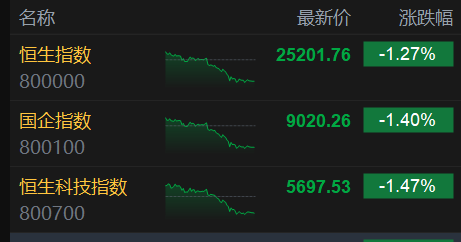
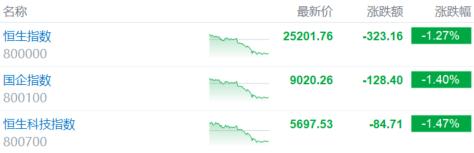
Market Overview - The Hong Kong stock market experienced a significant decline, with the Hang Seng Index dropping by 1.27%, closing at 25,201.76, down 323.16 points [1][2] - The Hang Seng Tech Index and the Hang Seng China Enterprises Index also fell by 1.47% and 1.4%, respectively, with the China Enterprises Index barely holding above the 9,000-point mark [1][2] Sector Performance - Major technology stocks saw a downturn, with companies like Kuaishou and Meituan falling over 3%, while JD.com dropped by 2.5% [5][6] - Financial sectors, including banks and insurance stocks, collectively underperformed, contributing to the overall market decline [2][5] - The biopharmaceutical sector faced significant losses, particularly after former President Trump announced plans to impose tariffs on drugs, leading to a broad sell-off in biotech stocks [2][5] Real Estate and Property Management - Property management stocks experienced sharp declines, with companies like Excellence Commercial Services dropping 16% and Country Garden Services falling over 11% [7] - Recent real estate policies in major cities like Beijing and Shanghai are expected to stabilize the market, with analysts optimistic about recovery in core cities [7] Brokerage Firms - Chinese brokerage stocks also fell, with Shenwan Hongyuan down over 6% and other major firms like Dongfang Securities and Huatai Securities declining more than 5% [8] - Despite the downturn, there is optimism regarding the brokerage sector's performance due to increased market activity and potential earnings growth [8] Biopharmaceutical Sector - The biopharmaceutical and innovative drug sectors saw significant declines, with stocks like CanSino Biologics and Innovent Biologics dropping over 7% [9] - Analysts suggest that recent changes in liquidity conditions may support a rebound in the Hong Kong stock market, narrowing the gap with the rapidly rising A-share market [9] Consumer Sector - New consumption concept stocks also faced declines, with companies like Nayuki's Tea and Bubble Mart dropping over 5% [10] - The Chinese Ministry of Commerce plans to introduce policies to boost service consumption, indicating a shift towards a balanced consumption model [10] Apple-Related Stocks - Apple-related stocks performed well, with Lens Technology rising nearly 8% ahead of the upcoming iPhone 17 launch event scheduled for September 9 [3][12] Capital Inflows - Southbound capital saw a net inflow of 15.371 billion HKD, indicating continued interest in Hong Kong stocks from mainland investors [12] Hedge Fund Activity - Recent reports indicate that global hedge funds have increased their bets on Chinese stocks, with significant inflows observed in consumer staples and industrial sectors [14]

港股收评:午后跳水恒指跌1.27%,科技股、金融股普遍弱势!蓝思科技涨8%,快手美团跌超3%,百度网易腾讯跌近2%
Ge Long Hui· 2025-08-27 08:40
Market Overview - The Hong Kong stock market experienced a significant decline in the afternoon, with the Hang Seng Index dropping by 1.27%, losing over 300 points. The Hang Seng China Enterprises Index and the Hang Seng Tech Index fell by 1.4% and 1.47% respectively, with the former barely holding above the 9000-point mark [2] - Major technology stocks, which serve as market indicators, continued to decline in the afternoon. Kuaishou and Meituan fell over 3%, while JD.com dropped by 2.5%. Baidu, NetEase, and Tencent saw declines close to 2%, and Xiaomi fell by 0.56%. Alibaba managed to stay slightly positive [3] Sector Performance - The financial sector, including banks, insurance companies, and Chinese brokerage firms, collectively underperformed, contributing to the overall market decline. The performance of individual stocks continued to be affected by ongoing earnings reports, with property management and real estate stocks experiencing significant drops [3] - Biopharmaceutical stocks faced a collective downturn, particularly in the innovative drug sector, following comments from Trump regarding the rapid imposition of tariffs on pharmaceuticals. This led to notable declines in various biopharma stocks [3] Specific Stock Movements - Several biopharmaceutical companies saw substantial declines, including Kanghao Ya-B (-8.59%), Qiansirui Biotechnology (-7.42%), and Kangfang Biotechnology (-7.10%). Other notable decliners included Xiansheng Pharmaceutical (-6.79%) and Shiyao Group (-6.36%) [3] - In contrast, the rare earth sector remained strong, benefiting from the implementation of supply reforms and multiple catalysts. Apple’s upcoming event on September 9, where the iPhone 17 series is expected to be launched, led to a rise in Apple-related stocks, with Lens Technology (300433) surging nearly 8% and reaching a new high since its listing [4]