
BYD(01211)

Search documents
微信屏蔽元宝红包链接;马斯克成全球首位身家超8000亿美元者;盖茨严词驳斥爱泼斯坦指控;iQOO15Ultra手机发布......
Sou Hu Cai Jing· 2026-02-05 00:45
Group 1 - Tencent's Yuanbao AI red envelope sharing has been changed to "password red envelope" after WeChat banned links related to it due to excessive marketing and inducement sharing behaviors [2] - Elon Musk becomes the world's first person with a net worth exceeding $800 billion, reaching $852 billion after SpaceX's acquisition of xAI, surpassing the second richest person, Larry Page, by $578 billion [3] - iQOO 15 Ultra smartphone launched with Snapdragon 8 Elite Gen5 processor, active cooling fan, and pressure-sensitive shoulder keys, starting at 5499 yuan [7] Group 2 - Xiaohongshu's valuation has soared to $50 billion, with a head fund reportedly selling part of its shares at this valuation [9] - Intel's CEO confirmed the appointment of a new chief architect for GPU development to meet the surging demand for AI data center chips, while also stating that the shortage of storage chips may last until 2028 [10] - BYD announced the launch of its first B-class pure electric SUV, the Song Ultra EV [11] Group 3 - Samsung and SK Hynix are expected to record their highest profit margins in a decade this year, with NAND products potentially reaching historical profitability levels [15] - The China Photovoltaic Industry Association responded to the "space photovoltaic" concept surge, stating that related technologies are still in the early stages of exploration and verification [16] - 360 million drivers in China have successfully obtained electronic driving licenses, accelerating the digitalization of traffic management [17] Group 4 - Ford and Geely are reportedly discussing cooperation to leverage Ford's production capacity and Geely's smart driving technology for mutual benefit [24] - Microsoft has promoted four sales executives to executive vice president to accelerate AI business growth, reallocating more computing resources to AI products [25] - AMD's CEO stated that despite rising memory prices potentially leading to a decline in the global PC market in 2026, the company will focus on the enterprise and high-end markets for continued growth [44]




扭亏“上岸”!比亚迪财险年赚近亿元,新能源车险盈利露曙光?
Guo Ji Jin Rong Bao· 2026-02-05 00:41
Core Viewpoint - BYD Insurance has reported its first annual profit, indicating a significant turnaround in its financial performance and reflecting a broader trend of profitability in the new energy vehicle insurance sector [1][8]. Group 1: Company Performance - In 2025, BYD Insurance achieved insurance business revenue of 2.871 billion yuan, a year-on-year increase of 112.56%, and a net profit of 93.62 million yuan, a substantial improvement from a net loss of 169 million yuan in 2024 [1][3]. - The comprehensive cost ratio for BYD Insurance dropped to 102.49% in 2025 from an extreme level of 308.81% in 2024, indicating improved operational efficiency [4]. - The company’s total premium income reached 2.897 billion yuan, all generated through direct sales channels, linking its revenue growth directly to BYD's vehicle sales, which totaled 4.602 million units in 2025 [4][5]. Group 2: Industry Trends - The new energy vehicle insurance market is projected to see a premium scale of 200 billion yuan in 2025, with a growth rate exceeding 30%, and is expected to reach approximately 480 billion yuan by 2030 [6][8]. - Major insurance companies like China Pacific Insurance and Ping An have also reported profitability in their new energy vehicle insurance segments, suggesting a shift in the industry's financial landscape [1][8]. - The industry is entering a critical window for underwriting profitability, driven by improved claims ratios and operational efficiencies [2][8]. Group 3: Competitive Advantages - BYD Insurance benefits from its parent company's extensive data and technology capabilities, allowing for precise pricing and risk management, which are crucial in controlling claims costs [4][5]. - The direct sales model eliminates intermediary costs, enhancing profitability and customer acquisition efficiency, as BYD owners tend to exhibit high brand loyalty [5][7]. - The integration of vehicle data for dynamic risk assessment enables BYD Insurance to implement differentiated pricing strategies, further reducing claims pressure [5][7]. Group 4: Future Outlook - The success of BYD Insurance highlights a potential future direction for the new energy vehicle insurance market, emphasizing the importance of data integration and ecosystem control for other automotive companies considering entry into the insurance sector [6][7]. - The industry is witnessing a strategic opportunity for transformation, necessitating a comprehensive approach to risk management, technology application, and innovative business models to thrive in a competitive environment [9].
比亚迪:2026年1月销量点评行业政策过渡短期承压,仍需关注后续新车周期及出口-20260205
ZHONGTAI SECURITIES· 2026-02-05 00:30
Investment Rating - The investment rating for the company is "Buy" [1][4][9] Core Views - The company reported a significant decline in January sales, with total wholesale sales of 210,000 units, down 30.1% year-on-year and 50.0% month-on-month. Domestic sales were 100,000 units, down 53.2% year-on-year and 61.9% month-on-month, while overseas sales reached 110,000 units, up 51.5% year-on-year, accounting for 47.8% of total sales [5] - The decline in sales is attributed to proactive inventory reduction and a transitional policy period, with a focus on domestic inventory reduction and high overseas sales [5] - The company is expected to benefit from new vehicle cycles and export growth, with plans to expand its self-built fleet and overseas factories [5] Financial Summary - The total share capital is 9,117.20 million shares, with a market price of 87.37 yuan and a market capitalization of approximately 796.57 billion yuan [2] - Revenue projections for the company are as follows: 602,315 million yuan for 2023, 777,102 million yuan for 2024, 837,086 million yuan for 2025, 965,414 million yuan for 2026, and 1,080,692 million yuan for 2027, reflecting growth rates of 42%, 29%, 8%, 15%, and 12% respectively [4] - Net profit attributable to the parent company is projected to be 30,041 million yuan for 2023, 40,254 million yuan for 2024, 39,541 million yuan for 2025, 43,965 million yuan for 2026, and 52,273 million yuan for 2027, with growth rates of 81%, 34%, -2%, 11%, and 19% respectively [4] - The company maintains a P/E ratio of 26.5 for 2023, decreasing to 15.2 by 2027, and a P/B ratio of 5.7 for 2023, decreasing to 2.5 by 2027 [4] Sales and Market Trends - The company is focusing on new product launches and has introduced four models with a 210 km battery range to enhance competitiveness in the domestic market [5] - The company is expected to see improved sales performance following the introduction of new vehicles and the expansion of provincial replacement subsidies [5] - The report emphasizes that exports are a crucial long-term support for the company's growth, with ongoing investments in logistics and production capacity overseas [5]
新势力系列点评二十六:1月车市表现平淡,新势力同比表现好于行业
Guolian Minsheng Securities· 2026-02-05 00:25
Investment Rating - The report maintains a positive investment rating for the new energy vehicle sector, indicating a favorable outlook for the industry [7]. Core Insights - The performance of the new energy vehicle market in January 2026 was relatively flat, with a total retail market size of approximately 1.8 million vehicles, a month-on-month decrease of 20.4%, but a slight year-on-year increase. The penetration rate for new energy vehicles reached 44.4% [4]. - Five key new energy vehicle companies (excluding Xiaomi and Aion) delivered a total of 130,772 vehicles in January, representing a year-on-year increase of 17.5% but a month-on-month decrease of 28.0%, outperforming the industry average [4]. - The report anticipates a stabilization and recovery in automotive demand post-Chinese New Year, driven by the rollout of local government subsidies and the introduction of new models [4]. Summary by Relevant Sections Delivery Performance - Leap Motor delivered 32,059 vehicles in January, a year-on-year increase of 27.4% but a month-on-month decrease of 31.9%. The strong performance is attributed to the competitive pricing of models C10 and B01 [5]. - Ideal Auto reported 27,668 vehicles delivered, a year-on-year decrease of 7.5% and a month-on-month decrease of 37.5%. The company is focusing on enhancing user experience through software updates and expanding its service network [9]. - NIO delivered 27,182 vehicles, marking a significant year-on-year increase of 96.1% but a month-on-month decrease of 14.2%. The ES8 model was the top performer [6]. - Zeekr delivered 23,852 vehicles, with a year-on-year increase of 99.7% and a month-on-month decrease of 9.3% [10]. - Xpeng delivered 20,011 vehicles, reflecting a year-on-year decrease of 34.1% and a month-on-month decrease of 38.0% [6]. Market Trends - The report highlights the ongoing trend of intelligent driving technology adoption, with companies like Xpeng and Huawei leading the charge. The expectation is that advancements in intelligent driving will lower hardware costs and expand market access [12]. - The report suggests that the intelligent driving capabilities will become a key competitive factor for automakers, with a focus on companies that are leading in this area [12]. Investment Recommendations - The report recommends focusing on companies with strong intelligent driving capabilities and those that are well-positioned in the new energy vehicle supply chain. Specific companies highlighted include Geely, Xpeng, and BYD [12].



智通ADR统计 | 2月5日





智通财经网· 2026-02-04 22:19
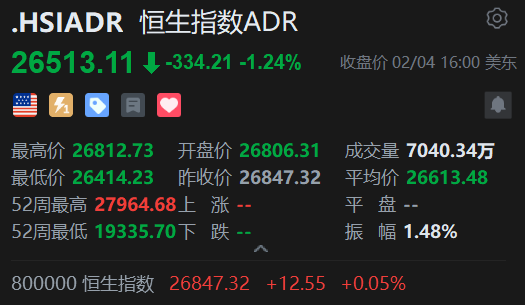
Market Overview - The Hang Seng Index (HSI) closed at 26,513.11, down by 334.21 points or 1.24% [1] - The index reached a high of 26,812.73 and a low of 26,414.23 during the trading session [1] - The trading volume was 70.4034 million shares, with an average price of 26,613.48 [1] Major Blue-Chip Stocks Performance - HSBC Holdings closed at HKD 139.704, up by 0.51% compared to the previous close [2][3] - Tencent Holdings closed at HKD 552.190, down by 1.04% compared to the previous close [2][3] - Alibaba Group (W) closed at HKD 159.500, down by 0.93% [3] - AIA Group closed at HKD 90.700, up by 1.40% [3] - Xiaomi Group (W) closed at HKD 33.960, down by 1.85% [3] - Meituan (W) closed at HKD 92.150, down by 1.13% [3] - China Ping An closed at HKD 72.050, up by 1.05% [3] ADR Performance - Tencent's ADR (TCEHY) was priced at USD 552.190, reflecting a decrease of 1.04% compared to its Hong Kong counterpart [3] - Alibaba's ADR (BABA) was priced at USD 155.411, down by 2.56% compared to its Hong Kong counterpart [3] - HSBC's ADR (HSBC) was priced at USD 139.704, up by 0.51% compared to its Hong Kong counterpart [3]
根据德国联邦汽车运输管理局周三发布的数据,比亚迪1月份在德国售出2,629辆新车
Xin Lang Cai Jing· 2026-02-04 19:10
根据德国联邦汽车运输管理局周三发布的数据, 比亚迪 1月份在德国售出2,629辆新车(去年同期为235 辆),是 特斯拉 1,301辆注册量的两倍多。 ...
能走出至暗时刻么?
Xin Lang Cai Jing· 2026-02-04 14:12
来源:市场资讯 (来源:亨特hunter) 到昨天微软还在跌,而且创下了财报后的新低。 美股软件股的崩盘还在加速,这两天OTA也开始暴跌,Booking下跌9%,Expedia下跌15%,Airbnb下跌 7%,担心谷歌的Agent替代掉OTA平台。 这里更严峻的问题在于这个逻辑看起来该受益的AI公司并没有进一步的上涨...市场陷入了负和博弈的循 环当中。 AH股和AI相关的大票近期走势也很弱,A股光模块,港股互联网... 我从来不认为AI的叙事会快速结束,但只要叙事松动,对于高拥挤度资产来说就有巨大风险。 高拥挤度背后从来都是极其敏感的脆弱... 销量崩盘的一个月 近期,各大新能源车企都披露了其一月的销量。 这么差的销量市场是有一定预期的。 这里有三个原因: 第一,去年底有购置税的退坡,这使得很多需求被前置了,消费者选择了提前买而不是跨年到了1月再 买,去年买要省不少钱。 第二,国补的以旧换新政策一月公布,但各个省具体执行还需要点时间,大部分省份都是一月下旬才真 的落地开始执行。 说实话,数据真的很难看。 根据统计,目前已披露的新能源车企销量合计约57.5万辆,同环比分别-14%/-43%。 环比下滑很正常 ...
Tesla UK sales plunge in January as Chinese rivals race ahead, New Automotive data shows
Reuters· 2026-02-04 14:08
Group 1 - Tesla sold less than half the number of battery-electric vehicles in the UK compared to Chinese rival BYD last month [1] - Data from New Automotive indicates increasing competitive pressure in the electric vehicle market [1]
销量暴增1000%、特斯拉的两倍多,比亚迪在德国卖爆了
Feng Huang Wang· 2026-02-04 14:03
Core Viewpoint - BYD has significantly increased its sales in Germany, outperforming Tesla and establishing a strong presence in the European electric vehicle market [1][2]. Group 1: BYD's Performance - In January, BYD sold 2,629 new vehicles in Germany, a year-on-year increase of over 1,000% from just 235 units [1]. - BYD's sales in Germany are more than double that of Tesla, which registered 1,301 vehicles in the same month [1]. Group 2: Competitive Landscape - BYD has surpassed Tesla in sales in both Germany and the UK, further widening its competitive advantage [1]. - The electric vehicle market in Germany is becoming increasingly competitive, with Chinese brands like SAIC MG, Leap Motor, and Xpeng expanding their presence [1]. - Tesla is facing challenges in Europe due to increasing competition from both Chinese and local brands, as well as consumer backlash against CEO Elon Musk's political activities [1]. Group 3: Tesla's Market Situation - Tesla's sales in Germany increased by only 1.9% year-on-year in January, which is based on a low sales base from the previous year [2]. - The company is experiencing a decline in the European market, with sales in France hitting a three-year low and a dramatic 88% drop in Norway [2].

英国1月新车总销量同比下降4.6%至133,571辆,特斯拉英国1月新车销量同比下降57.2%,至647辆电动汽车。比亚迪英国1月新车销量同比增长20.9%,达1326辆。
Jin Rong Jie· 2026-02-04 13:39
Core Insights - The total new car sales in the UK for January decreased by 4.6% year-on-year, amounting to 133,571 vehicles [1] Company Performance - Tesla's new car sales in the UK for January saw a significant decline of 57.2%, with only 647 electric vehicles sold [1] - BYD, on the other hand, experienced a growth in new car sales in the UK for January, increasing by 20.9% to reach 1,326 vehicles [1]