BYD(01211)

Search documents
对话李珂:为什么比亚迪在欧洲这么强?|欧陆志
Xin Lang Cai Jing· 2026-01-29 13:49
Core Viewpoint - BYD's strategy in Europe focuses on establishing a strong presence through local dealerships, enhancing social networks, and introducing models tailored for the European market, capitalizing on the region's potential for electric vehicles [2][13]. Group 1: Market Strategy - BYD plans to open one to two 4S stores in Davos, Switzerland, indicating a commitment to expanding its footprint in Europe [1]. - The company aims to build dealerships in every European country and strengthen local relationships to enhance market penetration [2][13]. - BYD's "Family Portrait" strategy includes a diverse range of vehicles from affordable models like Dolphin Surf to premium options like Atto 8, ensuring comprehensive market coverage [4][14]. Group 2: Infrastructure and Consumer Focus - Contrary to common perceptions, BYD's executive believes that European charging infrastructure is adequate but lacks efficiency, prompting the company to invest in fast-charging stations [4][14]. - BYD is introducing a fast-charging vehicle, Tengshi, which features parallel parking capabilities suited for narrow European streets [4][14]. - The company emphasizes listening to consumer needs and addressing concerns, such as charging times, by offering innovative solutions like a one-megawatt fast charger [7][17]. Group 3: Regulatory Environment - The EU's shifting policies on fuel vehicle bans and emissions targets create uncertainty, but BYD remains focused on consumer preferences rather than regulatory changes [5][15][17]. - Germany's recent decision to restart electric vehicle subsidies without origin restrictions is seen as a positive development for BYD, as it aligns with the company's competitive strategy [8][19]. Group 4: Innovation and Competitive Edge - BYD's strength lies in its technological capabilities, with a significant number of engineers and patents, positioning it as a leader in innovation within the automotive sector [9][20]. - The company prioritizes user experience and customer service, aiming to build long-term relationships with consumers rather than competing solely on price [9][20][21].



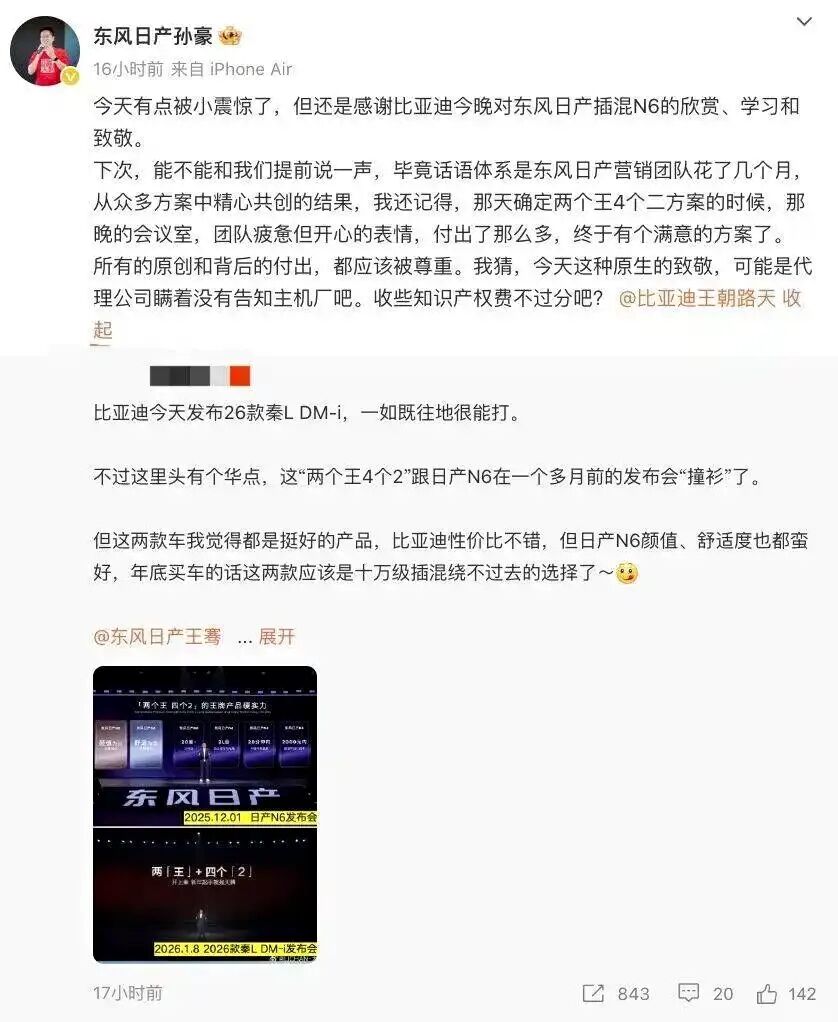
2026车圈第一瓜,比亚迪与东风日产在“斗地主”上起热议
3 6 Ke· 2026-01-29 13:47
Core Viewpoint - The recent controversy surrounding BYD's product launch and its similarity to Dongfeng Nissan's marketing language highlights the competitive dynamics and creative strategies within the automotive industry, particularly in the context of brand identity and innovation [1][3]. Group 1: Industry Dynamics - Dongfeng Nissan's recent marketing strategy has shifted towards "traffic-driven" approaches, aiming to attract consumer attention amid declining sales and market share [9][10]. - The company has faced a continuous decline in sales for seven consecutive years, with a reported 4.94% drop in 2025, leading to a reliance on a single model, the Sylphy, to maintain sales figures [11][12]. - The electric vehicle segment shows potential growth, but the N7 model has seen a significant drop in sales after an initial spike, indicating challenges in sustaining momentum [11][12]. Group 2: Brand Identity and Strategy - Historically, Nissan was synonymous with technology and reliability, but the shift towards a "traffic marketing" strategy suggests a departure from its technical roots [10][11]. - The company has been criticized for its slow response to the rise of domestic electric vehicle brands, which have rapidly adapted to market demands, while Nissan has lagged in its transition to electric vehicles [17][28]. - Nissan's decision to sell its global headquarters for 97 billion yen (approximately 4.5 billion RMB) reflects financial struggles, with reported losses of 670.9 billion yen (approximately 30.3 billion RMB) in the 2023-2024 fiscal year [12][13]. Group 3: Future Prospects - The partnership between Dongfeng and Nissan aims to leverage each other's strengths, with Dongfeng providing local market insights and Nissan contributing its global brand recognition [56][58]. - The introduction of the "GLOCAL" model in 2024 allows for greater autonomy in product development for the Chinese team, indicating a strategic shift to better align with local consumer preferences [36][58]. - Despite these changes, challenges remain, including geopolitical factors and the increasing focus on domestic brands, which may further complicate Nissan's market position in China [38][48].
中国车企欧洲狂飙
Hua Er Jie Jian Wen· 2026-01-29 13:33
Core Insights - The European automotive market is experiencing a significant shift, with battery electric vehicles (BEVs) achieving a market share of 22.6% in December 2025, surpassing traditional gasoline vehicles at 22.5% [1] - Chinese automakers are no longer distant players but are aggressively entering the European market, aiming to capitalize on the transition to electric vehicles [1][2] - The competition is intensifying as Chinese companies invest heavily in Europe, with a focus on scaling operations before traditional giants adapt to the changing landscape [1] Market Performance - In 2025, new car registrations in Europe reached 13.3 million, with a modest growth rate of 2.3%. Chinese automakers saw a remarkable performance, with sales exceeding 100,000 units for the first time, achieving a year-on-year growth of 127% [3] - Chinese brands captured a market share of 9.5%, up from 4.5% in the previous year, indicating that one in ten new cars sold in Europe has Chinese origins [3] Company Strategies - BYD's sales in Europe surged from 49,000 units in 2024 to 186,600 units in 2025, marking a 276% increase. The company is focusing on local partnerships and expanding its sales network [5] - SAIC's MG brand achieved sales of 307,282 units in Europe in 2025, leveraging localized operations and design to position itself as a high-value local brand [5] - Leap Motor emerged as a significant player, with sales skyrocketing from 771 units to 22,077 units, utilizing existing global channels for rapid expansion [6] Localization Efforts - Chinese automakers are accelerating localization, with companies like Leap Motor and BYD establishing local production facilities to reduce costs and enhance competitiveness [8] - BYD plans to double its sales outlets in Europe to 2,000 by the end of 2026, while Chery aims for over 80% localization in its Barcelona facility by 2026 [8] Future Outlook - The year 2026 is projected to be a pivotal moment for the Chinese automotive industry, with expectations of valuation recovery driven by high export growth and profitability from overseas markets [9] - The average profit per vehicle in overseas markets is estimated to be 2-3 times higher than in the domestic market, with overseas gross margins surpassing domestic ones in some cases [10] - Chinese brands are transitioning from merely selling cars to providing comprehensive solutions for smart, green, and efficient mobility, becoming integral to the European automotive landscape [11]

电动无人驾驶矿卡企业伯镭科技获比亚迪亿元战略投资
Xin Lang Cai Jing· 2026-01-29 11:59
Core Viewpoint - The strategic investment of 100 million yuan from BYD signifies market recognition of Berai Technology's technological direction and commercial value [1] Group 1: Investment Details - Berai Technology received a strategic investment of 100 million yuan from BYD [1] - The funds will be primarily used to enhance R&D investment, expand intelligent production capacity, accelerate domestic and international market expansion, and deepen industrial ecosystem cooperation [1] Group 2: Company Profile - Berai Technology is a leading provider of electric unmanned mining trucks and zero-carbon mining solutions in China [1] - The company has developed a full-stack technology system that addresses operational pain points in traditional mining [1] Group 3: Strategic Alignment - BYD's Chief Investment Officer, Li Qian, stated that Berai Technology's capabilities in unmanned mining and green energy supply complement BYD's core technological advantages in electrification and intelligence [1]
无人驾驶矿卡企业伯镭科技获比亚迪亿元战略投资
Xin Lang Cai Jing· 2026-01-29 10:09
Core Viewpoint - Berai Technology, a provider of electric driverless mining trucks and zero-carbon mining solutions, has secured a strategic investment of 100 million yuan from BYD Company Limited to enhance R&D, expand intelligent production capacity, accelerate domestic and international market development, and deepen industrial ecosystem cooperation [1] Group 1 - The strategic funding will primarily be used to strengthen research and development efforts [1] - The investment aims to expand intelligent production capacity [1] - The partnership is expected to facilitate the joint exploration of the international high-end mining equipment market [1] Group 2 - The collaboration will promote the application of new energy and intelligent technologies in the heavy industry sector in China and globally [1] - The investment reflects a commitment to advancing zero-carbon solutions in the mining industry [1]
海昌智能冲关北交所:关联方和比亚迪的订单也难治“利润贫血”? |IPO观察
Tai Mei Ti A P P· 2026-01-29 10:00
Core Viewpoint - Haichang Intelligent is preparing for its IPO on the Beijing Stock Exchange amid challenges such as declining profit margins and heavy reliance on major clients like BYD and Luxshare Precision, raising concerns about its business model and governance [2][3][19]. Group 1: Company Overview - Haichang Intelligent, formerly a part of Tianhai Electric, specializes in manufacturing high-performance automotive wiring harness equipment, with significant revenue contributions from fully automatic crimping machines and testing equipment [5][8]. - The company has a workforce of over 700, but its asset structure reveals a low level of fixed assets, indicating a labor-intensive operation rather than a high-end equipment manufacturer [2][10]. Group 2: Financial Performance - Revenue growth from 2022 to 2025 shows an increase from 5.2 billion to 8 billion yuan, but net profit growth has been under pressure, with net profits declining from 1.08 billion to 0.61 billion yuan during the same period [8][19]. - The gross margin has decreased from 37.74% in 2022 to 33.5% in 2025, attributed to increased market competition and higher costs associated with customized orders [8][19]. Group 3: Client Dependency and Market Position - Haichang Intelligent's major clients include Tianhai Electronics, BYD, and Luxshare Precision, with the top five clients accounting for over 54% of total sales, indicating a high concentration risk [9][10]. - The company has defined BYD and Jietai Technology as "strategic low-price clients," which suggests a reliance on low pricing to secure sales, impacting profit margins [8][19]. Group 4: IPO and Expansion Plans - The company plans to raise 4.52 billion yuan through its IPO to expand production capacity by 60%, despite concerns about the ability to absorb this new capacity in a slowing market for electric vehicles [2][14]. - The planned expansion includes investments in intelligent equipment and a research center, with expectations of generating an additional 4.8 billion yuan in revenue post-expansion [12][13]. Group 5: Regulatory Scrutiny and Governance Concerns - The company faces heightened scrutiny from regulators due to its ties with Tianhai Electronics, which is both a major customer and a significant accounts receivable source, raising questions about revenue recognition and governance transparency [18][19]. - Recent incidents involving sensitive financial transactions between Haichang Intelligent and its parent company have amplified concerns regarding internal controls and the quality of reported profits [18][19].
加强系统化、集成化改革创新,广东贸促会助企惠企开新局
Huan Qiu Wang· 2026-01-29 08:44
Core Viewpoint - The Guangdong Provincial Council for the Promotion of International Trade (GCPIT) is focusing on building a comprehensive trade promotion system to support enterprises in seizing market opportunities and enhancing industrial chains, aiming to transition from "product export" to "brand export" for Chinese manufacturing [1][2]. Group 1: Trade Promotion Initiatives - GCPIT has successfully implemented key tasks from the China Council for the Promotion of International Trade, including hosting significant events like the third Guangdong-Hong Kong-Macao Greater Bay Area Development Business Conference and participating as a guest province in the third Chain Expo [1]. - The council is advancing six key initiatives to enhance economic cooperation in the Greater Bay Area, including establishing trade cooperation platforms and improving international business certification services [1][2]. Group 2: Economic Cooperation Platforms - A major focus is on building the Greater Bay Area economic cooperation platform, with plans to participate in the fourth Guangdong-Hong Kong-Macao Greater Bay Area Development Business Conference and to release a 2026 supply chain promotion report [3]. - GCPIT aims to enhance the exhibition industry in the Greater Bay Area, promoting collaborative development and addressing key issues such as efficient flow of resources and integrated trade standards [3]. Group 3: Industry Support and Services - GCPIT is actively promoting "chain services" to support the development of the new energy vehicle industry, facilitating collaborations among leading companies like Xpeng, GAC Aion, and BYD [7]. - The council plans to launch a "Guangdong Enterprises Going Global" service initiative to assist local new energy vehicle companies in expanding their international market presence [7]. Group 4: Cross-Border E-Commerce Development - Guangdong's import and export trade reached 9.49 trillion yuan in 2025, maintaining a leading position nationally, with plans to deepen the "Hundred Exhibitions and Ten Thousand Enterprises" initiative to help over 10,000 companies secure orders [8][10]. - The "Cross-Border E-Commerce + Industrial Belt" model is being promoted to stimulate county-level economic growth, with the "Hundred Counties Project" already covering nearly 120 industrial belts across the province [10].


2025年全球纯电动汽车销量出炉:比亚迪超越特斯拉
Huan Qiu Wang· 2026-01-29 08:06
Group 1 - The core viewpoint of the article indicates that global sales of pure electric vehicles (BEVs) are projected to exceed 12.1 million units by 2025, maintaining a double-digit year-on-year growth rate [1] - BYD is expected to surpass Tesla in global BEV sales by 2025, marking a significant shift in the global new energy vehicle landscape [1] - The growth in BYD's global sales is primarily driven by its entry-level electric models, such as Dolphin and Atto 3, highlighting the competitiveness of BYD's products [4] Group 2 - Tesla focuses on attracting tech-savvy high-end consumers, positioning itself as a technology-driven company, with its AI research extending into robotics and energy management [4] - IDC notes that the growth logic in the entry-level market differs from the early stages of market development, emphasizing the importance of cost efficiency, channel coverage, and operational capabilities [4]

3月19-20日 常州!2026锂电关键材料及应用市场高峰论坛
鑫椤锂电· 2026-01-29 08:00
Core Viewpoint - The lithium battery industry is poised for a significant growth cycle starting in 2026, characterized by strong demand recovery, accelerated global expansion, and disruptive technological advancements, leading to a "spiral rise" in both volume and price [3]. Group 1: Market Predictions - By 2025, global lithium battery production is expected to reach 2250 GWh, with a growth rate of 30% in 2026, and the energy storage sector projected to grow at an impressive 48.3% [5]. - The demand surge will create substantial pressure on the supply of battery cells and four key upstream materials, highlighting a potential supply gap that needs to be addressed for stable and efficient supply chains [5]. Group 2: Conference Details - The 2026 Lithium Key Materials and Application Market Summit will be held on March 19-20, 2026, in Changzhou, Jiangsu, organized by Xinluo Information [4]. - The summit will focus on three core topics: in-depth discussions on cutting-edge technologies and market supply-demand dynamics, B2B procurement matching, and strategic insights for high-quality development in the lithium battery industry [5][6]. Group 3: Key Discussion Topics - The conference will feature discussions on lithium carbonate futures and options, market volatility responses from lithium battery companies, and the potential of global lithium resources in 2026 [7]. - Other topics include the opportunities presented by solid-state battery development for lithium salt companies and the practical aspects of lithium carbonate futures and supply-demand outlooks [7][8]. Group 4: Industry Collaboration - The summit aims to facilitate B2B procurement connections among top global battery companies and material suppliers, covering the entire supply chain from cathode materials to electrolytes [6]. - It will also provide authoritative data releases, benchmark company rankings, and deep industry connections to help businesses seize growth opportunities in the lithium battery sector [6].







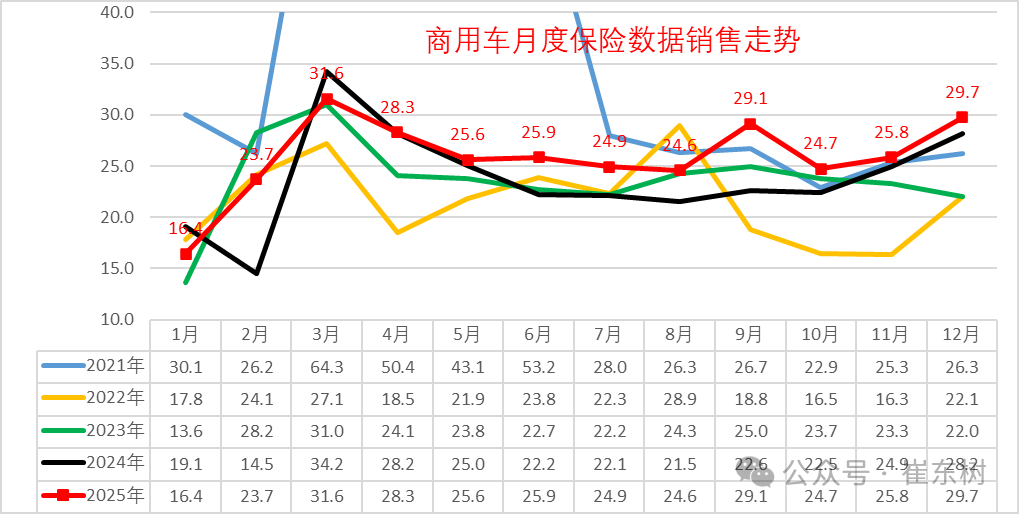
崔东树:2025年国内商用车交强险数据强势增长 12月商用车国内销量同比增5%
智通财经网· 2026-01-29 07:46
Core Insights - The commercial vehicle market in China is expected to see significant growth in 2025, driven by the strong performance of new energy vehicles (NEVs) and supportive policies for vehicle upgrades [1][7][12] - In December 2025, the sales of commercial vehicles reached 300,000 units, marking a 5% year-on-year increase and a 15% month-on-month increase [7][12] - The penetration rate of new energy commercial vehicles is projected to reach 46% by December 2025, a substantial increase from 29% in December 2024 [12][14] Commercial Vehicle Market Analysis - The total sales of commercial vehicles in China for 2025 are forecasted to be 3.1 million units, representing a 9% year-on-year growth compared to the stable period since 2022 [1][7] - The market showed a strong upward trend from March to December 2025, with December achieving a historical high for the month [5][7] - The sales of new energy commercial vehicles in December 2025 are expected to hit 140,000 units, reflecting a 71% year-on-year increase and a 49% month-on-month increase [1][8] New Energy Vehicle Performance - The penetration rate of new energy commercial vehicles has increased significantly, from approximately 3% in 2019-2021 to 46% in December 2025 [12][14] - The sales of new energy commercial vehicles for the entire year of 2025 are projected to reach 910,000 units, a 57% increase compared to the previous year [1][8] - The growth in new energy vehicle sales is attributed to strong demand and government incentives, particularly in the commercial vehicle sector [10][12] Market Structure and Competition - The market for commercial vehicles is characterized by a stable structure, with significant contributions from light and heavy-duty trucks [14][18] - Key players in the commercial vehicle market include Beiqi Foton, SAIC-GM-Wuling, and China National Heavy Duty Truck Group, which dominate the light truck, heavy truck, and bus segments respectively [15][18] - The performance of heavy-duty trucks has improved significantly due to subsidy policies, with notable growth in electric heavy-duty trucks in regions like Beijing, Tianjin, and Shanghai [16][17] Regional Market Dynamics - The light truck market is particularly strong in regions such as East China and South China, with increasing sales in these areas [18][19] - The penetration of new energy vehicles in the truck segment reached 38% in December 2025, while the bus segment saw a penetration rate of 78% [14][18] - The market for new energy light trucks is primarily concentrated in East China and South China, with significant growth observed in these regions [19][21]