BYD(01211)

Search documents
比亚迪财险靠投资翻身,车险车均保费下降了
Sou Hu Cai Jing· 2026-02-27 02:46
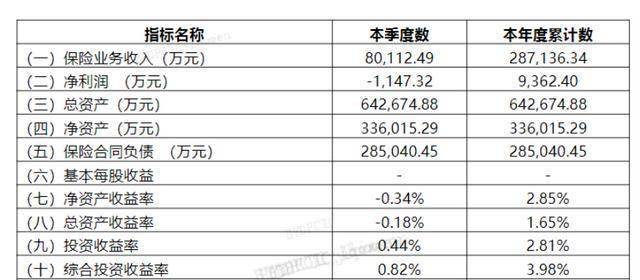
Core Viewpoint - BYD's insurance subsidiary has achieved profitability in 2025, contrary to market expectations of a longer cultivation period after its acquisition of 100% of Yi'an Insurance in May 2023 [6]. Financial Performance - In 2025, BYD Insurance reported insurance business revenue of 2.871 billion yuan, a year-on-year increase of 112.56%, and a net profit of 93.62 million yuan, recovering from a net loss of 169 million yuan in 2024 [7]. - The comprehensive cost ratio for BYD Insurance in 2025 was 102.49%, significantly reduced from 308.81% in 2024 [8]. - The comprehensive investment return rate for BYD Insurance in 2025 was 3.98%, up from 2.41% in the previous year [10]. Operational Efficiency - BYD Insurance achieved a direct sales channel for its insurance products, with direct sales premiums amounting to 2.897 billion yuan in 2025, and an average premium per vehicle of 4,054.53 yuan, down from 4,500 yuan in 2024 [9]. Challenges Ahead - Despite returning to profitability in 2025, BYD Insurance faces challenges such as pressure from underwriting losses, as the overall cost ratio remains above 100%, indicating ongoing core insurance business losses [11]. - The comprehensive solvency adequacy ratio decreased to 589.95% by the end of Q4 2025, down 66.60 percentage points from the previous quarter [11]. - There are risks associated with related-party transactions, as BYD Insurance has engaged in significant transactions with BYD Auto, with 13 major related-party transactions recorded in 2025 [11].


电动汽车市场洞察,全球前20强生产商排名及市场份额
QYResearch· 2026-02-27 02:23
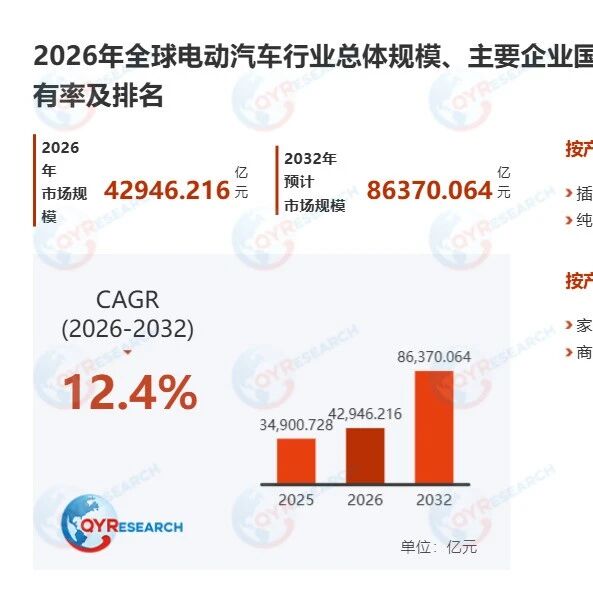
Core Viewpoint - Electric vehicles (EVs) are essential for decarbonizing the transportation sector, offering higher energy conversion efficiency, instant torque, lower noise, and zero tailpipe emissions [2] Market Size - The global electric vehicle market is projected to reach $1,269.9 billion by 2032, with a compound annual growth rate (CAGR) of 12.35% over the coming years [3] Market Landscape - Major global electric vehicle manufacturers include BYD, Tesla, BMW, Volkswagen, Li Auto, Seres Group, Geely, Mercedes-Benz, Volvo, SAIC Motor, Hyundai-Kia, Stellantis, Great Wall Motors, Renault, Chery, NIO, Toyota, GAC Group, Xpeng, Leap Motor, Xiaomi, Ford, and BAIC Group [5][6] - The top five manufacturers hold approximately 47% of the market share [6] Industry Development Opportunities - Advancements in battery technology, thermal management systems, 800V high-voltage architecture, and vehicle electronic platforms provide opportunities for performance enhancement and cost reduction, allowing electric vehicles to penetrate a broader price range [11] - The integration of vehicles with energy systems is expanding application boundaries, promoting a shift from one-time vehicle sales to ongoing service models [11] - The acceleration of electrification in light commercial vehicles, logistics, shared mobility, and emerging markets creates new growth paths for companies with scalable manufacturing, cost control, and localized operations [11] Key Obstacles - Uneven progress in charging network construction across regions affects user experience and convenience [10] - Price fluctuations of key battery materials, supply chain geopolitical risks, and an immature recycling system challenge cost control and long-term stability [10] - Consumer expectations regarding range performance, low-temperature operation, maintenance costs, and second-hand value, along with subsidy policy reductions and electricity price volatility, slow market penetration [10]




智驾平权系列六:AI 智能涌现新阶段,智驾 VLA 与世界模型之争
Changjiang Securities· 2026-02-27 00:50
Investment Rating - The report maintains a "Positive" investment rating for the automotive and automotive parts industry [11] Core Insights - The report highlights a significant leap in the development of general artificial intelligence large models, with continuous breakthroughs in model scale, training paradigms, and reasoning capabilities, establishing a solid technological foundation for various AI applications. Intelligent driving, being an application of "physical AI," is evolving towards large models, marking a new phase of intelligent emergence [3][6] Summary by Sections Introduction: AI Empowerment, Intelligent Driving Enters the Large Model Era - The report discusses the rapid development of general artificial intelligence large models, emphasizing their role in enhancing intelligent driving through technological iterations [6][19] Emergence of General Large Model Capabilities - The AI large model era is characterized by the use of the Transformer architecture, exponential increases in computing power, and the accumulation of vast multimodal data, leading to critical breakthroughs in AI applications [7][21] Progression of Intelligent Driving Large Models - Intelligent driving has transitioned from rule-based models to end-to-end large models, gradually evolving towards VLA (Vision-Language-Action) and world models, enhancing deep reasoning and decision-making capabilities [8][50] Investment Recommendations - The report suggests that the continuous emergence of AI large model capabilities will accelerate the commercialization of high-level intelligent driving. Key recommendations include companies like XPeng Motors, BYD, and Geely in the vehicle sector, and Top Group and Bertelson in the parts sector [9]





智通ADR统计 | 2月27日





Xin Lang Cai Jing· 2026-02-26 22:27
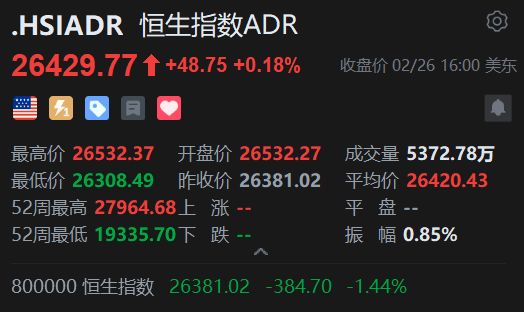
Market Overview - On Thursday, the three major U.S. stock indices showed mixed performance, while the Hang Seng Index ADR rose, closing at 26,429.77 points, an increase of 48.75 points or 0.18% compared to the Hong Kong market close [1]. Company Performance - Major blue-chip stocks exhibited varied performance: HSBC Holdings closed at HKD 147.859, up 1.97% from the Hong Kong market close; Tencent Holdings closed at HKD 513.204, up 0.24% [3]. - Tencent Holdings reported a price of HKD 512.000, with a decline of 2.01%, while its ADR price was 513.204, reflecting a 0.24% increase [4]. - Alibaba Group's stock price was HKD 143.000, down 3.57%, with its ADR at 144.779, showing an increase of 1.779% [4]. - HSBC's stock price was HKD 145.000, up 1.61%, with its ADR at 147.859, reflecting a 1.97% increase [4]. - China Ping An's stock price decreased by 4.64% to HKD 67.850, while its ADR showed a slight increase of 0.49% [4]. - Meituan's stock price fell by 2.72% to HKD 80.450, with its ADR showing a minimal change of -0.03% [4].
1月头部车企销量表现分化 呈现“五增五降”格局
Zhong Guo Zheng Quan Bao· 2026-02-26 21:09
Core Insights - In January 2026, China's automotive sales reached 2.346 million units, reflecting a year-on-year decline of 3.2%, while production was stable at 2.45 million units, showing a slight increase of 0.01% [1][4] - The top ten automotive companies accounted for 1.962 million units sold, representing 83.6% of total sales, indicating a significant concentration in the market [1][2] - The market is characterized by a "stronger getting stronger" effect, with a clear division between companies experiencing sales growth and those facing declines [1][3] Market Performance - The top ten companies displayed a clear tiered performance, with SAIC Motor leading at 327,000 units sold, followed by Geely and FAW at 270,000 and 275,000 units respectively [2] - Among the growth cohort, SAIC Motor saw a substantial increase of 23.9% year-on-year, driven by strong performance in new energy vehicles and overseas sales [2][3] - Conversely, companies like FAW and BYD experienced slight declines, with FAW down 3% and BYD's domestic sales not compensating for its strong export performance [3][4] Industry Trends - The automotive market is undergoing a transformation towards electrification and globalization, with companies that have effectively expanded their new energy product lines and overseas markets showing better resilience [3][4] - The decline in sales for some companies is attributed to mismatches in product structure adjustments and market demand changes, highlighting the importance of aligning product offerings with consumer needs [4] Company Strategies - Major automotive companies have set clear sales targets for 2026, focusing on product launches and technological advancements to capture market share [5][6] - Traditional automakers like FAW and Dongfeng are emphasizing steady growth and new energy transitions, with FAW targeting 3.546 million units and Dongfeng aiming for 3.25 million units [5][6] - New energy leaders like BYD are focusing on global expansion, setting an overseas sales target of 1.3 million units, while startups like Leap Motor and Xiaomi aim for aggressive growth through new product launches [7]




1月头部车企销量表现分化呈现“五增五降”格局
Zhong Guo Zheng Quan Bao· 2026-02-26 20:28
Core Insights - The Chinese automotive market is expected to see record production and sales, with 2026 January sales data serving as a significant indicator for the year's trends [1] - The market is characterized by a high concentration of sales among the top ten companies, which accounted for 83.6% of total sales, indicating a "Matthew Effect" where the strong continue to strengthen [1][2] - The competition among automakers is intensifying, with a clear divide between companies experiencing sales growth and those facing declines [1][3] Market Performance - In January 2026, total domestic car sales reached 2.346 million units, a year-on-year decrease of 3.2%, while production was 2.45 million units, showing a slight increase of 0.01% [1] - The top ten automakers sold a combined 1.962 million units, with five companies showing sales growth and five experiencing declines, highlighting a distinct market segmentation [1][3] Sales Growth Leaders - SAIC Motor led sales with 327,000 units, a significant year-on-year increase of 23.9%, driven by growth in its self-owned brands, new energy vehicles, and overseas sales [2] - Geely and FAW Group followed in the second tier, with sales of 270,100 and 275,000 units respectively, while BYD and Chery ranked in the third tier with sales of 210,100 and 200,300 units [2][3] Factors Influencing Sales - The decline in January sales is attributed to the transition of new energy vehicle purchase tax policies, changes in local subsidies, and the early release of consumer demand at the end of 2025 [4] - Companies that achieved growth typically had advantages in new energy product offerings or overseas market expansion, while those with declining sales struggled to align product adjustments with market demand [4] Strategic Focus of Automakers - Major automakers are setting clear sales targets for 2026, emphasizing product launches and technological advancements to capture market share [5] - Traditional automakers like FAW and Dongfeng are focusing on steady growth and new energy transitions, with specific sales targets set for the year [5][6] Differentiated Strategies - Leading independent brands such as SAIC, Geely, and Great Wall are adopting differentiated strategies to maintain stability and growth, with SAIC's target speculated to be between 4.5 million to 5 million units [5][6] - New energy leaders like BYD are focusing on overseas sales, targeting 1.3 million units, while also expanding their domestic product offerings [6]
政策金融双轮驱动 新春车市回暖
Zhong Guo Zheng Quan Bao· 2026-02-26 20:28
Core Viewpoint - The domestic automotive market is experiencing a consumption boom driven by both policy and financial incentives, with a notable shift towards financing options over direct price reductions [1][3][5]. Group 1: Market Trends - The automotive market is seeing a strong influx of customers, particularly for new energy and luxury fuel brands, with significant foot traffic reported at stores for brands like BMW, Mercedes-Benz, and others [1][2]. - There is a noticeable shift in consumer purchasing behavior from basic needs to a focus on quality and personalization, as evidenced by the diverse customer profiles visiting dealerships [2][3]. - The "Lego New Spring" promotional events across various regions are contributing to increased consumer engagement and sales activity in the automotive sector [3][5]. Group 2: Financial Policies - Over 20 automotive brands have introduced long-term low-interest financing options, with some offering up to 7 years of financing at low or zero interest rates, reflecting a strategic shift in promotional tactics [4][5]. - Major brands like Tesla and BYD are leading the way with attractive financing plans, which are becoming the primary method of promotion rather than direct price cuts [4][5]. - The combination of national and local subsidies, including the new vehicle replacement policy, is further reducing the cost of purchasing vehicles, enhancing consumer incentives [5][6]. Group 3: Consumer Sentiment - Consumer sentiment is divided, with some buyers eager to take advantage of multiple subsidies while others remain cautious, reflecting concerns over price trends and policy sustainability [3][6]. - The market is expected to face challenges post-holiday, with a potential decline in sales due to cautious consumer attitudes and high inventory levels [6]. Group 4: Industry Outlook - The automotive industry is entering a high-end consumption phase, where simple price reductions are no longer effective, necessitating a focus on technology and product experience to meet evolving consumer demands [6]. - Experts predict that the market will see a temporary adjustment period for new energy vehicles after the holiday season, as promotional activities may slow down [1][6].

比亚迪:公司拥有行业领先的电池开发团队,关注全行业的技术创新
Zheng Quan Ri Bao Wang· 2026-02-26 11:50
证券日报网讯 2月26日,比亚迪(002594)在互动平台回答投资者提问时表示,公司拥有行业领先的电 池开发团队,关注全行业的技术创新。公司已经充分关注锂矿供应情况,并积极提升相关供应链能力。 在替代技术方面,公司储备了钠离子电池等技术应用、并进入商用阶段。 ...
800V新能源车渗透率破10%,超充电池、超充桩等率先升级
高工锂电· 2026-02-26 11:00
Core Viewpoint - The article emphasizes the collaborative upgrade of the supercharging ecosystem, highlighting the increasing penetration of the 800V high-voltage platform in the electric vehicle market and the simultaneous advancements in battery and supercharging infrastructure [1]. Group 1: 800V High-Voltage Platform - The 800V high-voltage platform is transitioning from a high-end configuration to a mainstream standard, with a projected penetration rate exceeding 10% by 2025, translating to nearly 1.5 million units sold, and a forecast of 15% penetration in 2026 [2]. - As the penetration of 800V high-voltage electric vehicles rises, supporting components such as batteries and supercharging stations are also undergoing upgrades [3]. Group 2: Battery Technology - The mainstream battery for the 800V high-voltage platform is the 5C battery, utilized in models like Xiaopeng G9 Max, NIO ET9, and others, with major suppliers including CATL, Zhongchuang Innovation, and Yiwei Lithium Energy [3]. - The narrative around 6C batteries is shifting from a ternary material system to lithium iron phosphate (LFP), with CATL and SAIC General collaborating on LFP 6C batteries, and Chu Neng New Energy set to release a 6C LFP "Everest" battery in October 2025 [4]. Group 3: Supercharging Infrastructure - The supercharging infrastructure is evolving, with BYD initiating a megawatt-level supercharging competition in early 2025, applying it to models with a 1000V high-voltage platform, thus closing the loop for rapid energy replenishment for 800V and above models [4]. - BYD's second-generation megawatt supercharging station, with a maximum output power of 1.5 megawatts, is in the construction phase, featuring two charging guns and two 200kWh energy storage cabinets to enhance charging efficiency and reduce fluctuations [5][6]. Group 4: Industry Collaboration - The widespread adoption of ultra-fast charging technology relies on the technical and product collaboration among automakers, battery manufacturers, and charging station companies across the supply chain [7].



荣耀前高管郭锐任智界汽车CEO,与比亚迪前高管赵长江搭班
Nan Fang Du Shi Bao· 2026-02-26 10:36
Group 1 - The core point of the article is that Guo Rui, former CMO of Honor, has joined Zhijie Auto as CEO, indicating a strategic move for the company as it prepares for product line expansion and global market penetration [2][3]. - Guo Rui's background includes a PhD from Peking University and experience in major companies like Huawei and Procter & Gamble, which positions him well for leading Zhijie Auto [2]. - The combination of Guo Rui and Zhao Changjiang, former head of BYD's Tengshi brand, is seen as a strategic effort by Zhijie to enhance its brand positioning and market reach [3]. Group 2 - Zhijie Auto faces challenges in defining its brand identity between performance-oriented vehicles and those focused on autonomous driving technology [3][4]. - The company benefits from Chery's established manufacturing and sales network, which has been successful in international markets, providing a foundation for Guo Rui's global expansion efforts [3][4]. - The transition from the smartphone industry to the automotive sector presents integration challenges for Guo Rui, as he aims to implement strategies for brand youthfulness and globalization [4].