XIAOMI(01810)

Search documents
当“华米OV 耀”都不再满足于造手机
3 6 Ke· 2026-02-11 02:28
Core Viewpoint - The mobile phone manufacturers are shifting their focus towards the professional camera and handheld imaging device market, which was previously considered untouchable, indicating a significant transformation in the industry landscape [1]. Group 1: Market Dynamics - OPPO and vivo are the first to target the market dominated by DJI's Pocket series, which has become a standard for content creators and tourists seeking better image quality and stabilization than smartphones [2][4]. - vivo is developing a standalone Vlog camera aimed at competing directly with DJI's Pocket series, featuring a lightweight design and integration with its OriginOS for seamless editing and sharing [4][6]. - OPPO is also working on a new imaging product that may be part of its Find series, focusing on high-quality material collection while leveraging mobile processing power for editing and social sharing [8]. Group 2: Product Innovations - Xiaomi is pursuing a modular approach with a magnetic lens system that allows its smartphones to transform into high-quality cameras, potentially launching with the MIX 5 or 16 Ultra in 2026 [9][12]. - The magnetic lens module will enable users to attach a large optical module to their phones, enhancing photography capabilities while maintaining a lightweight design [13][15]. - Honor is taking a more radical approach by integrating a mechanical gimbal into its upcoming "Robot Phone," allowing for advanced stabilization and 360-degree tracking [17][19]. Group 3: Strategic Collaborations - Huawei is not developing a standalone Vlog camera but is collaborating with DJI for deeper integration of camera controls within its HarmonyOS, indicating a strategic focus on software rather than hardware [21][26]. - Huawei is also testing a square sensor for front cameras, aimed at optimizing social media content creation by allowing for maximum image capture regardless of phone orientation [23][24]. Group 4: Industry Trends - The year 2026 is seen as a pivotal moment for the smartphone industry, as manufacturers face diminishing returns on hardware improvements and are compelled to innovate through external devices or standalone products [27]. - The shift towards integrating advanced computational photography into traditional camera forms represents a significant challenge to established camera manufacturers, who have struggled to meet the demands of modern content creators [28][29].


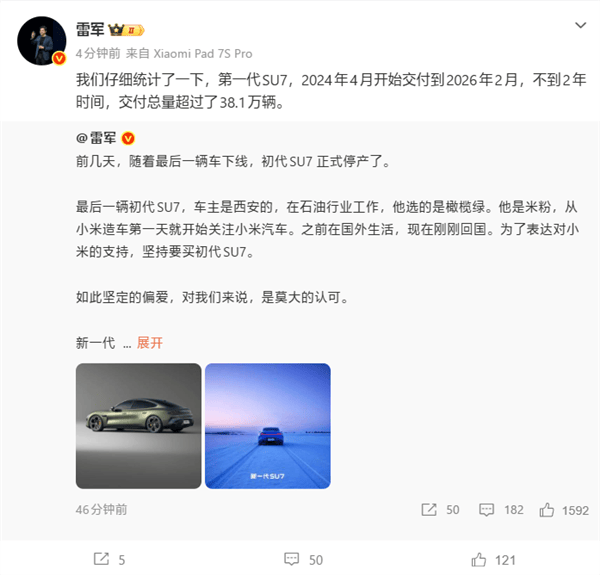
雷军:第一代SU7交付总量超38.1万辆
Sou Hu Cai Jing· 2026-02-11 02:21
Core Insights - The first generation of Xiaomi SU7 has officially ceased production, with total deliveries nearing 381,000 units since its launch in April 2024 [1][3] - The SU7 achieved remarkable sales performance, becoming a phenomenon in the 200,000 to 300,000 yuan pure electric sedan market due to precise pricing, high-performance configuration, and synergy within the Xiaomi ecosystem [3] - The SU7 became the best-selling sedan in 2025, surpassing 200,000 units in sales, and was the first pure electric model to exceed the sales of Tesla Model 3 [5] Delivery Performance - The first generation SU7 was launched on March 28, 2024, and delivered over 130,000 units in its first year (9 months) [3] - In 2025, the total deliveries reached approximately 258,000 units [3] Transition to Next Generation - The production line for the first generation SU7 is transitioning to the new generation SU7, which is expected to be launched in April 2026 [5] - Starting from February 13, 2026, display models of the new generation SU7 will be available in core cities for user experience before ordering [5]
港股恒生科技指数盘中涨超1%,恒生指数涨0.2%,商汤(00020.HK)涨超5.7%,腾讯音乐(01698.HK)涨近5%哔哩哔哩(09626.HK)...
Jin Rong Jie· 2026-02-11 02:18
Group 1 - The Hang Seng Tech Index rose over 1% during the trading session, while the Hang Seng Index increased by 0.2% [1] - SenseTime (00020.HK) saw a significant increase of over 5.7% [1] - Tencent Music (01698.HK) experienced a rise of nearly 5% [1] - Bilibili (09626.HK) surged by more than 4.5% [1] - Xiaomi Group (01810.HK), NIO (09866.HK), and Li Auto (02015.HK) all recorded gains exceeding 2.5% [1]


未知机构:小米业务经理访谈纪要260209GD家电家电业务-20260211
未知机构· 2026-02-11 01:55
Summary of Xiaomi's Business Conference Call Industry Overview - The conference call primarily discusses Xiaomi's home appliance and technology sectors, including air conditioning, Internet of Things (IoT), smartphones, and automotive business. Key Points Home Appliances - **Air Conditioning Shipment**: The target for 2025 is to ship 10 million units, with an actual completion of 9.2 million units in 2025 [1] - **Strategic Shift**: Starting from Q4 2025, the strategy will shift to focus on profitability in the home appliance sector [1] - **Air Conditioning Profit Margins**: The gross margin for air conditioning was 18% last year, with a net profit margin around 2%. The goal for 2026 is to increase the gross margin to over 23% [1] IoT and Internet - **IoT Revenue Structure**: Black and white appliances account for 43% of revenue with an overall gross margin of 15%, while other IoT products contribute 57% of revenue with a gross margin of 35% [1] - **Internet Revenue**: In 2025, the internet segment generated revenue of 36 billion yuan with a net profit margin of 58% [2] Television - **Global Shipment**: The global shipment of televisions remains stable at 12 million units, with hardware yielding zero net profit and internet services generating profit [3] Smartphones - **Profitability Levels**: The breakeven gross margin for smartphones is 12%. The gross margin reported for Q3 2025 was 11%, with expectations for Q4 2025 to drop below 9%. Pressure on margins is expected to continue into Q1 2026, with some relief anticipated in Q2 2026 [3] - **Shipment Volume**: For Q4 2025, the expected shipment is 37 million units, with a forecast of 35 million units for Q1 2026. The annual shipment target for 2026 has been revised down from 185 million to 155 million units, following an actual shipment of 166 million units in 2025, which fell short of the 175 million target [3] Automotive Business - **Order Status**: As of mid-January, there are 133,000 existing orders (equivalent to 3.5 months of production capacity), with an additional 13,000 new orders (only for the Yu7 model) [4] - **Production Capacity**: The Beijing factory has a full production capacity of 1.2 million units, while the Wuhan factory has a capacity of 450,000 units [4] - **Profit per Vehicle**: The net profit per vehicle in 2025 is approximately 35,000 yuan, with investments in AI and robotics affecting apparent profitability [4] New Industry Investments - **Robotics**: An estimated investment of 2.5 to 3 billion yuan is planned for 2026, focusing on model development and hardware research [4] - **Chip Development and OS**: An annual investment of 9 billion yuan is allocated, with 13.5 billion yuan invested over four years in the Xuanjie chip [4] - **Autonomous Driving**: An investment of 3.5 billion yuan is planned for 2026 [4] - **AI Large Models**: An investment of 8 billion yuan is required for 2026 [4] Offline Channel Adjustments - **Store Count Reduction**: The number of stores decreased from 18,000 in mid-2025 to 14,000 by the end of 2025, with plans to further reduce to 10,000 to 12,000 stores, focusing closures on lower-tier cities [4] - **Adjustment Logic**: The rapid expansion of stores and low commission rates for franchisees are cited as reasons for the adjustments [5] - **Major Appliance and Automotive Store Count**: Currently, there are over 400 stores selling cars and 2,000 stores selling major appliances, with a cap of 4,000 stores for major appliances [5]
2.11犀牛财经早报:10年期国债收益率下破1.8%
Xi Niu Cai Jing· 2026-02-11 01:53
Group 1: Banking and Wealth Management - The scale of bank wealth management products has decreased by approximately 815 billion yuan, with 14 major wealth management companies managing a total of 24.59 trillion yuan as of the end of January 2026, marking a decline for the second consecutive month since reaching a peak in November 2025 [1][2] - Despite the decline, there is optimism in the industry as low fixed deposit rates and a large amount of fixed deposits maturing in 2026 may lead to a reallocation of household wealth towards wealth management products [1] - Sales of bank wealth management products surged before the Spring Festival, with some products breaking sales records, indicating a potential recovery in the market [1] Group 2: Private Equity and Investment - The number of domestic private equity firms managing over 10 billion yuan has reached a record high of 122, increasing by 10 from the end of December 2025 [1] - Eight new private equity firms entered the 10 billion yuan club in January 2026, showcasing a growing trend in the private equity sector [1] Group 3: Energy Market - The EIA's short-term energy outlook report predicts that Brent crude oil prices will average $58 per barrel in 2026, up from a previous estimate of $56 per barrel, while WTI crude oil prices are expected to average $53.42 per barrel, an increase from $52.21 per barrel [2] Group 4: Silver Market - The World Silver Association forecasts that the silver market will experience a supply deficit for the sixth consecutive year in 2026, with a projected shortfall of 67 million ounces [3] - Global silver demand is expected to remain stable, driven by robust retail investment, which may offset declines in other key demand areas such as jewelry and industrial use [3] Group 5: IPO Market - The Hong Kong IPO market has been active in 2026, with fundraising exceeding 79 billion HKD, representing a year-on-year increase of over 1220% [3][4] - As of February 10, 2026, 422 companies are queued for IPOs in Hong Kong, with over 100 having submitted applications since the beginning of the year [3] Group 6: Credit Card Industry - In 2025, 65 credit card centers were closed, surpassing the total number of closures from 2020 to 2024, indicating a significant contraction in the credit card industry [4] - The trend of closing credit card centers is spreading from state-owned and joint-stock banks to city commercial banks, reflecting a shift from expansion to competition in the credit card sector [4] Group 7: Corporate Actions - Ningde Times issued its first green technology innovation bond for 2026, raising 5 billion yuan with a coupon rate of 1.70% [6] - Huazhang Technology plans to acquire 100% of Huayi Microelectronics for 29.96 billion yuan, aiming to enhance its packaging and testing business in the semiconductor sector [10]




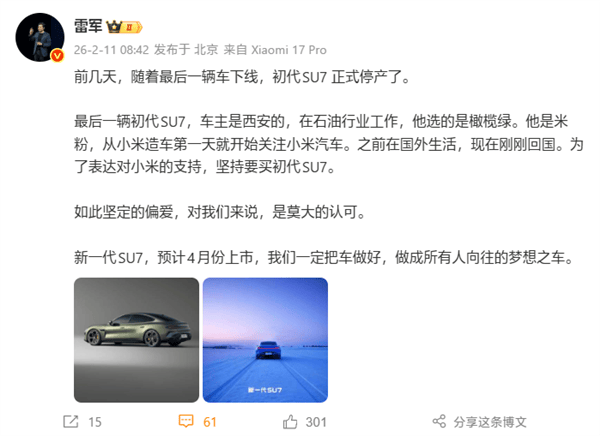
雷军谈新一代SU7:我们一定把车做好!做成所有人向往的梦想之车
Sou Hu Cai Jing· 2026-02-11 01:28
Group 1 - The core point of the article is that Xiaomi's founder Lei Jun announced the official discontinuation of the first-generation SU7 model, with the last vehicle produced being delivered to a customer in Xi'an [1] - The new generation SU7 is expected to launch in April, with pre-orders already open, featuring three versions: Standard, Pro, and Max, priced at 229,900 yuan, 259,900 yuan, and 309,900 yuan respectively, reflecting an increase of over 10,000 yuan compared to the previous generation [3][9] - The price increase is attributed to significant upgrades in configuration and rising costs of raw materials, which have put pressure on production costs [3][5] Group 2 - The new generation SU7 boasts comprehensive enhancements in product capabilities, including safety, range, chassis, assisted driving, and design [5] - Safety features include standard 2200MPa ultra-strong steel, nine airbags, and advanced driver assistance systems with laser radar and high computing power [10] - The Pro version offers a CLTC range of 902 km, while the Max version can achieve a range of 670 km with a 15-minute charge, showcasing significant improvements in battery technology [11]
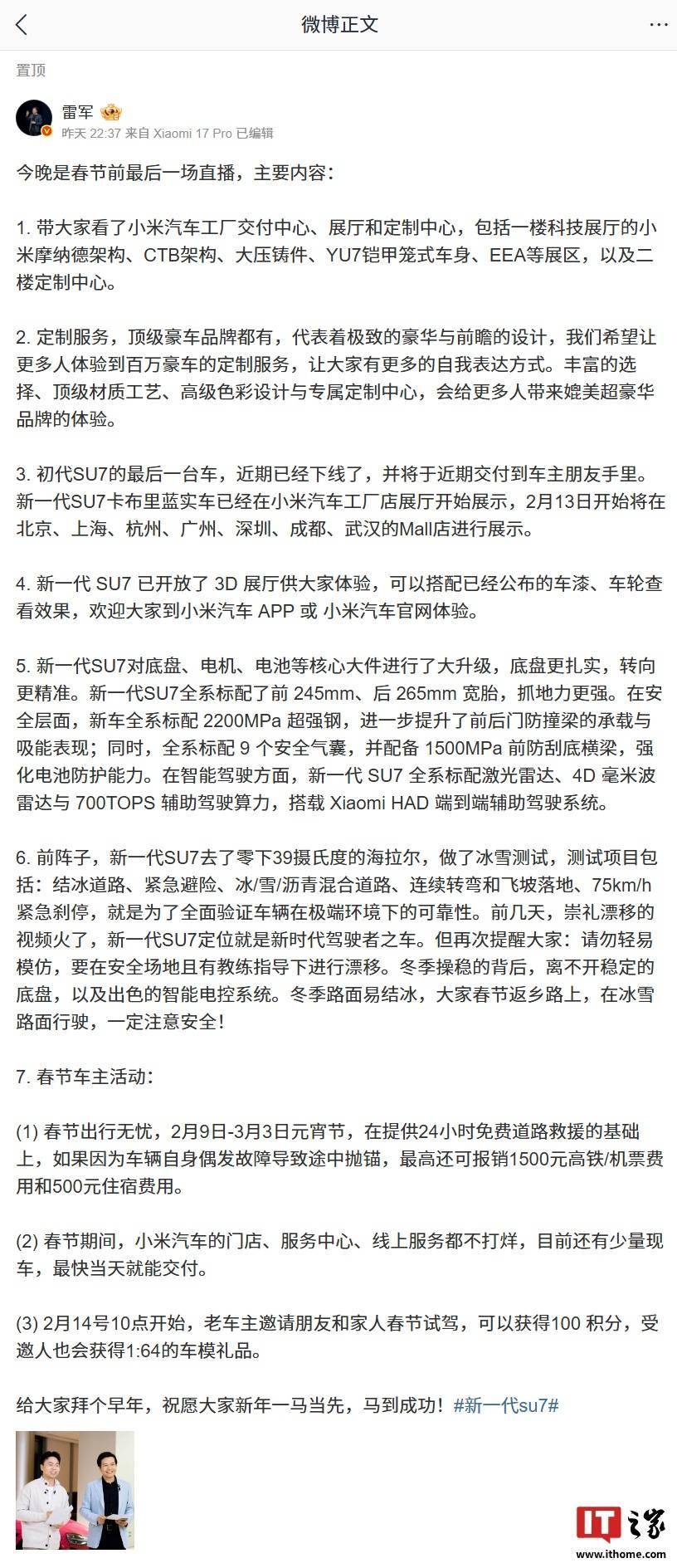
雷军总结昨晚小年直播,称新一代小米SU7定位新时代驾驶者之车
Sou Hu Cai Jing· 2026-02-11 01:17
IT之家 2 月 11 日消息,昨晚的直播结束后,小米创办人、董事长兼 CEO 雷军对小年直播进行了总结,汇总了重点内容: 1. 带大家看了小米汽车工厂交付中心、展厅和定制中心,包括一楼科技展厅的小米摩纳德架构、CTB 架构、大压铸件、YU7 铠甲笼式车身、 EEA 等展区,以及二楼定制中心。 2. 定制服务,顶级豪车品牌都有,代表着极致的豪华与前瞻的设计,我们希望让更多人体验到百万豪车的定制服务,让大家有更多的自我表达方 式。丰富的选择、顶级材质工艺、高级色彩设计与专属定制中心,会给更多人带来媲美超豪华品牌的体验。 3. 初代 SU7 的最后一台车,近期已经下线了,并将于近期交付到车主朋友手里。新一代 SU7 卡布里蓝实车已经在小米汽车工厂店展厅开始展 示,2 月 13 日开始将在北京、上海、杭州、广州、深圳、成都、武汉的 Mall 店进行展示。 4. 新一代 SU7 已开放了 3D 展厅供大家体验,可以搭配已经公布的车漆、车轮查看效果,欢迎大家到小米汽车 App 或小米汽车官网体验。 5. 新一代 SU7 对底盘、电机、电池等核心大件进行了大升级,底盘更扎实,转向更精准。新一代 SU7 全系标配了前 24 ...
技术硬件与设备行业2025年信用回顾与2026年展望
新世纪评级· 2026-02-11 01:17
Investment Rating - The technology hardware and equipment industry is rated as stable for 2025 and 2026 [1] Core Insights - The technology hardware and equipment industry is experiencing a slow recovery driven by inventory replenishment cycles and AI technology, despite overall pressure from weak global economic growth since 2025. There is significant differentiation among sub-industries, with strong demand for data center equipment driven by computing power, while traditional telecom equipment shows sluggish growth [2][3] - The Chinese government has established a policy framework to support the industry, focusing on short-term growth stabilization, medium-term supply chain strengthening, and long-term innovation promotion, primarily through domestic substitution to overcome high-end equipment and material bottlenecks [2] - The industry is expected to benefit from the deepening of digital China initiatives and the industrialization of cutting-edge technologies like AI, entering a structurally growth-driven cycle. However, geopolitical disturbances and rapid technological iterations may lead to uneven recovery across the industry [5] Summary by Sections Industry Overview - The electronic information manufacturing industry is closely tied to global economic conditions, showing signs of recovery since 2024 due to inventory replenishment and AI-driven demand. It is a core industry in China's economic structure transformation and upgrade [7][8] - In 2024, the added value of China's electronic information manufacturing industry grew by 11.8%, outperforming overall industrial and high-tech manufacturing growth rates [8] Financial Performance - Sample companies in the technology hardware and equipment industry reported positive revenue growth year-on-year in 2025, aligning with industry recovery trends. However, high R&D investments and asset impairment losses have pressured net profits, while EBITDA showed year-on-year growth, indicating profit resilience [3] - The debt scale and liability ratios of sample companies have increased, with a decline in the EBITDA coverage ratio for rigid debt, although interest coverage has improved due to lower financing costs [3] Sub-Industry Insights Communication Equipment - The communication equipment sector is experiencing growth opportunities driven by AI and industrial interconnectivity, with significant demand for data center equipment but slow growth in traditional telecom network equipment. The market is highly competitive and concentrated [24][27] - The deployment of high-speed optical modules and data center switches is expected to grow significantly, while traditional telecom equipment investments are declining as operators shift focus to computing power networks [28] Computers and Peripheral Devices - The global PC and server markets are stable, with Chinese manufacturers gaining market share due to domestic substitution. The AI PC segment is becoming a core growth driver, with AI PC shipments expected to increase significantly [37][38] - The global server market is experiencing robust growth driven by AI computing demand, with significant revenue increases expected in the coming years [42] Electronic Devices, Instruments, and Components - The electronic devices, instruments, and components sector is seeing overall recovery driven by AI innovation and domestic supply chain localization. Key areas of growth include computing power chips and advanced packaging [48][49] - The semiconductor industry is entering an upward trend, with significant sales growth expected in both global and Chinese markets [56]



雷军宣布初代小米 SU7 正式停产;《黑神话:钟馗》发布六分钟实机预告;字节、阿里、腾讯连发多个新模型|极客早知道
Sou Hu Cai Jing· 2026-02-11 01:07
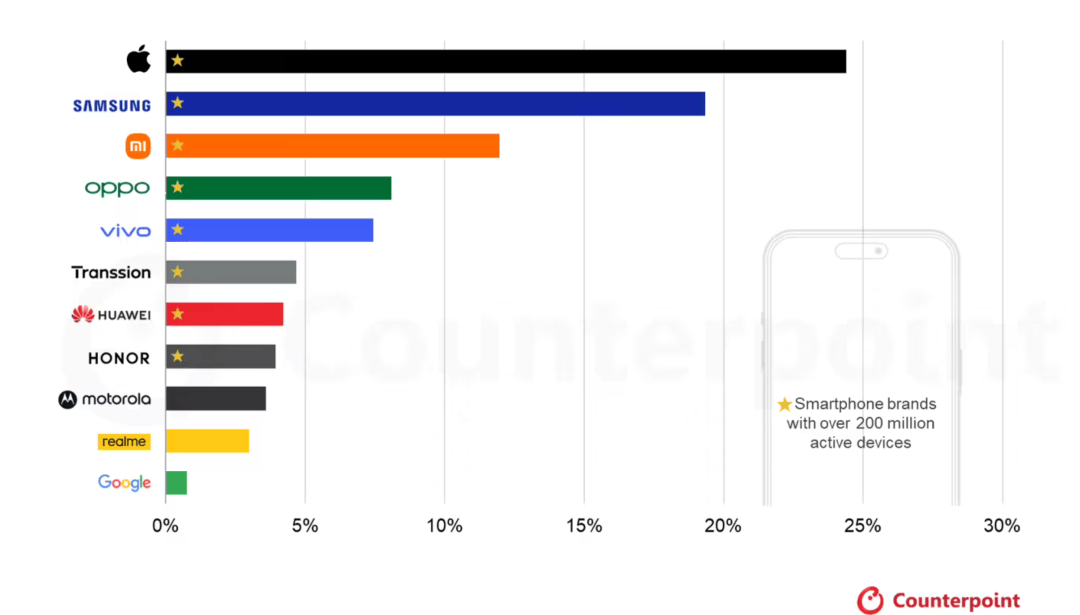
Group 1: Cybersecurity Threats - The RCtea zombie network is rapidly spreading, targeting IoT devices in China, with nearly 10,000 infected devices reported [1][2] - The peak number of active infected devices reached 4,870 in a single day, with a maximum of 278,000 server access requests [1] - The network employs advanced encryption and anti-tracking mechanisms, capable of launching various DDoS attacks [1][2] Group 2: Smartphone Market Insights - By 2025, the global smartphone active device stock is expected to grow by 2%, with an extended replacement cycle nearing four years [3][4] - Eight smartphone brands have surpassed 200 million active devices, collectively holding over 80% of the market share [4] - Apple and Samsung are the only brands with active device counts exceeding 1 billion, together accounting for 44% of the global market [4] Group 3: Automotive Industry Developments - Xiaomi's first-generation SU7 has officially ceased production, with nearly 370,000 units delivered [6][7] - The new generation SU7 is expected to launch in April 2026, with a price range starting from 229,900 yuan [8][9] Group 4: AI and Technology Advancements - GitHub has integrated OpenAI's GPT-5.3-Codex into Copilot, improving performance on agentic coding tasks by approximately 25% [2][3] - ByteDance's Seedream 5.0 image generation model has been launched, enhancing accuracy and speed in image creation [14] - Alibaba's Qwen-Image-2.0 model has been released, achieving high scores in image generation and editing capabilities [15][17] Group 5: E-commerce Trends - Taobao's flash sales for New Year goods saw a 347% increase in sales, with orders from third- and fourth-tier cities rising over 580% [12] - The online retail landscape is shifting, with down-market areas becoming the main consumer base for New Year shopping [12] Group 6: Legal and Corporate Changes - MiHoYo has terminated its partnership with Shanghai Huiye Law Firm, placing it on a blacklist for future collaborations [13] - Envision Energy has withdrawn its lawsuit against MiHoYo, which has been approved by the court [13]


雷军宣布初代小米SU7正式停产
新华网财经· 2026-02-11 00:59
Group 1 - The core point of the article is that Xiaomi's founder, Lei Jun, announced the completion of the production of the first-generation Xiaomi SU7, with nearly 370,000 units delivered [1] - The last unit of the initial Xiaomi SU7 is currently being transported for delivery to the owner [1] Group 2 - During the Spring Festival, Xiaomi's automotive division faced issues with vehicle breakdowns, offering reimbursement of 1,500 yuan for high-speed rail or flight tickets and 500 yuan for accommodation [6]