
ZTO EXPRESS(02057)

Search documents
当前时点如何看待快递“反内卷”?
2025-08-05 03:15
Summary of Conference Call on the Express Delivery Industry Industry Overview - The express delivery industry is facing multiple challenges including intensified market competition, the influence of e-commerce platforms, and regulatory pressures, leading to a pronounced issue of overcapacity [1][2] - Technological advancements and improvements in transportation efficiency are further driving down prices, resulting in reduced cost and brand premium differences among companies, making price competition the primary strategy [1][2] Core Points and Arguments - The regulatory framework aims to alleviate cash flow pressures on franchisees, stabilize employment, enhance service satisfaction, and address issues like illegal charges in rural delivery [1][2] - The "anti-involution" policy is designed to stabilize the competitive baseline of the industry, preventing competition below cost and improving service quality, although it is not expected to change the market structure significantly [1][3] - Price increases have a significant impact on the profitability elasticity of listed companies, but the effects vary by region and customer tier, making it difficult to generalize price increases across the board [1][6] - Major express delivery companies such as Shentong, Yunda, YTO, and ZTO have room for improvement in EPS, but volatility may increase due to recent price increases [1][7] Important but Overlooked Content - The anti-involution policy has positive implications for investors, but the long-term stability of profitability and valuation improvements are limited [4] - The impact of price increases on overall network performance varies; for instance, a price increase of 0.8 to 0.9 yuan per kilogram may have limited overall network impact (15%-20% of the national average) [4] - The express delivery industry is currently experiencing a high concentration level (CR8 at approximately 85%), indicating a clear oligopoly effect, which suggests that while policies may not alter market dynamics, they will influence the competitive baseline [3] - The success of price increases depends on specific conditions, including the need for reasonable profitability and income levels as desired by regulators [5] Future Market Expectations - Market expectations in the coming months will hinge on the implementation of price increases, including specific regions, magnitude, and sustainability [8] - As the industry enters a peak season, the early initiation of price increases in 2025 suggests that further related policies may emerge, likely serving as positive catalysts for the market [8]



港股收盘 | 恒指收涨0.92% 黄金股全天强势 英诺赛科再度强势冲高
Zhi Tong Cai Jing· 2025-08-04 09:02
Market Overview - Hong Kong stocks opened lower but closed higher, with all three major indices ending in the green. The Hang Seng Index rose by 0.92% or 225.64 points, closing at 24,733.45 points, with a total turnover of HKD 2,346.82 million [1] - The Hang Seng Tech Index performed well, increasing by 1.55% to 5,481.25 points, indicating a healthy overall upward trend in the market driven by improving fundamentals and positive policy expectations [1] Blue Chip Performance - New Oriental Education (02057) led blue-chip stocks, rising by 6.49% to HKD 36.58, contributing 2.7 points to the Hang Seng Index. The company reported a 9.4% year-on-year revenue growth for the fourth fiscal quarter, exceeding market expectations [2] - Other notable blue-chip performances included Zhongsheng Holdings (00881) up 5.59%, Lenovo Group (00992) up 4.95%, while Xinyi Glass (00868) fell by 5.87% [2] Sector Highlights - Gold stocks surged due to lower-than-expected U.S. non-farm payroll data, with Shandong Gold (01787) rising by 10.7% and Chifeng Jilong Gold (06693) up 8.89% [3] - Semiconductor stocks also saw significant gains, with Hua Hong Semiconductor (01347) increasing by 8.69% and Shanghai Fudan (01385) up 5.66%, driven by ongoing AI demand and domestic substitution expectations [4] Stablecoin Sector - Stablecoin concept stocks continued to decline, with Yunfeng Financial (00376) down 6.91% and Guotai Junan International (01788) down 6.48%. The recent implementation of the Stablecoin Regulation in Hong Kong has led to stricter licensing requirements, delaying the issuance of licenses until early 2026 [5][6] Notable Stock Movements - InnoCare (02577) saw a significant increase of 30.47% after announcing a partnership with NVIDIA to promote a new power architecture for AI data centers [7] - Huajian Medical (01931) rose by 20.7% following a strategic cooperation agreement with BGI to establish a fund for innovative drug tokenization [8] - Conversely, China Resources Medical (01515) fell by 15.58% due to a profit warning indicating a potential 20% to 25% decline in profit for the upcoming six months [9] Earnings Reports - Xinjiang Xinmin Mining (03833) issued a profit warning, expecting a 50.8% decline in net profit compared to the previous year, despite a slight increase in revenue [10]

港股收盘(8.04) | 恒指收涨0.92% 黄金股全天强势 英诺赛科(02577)再度强势冲高
智通财经网· 2025-08-04 08:55
Market Overview - Hong Kong stocks opened lower but closed higher, with all three major indices ending in the green. The Hang Seng Index rose by 0.92% to 24,733.45 points, with a total turnover of HKD 234.68 billion [1] - The overall upward trend in Hong Kong stocks is considered healthy, shifting from previous risk-averse sentiment to improvements in fundamentals and positive policy expectations [1] Blue Chip Performance - New Oriental-S (02057) led blue-chip stocks, rising by 6.49% to HKD 36.58, contributing 2.7 points to the Hang Seng Index. Its revenue for the fourth fiscal quarter grew by 9.4% year-on-year, exceeding market expectations [2] - Other notable blue-chip performances included Zhongsheng Holdings (00881) up 5.59%, Lenovo Group (00992) up 4.95%, while Xinyi Glass (00868) fell by 5.87% [2] Sector Highlights - Gold stocks performed strongly due to lower-than-expected U.S. non-farm payroll data, with Shandong Gold (01787) rising by 10.7% and Chifeng Jilong Gold Mining (06693) up 8.89% [3] - Semiconductor stocks also saw significant gains, with Hua Hong Semiconductor (01347) up 8.69% and Shanghai Fudan (01385) up 5.66% [4] Stablecoin Sector - The stablecoin sector continued to decline, with Yunfeng Financial (00376) down 6.91% and Guotai Junan International (01788) down 6.48%. The Hong Kong Monetary Authority's new regulations on stablecoins are expected to delay the issuance of licenses until early 2026 [5][6] Notable Stock Movements - InnoCare Pharma (02577) surged by 30.47% after announcing a partnership with NVIDIA to promote a new power architecture for AI data centers [7] - Huajian Medical (01931) rose by 20.7% following a strategic cooperation agreement with BGI [8] - China Resources Medical (01515) fell by 15.58% due to a profit warning, expecting a decline of 20% to 25% in profit for the upcoming six months [9]

交通运输行业周报(20250728-20250803):聚焦:继续强调“反内卷”下快递投资机会-20250804
Huachuang Securities· 2025-08-04 05:14
证 券 研 究 报 告 交通运输行业周报(20250728-20250803) 一、聚焦:继续强调"反内卷"下电商快递投资机会 1、 以史为鉴:"反内卷"在快递行业是否有效且能否持续推进? 1)从 21 年经验看,义乌地区率先涨价并逐步扩散。根据邮管局数据计算,21 年 9 月义乌地区单票价格 2.94 元,环比 8 月 2.64 元上涨 0.3 元,价格同比由 8 月的-16%迅速收窄至-1%;此后,在 21 年四季度,价格仍表现坚挺,10 月 义乌地区单票收入同比回正至+2%,11-12 月同比+8%,2022 年 1-8 月依然保 持同比正增。而从全国范围看,申通、韵达、圆通单票收入环比持续提升,可 推测涨价落地并逐步扩散。21 年 9 月三家环比分别上涨 0.16、0.09 和 0.15 元, 到 11 月三家相较于 8 月分别上涨 0.51、0.33、0.46 元(当中包含旺季季节性 涨幅)。同比看,圆通 21 年 8 月实现单票同比转正,21 年 11 月三家均实现价 格同比正增。2)2021 年-22 年的经验看,行业具备价格-盈利提升的传导潜力。 最为显著的,如圆通从 21Q3 的单票扣非净利 ...
金十图示:2025年08月04日(周一)中国科技互联网公司市值排名TOP 50一览




news flash· 2025-08-04 02:59
Core Viewpoint - The article presents the market capitalization rankings of the top 50 Chinese technology and internet companies as of August 4, 2025, highlighting significant players in the industry and their respective valuations in billions of USD [1]. Group 1: Top Companies by Market Capitalization - TSMC leads the ranking with a market capitalization of $121.99 billion [3]. - Tencent Holdings follows in second place with a valuation of $63.46 billion [3]. - Alibaba ranks third with a market cap of $27.92 billion [3]. - Xiaomi Group is fourth with a market capitalization of $18.07 billion [3]. - Pinduoduo holds the fifth position with a valuation of $15.62 billion [3]. Group 2: Additional Notable Companies - Meituan ranks sixth with a market cap of $9.45 billion [4]. - NetEase is seventh with a valuation of $8.06 billion [4]. - SMIC (Semiconductor Manufacturing International Corporation) is eighth with a market cap of $5.24 billion [4]. - Dongfang Fortune ranks ninth with a valuation of $5.11 billion [4]. - JD.com is in tenth place with a market capitalization of $4.46 billion [4]. Group 3: Rankings and Changes - Kuaishou is ranked eleventh with a market cap of $4.16 billion [5]. - Tencent Music holds the twelfth position with a valuation of $3.18 billion [5]. - Baidu is thirteenth with a market cap of $2.96 billion [5]. - Li Auto ranks fourteenth with a valuation of $2.70 billion [5]. - Beike is fifteenth with a market capitalization of $2.17 billion, showing an increase in ranking by 11 spots [5].


港股收盘 | 恒指收跌1.07% 稳定币概念大幅回落 英诺赛科大涨30%
Zhi Tong Cai Jing· 2025-08-01 08:55
港股8月开局不利,三大指数继续承压走低,尾盘跌幅有所扩大。截止收盘,恒生指数跌1.07%或265.52 点,报24507.81点,大市交投缩减,全日成交额为2546.74亿港元;恒生国企指数跌0.88%,报8804.42 点;恒生科技指数跌1.02%,报5397.4点。全周来看,恒指累跌3.47%,国指累跌3.78%,恒科指累跌 4.94%。 东吴证券指出,往后看,市场担心海外风险上行。一是,美元资产继续上涨,或会导致全球资金减少对 中国资产的关注;二是,对等关税截止日临近,市场预期关税博弈更偏向税率"缓"+"降"。交银国际认 为,港股市场当前流动性状态仍较为充裕,估值水平保持合理,适度的市场拥挤度也为投资者提供了较 为理想的配置窗口。 蓝筹股表现 5.71港元。 1.个别快递股逆市走高。截至收盘,中通快递-W(02057)涨7.44%,报163.2港元;极兔速递-W(01519)涨 2.52%,报10.58港元。 7月29日,国家邮政局召开快递企业座谈会,就依法依规治理行业"内卷式"竞争,强化农村地区领取快 件违规收费等突出问题整治,促进行业高质量发展进行座谈交流。据现代物流报,7月17日义乌邮管局 已率先 ...


港股收盘(08.01) | 恒指收跌1.07% 稳定币概念大幅回落 英诺赛科(02577)大涨30%
智通财经网· 2025-08-01 08:53
Market Overview - The Hong Kong stock market started poorly in August, with the Hang Seng Index closing down 1.07% at 24,507.81 points, and a total trading volume of 254.67 billion HKD [1] - The Hang Seng Index fell 3.47% over the week, while the Hang Seng China Enterprises Index and the Hang Seng Tech Index dropped 3.78% and 4.94%, respectively [1] - Concerns about rising overseas risks are prevalent, including the increase in dollar assets potentially reducing global interest in Chinese assets [1] Blue-Chip Performance - ZTO Express (02057) led blue-chip stocks, rising 7.44% to 163.2 HKD, contributing 7.92 points to the Hang Seng Index [2] - Other notable blue-chip performances included Xinyi Solar (00968) up 1.31% and Baidu Group (09888) up 1.06%, while Sinopec (00386) and PetroChina (00857) saw declines of 5.87% and 3.26%, respectively [2] Sector Highlights - The logistics sector saw a positive response to anti-competitive policies, with ZTO Express and Jitu Express (01519) both rising [3] - The photovoltaic sector was active following the Ministry of Industry and Information Technology's announcement of energy-saving inspections, with several solar stocks showing gains [4] - The stablecoin sector experienced a significant downturn after the implementation of the Stablecoin Regulation in Hong Kong, with major declines in related stocks [5][6] Notable Stock Movements - Joy City Property (00207) surged 45.95% after announcing a share buyback plan at a premium price [7] - InnoCare Pharma (02577) rose 30.91% following its inclusion in NVIDIA's partner list for 800V DC power architecture [8] - NIO Inc. (09866) saw an 8.62% increase after launching its new flagship SUV model [9] - Innovent Biologics (09939) faced a 16.8% drop due to a planned share placement at a discount [10] - Sinopec's stock fell 5.87% after a profit warning indicating a significant year-on-year decline in net profit [11]
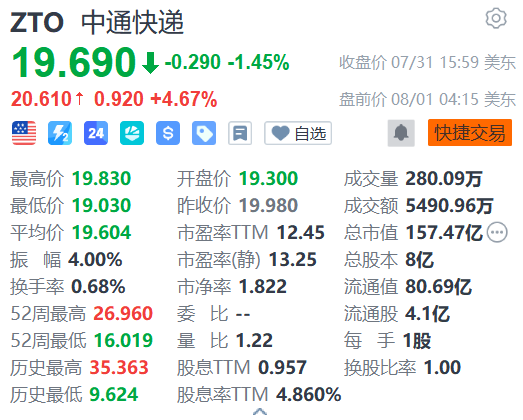
美股异动 | 中通快递盘前涨超4% “反内卷”背景下快递价格有望修复
Ge Long Hui· 2025-08-01 08:28
| ZTO 中通快递 | | 03 | | --- | --- | --- | | 19.690 ↓ -0.290 -1.45% | | | | 20.610 ↑ 0.920 +4.67% | | 盘前价 08/01 04:15 美东 | | 盤 ½ 24 じ S S 同 ♥ 自选 | | ● 快捷交易 | | 最高价 19.830 | 开盘价 19.300 | 成交量 280.09万 | | 最低价 19.030 | 昨收价 19.980 | 成交额 5490.96万 | | 平均价 19.604 | 市盈率 TM 12.45 | 总市值 157.47亿 (…) | | 振 幅 4.00% | 市盈率(静) 13.25 | 总股本 8亿 | | 换手率 0.68% | 市净率 1.822 | 流通值 80.69亿 | | 52周最高 26.960 委 比 -- | | 流通股 4.1亿 | | 52周最低 16.019 | 量 比 1.22 | 色 手 1 股 | | 历史最高 35.363 | 股息TTM 0.957 换股比率 1.00 | | | 历史最低 9.624 | 股息率TM 4.860% | ...
浙商证券:“反内卷”背景下 快递价格有望修复
Zhi Tong Cai Jing· 2025-08-01 07:47
Core Viewpoint - The express delivery industry is expected to see price stabilization and potential recovery in performance due to government policies against "involution" and recent mergers and acquisitions [1][4]. Short-term Price Stabilization - The express delivery industry has maintained a double-digit growth rate in volume since 2025, with an expected growth rate of 15% for the year. However, due to intense price competition among leading companies, the performance of franchise express companies has declined in Q1 2025, and this trend may continue into Q2 2025 [2][3]. Policy Background and Price Recovery - Under the guidance of local postal authorities, express delivery prices in certain grain-producing areas have shown signs of stabilization. As the off-peak season ends and the peak season begins in September, a broader price recovery is anticipated, which may alleviate the pressure on franchise operators and improve overall industry sentiment. A price increase of 0.1 yuan is estimated to increase net profit per share by 0.0375 yuan for listed companies [3][4]. Long-term Competitive Ecology Optimization - On July 25, Shentong announced a cash acquisition of 100% of Daniao Logistics for 362 million yuan. This move aims to create a dual business matrix of "economical express + quality express," optimizing product structure and capturing new market opportunities. The State Post Bureau has been encouraging mergers and acquisitions in the express delivery sector, which is expected to lead to a healthier industry structure and improved competitive ecology, presenting investment opportunities [4][5]. Investment Recommendations - Despite significant operational pressure in the express delivery sector in H1 2025, the potential for performance recovery in the short term and competitive ecology optimization in the long term suggests that express companies may see improved results. Recommendations include Jitu Express, Shentong, YTO Express, Zhongtong, and Yunda Express due to their respective growth prospects and market positions [5].

港股午评 恒生指数早盘跌0.18% 英诺赛科(02577)飙升30%
Jin Rong Jie· 2025-08-01 05:11
Group 1 - The Hang Seng Index fell by 0.18%, down 45 points, closing at 24,727 points, while the Hang Seng Tech Index decreased by 0.12% [1] - In the semiconductor sector, InnoSilicon became the only Chinese chip manufacturer included in NVIDIA's latest 800V architecture supplier list, leading to a more than 30% increase in InnoSilicon's stock [1] - The Ministry of Industry and Information Technology issued a special energy-saving inspection task list for the polysilicon industry, boosting the solar panel sector, with notable stock increases for companies like Kaisheng New Energy (up over 5%) and Fuyao Glass (up over 4%) [1] Group 2 - Stone Pharmaceutical Group's stock rose over 6% after announcing a more than $2 billion overseas business development deal [2] - Ruihe Smart's stock surged over 10% following a profit warning, with expected net profits for the first half of the year reaching up to 44 million yuan, marking a turnaround from losses [3] - Inspur Digital Enterprises' stock increased nearly 6%, reaching a new high, with expected net profits for the first half of the year up to 190 million yuan, supported by its parent company Inspur Group [4] Group 3 - Xirui's stock rose over 4%, reaching a new high, as institutions predict rapid growth in the private aviation market [5] - Qiniu Intelligent's stock increased by over 8%, with its AI model user base surpassing 10,000, marking a significant milestone in its AI strategy [6] - Tsugami Machine Tool's stock rose over 5%, with its Japanese division reporting a 38.1% year-on-year increase in profits for the first quarter [7] Group 4 - New Macau International Development's stock fell over 4%, with its subsidiary New Macau Borya reporting a nearly 20% year-on-year decline in net income for the second quarter [7] - Kintor Pharmaceutical's stock plummeted over 16% after the company announced a discounted placement of shares at an 18.75% discount, raising approximately 40.34 million Hong Kong dollars [7]