AUNTEA JENNY(02589)

Search documents
沪上阿姨上市后,背后投资大佬首次公开……
创业家· 2025-06-03 09:58
Core Viewpoint - The article discusses the successful strategies employed by companies like "沪上阿姨" and "锅圈食汇" to achieve rapid expansion and significant market presence, emphasizing the importance of high goals and operational efficiency in scaling business models [2][9][19]. Group 1: Company Performance - "沪上阿姨" was listed on the Hong Kong Stock Exchange on May 8, with an initial price of 113.12 HKD per share, opening at 190.6 HKD, reflecting a 68.5% increase from the issue price [2]. - "锅圈食汇" expanded its store count from over 3,000 to 10,000 within three years, achieving a successful listing in just six years since its establishment [4]. Group 2: Business Strategy - The methodology for scaling from hundreds to thousands of stores is termed "refusing to be small and beautiful, moving towards 'high-end'" which involves setting high goals, large aspirations, and rapid execution [7][19]. - The concept of "market value to finance" is introduced, where a target of 30 billion in revenue corresponds to a profit of 1.5 billion, establishing a framework for achieving a market value of 1,000 billion [9][10]. Group 3: Operational Framework - The operational strategy includes a four-step process: from financial targets to business execution, validating business models against market support, and aligning organizational capabilities to meet ambitious goals [10][11][19]. - A "pressure testing" approach is recommended, where operational capabilities are tested against high targets to identify and resolve organizational weaknesses [13][14][19]. Group 4: Future Outlook - The article highlights the importance of adapting to changing market conditions, particularly in the context of global trade dynamics and technological advancements, suggesting that companies must evolve or risk obsolescence [21][22].


沪上阿姨上市,背后投资大佬首次公开……
创业家· 2025-06-01 09:58
Core Viewpoint - The article discusses the successful listing of "沪上阿姨" on the Hong Kong Stock Exchange and highlights the growth strategies of companies like "锅圈食汇" in the current challenging business environment [1][4]. Group 1: Company Performance - "沪上阿姨" was listed on May 8 at an issue price of HKD 113.12 per share, opening at HKD 190.6, representing a 68.5% increase from the issue price [1]. - "锅圈食汇" expanded its store count from over 3,000 to 10,000 within three years, achieving a significant milestone by listing on the Hong Kong Stock Exchange just six years after its establishment [4]. Group 2: Growth Strategy - The methodology for scaling from hundreds to thousands of stores is termed "refusing to be small and beautiful, moving towards 'high-end'" [6]. - The first step in achieving high goals is "market value to finance," where a target net profit margin of 5%-6% is set against projected sales to determine necessary revenue [9]. - The second step is "finance to business," where sales targets are translated into operational metrics, such as the number of stores and average sales per store [10][11]. - The third step involves validating business models against market conditions, ensuring that the operational assumptions are feasible [11]. - The fourth step is "market to organization," focusing on internal capabilities to meet market demands [11]. Group 3: Setting Aspirations - High goals should be translated into "big wishes" that resonate with stakeholders, similar to how Alibaba's Jack Ma framed his ambitious sales targets [12]. - For "锅圈食汇" and "沪上阿姨," the big wish is to make franchisees the happiest in China, aiming to create numerous millionaires and billionaires [12]. Group 4: Speed and Pressure Testing - The article emphasizes the importance of speed in execution, with successful chains achieving rapid expansion, such as opening 300 new stores monthly [13]. - A "pressure testing" methodology is introduced to identify and address organizational weaknesses under high operational demands [13][14]. - The pressure testing process involves setting ambitious targets, quantifying challenges, requesting resources, and aligning timelines across departments [16][17]. Group 5: Preconditions for Success - The success of the pressure testing approach relies on having a solid single-store model, ensuring that a majority of franchisees can recoup their investments within 18 months [18]. - The article concludes that to scale from hundreds to thousands of stores, companies must focus on high aspirations while ensuring operational excellence and product-channel alignment [18].
杯盏间的刀光剑影:茶饮股的营销博弈之道
Jin Rong Jie· 2025-05-30 12:49
Core Insights - The article highlights the contrasting business models of tea beverage brands in China, with a focus on the shift from self-operated models to asset-light franchise operations, exemplified by brands like Mixue and Bawang Chaji [1][29]. Business Models - Mixue and other emerging brands like Gu Ming, Hu Shang A Yi, and Cha Bai Dao primarily adopt a franchise model for rapid expansion, generating revenue mainly from supplying products and equipment to franchisees rather than from franchise fees [1][2]. - In contrast, traditional franchise models, such as McDonald's, rely heavily on rental income and franchise fees, providing a safety net even if franchisees perform poorly [2]. Marketing Strategies - Mixue employs social media and various offline activities to engage consumers, with a marketing expenditure of 1.599 billion RMB in 2024, representing 6.44% of total revenue [3][4]. - Gu Ming's marketing spending surged by 42.43% to 479 million RMB, accounting for 5.45% of its revenue [5][6]. - Hu Shang A Yi focuses on a multi-channel marketing approach, with a marketing budget of 394 million RMB, which is 12.0% of its revenue [7][9]. - Cha Bai Dao's marketing expenses increased by 201.64% to 395 million RMB, making up 8.03% of its revenue, reflecting the competitive landscape [10][11]. - Bawang Chaji's marketing costs skyrocketed by 323.96% to 1.109 billion RMB, constituting 8.94% of its revenue, indicating aggressive promotional efforts [12]. Store Expansion - Mixue has expanded to 46,500 stores globally, with a significant presence in lower-tier cities, where 51.33% of its stores are located [13][14]. - Gu Ming has established a presence in 17 provinces, with 80% of its stores in second-tier and below cities, indicating a focus on untapped markets [15][16]. - Hu Shang A Yi operates 9,176 stores across various regions, with 50.4% in lower-tier cities, and has begun international expansion [18][19]. - Cha Bai Dao has increased its store count in lower-tier cities, with plans for further expansion and improved logistics [22]. - Bawang Chaji has rapidly expanded to 6,440 stores, with a notable presence in East China, but faces challenges in maintaining growth [23][24]. Franchisee Retention - The article discusses the importance of franchisee retention rates as a measure of brand attractiveness, with Mixue showing a lower franchisee turnover rate compared to its competitors [26][28]. - Mixue's franchisee turnover rate is approximately 6.97%, while Gu Ming, Hu Shang A Yi, and Cha Bai Dao report significantly higher rates of 18.88%, 19.47%, and 20.66%, respectively [28]. Conclusion - The article concludes that the new tea beverage brands are reshaping the industry with a franchise ecosystem that emphasizes supply chain efficiency over traditional rental models [29]. - Mixue stands out for its effective low-cost marketing strategy, while Bawang Chaji's aggressive expansion raises questions about sustainable growth [29].
沪上阿姨上市后,背后投资大佬首次公开……
创业家· 2025-05-27 10:02
Core Viewpoint - The article discusses the successful strategies employed by companies like "沪上阿姨" and "锅圈食汇" to achieve rapid growth and expansion in the competitive market, emphasizing the importance of high goals, financial metrics, and organizational efficiency [1][3][18]. Group 1: Company Growth Strategies - "沪上阿姨" went public on May 8, with an opening price of 190.6 HKD, a 68.5% increase from its issue price of 113.12 HKD [1]. - "锅圈食汇" expanded its store count from over 3,000 to 10,000 within three years, demonstrating rapid growth since its establishment just six years ago [3]. - The methodology for scaling from hundreds to thousands of stores is termed "refusing small and beautiful, moving towards 'high-end'" [5][18]. Group 2: Financial Metrics and Business Model - The concept of "市值到财务" (market value to financials) is introduced, where a target net profit margin of 5%-6% implies a need for 600 billion in sales to achieve a market value of 1 trillion [9]. - The second step, "财务到业务" (financials to business), involves determining feasible sales and store counts, with a focus on achieving 600 billion in sales through a realistic number of stores [10]. - The importance of validating the business model is highlighted, ensuring that a significant percentage of franchisees can recoup their investment within 18 months [18]. Group 3: Organizational Efficiency - The article emphasizes the need for a "pressure testing" approach to identify and resolve organizational weaknesses, allowing for a target of opening 300 stores per month [12][17]. - The pressure testing process involves setting ambitious goals, quantifying difficulties, requesting resources, and aligning timelines across departments [15][16]. - Successful implementation of these strategies has led to consistent monthly openings of 300 stores, demonstrating the effectiveness of the pressure testing methodology [17].

沪上阿姨成功上市,背后的投资大佬赢麻了
创业家· 2025-05-23 09:59
Core Viewpoint - The article emphasizes the importance of national consumer brands adapting to market changes and outlines five key strategies for success in the current economic environment [6][8]. Group 1: Successful Brand Strategies - The first strategy is that brands capable of penetrating lower-tier markets are considered good national brands [6]. - The second strategy highlights the necessity of targeting central regions in China, specifically the four provinces of Henan, Hebei, Shandong, and Shanxi, which collectively have over 300 million people [6]. - The third strategy focuses on maintaining sales during off-peak seasons, suggesting that brands should aim to eliminate seasonal downturns [6]. - The fourth strategy stresses the importance of integrating product and channel, as seen in successful brands like Guoquan Shihui and Hu Shang Ayi [6]. - The fifth strategy emphasizes the significance of the sequence of people, products, and places, advocating for a focus on younger demographics and specific product categories [6][8]. Group 2: Market Trends and Future Outlook - The article notes a shift from influencer brands to national brands, with a focus on value-for-money and market penetration [8]. - It mentions the upcoming challenges in 2025, including an escalation in global trade wars and the restructuring of business logic due to AI advancements [9]. - The narrative suggests that this period is not a crisis but rather a golden opportunity for innovators and entrepreneurs [10]. Group 3: Upcoming Events - The article promotes a significant event scheduled from June 6 to June 8, 2025, featuring prominent industry leaders and experts [11][12]. - It highlights the event as a platform for entrepreneurs to connect, share ideas, and gain insights into the evolving market landscape [11].

年报盘点|赚最多的蜜雪冰城董事长年薪超千万,古茗、沪上阿姨管理层总薪资腰斩
Di Yi Cai Jing· 2025-05-21 10:36
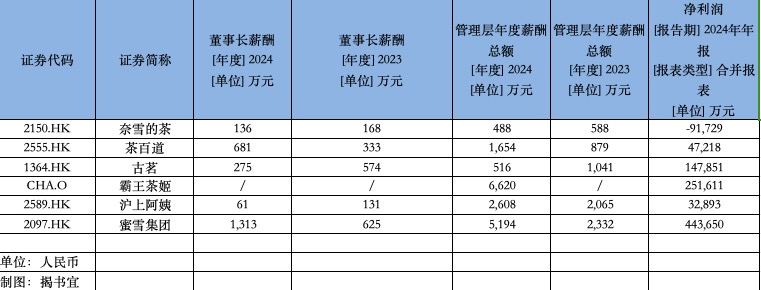
Core Insights - The tea beverage industry is witnessing rapid growth, with BaWang Tea Ji emerging as the fastest-growing player in 2024, despite not being the most profitable [1][4] - The new tea beverage sector is expected to heat up with several companies planning to go public in 2025, as financial disclosures reveal management compensation for 2024 [1] Group 1: Management Compensation - In the new tea beverage industry, disclosed CEO salaries range from 606,000 to 13.128 million RMB, showing significant disparity [2] - BaWang Tea Ji reported the highest management compensation at 66.2 million RMB (approximately 9.1 million USD) for 2024, surpassing other companies [2] - MiXue Group followed with a total management compensation of 53.14 million RMB, ranking second among listed companies [3] Group 2: Financial Performance - MiXue Ice City led the industry with a net profit of 4.4 billion RMB in 2024, while BaWang Tea Ji ranked second with a profit of 2.5 billion RMB [3][4] - BaWang Tea Ji expanded its store count to 6,440, achieving a revenue growth of 167% to 12.4 billion RMB and a net profit increase of 213% [4] - GuMing reported a revenue of 8.791 billion RMB, a year-on-year growth of 14.45%, with a net profit of 1.542 billion RMB, reflecting a 36.95% increase [4] Group 3: Market Trends - The new tea beverage market in China exceeded 300 billion RMB last year, indicating a gradually saturated market with brands entering a phase of stock competition [5] - The market is projected to maintain slight but stable growth, potentially surpassing 400 billion RMB by 2028 [5] - The industry is characterized by a competitive landscape where larger players may acquire smaller ones, with companies having fewer than 3,000 stores likely to exit the market [5]
沪上阿姨升级果蔬茶增加膳食纤维,新茶饮迈入健康消费新时代
Nan Fang Du Shi Bao· 2025-05-19 11:00
Core Viewpoint - The new tea beverage industry is entering a "health upgrade era," with companies focusing on product innovation and nutritional enhancement to meet evolving consumer demands for healthier options [2][5]. Group 1: Product Innovation - Hu Shang A Yi is launching five new upgraded "Super Fruit and Vegetable Tea Series" products, each containing over 5g of dietary fiber, which can fulfill 20%-35% of the daily dietary fiber requirement for adults [3][4]. - The new products include combinations of various fruits and vegetables, such as kale, dragon fruit, and tomatoes, aimed at providing a convenient way for consumers to incorporate health into their daily lives [3][4]. Group 2: Consumer Health Trends - There is a growing consumer demand for healthier beverage options, with a significant focus on dietary fiber intake, as the average daily fiber consumption for the 18-35 age group in China is only 11.8g, well below the recommended 25-30g [3][5]. - The health consciousness among consumers is shifting the focus from taste alone to the health benefits of ingredients, with 63.0% of consumers prioritizing flavor and 35.3% considering the healthiness of ingredients when choosing ready-to-drink tea [6][7]. Group 3: Industry Standards and Recommendations - The "White Paper" provides guidelines for the tea beverage industry to enhance dietary fiber and other nutritional components while reducing sugars and unhealthy fats, aiming to address product homogeneity and optimize supply chains [6][7]. - Hu Shang A Yi's CEO emphasizes the commitment to improving product innovation and building a high-quality supply chain to support the health upgrade trend in the tea beverage industry [7].

商贸社服行业周报:keeta宣布进入巴西市场,京东外卖日订单量突破2000万-20250519
CMS· 2025-05-19 08:44
Investment Rating - The report maintains a "strong buy" rating for key companies in the e-commerce, local life, and shared mobility sectors, including Alibaba, JD Group, Pinduoduo, Meituan, and Didi Chuxing [18][20][19]. Core Insights - The e-commerce sector is expected to see a stable increase in profits, with leading companies currently undervalued, recommending Alibaba, JD Group, Pinduoduo, and Vipshop [18]. - Meituan's core business profits exceeded expectations, with significant growth in its takeaway services and plans for global expansion [19]. - Didi Chuxing is projected to maintain stable growth and profitability, supported by a solid user base and supply chain [20]. - Ctrip's overseas business is anticipated to grow steadily, with a projected revenue increase of 14%-15% in 2025 [21]. Industry Performance - The restaurant and tourism sector index decreased by 0.26%, underperforming compared to the Shanghai Composite Index, which rose by 1.12% [5][7]. - The retail sector index increased by 2.23%, outperforming both the Shanghai Composite Index and the ChiNext Index [5][7]. - The report highlights that the restaurant and tourism sector has seen a decline of 2.79% since the beginning of 2025, while the retail sector has decreased by 2.61% [7]. Key Company Recommendations - E-commerce: The competitive landscape is better than expected, with a recommendation for Alibaba, Pinduoduo, JD Group, and Vipshop [18]. - Local Life: Meituan's core business is expected to continue growing rapidly, with a target price of 178.8 HKD based on a 20x PE ratio [19]. - Shared Mobility: Didi Chuxing is recommended due to its stable market share and significant profit growth potential [20]. - OTA: Ctrip's revenue for Q4 2024 is projected at 12.74 billion CNY, with a 23.4% increase year-on-year [20]. Major News - JD's takeaway service surpassed 20 million daily orders within 75 days of launch, indicating strong market penetration [28]. - Keeta announced its entry into the Brazilian market, planning to invest 1 billion USD over five years [30]. - The successful IPO of the tea brand "Hushang Ayi" on the Hong Kong Stock Exchange, opening with a 68.49% increase [25].



港股概念追踪|新茶饮赛道上演资本市场“敲钟潮” 头部品牌发展势头强劲(附概念股)
智通财经网· 2025-05-19 06:43
Group 1 - The HuRun Research Institute released the "2025 HuRun China New Tea Beverage Brand TOP 20," featuring brands like Mixue Ice City, Gu Ming, and Heytea [1] - Chinese companies account for over half of the 47 food and beverage enterprises on the global unicorn and future unicorn list, with 26 brands, including new tea beverage brands [1] - The new tea beverage industry has deeply integrated into the Chinese tea industry chain, with the tea used by these brands accounting for nearly 10% of China's total tea production [1] Group 2 - The global ready-to-drink beverage market is expected to grow at a compound annual growth rate (CAGR) of 7.2% from 2023 to 2028, reaching a market size of $1,103.9 billion by 2028 [1] - China and Southeast Asia are projected to be the fastest-growing markets during 2023-2028, with respective CAGRs of 17.6% and 19.8%, contributing nearly 40% of the global market growth [1] - On May 8, Heytea successfully listed on the Hong Kong Stock Exchange, while Green Tea Group initiated its IPO on the same day, indicating a trend of mainland restaurant companies pursuing dual strategies of opening stores and listing in Hong Kong [1] Group 3 - Notable brands like Mixue Group, Haidilao, and Green Tea Group are among those aiming for IPOs in Hong Kong, leveraging the market for international experience and capital [2] - Mixue Ice City has established its leading position in the competitive ready-to-drink beverage market through supply chain scale effects and a strong brand image [2] Group 4 - Relevant companies in the tea beverage industry listed on the Hong Kong Stock Exchange include Mixue Group (02097), Cha Bai Dao (02555), Heytea (02589), Gu Ming (01364), Nai Xue's Tea (02150), and Green Tea Group (06831) [3]
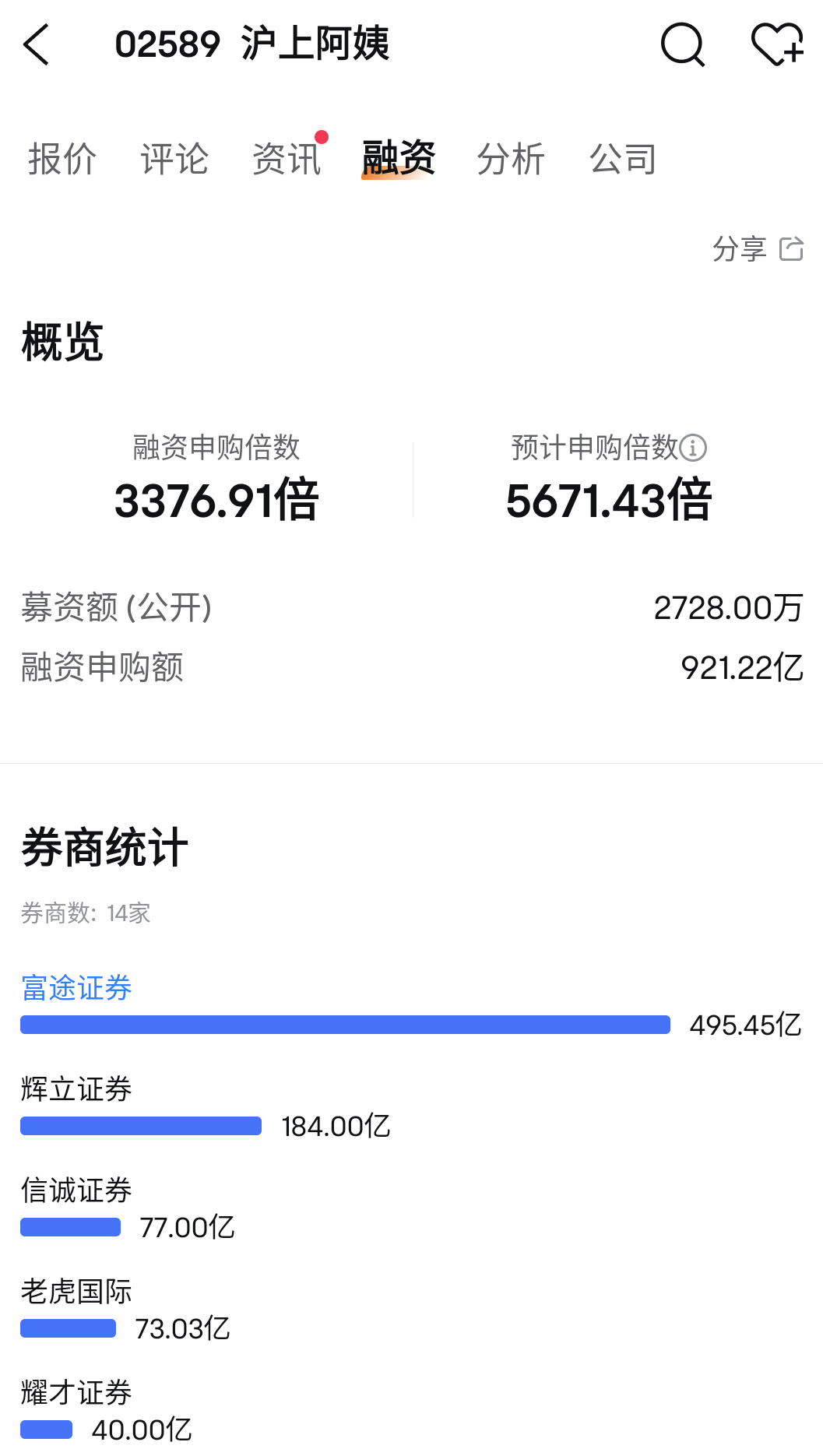
3377倍神话!最强夫妻档揭秘:年轻人的钱,正在撑起港股消费牛市
Sou Hu Cai Jing· 2025-05-18 06:23
Group 1 - The core viewpoint of the article highlights the resurgence of the Hong Kong capital market, particularly in the new tea beverage sector, with significant IPO activities and investor interest [1][7][9] - The new tea beverage companies, including Hu Shang A Yi, have seen overwhelming subscription rates, with Hu Shang A Yi's IPO achieving a subscription rate of 3377 times and raising 272.8 million HKD [1][7] - The market has witnessed a wave of new listings from various consumer companies, indicating a trend where many brands are opting for Hong Kong as their listing destination [9][19] Group 2 - Hu Shang A Yi, founded by a couple in Shanghai, has expanded rapidly from a single store to over 9,176 stores by the end of 2024, driven by a focus on lower-tier cities [10][12][15] - The company is projected to generate revenue of 3.28 billion RMB in 2024, with nearly half of its income coming from third-tier cities and below [15] - The new tea beverage sector had previously experienced a lull in IPO activities, but recent successful listings have reignited investor interest and confidence in the market [16][19] Group 3 - The article discusses the changing consumer landscape, where younger consumers are driving new trends and preferences, leading to a shift in valuation logic for companies [20][23] - The success of companies like Mi Xue Bing Cheng and the emergence of new players have set valuation benchmarks, encouraging more consumer companies to pursue IPOs [26] - Policy changes favoring consumer companies in Hong Kong, such as lower profitability requirements for listings, have attracted many businesses to the market [27][28]