
MEITUAN(03690)

Search documents
港股收评:三大指数齐涨!半导体、机器人概念股强势,风电股低迷
Ge Long Hui· 2025-12-30 08:49
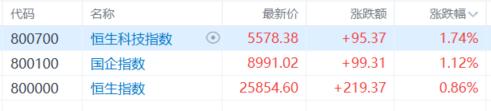
Market Overview - The Hong Kong stock market saw all three major indices rise, with the Hang Seng Technology Index increasing by 1.74%, the Hang Seng Index by 0.86%, and the National Enterprises Index by 1.12% [1][2]. Technology Sector - Major technology stocks collectively rose, with Baidu surging nearly 9%, and NetEase and Xiaomi both increasing over 2%. Other notable gains were seen in JD.com, Tencent, Alibaba, and Meituan [5][6]. - Semiconductor stocks also experienced significant gains, led by InnoCare, which rose over 15%, while major players like SMIC increased by over 4% [7][8]. New Listings - Six new stocks were listed on the Hong Kong market, with notable increases including InnoSilicon up 24.66%, and Wuyiyi Vision up 29.9% [3]. Energy Sector - Oil stocks strengthened, with CNOOC rising nearly 4% as international oil prices surged due to heightened geopolitical risks. WTI crude surpassed $58 per barrel, and Brent approached $62 per barrel [14]. Entertainment Sector - The film and entertainment sector was active, with Emperor Culture Industries rising nearly 9%. The 2025 box office has already surpassed 5.3 billion yuan, marking a new high in recent years [13]. Wind Power Sector - Wind power stocks fell sharply, with Goldwind Technology dropping nearly 11%, alongside declines in other related companies [16][17]. AI and Robotics Sector - AI application companies like MaiFusTech saw significant gains, rising over 11% after announcing strategic partnerships with major tech firms [18][21]. - Robotics stocks also performed well, with Sanhua Intelligent Control increasing over 12% [11]. Investment Outlook - Analysts suggest that the Hong Kong market may continue to trend upward due to supportive domestic policies and a weaker US dollar. There is a focus on technology growth and high dividend strategies as potential investment opportunities [23].





美国人的消费是义务,中国人的消费是权利
3 6 Ke· 2025-12-30 01:58
Core Insights - The financial structure of American consumers is under significant strain, with 37% unable to handle a $400 emergency, indicating a precarious financial situation despite seemingly high incomes [2][8] - In contrast, Chinese consumers exhibit a more flexible spending structure, with a higher proportion of disposable income available for discretionary spending, leading to different consumption behaviors [7][13] Group 1: American Consumer Spending - In the U.S., consumer spending is largely driven by obligations, with essential expenses like housing, transportation, and healthcare consuming over 70% of income, leaving little room for discretionary spending [5][6] - The rising costs of healthcare are particularly burdensome, with average family insurance premiums reaching $26,993 annually, which can significantly impact disposable income [5][6] - The perception of strong consumer spending in the U.S. is misleading, as much of it is tied to rigid expenses rather than discretionary choices [6][8] Group 2: Chinese Consumer Spending - Chinese consumers have a more balanced spending structure, with only 50-55% of income tied to essential expenses, allowing for greater flexibility in discretionary spending [7][8] - Recent data shows that while physical goods consumption is weakening, service consumption is on the rise, indicating a shift in consumer priorities towards experiences rather than ownership [9][12] - The high savings rate in China, estimated at 32.4%, provides a buffer for consumers, allowing them to wait for compelling reasons to spend rather than being forced to spend due to obligations [8][15] Group 3: Investment Implications - Companies reliant on impulsive spending may face challenges as consumers become more budget-conscious, while those with stable cash flows and strong user engagement may be undervalued in the current market [10][11] - Certain sectors, such as experience-based consumption and value-driven products, are likely to benefit from the current consumer behavior shift, as consumers prioritize spending on experiences and affordable options [11][12] - The distinction between passive market declines and active consumer retrenchment is crucial for investment strategies, as the latter may indicate potential for recovery given the substantial savings available [9][13]





筑牢平台经济底座 让外卖骑手有更多获得感
Zhong Guo Qing Nian Bao· 2025-12-30 00:35
Core Viewpoint - Flexible employment and new employment forms have become significant channels for income growth among workers in China, with over 200 million flexible workers reported. The central economic work conference emphasized the need for a win-win development model for platform enterprises, operators, and workers, setting a clear direction for the future of the platform economy [1]. Group 1: Industry Developments - The external competition among delivery platforms has intensified, leading to pressure on merchants and delivery riders. The State Administration for Market Regulation has urged platform companies to adhere to fair competition principles to protect the rights of consumers, merchants, and delivery riders [1]. - A new national standard for delivery platform service management was released, focusing on strengthening the protection of delivery riders' rights [1]. - The government plans to introduce measures to safeguard the rights of new employment form workers, further improving the rights protection system for flexible employment [1]. Group 2: Rider Experiences - Riders like Gu Shutian and Zhang Jinqian have reported positive changes in their lives due to platform policies, such as receiving pension insurance subsidies, which have become foundational for their families [2][3]. - The intense competition during the delivery wars led to mixed experiences for riders, with some benefiting from increased order volumes while others faced challenges due to system overloads and unclear fee structures [6][7]. - The stability of income and job security is a priority for many riders, who prefer consistent earnings over fluctuating high payouts from competitive platforms [9][10]. Group 3: Policy and Social Security - Platforms have begun implementing pension insurance subsidies, with companies like JD and Meituan covering a significant portion of the costs for riders, thus enhancing their social security [12][21]. - The new policies aim to lower the barriers for riders to participate in social insurance, allowing them to choose where to enroll based on their work location or home [16][17]. - Efforts are being made to increase awareness and participation in social insurance among riders, with local governments and platforms collaborating to provide accessible information and services [20][21].

智通港股沽空统计|12月30日
智通财经网· 2025-12-30 00:25
Group 1 - The core viewpoint of the news highlights the short-selling ratios and amounts of various companies, indicating significant market sentiment towards these stocks [1][2]. - AIA Group (81299) and Anta Sports (82020) have the highest short-selling ratios at 100.00%, while Lenovo Group (80992) follows closely with a ratio of 94.69% [1][2]. - The top three companies by short-selling amount are Xiaomi Group (01810) with 2.179 billion, Alibaba Group (09988) with 1.174 billion, and China Merchants Bank (03968) with 1.027 billion [1][2]. Group 2 - The top short-selling ratio rankings show that AIA Group and Anta Sports are at the forefront, both with a ratio of 100.00%, indicating a strong bearish sentiment [2]. - The short-selling amounts for the top companies reveal that Xiaomi Group leads with 21.79 billion, followed by Alibaba Group at 11.74 billion, and China Merchants Bank at 10.27 billion [2]. - The deviation values, which reflect the difference between current short-selling ratios and the average over the past 30 days, show China National Offshore Oil Corporation (80883) at 44.86%, Alibaba Group at 40.72%, and AIA Group at 37.45% [1][2].


智通ADR统计 | 12月30日





智通财经网· 2025-12-29 22:58
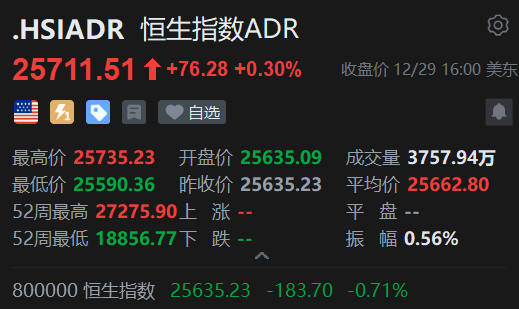
Market Overview - The Hang Seng Index (HSI) closed at 25,711.51, up by 76.28 points or 0.30% from the previous close [1] - The index reached a high of 25,735.23 and a low of 25,590.36 during the trading session [1] - The trading volume was 37.5794 million shares, with an average price of 25,662.80 [1] Blue-Chip Stocks Performance - HSBC Holdings closed at HKD 122.589, an increase of 0.57% from the previous close [2] - Tencent Holdings closed at HKD 598.176, up by 0.28% from the previous close [2] Individual Stock Movements - Tencent Holdings (00700) reported a latest price of HKD 596.500, down by HKD 6.500 or 1.08% [3] - Alibaba Group (09988) closed at HKD 143.300, down by HKD 2.700 or 1.85% [3] - HSBC Holdings (00005) reported a price of HKD 121.900, down by HKD 1.900 or 1.53% [3] - China Construction Bank (00939) increased by HKD 0.060 or 0.79%, closing at HKD 7.620 [3] - Xiaomi Group (01810) decreased by HKD 0.640 or 1.63%, closing at HKD 38.580 [3] - AIA Group (01299) closed at HKD 82.200, down by HKD 1.050 or 1.26% [3] - NetEase (099999) increased by HKD 3.000 or 1.41%, closing at HKD 216.200 [3] - Meituan (03690) closed at HKD 104.200, up by HKD 1.000 or 0.97% [3] - Industrial and Commercial Bank of China (01398) increased by HKD 0.100 or 1.63%, closing at HKD 6.230 [3] - Hong Kong Exchanges and Clearing (00388) closed at HKD 408.200, down by HKD 1.800 or 0.44% [3] - Ping An Insurance (02318) increased by HKD 0.200 or 0.30%, closing at HKD 66.400 [3] - Bank of China (03988) closed at HKD 4.440, up by HKD 0.010 or 0.23% [3] - Ctrip Group (09961) decreased by HKD 4.000 or 0.71%, closing at HKD 559.500 [3] - BYD Company (01211) increased by HKD 3.500 or 3.74%, closing at HKD 97.100 [3] - CITIC Limited (00267) increased by HKD 0.060 or 0.50%, closing at HKD 12.050 [3] - Baidu (098888) closed at HKD 119.100, down by HKD 0.400 or 0.33% [3] - JD.com (09618) decreased by HKD 0.800 or 0.71%, closing at HKD 112.000 [3] - China Hongqiao Group (01378) decreased by HKD 0.560 or 1.73%, closing at HKD 31.760 [3] - Hang Seng Bank (00011) closed at HKD 153.600, down by HKD 0.300 or 0.19% [3] - Kuaishou Technology (01024) decreased by HKD 0.800 or 1.24%, closing at HKD 63.800 [3] - Sun Hung Kai Properties (00016) closed at HKD 94.900, down by HKD 1.700 or 1.76% [3] - Pop Mart International (09992) decreased by HKD 0.300 or 0.15%, closing at HKD 199.900 [3] - BeiGene (06160) increased by HKD 0.300 or 0.16%, closing at HKD 183.800 [3] - China Merchants Bank (03968) increased by HKD 0.550 or 1.07%, closing at HKD 52.150 [3]
南向资金今日成交活跃股名单(12月29日)
Zheng Quan Shi Bao Wang· 2025-12-29 15:03
Group 1 - The Hang Seng Index fell by 0.71% on December 29, with southbound capital totaling HKD 115.16 billion, comprising HKD 55.87 billion in buying and HKD 59.29 billion in selling, resulting in a net sell of HKD 3.14 billion [1] - The southbound trading through Stock Connect (Shenzhen) had a total turnover of HKD 44.21 billion, with buying at HKD 20.56 billion and selling at HKD 23.65 billion, leading to a net sell of HKD 3.08 billion [1] - The southbound trading through Stock Connect (Shanghai) recorded a total turnover of HKD 70.95 billion, with buying at HKD 35.31 billion and selling at HKD 35.64 billion, resulting in a net sell of HKD 0.33 billion [1] Group 2 - Among the actively traded stocks, Alibaba-W had the highest turnover at HKD 66.55 billion, followed by Tencent Holdings at HKD 60.71 billion and SMIC at HKD 51.50 billion [1] - The top net buying stock was China Merchants Bank with a net buy of HKD 9.71 billion, closing up by 1.07%, while the highest net sell was China Mobile with a net sell of HKD 14.50 billion, closing down by 1.21% [1] - The stocks with continuous net selling included China Mobile and Tencent Holdings, with cumulative net sells of HKD 86.54 billion and HKD 20.18 billion respectively [2]



DeepSeek一夜爆火、Labubu引爆全球抢购潮、“史诗级”外卖大战……2025年中国十大商业事件全盘点
硬AI· 2025-12-29 14:24
Core Viewpoint - The year 2025 marks a transformative period for Chinese business, driven by technological advancements and strategic market maneuvers, including DeepSeek's cost paradigm shift in AI, the establishment of a "stabilization fund" by state-owned enterprises, and fierce competition in various sectors like food delivery and consumer products [2][3][4]. Group 1: AI and Technology - DeepSeek's R1 model demonstrated a significant cost advantage, achieving comparable performance to OpenAI's models at a fraction of the cost, leading to a reevaluation of AI asset values globally [10]. - The Chinese stock market reacted positively to the implications of DeepSeek's success, with the Nasdaq China Golden Dragon Index rising over 4% shortly after [10]. - The launch of L3 autonomous driving vehicles in China signifies a major milestone in the commercialization of advanced driving technologies, with expectations of a market size exceeding 1 trillion yuan by 2030 [49][51]. Group 2: Market Stability Measures - In response to external economic pressures, the "national team" intervened in the stock market by establishing a "stabilization fund," which included significant investments from state-owned enterprises to restore market confidence [12][14][18]. - The People's Bank of China supported these efforts by promising sufficient liquidity to stabilize the market, reinforcing the government's commitment to maintaining financial security [14][18]. Group 3: Consumer and Service Sector Developments - JD.com entered the food delivery market, intensifying competition with Alibaba and Meituan, leading to aggressive pricing strategies and significant order volume growth [26][30]. - Pop Mart's Labubu character achieved global popularity, resulting in a revenue surge of 170%-175% in Q1 2025, with notable growth in international markets [20][22]. - The competition in the food delivery sector is characterized by substantial subsidies and promotional offers, indicating a shift towards efficiency and market share acquisition among major players [28][30]. Group 4: Capital Market Movements - The collective IPO efforts of China's "four little dragons" in the GPU sector highlight a significant moment for domestic chip manufacturers, with substantial market valuations and growth expectations [52][54]. - The stock prices of Pop Mart surged over 200% in the first half of 2025, reflecting strong market interest and future growth potential, despite a subsequent correction [22][25]. Group 5: Breakthroughs in Energy and Aerospace - China achieved significant milestones in nuclear fusion research, with advancements in plasma physics and the development of the next-generation fusion energy experimental device [58][59]. - The successful test flights of reusable rockets by both private and state-owned enterprises mark a new era in China's commercial space industry, aiming for cost reductions and increased launch frequency [60][63].


美团的\"碰一碰\"来了
Xin Lang Cai Jing· 2025-12-29 13:45
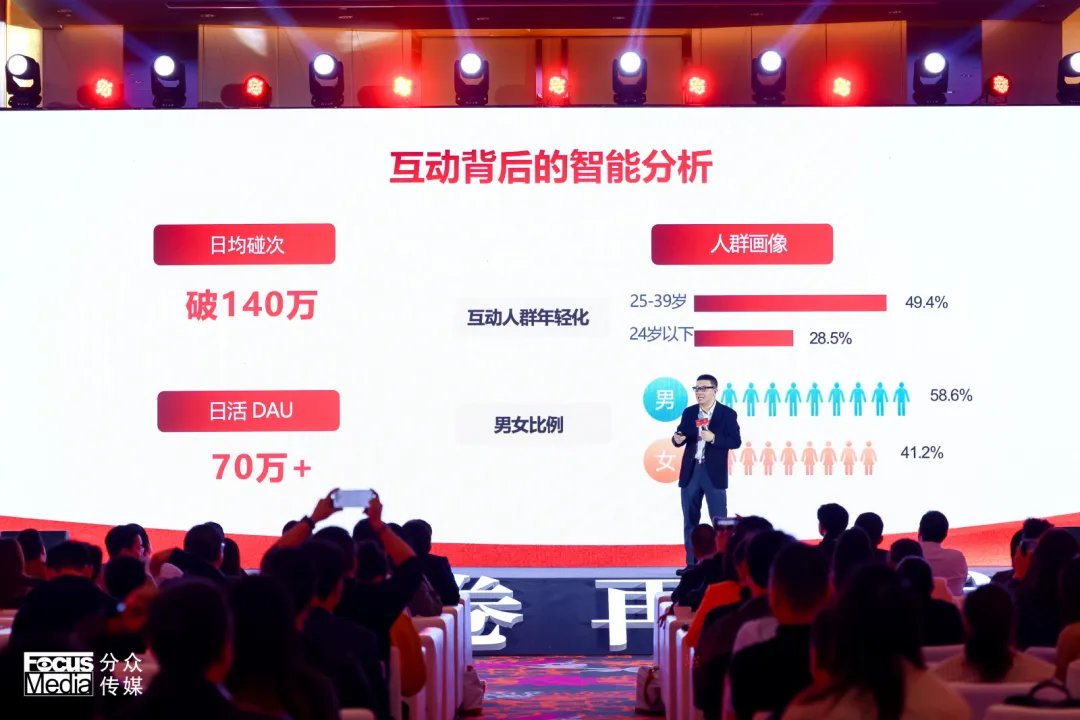
Group 1 - Retail media networks (RMN) are projected to grow at an annual rate of 25% over the next five years, expected to account for two-thirds of global retail advertising spending by 2025 [1][18] - The "Tap and Go" feature from Alipay and Focus Media exemplifies the efficiency of retail advertising, reducing the steps from payment to completion from 4-5 to just 2, with significant engagement metrics [1][19] - Meituan's smart charging screens are designed to influence consumer purchasing decisions at critical moments in real shopping scenarios, showcasing promotions and new products effectively [3][22] Group 2 - Brands are increasingly recognizing the need for marketing solutions in real shopping environments, as traditional online advertising becomes fragmented and costly [5][24] - The shift towards offline advertising is accompanied by challenges in measuring effectiveness and leveraging data for personalized experiences [6][25] - Retail advertising based on advertising platforms offers a new opportunity for brands to utilize data analytics for tailored advertising content, enhancing exposure and conversion rates [8][26] Group 3 - Meituan has strategically positioned itself in the "retail + technology" space, with over 5 million offline touchpoints through its charging stations, facilitating a blend of retail, technology, and media [9][28] - The charging stations serve as a new media touchpoint, allowing brands to create a digital consumption experience that enhances the commercial value of offline scenarios [12][31] - The smart charging screens are considered "the most technological outdoor advertising," addressing traditional outdoor advertising's shortcomings in precision and efficiency [14][33] Group 4 - The smart charging screens can significantly improve the conversion rates of offline advertising and provide measurable results for advertising agencies, while also increasing foot traffic and order rates for stores [18][37] - Brands must adapt their content marketing strategies to create more engaging and differentiated narratives that resonate with consumers in specific contexts [36] - The ability to connect with consumers at the point of decision-making is crucial for brands to capitalize on retail advertising opportunities in the evolving market landscape [37]
复盘2025外卖“三国杀”,烧钱千亿后的市场何去何从
3 6 Ke· 2025-12-29 13:11
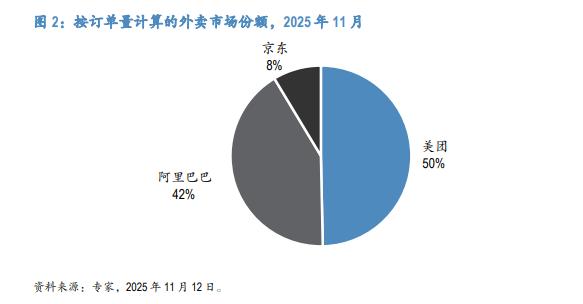
Core Insights - The food delivery industry has been significantly reshaped by a fierce competition initiated by JD.com, leading to a substantial financial outlay of nearly 100 billion yuan and a reconfiguration of market dynamics [1][2] - The future of the food delivery sector hinges on long-term ecological restructuring rather than short-term traffic battles, with each platform focusing on redefining relationships among platforms, merchants, delivery personnel, and consumers [1] Group 1: Differentiated Strategies - JD.com adopted a high-profile entry strategy into the food delivery market, leveraging a "0 commission" model to attract over 2 million merchants and implementing a 10 billion yuan subsidy plan [3] - Alibaba transitioned from a passive response to an active restructuring, rebranding Ele.me to Taobao Flash Purchase and integrating its logistics and supply chain to enhance its competitive edge [4][5] - Meituan, as the industry leader, focused on defensive strategies, increasing marketing expenditures by 90.9% to retain core users while enhancing its delivery network efficiency [6] Group 2: Gains and Losses - JD.com achieved rapid growth in food delivery orders, reaching 25 million daily orders within 90 days, but faced significant losses, with new business losses expanding to 15.736 billion yuan in Q3 [8][9] - Alibaba's integration of instant retail and e-commerce led to a 60% year-on-year revenue increase in instant retail, but it also incurred substantial marketing costs, resulting in an 85% drop in operating profit [9][10] - Meituan maintained its market leadership with a 50% market share and high customer retention rates, but reported a record net loss of 16 billion yuan in Q3 due to increased marketing expenses [11] Group 3: 2026 Outlook - The intense competition is expected to cool down, with platforms likely to shift from aggressive subsidy strategies to value-based competition, focusing on user experience and operational efficiency [12][13] - The instant retail market is projected to exceed 1 trillion yuan in 2026, indicating that competition will persist as platforms seek to secure their positions [12] - Analysts predict that Meituan may achieve breakeven by mid-2026, while Alibaba's food delivery business may continue to face challenges until late 2026 [13]
京东掀起一场风暴
Hua Er Jie Jian Wen· 2025-12-29 13:06
Core Insights - JD.com has launched a nationwide recruitment plan for its quality dining brand, Qixian Xiaochu, aiming to expand its operations across major cities by the end of 2026, marking a significant shift in the food delivery industry [1][5] - The company is adopting a differentiated strategy in the competitive food delivery market, focusing on direct involvement in food preparation rather than engaging in subsidy wars like its competitors [1][2][6] Expansion Plans - Qixian Xiaochu plans to open new stores in cities such as Shenzhen, Guangzhou, Shanghai, and Tianjin by January 2026, with a goal to cover all first- and second-tier cities in China by the end of 2026 [1][5] - The brand has already established 30 stores in Beijing, achieving significant market penetration within the city [4][5] Business Model Innovation - The core innovation of Qixian Xiaochu lies in its "Dish Partner" model, which allows partners to provide recipes while JD.com handles the cooking and quality control, thus creating a collaborative platform for restaurant brands and individual chefs [3][4] - This model includes features like 24-hour kitchen live streaming, enhancing transparency and consumer trust [3] Market Performance - Qixian Xiaochu has shown promising operational metrics, with daily orders exceeding 1,000 in its first week and reaching 1,500 within two months [5] - A promotional event led to over 16,000 orders across 30 stores in Beijing during a three-day period [5] Strategic Partnerships - The brand has demonstrated openness to cross-platform operations, having launched on Meituan and formed strategic partnerships with hotel chains like Jinjiang [5] Challenges Ahead - The rapid expansion faces challenges such as balancing standardization with regional taste preferences and managing the complexities of a centralized kitchen model [6] - The competitive landscape remains uncertain, with potential counteractions from rivals as the food delivery market evolves [6]