
JD(09618)

Search documents
8点1氪:官方回应吸毒记录封存相关问题;强生爽身粉致癌案判赔女子约110亿元;俞敏洪敲定东方甄选接班人
36氪· 2025-12-25 00:26
Group 1 - The revised Public Security Administration Punishment Law will take effect on January 1, 2026, and has garnered significant attention from media and the public regarding Article 136 [4][5] - The law's revision process included public consultations during its initial and second readings in August 2023 and June 2024, respectively, with specific provisions for sealing records of minor offenders [5][6] Group 2 - The law's provisions for sealing public security violation records apply to minors, covering various types of violations [5] - The law aims to address public concerns and clarify the implications of sealing records for individuals involved in minor offenses [4][5] Group 3 - The law's revisions reflect a broader trend in legal reforms aimed at balancing public safety with the rehabilitation of young offenders [5][6] - The law's implementation is expected to influence public perception and legal practices surrounding juvenile offenses in China [4][5]





京东、盒马等回应了!都是假的
Zhong Guo Jing Ji Wang· 2025-12-25 00:02
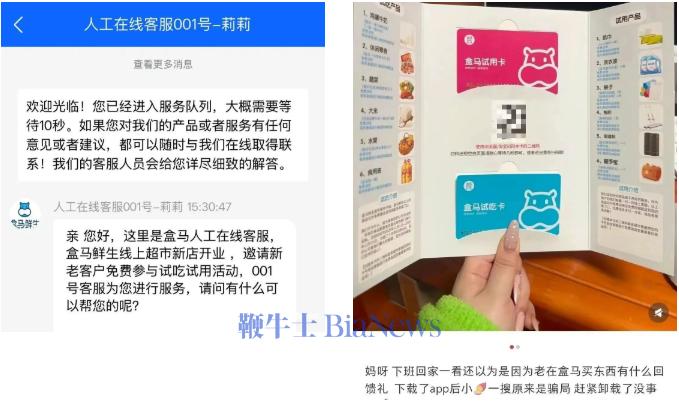
Core Viewpoint - Recent reports indicate a surge in fraudulent activities involving fake trial cards from well-known retailers like Hema Fresh, Yonghui Supermarket, and JD.com, misleading consumers into providing personal information and downloading malicious apps [1][3][10]. Group 1: Fraudulent Activities - Multiple consumers reported receiving free trial cards from Hema Fresh, with some claiming that every household in their community received them [1]. - The cards prompted users to scan a QR code, leading to a customer service page that requested personal information and encouraged app downloads [3]. - Similar reports emerged regarding fake trial cards from Yonghui Supermarket and promotional gifts from JD.com, including gift boxes containing bowls and gift cards [3][8]. Group 2: Scam Mechanisms - Scammers use enticing offers, such as free gifts or high returns, to gain consumer trust before leading them into further scams, including joining "刷单" (order brushing) or investment groups [11]. - Consumers are warned against engaging with unknown packages or advertisements that promise free items or high rewards, especially those containing QR codes [12][13]. - Official responses from Hema Fresh, Yonghui Supermarket, and JD.com confirm that these promotional activities are not sanctioned by them, urging consumers to remain vigilant [14].

智通ADR统计 | 12月25日
智通财经网· 2025-12-24 22:22
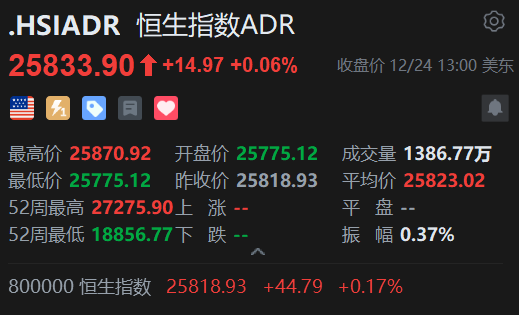
Market Overview - The Hang Seng Index (HSI) closed at 25,833.90, up by 14.97 points or 0.06% [1] - The index reached a high of 25,870.92 and a low of 25,775.12 during the trading session, with a trading volume of 13.8677 million [1] - The 52-week high for the index is 27,275.90, while the 52-week low is 18,856.77, indicating a fluctuation of 0.37% [1] Major Blue-Chip Stocks Performance - HSBC Holdings closed at 123.759 HKD, down 0.03% from the Hong Kong close [2] - Tencent Holdings closed at 602.001 HKD, down 0.17% from the Hong Kong close [2] - Alibaba Group (W) saw a decrease of 1.200 HKD, closing at 146.000 HKD, a drop of 0.82% [3] - China Construction Bank decreased by 0.050 HKD, closing at 7.560 HKD, a decline of 0.66% [3] - Xiaomi Group (W) increased slightly by 0.020 HKD, closing at 39.220 HKD, a rise of 0.05% [3] ADR Performance - Tencent's ADR closed at 602.001, down by 0.999 HKD or 0.17% compared to its Hong Kong stock price [3] - Alibaba's ADR closed at 145.796, down by 0.204 HKD or 0.14% compared to its Hong Kong stock price [3] - HSBC's ADR closed at 123.759, down by 0.041 HKD or 0.03% compared to its Hong Kong stock price [3] - AIA Group's ADR closed at 83.298, up by 0.048 HKD or 0.06% compared to its Hong Kong stock price [3]




破局 即时零售站在万亿市场门槛上
Shang Hai Zheng Quan Bao· 2025-12-24 19:15
Core Insights - 2025 is a pivotal year for the instant retail market in China, with the market size expected to approach 971.4 billion yuan, and projected to exceed 1 trillion yuan in 2026, marking it as the year of breakthrough for instant retail [1][6] - The future competition in instant retail will focus on "quality," "efficiency," and "experience," moving beyond mere scale and speed to establish a sustainable and healthy ecosystem [1][6] Group 1: Market Definition and Growth - Instant retail is defined as a retail format that meets local immediate demand through online ordering and offline fulfillment, covering a wide range of products including fresh goods, electronics, pharmaceuticals, and more [2] - Major platforms like JD, Meituan, and Alibaba are heavily investing in instant retail to seek new consumer growth and escape traditional e-commerce competition, with significant resources allocated to boost daily order volumes to the billion-level [2][3] Group 2: Strategic Investments and Supply Chain Innovations - The strategic investments by platforms are driving deep changes in the retail supply side, with innovations like "front warehouses" and "lightning warehouses" emerging to enhance order fulfillment efficiency [4] - Instant retail is expanding the customer base and inventory turnover for physical stores, with thousands of offline stores integrating into instant retail platforms, transforming into "cloud warehouses" [4] Group 3: Stakeholder Benefits and Economic Impact - Consumers benefit from unprecedented convenience, while merchants gain new growth opportunities with support from platforms, including AI tools and traffic assistance [5] - The surge in orders has created new job opportunities for delivery personnel, with significant increases in their income and benefits [5] Group 4: Financial Performance and Future Challenges - Despite the growth in market size, major platforms are facing significant losses, with Alibaba's net profit down 53% and Meituan reporting a net loss of 16 billion yuan in Q3 [6] - The industry is transitioning from price-driven competition to a focus on user experience, with a need to convert initial investments into sustainable profitability [6][9] Group 5: Differentiated Competition Strategies - The three major platforms are adopting differentiated competition strategies, with Meituan focusing on rapid delivery, Alibaba integrating a vast product ecosystem, and JD emphasizing quality supply chains [7][9] - Future competition will increasingly rely on fulfillment capabilities and operational efficiency rather than just pricing [9]


理想汽车官方商城入驻京东
Mei Ri Jing Ji Xin Wen· 2025-12-24 16:13
Core Insights - JD.com announced that Li Auto's official store has officially entered the platform, marking the first exclusive collaboration between Li Auto and a third-party e-commerce platform [1] Group 1 - The partnership allows Li Auto to sell products such as small tables and headrests on JD.com, but does not include vehicle sales [1]
京东(JD):国补高基数效应显现,新业务亏损预计收窄
Shenwan Hongyuan Securities· 2025-12-24 15:20
Investment Rating - The investment rating for JD is maintained as "Buy" [1][4] Core Insights - The report highlights that JD's revenue for Q4 2025 is expected to decline by 0.4% year-on-year to 345.5 billion RMB, with an adjusted net profit of 216 million RMB, resulting in a net profit margin of 0.1% [4] - The report anticipates that JD's retail revenue growth will be under pressure due to a high base effect from the previous year, particularly in the electronics category, while daily necessities are expected to remain relatively stable [4] - JD's new business losses are projected to narrow, supported by a solid user base and strategic focus on food delivery and international expansion [4] Financial Data and Profit Forecast - Revenue projections for JD are as follows: - 2023: 1,084,662 million RMB - 2024: 1,158,819 million RMB - 2025E: 1,302,344 million RMB - 2026E: 1,402,107 million RMB - 2027E: 1,504,110 million RMB - The year-on-year growth rates are projected at 3.7% for 2023, 6.8% for 2024, 12.4% for 2025, 7.7% for 2026, and 7.3% for 2027 [3][5] - Non-GAAP net profit estimates are as follows: - 2023: 35,200 million RMB - 2024: 47,827 million RMB - 2025E: 26,163 million RMB - 2026E: 37,493 million RMB - 2027E: 52,256 million RMB - The adjusted EPS is projected to be 20.87 RMB for 2023, 31.14 RMB for 2024, 17.44 RMB for 2025E, 25.26 RMB for 2026E, and 35.01 RMB for 2027E [3][5]
京东时尚秒送合作门店数量增长超150%
Xin Lang Cai Jing· 2025-12-24 14:27
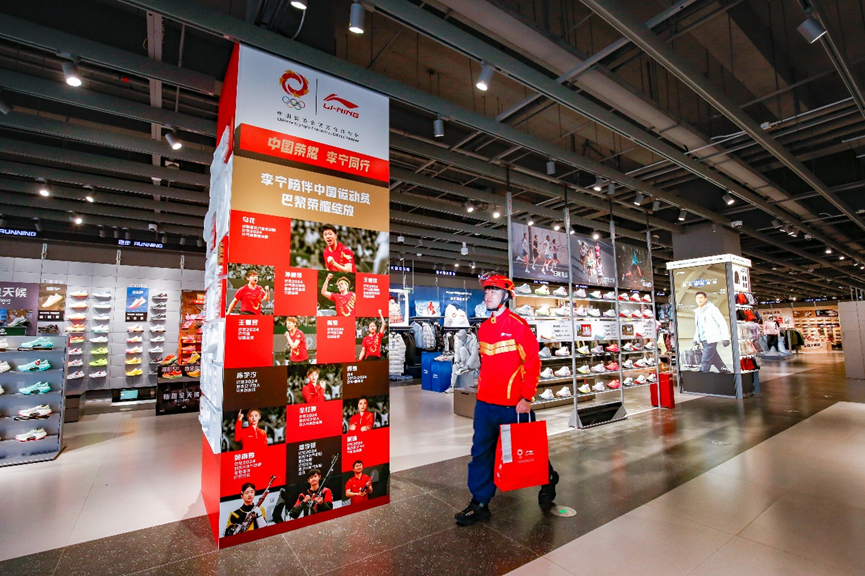
Core Insights - JD Fashion's "秒送" service is set to have over 1,000 merchants by the end of 2025, including major domestic retail giants and sportswear brands [1][2] - The number of operating stores has increased by over 150% year-on-year, covering various categories such as clothing, footwear, underwear, beauty, and outdoor sports [1][2] Performance Data - Year-to-date, brands like Nike, Adidas, Camel, and Anta have seen transaction volumes increase by over 200%, while the underwear brand Songshan Cotton Store's transaction volume has grown fivefold [3][5] - Following the winter demand for warmth, sales of Bosideng, which joined JD's "秒送" in November, have also shown an upward trend [3][5] Future Plans - JD Fashion's "秒送" will continue to partner with more collaborators to expand service and fulfillment capabilities, focusing on consumer pain points such as emergencies, seasonal changes, and gifting [3][5]
辟谣法国仓库失窃损失3亿!京东刘强东:出海已交十年学费
2 1 Shi Ji Jing Ji Bao Dao· 2025-12-24 14:19
12月23日深夜,京东官方回应称法国仓库失窃属实,损失与网传的3亿元出入较大。 (文章来源:21世纪经济报道) ...
刘强东继续“买买买”
财联社· 2025-12-24 13:45
Core Viewpoint - JD.com is accelerating its global expansion strategy, focusing on supply chain infrastructure through a series of overseas acquisitions, including a recent acquisition of logistics facilities in Singapore for 3.0 billion SGD (approximately 1.7 billion CNY) [3][4]. Group 1: Recent Acquisitions - JD.com has completed the acquisition of four high-standard warehouses in Singapore, totaling 175,000 square meters, marking a significant step in its Southeast Asia supply chain network [3][4]. - The company has planned to invest nearly 24 billion CNY in global acquisitions this year, with notable purchases including a logistics center in Australia for 240 million AUD and a supermarket chain in Hong Kong [4][5]. - JD.com has made a major acquisition offer for the European consumer electronics retail group CECONOMY, valued at over 18 billion CNY, aiming to penetrate the European retail market [4][6]. Group 2: Strategic Focus - JD.com's global strategy is centered around supply chain infrastructure, which has been a long-standing priority for CEO Liu Qiangdong, who emphasized the importance of internationalization for the company's survival [5][6]. - The logistics assets acquisition strategy is particularly evident in Europe, where JD.com has established over 20 overseas warehouses, covering more than 300,000 square meters, to support local retail operations [6]. - The recent acquisition in Singapore is seen as a crucial move to enhance JD.com's supply chain capabilities in Southeast Asia, which is vital for its global retail expansion [7]. Group 3: Market Context - The global retail market is becoming increasingly competitive, making supply chain efficiency a core competitive advantage [7]. - JD.com's approach of prioritizing logistics infrastructure through acquisitions is designed to ensure efficient and cost-effective delivery, thereby supporting its retail business's rapid expansion in international markets [7]. - As the Chinese e-commerce sector matures, international expansion has become a necessary strategy for leading platforms like JD.com, aligning with the broader trend of globalization among Chinese retail and logistics companies [7].

黄峥与刘强东殊途同归?
财富FORTUNE· 2025-12-24 13:10
Core Viewpoint - Pinduoduo has emerged as a significant player in the Chinese e-commerce market, finding a new direction that aligns with JD.com's future plans, as stated by its founder Huang Zheng [1] Group 1: Company Performance and Strategy - Pinduoduo's cross-border e-commerce brand Temu has achieved rapid growth, completing in three years what Pinduoduo took ten years to accomplish domestically, indicating that Temu's scale is approaching that of Pinduoduo's main platform [3] - The company announced a governance structure upgrade, implementing a co-chairman system with Chen Lei and Zhao Jiazhen, who emphasized a focus on reconstructing Pinduoduo by heavily investing in the Chinese supply chain over the next three years [3][6] - Pinduoduo's revenue growth has slowed compared to the previous year, influenced by both internal business model adjustments and external market conditions [4] Group 2: Market Challenges - The U.S. government's cancellation of tax exemptions for low-value packages from China has impacted Temu's reliance on a "small package shipping" model [5] - Increased regulatory scrutiny in China, including new rules on internet platform pricing behavior, requires Pinduoduo to enhance algorithm transparency [6] - The European Commission has conducted surprise inspections on Temu, marking a significant challenge for Pinduoduo in navigating international regulations [6] Group 3: Competitive Landscape - Pinduoduo's strategy contrasts with JD.com's approach; while JD.com focuses on building a robust supply chain with significant assets, Pinduoduo operates on a lighter asset model, leveraging data and platform efficiency [8][9] - Both companies recognize the importance of supply chain quality, but Pinduoduo's lighter asset model makes it more sensitive to geopolitical and trade policy fluctuations, potentially weakening its risk resilience compared to JD.com [9] - Pinduoduo is adapting by investing in local talent acquisition and enhancing its local warehousing capabilities to better navigate the global market uncertainties [9]

