POP MART(09992)

Search documents
港股收盘 | 恒指收涨0.07% 新消费概念表现亮眼 泡泡玛特涨近7%领跑蓝筹
Zhi Tong Cai Jing· 2025-11-27 08:47
Market Overview - The Hong Kong stock market experienced fluctuations today, with the Hang Seng Index closing up 0.07% at 25,945.93 points and a total trading volume of HKD 2,047.28 million [1] - The Hang Seng Tech Index fell by 0.36% to 5,598.05 points, indicating mixed performance among technology stocks [1] Blue-Chip Performance - Pop Mart (09992) led blue-chip stocks, rising 6.84% to HKD 218.6, contributing 16.32 points to the Hang Seng Index [2] - Other notable blue-chip movements included Sands China (01928) up 3.4% and Zhongsheng Group (00881) up 2.5%, while Alibaba Health (00241) fell 5.57% [2] Sector Highlights - The technology sector showed mixed results, with Xiaomi repurchasing over HKD 1.2 billion this month, leading to a price increase of over 2% [3] - The new consumption sector saw significant gains, with Pop Mart and other related stocks rising sharply due to government initiatives to boost consumption [3][4] - The cryptocurrency market rebounded strongly, with Bitcoin surpassing USD 91,323, reflecting a 4% increase in 24 hours [5] Company-Specific Developments - Lai Kai Pharmaceutical (02105) surged 16.07% following the announcement of a significant licensing deal worth HKD 2.045 billion for a breast cancer drug [5] - Alibaba Health reported a revenue increase of 17% to RMB 16.697 billion for the six months ending September 30, 2025, with a net profit growth of 64.7% [10] Emerging Trends - The Ministry of Industry and Information Technology outlined plans to enhance consumer goods supply and demand adaptability, targeting three trillion-level consumption fields by 2027 [4] - The semiconductor industry is expected to maintain an upward trend through 2025, driven by increasing demand for AI computing power and self-sufficiency in technology [6]

港股收盘(11.27) | 恒指收涨0.07% 新消费概念表现亮眼 泡泡玛特(09992)涨近7%领跑蓝筹
智通财经网· 2025-11-27 08:45
Market Overview - The Hong Kong stock market experienced fluctuations, with the Hang Seng Index closing up 0.07% at 25,945.93 points and a total trading volume of HKD 2,047.28 million [1] - The Hang Seng Tech Index fell by 0.36% to 5,598.05 points, indicating mixed performance among technology stocks [1] Blue-Chip Stocks Performance - Pop Mart (09992) led blue-chip stocks, rising 6.84% to HKD 218.6, contributing 16.32 points to the Hang Seng Index [2] - Other notable performers included Sands China (01928) up 3.4% and Zhongsheng Group (00881) up 2.5%, while Alibaba Health (00241) fell 5.57% [2] Sector Highlights - The technology sector showed mixed results, with Xiaomi repurchasing over HKD 1.2 billion this month, leading to a price increase of over 2% [3] - The new consumption sector saw significant gains, with Pop Mart rising nearly 7% following a government initiative to boost consumer goods supply [3][4] - The cryptocurrency market rebounded strongly, with Bitcoin surpassing USD 91,323, reflecting a 4% increase in 24 hours [5] Medical Sector Developments - Medical stocks showed a recovery, with Lai Kai Pharmaceutical (02105) surging 16.07% after announcing a significant licensing deal worth HKD 2.045 billion [5] - The report highlighted the growing competitiveness of Chinese pharmaceutical companies in innovative drug development [6] Chip Sector Insights - Semiconductor stocks faced a pullback, with SMIC (00981) down 0.73% and Hua Hong Semiconductor (01347) down 0.34% [6] - The semiconductor industry is expected to continue its upward trend, driven by increasing demand for AI computing power and self-sufficiency initiatives [6] Notable Stock Movements - Quantitative Group (02685) saw a remarkable debut, soaring 88.78% to HKD 18.5 after its IPO [7] - Gali International (01050) rose 8.73% following the release of its financial results, reporting a revenue increase of 5.4% [8] - Alibaba Health (00241) faced pressure, closing down 5.57% despite reporting a 17% increase in total revenue [10]
恒指涨0.07% 内房股普遍下挫
Mei Ri Jing Ji Xin Wen· 2025-11-27 08:29
Group 1 - The Hang Seng Index experienced a slight increase, closing up by 0.07%, while the Hang Seng Tech Index fell by 0.36% [1] - Real estate stocks generally declined, with Vanke Enterprises dropping nearly 8%, reaching a historical low [1] - Technology stocks mostly retreated, with Alibaba Health decreasing by over 5% and Alibaba falling by nearly 3% [1] Group 2 - The new consumption sector showed resilience, with Youran Dairy surging by 12% and Pop Mart rising by nearly 7% [1]



香港恒生指数收涨0.07% 恒生科技指数跌0.36%
Jin Rong Jie· 2025-11-27 08:22
Group 1 - The Hang Seng Index rose by 0.07%, while the Hang Seng Tech Index fell by 0.36% [1] - Most property stocks declined, with Vanke Enterprises dropping over 7%, Shimao Group falling over 6%, and Longfor Group decreasing over 3% [1] - Tech stocks showed mixed performance, with Xiaomi rising over 2% and Alibaba falling over 2% [1] Group 2 - Pop Mart surged over 6%, and Zhufeng Gold increased over 5% [1]



泡泡玛特大涨9%!六部门发文支持潮玩等消费品
Xin Lang Cai Jing· 2025-11-27 06:20
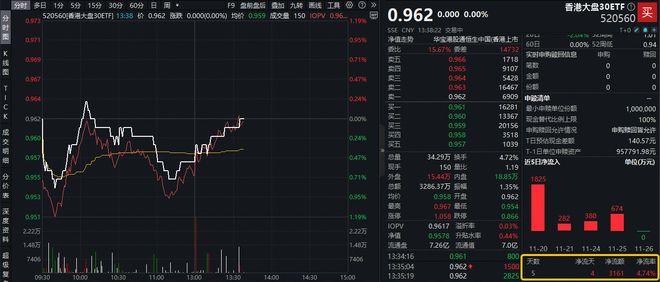
Group 1 - The Hong Kong Large Cap 30 ETF (520560) has experienced a slight decline after three consecutive days of gains, indicating a potential opportunity for investors to enter the market [1] - The ETF has attracted a total of 31.61 million yuan in the past five days, reflecting strong investor confidence in the future performance of Hong Kong stocks [1] - Key constituent stocks such as Pop Mart surged by 9%, regaining a market capitalization of over 300 billion HKD, while Xiaomi Group and China Life rose by over 3% [1] Group 2 - The U.S. Federal Reserve's recent Beige Book report has led to a surge in interest rate cut expectations, with an 85% probability of a 25 basis point cut in December [2] - The anticipated rate cuts are expected to weaken the U.S. dollar, which could improve liquidity in the Hong Kong stock market and attract foreign capital [2] - The "barbell strategy" is recommended for investors to balance between high-growth tech stocks and stable dividend-paying stocks, aligning with the current market environment [2] Group 3 - The Hong Kong Large Cap 30 ETF (520560) is designed to track the Hang Seng China (Hong Kong-listed) 30 Index, which includes major Chinese companies [3]
泡泡玛特大涨9%!六部门发文支持潮玩等消费品,自带哑铃策略的——香港大盘30ETF(520560)近5日吸金3161万元
Jin Rong Jie· 2025-11-27 06:13
Core Viewpoint - The Hong Kong Large Cap 30 ETF (520560) is experiencing a slight decline after three consecutive days of gains, indicating a potential opportunity for investors to enter the market as it remains near the waterline, with strong buying interest reflected in the premium trading range [1] Group 1: ETF Performance and Market Sentiment - The Hong Kong Large Cap 30 ETF (520560) has attracted a total of 31.61 million yuan in the past five days, suggesting positive sentiment towards the future performance of Hong Kong stocks [1] - Notable stocks within the ETF include Pop Mart, which surged by 9%, regaining a market capitalization of over 300 billion HKD, while Xiaomi Group and China Life both rose by over 3% [1] Group 2: Policy and Market Trends - On November 26, the Ministry of Industry and Information Technology and five other departments released a plan to enhance the adaptability of supply and demand in consumer goods, promoting interest-based products such as pet-related items and trendy toys [3] - Pop Mart has established a film studio and is seeking collaboration with global film companies for the development of the "Labubu" movie series, indicating a strategic expansion into entertainment [3] - The fourth quarter is traditionally a peak sales season for Pop Mart, particularly in overseas markets, which are expected to see strong demand for gifts and trendy toys due to upcoming holidays [3] Group 3: Macroeconomic Factors - The Federal Reserve's recent Beige Book indicates a rising expectation for interest rate cuts, with an 85% probability of a 25 basis point cut in December, which could positively impact the Hong Kong stock market [3] - A weaker US dollar following potential rate cuts is expected to improve liquidity in the Hong Kong market, attracting foreign capital and enhancing overall market conditions [3] Group 4: Investment Strategy - Given the current market environment, employing a "barbell strategy" is recommended for investors to balance between growth and high dividend stocks, aligning with the preferences of foreign institutional investors [4] - The Hong Kong Large Cap 30 ETF (520560) is highlighted as a suitable long-term investment tool, combining high-growth technology stocks with stable, high-dividend stocks [4]

泡泡玛特大涨9%!六部门发文支持潮玩等消费品,自带哑铃策略的—香港大盘30ETF(520560)近5日吸金3161万元
Xin Lang Ji Jin· 2025-11-27 05:58
Group 1 - The Hong Kong Large Cap 30 ETF (520560) experienced a slight decline after three consecutive days of gains, indicating a potential opportunity for investors to enter the market [1] - The ETF has attracted a total of 31.61 million yuan in the past five days, reflecting strong investor confidence in the future performance of Hong Kong stocks [1] - Key constituent stocks such as Pop Mart surged by 9%, regaining a market capitalization of over 300 billion HKD, while Xiaomi Group and China Life rose by over 3% [1] Group 2 - The fourth quarter is traditionally a peak sales season for Pop Mart, with strong demand expected in the overseas markets, particularly in the gift and trendy toy segments due to upcoming holidays [2] - The Federal Reserve's recent Beige Book indicated rising expectations for interest rate cuts, with an 85% probability of a 25 basis point cut in December, which could positively impact the Hong Kong stock market [2] - The "barbell strategy" is recommended for investors to mitigate uncertainty, aligning with the current market environment characterized by policy support and technological breakthroughs [2] Group 3 - The Hong Kong Large Cap 30 ETF (520560) is highlighted as a suitable long-term investment tool, combining high-growth technology stocks and stable high-dividend stocks [3] - The ETF includes major companies like Alibaba and Tencent, providing flexibility with a "T+0 mechanism" for trading [3]
港股午评|恒生指数早盘涨0.32% 泡泡玛特涨超8%
智通财经网· 2025-11-27 04:08
Market Overview - The Hang Seng Index rose by 0.32%, gaining 83 points to reach 26,011 points, while the Hang Seng Tech Index increased by 0.13%. The early trading volume in Hong Kong stocks was HKD 117.2 billion [1]. Paper Industry - Major paper companies are set to increase prices by the end of 2025, with cultural paper prices rising by HKD 200 per ton. Nine Dragons Paper (02689) saw a stock increase of 4.76%, and Lee & Man Paper (02314) rose by 5.98% [1]. Technology Sector - Cambridge Technology (06166) shares increased by 5% following reports that Google has placed additional orders for optical modules to expand its TPU cluster [2]. - Guanghe Communication (00638) shares surged over 8% as Huawei launched a companion robot "Smart Hanhai," and the company entered a strategic partnership with Luobo Intelligent [4]. - Quark AI glasses are set to be released soon, leading to a stock increase of over 4% for Konnate Optical (02276), with institutions optimistic about the company's XR business progress [7]. Healthcare Sector - Laika Pharmaceuticals-B (02105) saw its stock rise over 15%, with a cumulative increase of over 40% this month, following the recent acquisition of a significant BD order for LAE002 [5]. Energy Sector - Harbin Electric (01133) shares rose by over 3% due to the AIDC construction driving substantial electricity demand, indicating significant growth in the gas turbine industry [3]. Agriculture Sector - Youran Dairy (09858) shares increased by over 9%, with institutions optimistic about the cyclical resonance of beef and raw milk, suggesting potential profit improvements for leading agricultural enterprises [8]. Health Sector - Alibaba Health (00241) shares fell by 3.93%, despite a 64.7% year-on-year increase in interim net profit to CNY 1.266 billion [9]. - Chow Tai Fook (01929) shares dropped by over 3%, with net profit for the first half of the fiscal year remaining roughly flat year-on-year, and Daiwa projecting a conservative earnings outlook [10].
恒生指数早盘涨0.32% 泡泡玛特涨超8%
Zhi Tong Cai Jing· 2025-11-27 04:06
Group 1 - The Hang Seng Index rose by 0.32%, gaining 83 points to close at 26,011 points, while the Hang Seng Tech Index increased by 0.13%. The early trading volume in Hong Kong stocks reached HKD 117.2 billion [1] - Major paper companies announced price increases by the end of 2025, with cultural paper prices rising by HKD 200 per ton. Nine Dragons Paper (02689) saw a rise of 4.76%, and Lee & Man Paper (02314) increased by 5.98% [1] - Pop Mart (09992) surged by 8.7% as the market focused on the Labubu film adaptation, with the fourth quarter sales season approaching [1] Group 2 - Cambridge Technology (603083) (06166) rose by 5% following reports of Google placing additional orders for optical modules to expand its TPU cluster [2] - Harbin Electric (01133) increased by over 3% due to significant electricity demand from AIDC construction, leading to notable growth in the gas turbine industry [3] - Guanghetong (300638) (00638) surged by over 8% as Huawei launched the companion robot "Smart Hanhai," and the company formed a strategic partnership with Luobo Intelligent [4] Group 3 - Laika Pharmaceuticals-B (02105) saw a rise of over 15%, with a cumulative increase of over 40% this month, following the recent acquisition of a BD order for LAE002 [5] - Jiantao Laminates (01888) rose by over 2% during trading as copper-clad board manufacturers announced price increases, driven by demand from AI infrastructure [6] - Connet Optical (02276) increased by over 4% with the upcoming release of Quark AI glasses, and institutions are optimistic about the company's XR business progress [7] Group 4 - Alibaba Health (00241) fell by 3.93%, despite a 64.7% year-on-year increase in interim net profit to CNY 1.266 billion [8] - Chow Tai Fook (01929) dropped by over 3%, with net profit for the first half of the fiscal year remaining roughly flat year-on-year, and Daiwa expects conservative earnings guidance [9]
异动盘点1127 | 芯片股早盘走高,来凯医药-B再涨超15%;储能概念股集体上涨,高途跌超8%
贝塔投资智库· 2025-11-27 04:01
Group 1: Semiconductor Industry - Semiconductor stocks showed an upward trend, with Huahong Semiconductor rising 1.24% and SMIC increasing by 1.02%. The semiconductor industry is expected to continue its upward trajectory through 2025, driven by U.S. export controls and China's "14th Five-Year Plan" emphasizing technological self-reliance [1][2] Group 2: Pharmaceutical Sector - Lakai Pharmaceutical saw a significant increase of over 15%, with a cumulative rise of over 40% this month. The company has granted rights for its breast cancer candidate drug LAE002 to Qilu Pharmaceutical for a total transaction amount of 2.045 billion yuan, along with a potential sales commission of 10% to 20% [1] Group 3: Technology and AI - Cambridge Technology experienced a nearly 10% rise, with reports indicating that Meta is in talks with Google to potentially purchase TPUs for its data centers starting in 2027, with a procurement scale potentially reaching several billion dollars [1] - Guohua Tong surged over 14% after Huawei announced the launch of its first chat robot, "Smart Hanhan," priced at 399 yuan, marking Huawei's entry into the smart companionship market [2] - Xiaoma Zhixing reported a revenue increase of 72% year-on-year to 25.4 million USD in Q3 2025, with Robotaxi services growing by 89% [3] Group 4: Consumer Goods and Entertainment - Pop Mart rose over 8% after Sony Pictures acquired the film adaptation rights for Pop Mart's popular IP "Labubu," with plans for a movie series already in development [3] - Yuran Agriculture increased by over 9%, being recognized as the world's largest raw milk supplier with a comprehensive business model covering the entire dairy industry chain [4] Group 5: U.S. Market Movements - Robinhood's stock rose over 10.93% as the company announced the launch of a futures and derivatives exchange, deepening its investment in predictive markets [5] - Oracle's stock increased by 4.02% after Deutsche Bank raised its target price based on the company's growth potential in cloud infrastructure and AI services [6]