POP MART(09992)

Search documents
港股异动 | 泡泡玛特(09992)再涨超5% 六部门发文鼓励潮玩等消费 公司迎来传统销售旺季
智通财经网· 2025-11-28 02:16
Group 1 - The core viewpoint of the article highlights the positive market performance of Pop Mart (09992), with its stock price increasing by over 5% and reaching 229.2 HKD, alongside a trading volume of 1.129 billion HKD [1] - The Chinese government has issued a plan to enhance the adaptability of supply and demand in consumer goods, promoting diverse interest-based consumption products such as pet-related items, anime, and trendy toys [1] - Galaxy Securities expresses an optimistic outlook on the development of overseas business in the consumer sector by 2026, recommending Pop Mart as a key player in the trendy toy market [1] Group 2 - Recent high-frequency data from Ping An International indicates that U.S. sales data for the first week of November has returned to a high growth rate, suggesting strong sales potential for Pop Mart in the U.S. market during the upcoming holiday season [1] - Zhongyou Securities also notes that Q4 is traditionally a peak sales season for Pop Mart, with significant consumer demand expected for gifts and trendy toys during Halloween, Black Friday, and Christmas in core overseas markets [1]

智通港股沽空统计|11月28日
智通财经网· 2025-11-28 00:23
Summary of Key Points Core Viewpoint - The report highlights the short-selling ratios and amounts for various companies, indicating significant bearish sentiment in the market, particularly for JD Health, Tencent, and Lenovo, which have the highest short-selling ratios. Group 1: Short-Selling Ratios - JD Health-R (86618) has the highest short-selling ratio at 100.00% [1][2] - Tencent Holdings-R (80700) follows closely with a short-selling ratio of 98.01% [1][2] - Lenovo Group-R (80992) has a short-selling ratio of 88.02% [1][2] Group 2: Short-Selling Amounts - Alibaba-SW (09988) leads in short-selling amount with 2.651 billion [2] - Meituan-W (03690) has a short-selling amount of 1.308 billion [2] - Pop Mart (09992) follows with a short-selling amount of 979 million [2] Group 3: Short-Selling Deviation Values - Meilan Airport (00357) has the highest deviation value at 42.95% [1][2] - GF Securities (01776) has a deviation value of 38.39% [1][2] - The unnamed company has a deviation value of 36.78% [1][2]


智通港股通资金流向统计(T+2)|11月28日
智通财经网· 2025-11-27 23:34
Key Points - On November 25, Alibaba-W (09988), Kuaishou-W (01024), and Pop Mart (09992) ranked the top three in net inflow of southbound funds, with net inflows of 5.587 billion, 567 million, and 377 million respectively [1] - The top three in net outflow of southbound funds were Yingfu Fund (02800), SMIC (00981), and China Aluminum (02600), with net outflows of -364 million, -187 million, and -145 million respectively [1] - In terms of net inflow ratio, Southern East Select (03441), Prudential (02378), and Southern Hong Kong US Technology (03442) led the market with ratios of 88.59%, 85.03%, and 71.70% respectively [1] - The top three in net outflow ratio were GX China (03040), Greentown Service (02869), and Aidi Kang Holdings (09860) with ratios of -91.54%, -58.74%, and -54.29% respectively [1] Top 10 Net Inflow Stocks - Alibaba-W (09988) had a net inflow of 5.587 billion, representing a 24.06% increase, closing at 157.800 (+2.14%) [2] - Kuaishou-W (01024) saw a net inflow of 567 million, with a 15.90% increase, closing at 70.650 (+3.06%) [2] - Pop Mart (09992) recorded a net inflow of 377 million, with a 21.51% increase, closing at 200.200 (+0.35%) [2] - Other notable stocks included Xpeng Motors-W (09868) with a net inflow of 274 million and a 17.01% increase, and China Construction Bank (00939) with a net inflow of 271 million and a 15.20% increase [2] Top 10 Net Outflow Stocks - Yingfu Fund (02800) experienced a net outflow of -364 million, with a -2.62% change, closing at 26.040 (+0.85%) [2] - SMIC (00981) had a net outflow of -187 million, with a -3.52% change, closing at 67.950 (-0.15%) [2] - China Aluminum (02600) saw a net outflow of -145 million, with a -31.17% change, closing at 10.660 (+0.76%) [2] - Other significant outflows included Xinda Biopharmaceutical (01801) with -136 million and a -10.94% change, and ZTO Express-W (02057) with -122 million and a -29.90% change [2] Top 10 Net Inflow Ratios - Southern East Select (03441) led with a net inflow ratio of 88.59%, with a net inflow of 8.441 million, closing at 10.300 (+0.19%) [3] - Prudential (02378) followed with a ratio of 85.03%, net inflow of 11.732 million, closing at 107.800 (+0.94%) [3] - Southern Hong Kong US Technology (03442) had a ratio of 71.70%, with a net inflow of 14.887 million, closing at 9.080 (+2.66%) [3]


港股通(深)净买入6.93亿港元
Zheng Quan Shi Bao Wang· 2025-11-27 15:09
Core Points - The Hang Seng Index rose by 0.07% to close at 25,945.93 points on November 27, with a net inflow of HKD 1.328 billion through the southbound trading channel [1] - The total trading volume for the southbound trading was HKD 86.624 billion, with a net buy of HKD 1.328 billion [1] - In the Shanghai-Hong Kong Stock Connect, the trading volume was HKD 55.325 billion with a net buy of HKD 0.635 billion, while in the Shenzhen-Hong Kong Stock Connect, the trading volume was HKD 31.299 billion with a net buy of HKD 0.693 billion [1] Trading Activity - Alibaba-W was the most actively traded stock in the Shanghai-Hong Kong Stock Connect with a trading volume of HKD 73.15 billion and a net buy of HKD 6.02 billion, despite a closing price drop of 2.71% [1][2] - Xiaomi Group-W followed with a trading volume of HKD 35.41 billion and a net sell of HKD 5.37 billion, closing up by 2.49% [1][2] - In the Shenzhen-Hong Kong Stock Connect, Alibaba-W also led with a trading volume of HKD 36.70 billion and a net buy of HKD 3.17 billion, while Xiaomi Group-W had a net sell of HKD 1.52 billion [2] Summary of Active Stocks - The top ten actively traded stocks included Alibaba-W, Xiaomi Group-W, and Tencent Holdings, with respective trading volumes of HKD 73.15 billion, HKD 35.41 billion, and HKD 28.17 billion [1][2] - The net buy and sell amounts for these stocks indicated a strong interest in Alibaba-W, while Xiaomi Group-W faced significant selling pressure [1][2]


北水成交净买入13.28亿 芯片股遭内资抛售 阿里再获9亿港元加仓
Zhi Tong Cai Jing· 2025-11-27 13:05
Group 1: Market Overview - On November 27, the Hong Kong stock market saw a net inflow of 1.328 billion HKD from northbound trading, with 635 million HKD from the Shanghai Stock Connect and 693 million HKD from the Shenzhen Stock Connect [2] - The most net bought stocks included Alibaba-W (09988), Pop Mart (09992), and Meituan-W (03690), while the most net sold stocks were Zijin Mining (601899) (02899), Tencent (00700), and SMIC (00981) [2] Group 2: Stock Performance - Alibaba-W had a net inflow of 6.02 billion HKD, with a buy amount of 39.59 billion HKD and a sell amount of 33.57 billion HKD [3] - Pop Mart received a net inflow of 4.34 billion HKD, supported by positive sales data in the U.S. and expectations for strong performance during the holiday season [6] - Meituan-W had a net inflow of 3.25 billion HKD, with insights from Alibaba's CFO indicating a potential reduction in investment in flash purchase business due to improved efficiency [6] Group 3: Sector Insights - Longi Green Energy (601869) and Long Fiber (06869) saw a net inflow of 42.81 million HKD, driven by advancements in AI-driven growth and the development of next-generation optical fiber technology [7] - Semiconductor stocks, including Huahong Semiconductor (01347) and SMIC (00981), faced net sell-offs, with net outflows of 138.5 million HKD and 2.32 billion HKD respectively [7] - The IPO of domestic GPU leader Moore Threads has attracted attention, marking a significant event in the semiconductor sector [7]



中法关系改善利好欧洲经贸 消费龙头再度发力
Zhi Tong Cai Jing· 2025-11-27 12:34
Market Overview - US stock indices rebounded overnight, with Hong Kong stocks slightly fluctuating and closing up 0.07% [1] - The economic outlook remains cautious, with half of the Federal Reserve districts reporting decreased hiring intentions, indicating potential interest rate cuts in December [2] International Relations - Trump urged Japanese Prime Minister Kishi to avoid escalating tensions regarding Taiwan, reflecting a more restrained stance from Japan [1] - French President Macron is set to visit China from December 3, aiming to improve Sino-French relations, which could benefit European relations as well [1] Consumer Sector - Pop Mart (09992) is expected to benefit from the upcoming holiday season, with a nearly 7% increase in stock price [3] - The automotive sector is seeing growth, with the Ministry of Commerce promoting reforms to boost consumption, leading to significant stock price increases for companies like Yongda Automobile (03669) [2] Technology and Innovation - Alibaba's Quark AI glasses were launched, with significant pre-sale success, leading to a 4% increase in stock price for related companies [4] - TCL Electronics is also entering the AI glasses market, contributing to a 6% rise in its stock price [4] Pharmaceutical Industry - Hansoh Pharmaceutical (03692) is advancing its innovative drug pipeline, with significant revenue growth and a strong project reserve [7] - The company reported a 22.1% year-on-year increase in sales revenue for its innovative drugs in the first half of 2025 [7] Gold Market - Deutsche Bank has raised its gold price forecast for 2026, indicating a structural bull market driven by official purchases rather than consumer demand [6] - The potential shift of cryptocurrency funds into physical gold could further boost prices, impacting related stocks [6] Clinical Trials and Drug Approvals - Hansoh Pharmaceutical has over 40 innovative drug candidates in clinical trials, with several new drugs entering Phase III trials [9] - The company has secured international partnerships for its ADC products, highlighting its growing recognition in the global market [9]

今年“黑五”海外消费者开始看直播带货,中国直播业忙出海
Di Yi Cai Jing· 2025-11-27 11:33
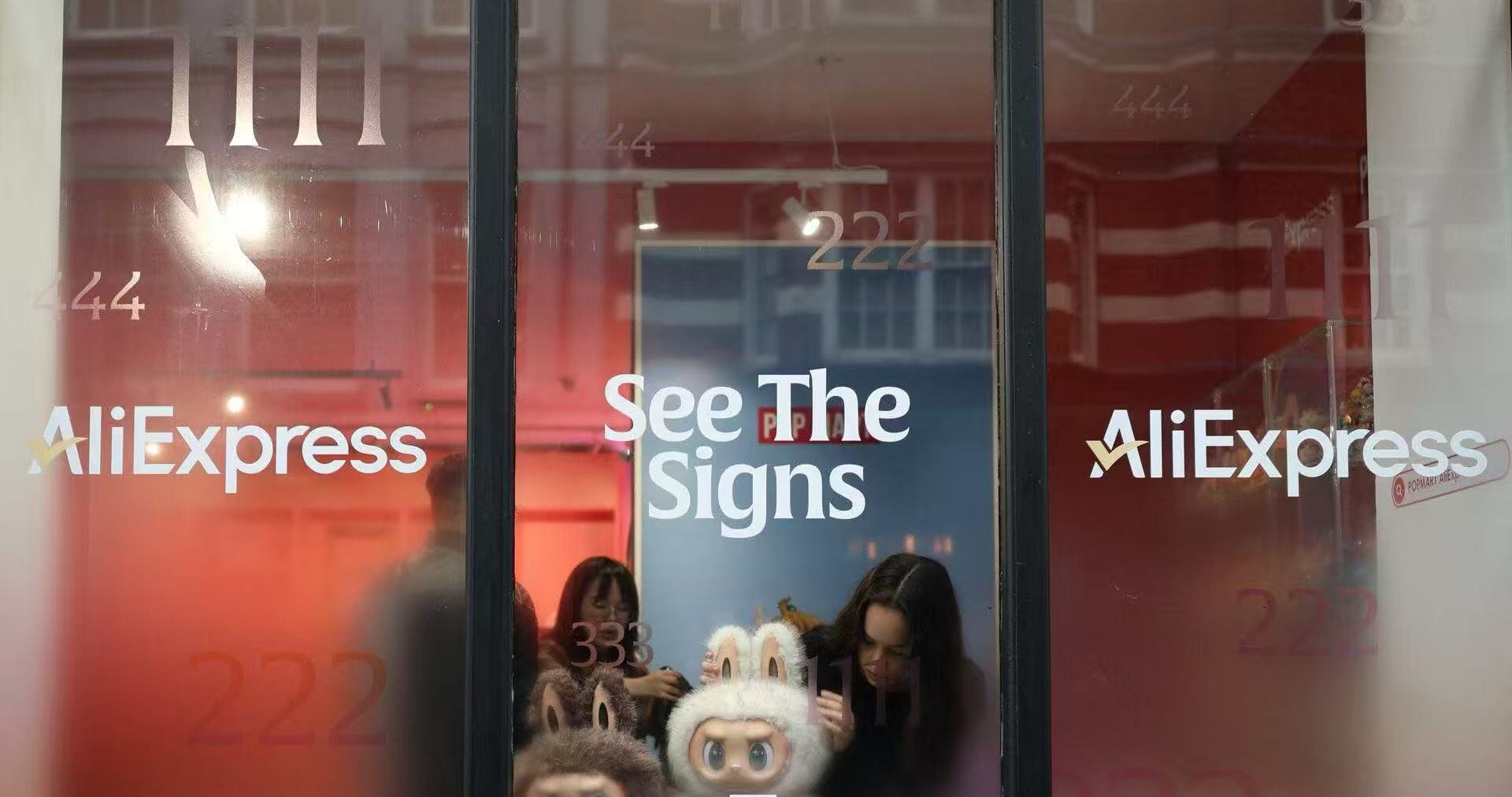
Core Insights - The effectiveness of live streaming in driving sales during overseas promotional events has been preliminarily validated, particularly during Black Friday [4][6][10] Group 1: Live Streaming Impact - Live streaming has significantly boosted sales during this year's overseas promotional season, with notable success for brands like Pop Mart in the UK, where sales surged by 1500% year-on-year in October [4][6] - The collaboration between AliExpress and UK influencers for Pop Mart's live streaming event resulted in rapid sell-outs of products within just two hours [3][4] - The live streaming event by Youmeng Technology in North America exceeded expectations, achieving a GMV of $630,000 in 12 hours, surpassing the initial target of $500,000 [4][8] Group 2: Market Trends and Brand Opportunities - Chinese brands are leveraging content platforms like TikTok to expand overseas, with significant potential in the US and European markets [5][10] - The UK retail brand Marks & Spencer has entered TikTok Shop, indicating a growing trend among foreign brands to engage in live streaming and content-driven e-commerce [6][10] - The overseas live streaming market is still in its early stages, but the integration of content and e-commerce is gaining traction, especially during major promotional events [6][9] Group 3: Market Maturity and Growth - Compared to last year's Black Friday, this year's live streaming efforts have shown marked improvement in terms of the number of live sessions and partnerships with influencers [7][8] - The number of influencers collaborating with Youmeng Technology has nearly doubled, indicating a growing influencer network in the North American market [8] - The increasing acceptance of live streaming as a commercial model among brands is attributed to market education and platform policies [8][9] Group 4: Consumer Behavior and Engagement - A significant portion of Gen Z and Millennials utilize platforms like TikTok for gift inspiration, with 43% of US Gen Z consumers shopping directly through TikTok Shop [9][10] - The third quarter GMV for TikTok Shop reached $19 billion, with US consumers contributing $4 to $4.5 billion, highlighting the platform's growing market presence [10] - The competitive landscape in the US live streaming market favors Chinese players, who possess advantages in supply chain and content marketing strategies [10]

智通港股通活跃成交|11月27日
智通财经网· 2025-11-27 11:04
Core Insights - On November 27, 2025, Alibaba-W (09988), Xiaomi Group-W (01810), and SMIC (00981) were the top three companies by trading volume in the southbound trading of the Stock Connect, with trading amounts of 7.315 billion, 3.541 billion, and 2.817 billion respectively [1] - In the Shenzhen-Hong Kong Stock Connect, Alibaba-W (09988), Xiaomi Group-W (01810), and Tencent Holdings (00700) also ranked as the top three, with trading amounts of 3.670 billion, 1.648 billion, and 1.450 billion respectively [1] Southbound Trading Highlights - **Top Active Companies in Southbound Trading (Shanghai-Hong Kong)** - Alibaba-W (09988): Trading amount of 7.315 billion, net buying of +0.602 billion [2] - Xiaomi Group-W (01810): Trading amount of 3.541 billion, net selling of -0.537 billion [2] - SMIC (00981): Trading amount of 2.817 billion, net selling of -0.431 billion [2] - Tencent Holdings (00700): Trading amount of 2.676 billion, net selling of -0.165 billion [2] - Pop Mart (09992): Trading amount of 1.979 billion, net buying of +0.290 billion [2] - **Top Active Companies in Southbound Trading (Shenzhen-Hong Kong)** - Alibaba-W (09988): Trading amount of 3.670 billion, net buying of +0.317 billion [2] - Xiaomi Group-W (01810): Trading amount of 1.648 billion, net selling of -0.152 billion [2] - Tencent Holdings (00700): Trading amount of 1.450 billion, net selling of -0.094 billion [2] - SMIC (00981): Trading amount of 1.326 billion, net buying of +0.198 billion [2] - Meituan-W (03690): Trading amount of 1.025 billion, net buying of +0.174 billion [2]

北水动向|北水成交净买入13.28亿 芯片股遭内资抛售 阿里(09988)再获9亿港元加仓
智通财经网· 2025-11-27 10:04
Core Insights - The Hong Kong stock market saw a net inflow of 1.328 billion HKD from northbound trading on November 27, with the Shanghai-Hong Kong Stock Connect contributing 635 million HKD and the Shenzhen-Hong Kong Stock Connect contributing 693 million HKD [1] Group 1: Stock Performance - Alibaba-W (09988) had a net inflow of 602 million HKD, driven by the launch of its Quark AI glasses, which integrate various services from its ecosystem [4] - Pop Mart (09992) received a net inflow of 434 million HKD, with expectations of strong sales growth in the U.S. market during the holiday season [5] - Meituan-W (03690) saw a net inflow of 325 million HKD, as Alibaba's CFO indicated a potential reduction in investment in flash purchase business due to improved efficiency [5] Group 2: Net Selling Stocks - Zijin Mining (02899) faced the highest net outflow of 369 million HKD, followed by Tencent (00700) with a net outflow of 258 million HKD and SMIC (00981) with a net outflow of 232 million HKD [6][7] - Hua Hong Semiconductor (01347) also experienced a net outflow of 138.5 million HKD [6] Group 3: Market Trends - The report indicates a strong demand for consumer products in the U.S. market, particularly during the holiday season, which is expected to benefit companies like Pop Mart [5] - The AI-driven growth in the optical fiber sector is highlighted, with Longi Fiber Optics (06869) receiving a net inflow of 42.81 million HKD due to advancements in next-generation fiber technology [5]
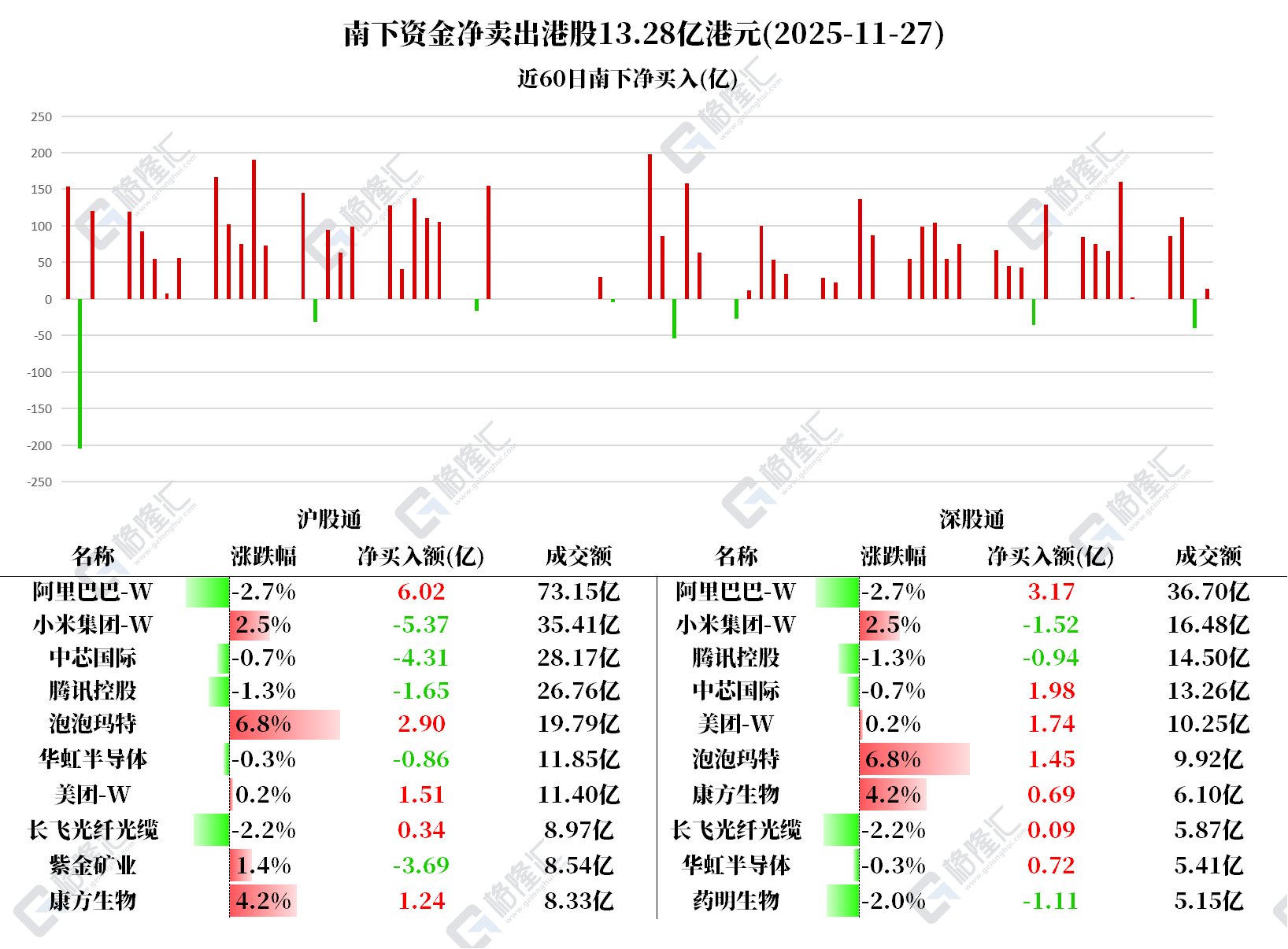
图解丨南下资金入阿里、泡泡玛特,出小米
Ge Long Hui A P P· 2025-11-27 09:53
Group 1 - Southbound funds net bought Hong Kong stocks worth 1.328 billion HKD today, with notable purchases including Alibaba-W (919 million HKD), Pop Mart (434 million HKD), Meituan-W (325 million HKD), and Kangfang Biotech (192 million HKD) [1] - Continuous net buying of Alibaba has reached 25.45042 billion HKD over 11 days, while SMIC has seen a continuous net selling totaling 1.89276 billion HKD over 6 days [1] - Tencent has experienced net selling for 3 consecutive days, amounting to 1.52864 billion HKD [1] Group 2 - Alibaba-W's stock price decreased by 2.7% with a net buying amount of 6.02 billion HKD and a trading volume of 73.15 billion HKD [3] - Xiaomi Group-W's stock price increased by 2.5% but faced a net selling of 5.37 billion HKD with a trading volume of 35.41 billion HKD [3] - Pop Mart's stock price rose by 6.8% with a net buying of 2.90 billion HKD and a trading volume of 19.79 billion HKD [3] - Meituan-W's stock price increased by 0.2% with a net buying of 1.51 billion HKD and a trading volume of 11.40 billion HKD [3] - Kangfang Biotech's stock price rose by 4.2% with a net buying of 1.24 billion HKD and a trading volume of 8.33 billion HKD [3]