Baosteel(600019)

Search documents
普钢板块9月4日跌1.63%,包钢股份领跌,主力资金净流出6.28亿元
Zheng Xing Xing Ye Ri Bao· 2025-09-04 08:50
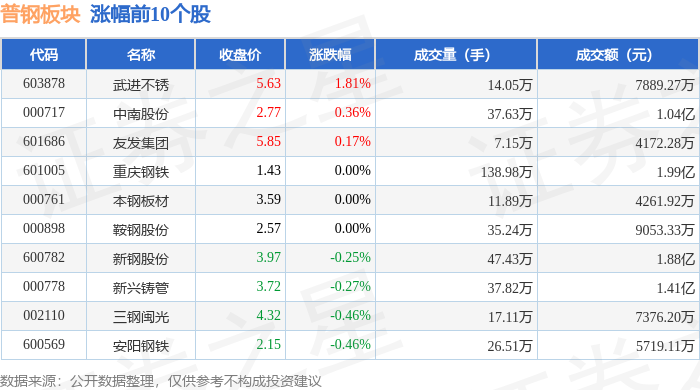
Market Overview - On September 4, the steel sector experienced a decline of 1.63% compared to the previous trading day, with Baogang Co. leading the drop [1] - The Shanghai Composite Index closed at 3765.88, down 1.25%, while the Shenzhen Component Index closed at 12118.7, down 2.83% [1] Individual Stock Performance - Notable performers included: - Wujin Stainless Steel (603878) with a closing price of 5.63, up 1.81% on a trading volume of 140,500 shares and a transaction value of 78.89 million yuan [1] - Zhongnan Co. (000717) closed at 2.77, up 0.36% with a trading volume of 376,300 shares and a transaction value of 104 million yuan [1] - Baogang Co. (600010) saw a significant decline of 4.69%, closing at 2.44 with a trading volume of 13,013,100 shares and a transaction value of 322.9 million yuan [2] Capital Flow Analysis - The steel sector experienced a net outflow of 628 million yuan from main funds, while retail investors saw a net inflow of 601 million yuan [2] - The capital flow for individual stocks showed: - Ma Steel (600808) had a net inflow of 18.89 million yuan from main funds, while retail investors had a net outflow of 28.27 million yuan [3] - Baogang Co. (600019) had a net inflow of 8.08 million yuan from main funds, but a net outflow of 23.39 million yuan from retail investors [3]


研判2025!中国连续油管行业发展历程、产业链、市场规模、竞争格局及发展趋势分析:油气勘探力度加大,连续油管行业规模达到43.42亿元[图]
Chan Ye Xin Xi Wang· 2025-09-04 01:16
Core Insights - The global energy demand is rising, particularly in developing countries, leading to increased reliance on oil and gas [1][10] - Continuous tubing is increasingly applied in oil and gas field development due to its efficiency and flexibility, especially in unconventional resource extraction [1][10] - The continuous tubing industry is evolving with advancements in technology, resulting in higher strength, better corrosion resistance, and longer service life [1][10] - The market size of China's continuous tubing industry is projected to reach 4.342 billion yuan in 2024, reflecting a year-on-year increase of 3.1% [1][10] Industry Overview - Continuous tubing, also known as coiled tubing, is made from low-carbon alloy steel and is characterized by its flexibility and continuous length, which can reach several kilometers [3][8] - The tubing must withstand high pressures (up to 70 MPa) and harsh downhole conditions, necessitating high strength and excellent plasticity [3][8] Industry Chain - The upstream of the continuous tubing industry involves the production of raw materials, primarily high-strength low-alloy steel and special alloy materials [8] - The midstream focuses on the manufacturing of continuous tubing, while the downstream encompasses its application in oil and gas field operations such as workover, drilling, completion, and logging [8] Market Dynamics - China's crude oil production is expected to rise from 191.506 million tons in 2017 to 212.823 million tons in 2024, with a 1.3% year-on-year increase in the first half of 2025 [9][10] - The growth in production is supported by both mature oil fields and new fields, contributing to a stable increase in demand for continuous tubing [9][10] Competitive Landscape - The global continuous tubing service market is highly concentrated, with major players like Schlumberger, Halliburton, and Baker Hughes holding about 60% of the market share [10] - Domestic companies are increasing R&D investments to enhance their product offerings and achieve domestic substitution for high-end products [10] Development Trends - The future of the continuous tubing industry is expected to focus on high-strength tubing to meet the demands of deeper wells [13] - There is a push towards the intelligent and automated development of the industry, incorporating fiber optics for remote monitoring and real-time decision-making [14] - The application of continuous tubing is expanding beyond traditional oil and gas sectors into geothermal energy development, driven by the need for corrosion-resistant and high-insulation materials [15]






截至7月底,全国已有6亿吨粗钢产能完成全流程超低排放改造
Zhong Guo Chan Ye Jing Ji Xin Xi Wang· 2025-09-04 01:08
Group 1: Industry Overview - The steel industry in China is accelerating its green transformation, with significant developments in green steel production and technology [1][2][3] - The urgency for the steel industry's green transition is highlighted by its status as a major carbon emitter, with over 60% of global steel emissions originating from China [3][7] - The introduction of carbon trading in the national carbon market is pushing steel companies to participate in carbon reduction efforts [1][3] Group 2: Technological Advancements - Hebei Province is leading the way in establishing a modern steel industry with the introduction of the first local standard for green low-carbon steel products [2] - Major companies like Baosteel and Hebei Iron and Steel are implementing innovative projects, such as hydrogen metallurgy and electric furnace technologies, to reduce carbon footprints [2][4] - The development of hydrogen metallurgy technology is crucial for achieving green steel production, with ongoing efforts to optimize hydrogen reduction processes [8] Group 3: Market Dynamics - The inventory of steel products has decreased, indicating a shift in market dynamics as companies adjust strategies to focus on green steel production [4] - The competitiveness of green steel products is increasing, with successful exports to the EU demonstrating the potential for large-scale application of green steel technologies [4][7] - The global steel market is facing increased pressure due to the upcoming EU carbon border adjustment mechanism, which could raise costs for Chinese steel exports [3][7] Group 4: Challenges and Future Outlook - Despite progress, the green steel industry faces challenges related to technology costs, infrastructure, and regulatory frameworks that need to be addressed for large-scale implementation [5][6] - The next five to ten years are seen as a critical window for the transformation of China's green steel industry, with expectations for significant breakthroughs in hydrogen metallurgy [7][8] - A unified national carbon accounting system and infrastructure for hydrogen transport are essential for supporting the growth of the green steel sector [7][8]

普钢板块9月3日跌1.24%,杭钢股份领跌,主力资金净流出4.64亿元
Zheng Xing Xing Ye Ri Bao· 2025-09-03 08:39
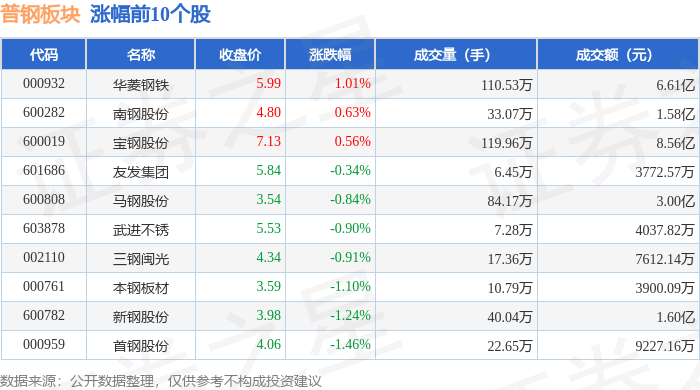
Market Overview - On September 3, the steel sector declined by 1.24%, with Hangzhou Steel leading the drop [1] - The Shanghai Composite Index closed at 3813.56, down 1.16%, while the Shenzhen Component Index closed at 12472.0, down 0.65% [1] Individual Stock Performance - Major stocks in the steel sector showed mixed performance, with Hualing Steel up by 1.01% and Hangzhou Steel down by 4.86% [1][2] - The trading volume for Hualing Steel was 1,105,300 shares, with a transaction value of 661 million yuan [1] - Hangzhou Steel had a trading volume of 1,052,100 shares, with a transaction value of 1.014 billion yuan [2] Capital Flow Analysis - The steel sector experienced a net outflow of 464 million yuan from institutional investors, while retail investors saw a net inflow of 476 million yuan [2][3] - Hualing Steel had a net inflow of 41.79 million yuan from institutional investors, while retail investors had a net outflow of 40.52 million yuan [3] - The overall trend indicates a shift in capital flow, with retail investors increasing their positions despite institutional selling [2][3]
A股回调之际,红利股逆势活跃!中国石油涨4%股价创年内新高,渝农商行、沪农商行、宝钢股份、宇通客车、美的集团、招商银行涨超3%
Ge Long Hui· 2025-09-02 06:59
Core Viewpoint - The A-share market experienced a pullback, but dividend stocks showed resilience in the afternoon session, with notable gains in several companies [1]. Group 1: Stock Performance - China Petroleum saw a rise of over 4%, reaching a new high for the year [1]. - Other companies such as Chongqing Rural Commercial Bank, Shanghai Rural Commercial Bank, Baosteel, Yutong Bus, Midea Group, and China Merchants Bank all increased by more than 3% [1].



35只股中线走稳 站上半年线
Zheng Quan Shi Bao Wang· 2025-09-02 03:59
Market Overview - The Shanghai Composite Index closed at 3844.84 points, above the six-month moving average, with a decline of 0.79% [1] - The total trading volume of A-shares reached 19,304.44 billion yuan [1] Stocks Performance - A total of 35 A-shares have surpassed the six-month moving average, with notable stocks including: - Gongsiao Daji (供销大集) with a deviation rate of 6.45% - Jidian Co. (吉电股份) with a deviation rate of 6.05% - *ST Sansheng (ST三圣) with a deviation rate of 4.29% [1] - Stocks with smaller deviation rates that just crossed the six-month line include: - Fuling Co. (富岭股份) - Hubei Energy (湖北能源) - Yunnan Tourism (云南旅游) [1] Top Stocks by Deviation Rate - The following stocks had the highest deviation rates on September 2: - Gongsiao Daji (供销大集): 9.84% increase, 4.84% turnover rate, latest price 2.68 yuan - Jidian Co. (吉电股份): 7.34% increase, 6.58% turnover rate, latest price 5.56 yuan - *ST Sansheng (ST三圣): 5.10% increase, 2.62% turnover rate, latest price 4.74 yuan [1] Additional Stocks with Notable Performance - Other stocks with significant performance include: - Huayuan Co. (华原股份): 3.93% increase, 2.74% turnover rate, latest price 17.71 yuan - Meiyan Jixiang (梅雁吉祥): 4.59% increase, 7.21% turnover rate, latest price 2.96 yuan - Qingdao Port (青岛港): 2.31% increase, 0.57% turnover rate, latest price 8.87 yuan [1]




普钢板块9月1日跌0.1%,包钢股份领跌,主力资金净流出11.9亿元
Zheng Xing Xing Ye Ri Bao· 2025-09-01 08:39
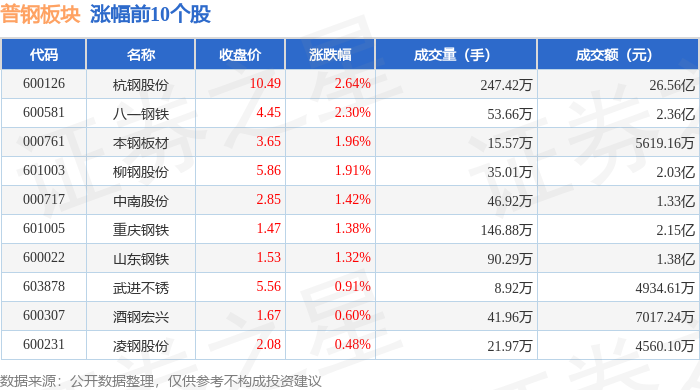
Market Overview - On September 1, the general steel sector experienced a slight decline of 0.1%, with Baogang Co. leading the drop [1] - The Shanghai Composite Index closed at 3875.53, up 0.46%, while the Shenzhen Component Index closed at 12828.95, up 1.05% [1] Individual Stock Performance - Notable gainers in the steel sector included: - Hangang Co. (600126) with a closing price of 10.49, up 2.64% and a trading volume of 2.4742 million shares, totaling 2.656 billion yuan [1] - Bayi Steel (600581) closed at 4.45, up 2.30% with a trading volume of 536,600 shares, totaling 236 million yuan [1] - Benxi Steel (000761) closed at 3.65, up 1.96% with a trading volume of 155,700 shares, totaling 56.1916 million yuan [1] - Conversely, Baogang Co. (600010) saw a decline of 1.43%, closing at 2.75 with a trading volume of 16.8029 million shares, totaling 4.601 billion yuan [2] - Other notable decliners included: - Hebei Steel (000709) down 1.21% to 2.44 with a trading volume of 139,090 shares [2] - Baosteel (600019) down 0.58% to 6.89 with a trading volume of 186,800 shares, totaling 1.291 billion yuan [2] Capital Flow Analysis - The steel sector experienced a net outflow of 1.19 billion yuan from major funds, while retail investors contributed a net inflow of 708 million yuan [2] - Specific stock capital flows included: - Chongqing Steel (601005) with a net inflow of 27.8511 million yuan from major funds, but a net outflow of 17.6784 million yuan from speculative funds [3] - Anshan Steel (000898) saw a net inflow of 7.5332 million yuan from major funds, with minimal activity from speculative and retail investors [3]


宝钢股份:除了沙特项目,公司也在积极关注其他的海外投资标的
Xin Lang Cai Jing· 2025-09-01 05:47
Group 1 - The core viewpoint of the article is that Baosteel Co., Ltd. is actively exploring overseas investment opportunities beyond its project in Saudi Arabia [1] - The company is currently in discussions with multiple potential partners regarding these investments [1] - The primary regions of focus for these overseas investments include Southeast Asia, Central Asia, the Middle East, and North Africa [1]
供给调控预期再起,钢厂利润有望修复
Minsheng Securities· 2025-08-31 00:47
Investment Rating - The report maintains a "Buy" rating for several steel companies, including Hualing Steel, Baosteel, Nanjing Steel, and others, indicating a positive outlook for their profitability and stock performance [3][4]. Core Insights - Supply control expectations are rising, which may lead to a recovery in steel mill profits. Despite high production levels, demand is slowly recovering, and inventory continues to accumulate, resulting in a slight decline in steel mill profits [3][4]. - The report highlights that the current steel prices are at a low point for the year, and with inventory levels low and demand stabilizing, the potential for further profit declines is limited [3][4]. - The report suggests that the recent supply-side adjustments may be more precise, promoting a competitive environment that could enhance the profitability of steel companies [3][4]. Price Trends - As of August 29, 2025, steel prices have decreased, with 20mm HRB400 rebar priced at 3,250 CNY/ton, down 20 CNY/ton from the previous week. Other steel products also saw slight price declines [1][11]. - The report notes that the average price changes for various steel products over the past month show a decrease of 5.8% for rebar and 4.2% for hot-rolled sheets [12]. Production and Inventory - As of August 29, 2025, the total production of the five major steel products reached 8.85 million tons, an increase of 6.55 million tons week-on-week. Rebar production increased by 5.91 million tons to 2.2056 million tons [2][3]. - Total social inventory of the five major steel products rose by 291,000 tons to 10.4532 million tons, while steel mill inventory decreased by 23,300 tons [2][3]. Profitability - The report indicates a decline in steel mill profits, with estimated gross margins for rebar, hot-rolled, and cold-rolled steel decreasing by 48 CNY/ton, 75 CNY/ton, and 61 CNY/ton respectively [1][3]. - The profitability of electric arc furnace steel also saw a decrease of 28 CNY/ton week-on-week [1][3]. Investment Recommendations - The report recommends several companies for investment, including Hualing Steel, Baosteel, Nanjing Steel in the flat steel sector, and Xianglou New Materials, CITIC Special Steel, Yongjin Co., Ltd. in the special steel sector [3][4].


宝钢股份相关公司新增一项142.80万元的招标项目
Xin Lang Cai Jing· 2025-08-29 20:39
Group 1 - The core point of the article is that Shanghai Meishan Steel Co., Ltd., a subsidiary of Baosteel Co., Ltd., has announced a bidding information for a transformer overhaul project with a budget of 1.428 million yuan [1] - Baosteel Co., Ltd. holds a 77.04% stake in Shanghai Meishan Steel Co., Ltd. [1]