
SAIC MOTOR(600104)

Search documents
2026第十二届金轩奖优秀奖名单出炉
汽车商业评论· 2026-01-23 23:07
Core Viewpoint - The 12th Jin Xuan Award ceremony serves as a significant event in the automotive marketing industry, recognizing outstanding achievements and innovations over the past year while promoting a professional evaluation system across the entire automotive industry chain [4][7]. Group 1: Event Overview - The 12th Jin Xuan Award ceremony took place on January 23, 2026, in Beijing, gathering attention from the automotive marketing community [4]. - The event marks a reflection on twelve years of dedication to the principles of fairness, objectivity, and long-termism in the evaluation process [5]. - The Jin Xuan Award is recognized as a "marketing barometer" in the industry, collaborating with other awards to enhance the evaluation framework [7]. Group 2: Award Categories and Winners - This year's awards include 6 annual awards, 20 gold awards for marketing cases, and 43 excellent marketing case awards, covering various categories such as creative works, public welfare, sustainable development, AIGC marketing, and brand IP marketing [8]. - The awards highlight innovative practices in user communication, emotional resonance, technological transformation, and social responsibility [11][12]. Group 3: Notable Award Winners - The Public Welfare and Sustainable Development category recognized winners such as Mercedes-Benz, Jaguar Land Rover China, and SAIC Volkswagen for their impactful initiatives [16]. - The Creative Works category awarded brands like Deep Blue Automotive, Beijing Automotive, and Changan Automobile for their innovative marketing campaigns [23]. - The Cross-Border Marketing category included winners like Geely Galaxy and Kaiyi Automotive, showcasing the synergy between automotive brands and other sectors [43]. Group 4: Marketing Innovations - The AIGC Marketing category awarded East Wind Yipai and SAIC Roewe for their integration of AI technology into marketing strategies [63]. - The Brand IP Marketing award was given to Wuling Automotive for successfully establishing deep emotional connections with users [72]. - The Personality Marketing category recognized Porsche and GAC Group for their effective engagement strategies that resonate with consumers [77].





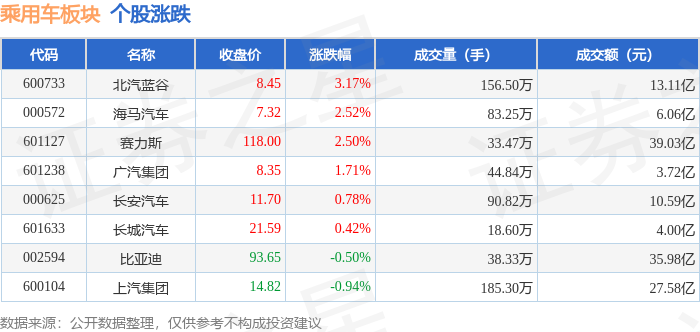
乘用车板块1月23日涨0.49%,北汽蓝谷领涨,主力资金净流出11.47亿元
Zheng Xing Xing Ye Ri Bao· 2026-01-23 09:04
Core Viewpoint - The passenger car sector experienced a slight increase of 0.49% on January 23, with Beijing Blue Valley leading the gains. The Shanghai Composite Index closed at 4136.16, up 0.33%, while the Shenzhen Component Index closed at 14439.66, up 0.79% [1]. Group 1: Market Performance - Beijing Blue Valley (600733) closed at 8.45, up 3.17% with a trading volume of 1.565 million shares and a transaction value of 1.311 billion yuan [1]. - Haima Automobile (000572) closed at 7.32, up 2.52% with a trading volume of 832,500 shares and a transaction value of 606 million yuan [1]. - Seres (601127) closed at 118.00, up 2.50% with a trading volume of 334,700 shares and a transaction value of 3.903 billion yuan [1]. - GAC Group (601238) closed at 8.35, up 1.71% with a trading volume of 448,400 shares and a transaction value of 372 million yuan [1]. - Changan Automobile (000625) closed at 11.70, up 0.78% with a trading volume of 908,200 shares and a transaction value of 1.059 billion yuan [1]. - Great Wall Motors (601633) closed at 21.59, up 0.42% with a trading volume of 186,000 shares and a transaction value of 400 million yuan [1]. - BYD (002594) closed at 93.65, down 0.50% with a trading volume of 383,300 shares and a transaction value of 3.598 billion yuan [1]. - SAIC Motor (600104) closed at 14.82, down 0.94% with a trading volume of 1.853 million shares and a transaction value of 2.758 billion yuan [1]. Group 2: Fund Flow Analysis - The passenger car sector saw a net outflow of 1.147 billion yuan from institutional investors, while retail investors contributed a net inflow of 718 million yuan [1]. - The main fund inflow for Seres (601127) was 118 million yuan, accounting for 3.02% of the total, while retail investors had a net outflow of 11.6 million yuan [2]. - Beijing Blue Valley (600733) had a main fund inflow of 108 million yuan, representing 8.26% of the total, with retail investors contributing a net inflow of 35.217 million yuan [2]. - Changan Automobile (000625) experienced a main fund inflow of 43.554 million yuan, accounting for 4.11%, while retail investors had a net inflow of 19.761 million yuan [2]. - Haima Automobile (000572) saw a main fund inflow of 26.734 million yuan, representing 4.41%, with a retail net outflow of 9.9696 million yuan [2]. - GAC Group (601238) had a main fund inflow of 18.375 million yuan, accounting for 4.94%, while retail investors experienced a net outflow of 26.513 million yuan [2]. - Great Wall Motors (601633) had a main fund inflow of 12.320 million yuan, representing 3.08%, with a retail net outflow of 35.988 million yuan [2]. - BYD (002594) experienced a significant net outflow of 686 million yuan from institutional investors, while retail investors had a net inflow of 51 million yuan [2]. - SAIC Motor (600104) faced a substantial net outflow of 788 million yuan from institutional investors, while retail investors had a net inflow of 34.2 million yuan [2].




汽车行业2025年四季报前瞻:行业盈利逐步回归中枢,看好出海+科技
Shenwan Hongyuan Securities· 2026-01-23 08:07
Investment Rating - The industry investment rating is "Overweight," indicating a positive outlook for the automotive sector compared to the overall market performance [12]. Core Insights - The automotive industry is gradually returning to its profit center, with a strong focus on overseas expansion [1]. - In Q4 2025, total vehicle production and sales reached 10.186 million and 10.023 million units, respectively, showing year-on-year increases of 3.9% and 1.7% [4]. - Domestic retail share of independent brands reached 66.9%, up 3.2 percentage points year-on-year, while wholesale of new energy passenger vehicles increased by 13.2% year-on-year [4]. - The average industry discount rate decreased by 1.33 percentage points to 12.28% in Q4 2025, indicating reduced terminal discounts [4]. - Traditional raw material prices saw a decline, while new energy raw material prices increased, impacting supply chain profitability [4]. Summary by Sections Vehicle Production and Sales - In Q4 2025, passenger vehicle production and sales were 9.018 million and 8.845 million units, with year-on-year changes of +2.2% and -0.3% respectively [4]. - Commercial vehicle production and sales reached 1.168 million and 1.178 million units, with year-on-year increases of +19.4% and +20.0% [4]. - Exports of vehicles in Q4 2025 totaled 2.147 million units, a significant year-on-year increase of 39.8%, with new energy vehicles showing remarkable growth [4]. Market Dynamics - The report highlights the leading position of independent brands in the market, with a notable increase in new energy vehicle sales [4]. - The report notes a divergence in profitability among automakers due to varying new vehicle release schedules and the suspension of trade-in subsidies [4]. Profit Forecasts - The report provides profit forecasts for key automotive companies, indicating significant growth for companies like Jifeng and Dongfang, while others like BYD and Li Auto are expected to see declines [6][8]. - Specific profit growth rates for Q4 2025 show a wide range, with some companies experiencing over 600% growth, while others face substantial losses [6]. Investment Recommendations - The report suggests focusing on companies benefiting from AI integration and overseas business support, such as BYD and Geely [4]. - It also emphasizes the importance of companies with strong performance in the supply chain, particularly in the context of rising raw material prices [4].


中国汽车,在欧洲卖爆了
凤凰网财经· 2026-01-23 03:11
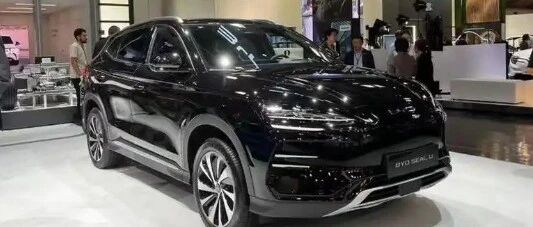
Core Viewpoint - The article highlights the significant growth of Chinese electric vehicle manufacturers in the European market, despite the EU's unfavorable stance towards Chinese electric cars, with a notable increase in sales and market share in 2025 [1][13]. Group 1: Market Performance - In December 2025, the European automotive market is projected to reach sales of 1.15 million units, a year-on-year increase of 7.6%. Chinese automakers' monthly sales in Europe surpassed 100,000 units for the first time, reaching 109,900 units, a 127% increase, with a market share of 9.5% compared to 4.5% in the same month of 2024 [1]. - For the entire year of 2025, the European market is expected to sell 13.3 million vehicles, a 2.3% increase year-on-year, with pure electric vehicle sales growing by 30% and plug-in hybrid vehicle sales by 34%. Chinese automakers are projected to sell 810,000 units in Europe, a 99% increase, capturing a market share of 6.1%, up from 3.1% in 2024 [1]. Group 2: Leading Brands - SAIC's MG brand emerged as the top-selling Chinese passenger car brand in Europe, selling 307,000 units in 2025, a 26% increase, ranking 16th in the market [3]. - BYD followed closely with sales of 187,000 units, a remarkable 276% increase, moving up from 31st to 22nd place in the rankings [5][6]. - Chery's Jaecoo and Omoda brands ranked third and fourth, with sales of 56,944 and 52,950 units, respectively, contributing to a total of 120,000 units sold by Chery in Europe, significantly up from 17,000 units in 2024 [7]. Group 3: Strategic Approaches - SAIC leveraged MG's British heritage to enhance localization, which contributed to its sales growth. The brand's pricing strategy, with models priced below £20,000, helped mitigate the impact of high EU tariffs on Chinese electric vehicles [3]. - BYD focused on meeting the core demands of European consumers for new energy vehicles, particularly with its Seal U model, which dominated the mid-size SUV segment in Europe [6]. - Polestar, a brand with limited presence in China, saw a 56% increase in sales to 47,579 units, with Europe accounting for approximately 78% of its global sales [11]. Group 4: Future Outlook - The article anticipates that the pressure from the EU market will continue, but Chinese automakers are expected to adapt and thrive. A price commitment mechanism is being discussed to replace high anti-subsidy tariffs, which may lead to short-term fluctuations in sales but ultimately improve competitiveness [14]. - Projections indicate that from 2026 to 2028, Chinese electric vehicle exports to the EU will maintain an annual growth rate of around 20%, positioning them as a key driver of global electric vehicle market growth [15].
上汽利润“暴涨”,“消失”的2700亿市值,能涨回来吗?
Xin Lang Cai Jing· 2026-01-22 08:34
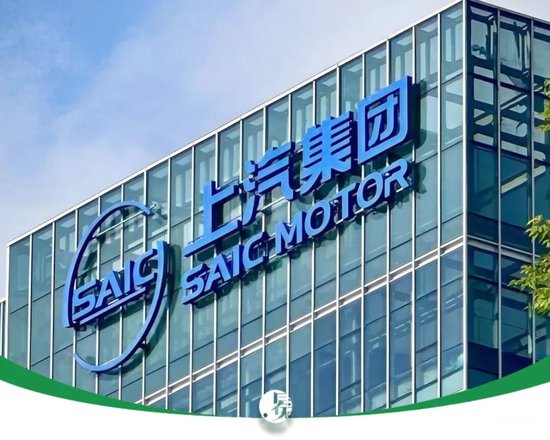
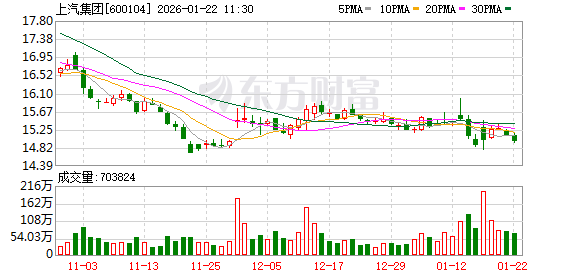
Core Viewpoint - SAIC Motor Corporation is experiencing a resurgence in sales and profitability, but the stock market response has been tepid, raising questions about the sustainability of its financial performance and market confidence [4][5][6]. Group 1: Sales and Profitability - In 2025, SAIC's wholesale vehicle sales reached 4.5075 million units, a year-on-year increase of approximately 12.3%, closing the gap with BYD to about 100,000 units [4][6]. - The company projected a net profit attributable to shareholders of 9 billion to 11 billion yuan for the previous year, representing a staggering year-on-year increase of 438% to 558% [4][6]. - However, in 2024, SAIC's net profit plummeted to less than 1.7 billion yuan, marking a significant decline in profitability [5][6]. Group 2: Market Capitalization and Stock Performance - SAIC's market capitalization peaked at nearly 440 billion yuan eight years ago but has since dropped to around 170 billion yuan, resulting in a loss of approximately 270 billion yuan in value [4][6][33]. - Despite a recovery in sales and profits, SAIC's stock price has remained stagnant, with a cumulative decline of 26.37% even as it surpassed BYD in sales during certain periods [4][6][43]. Group 3: Profit Quality and Concerns - The substantial profit increase in 2023 was partly due to a low base from previous asset impairment losses, which reduced net profit by approximately 7.87 billion yuan [5][7]. - A significant portion of the profit increase was attributed to a transaction involving MG Motor India, which added 5.178 billion yuan to net profit but was not a reflection of new cash earnings [7][8]. - The reliance on joint venture brands for revenue has been a concern, as their contribution to total revenue has been declining, impacting overall profitability [6][8][10]. Group 4: New Energy Vehicle (NEV) Strategy - SAIC's NEV sales have been increasing, with 1.643 million units sold in 2025, but this has not translated into significant revenue growth compared to competitors like BYD [9][10][22]. - The company faces challenges in the NEV market, particularly with its investments in brands like Feifan and Zhiji, which have struggled to meet sales targets [23][24][50][51]. - Upcoming models, such as the Shangjie Z7 and H7, are seen as potential game-changers for SAIC in the competitive NEV landscape [52][53].
南极光(300940.SZ):车规级背光模组已应用于小鹏汽车、上汽集团等知名车企
Ge Long Hui· 2026-01-22 08:31
Core Viewpoint - The company Nanji Guang (300940.SZ) has successfully applied its automotive-grade backlight modules in well-known automotive manufacturers such as Xpeng Motors and SAIC Motor [1] Group 1 - The automotive-grade backlight modules are being utilized in vehicles produced by prominent companies in the automotive industry [1]
南极光:公司车规级背光模组已应用于小鹏汽车、上汽集团等知名车企
Jin Rong Jie· 2026-01-22 08:29
Core Viewpoint - The company, Nanji Guang, confirmed that its automotive-grade backlight modules are being utilized by well-known automotive manufacturers such as Xiaopeng Motors and SAIC Group [1] Summary by Categories Company Information - Nanji Guang's automotive-grade backlight modules are currently applied in vehicles produced by Xiaopeng Motors and SAIC Group [1]

向改革要动力:上汽以技术突破重塑增长曲线
Guo Ji Jin Rong Bao· 2026-01-22 04:31
Core Insights - The article highlights the transformation of the Chinese automotive industry, particularly focusing on SAIC Motor Corporation's impressive performance and strategic shift towards high-quality development [2][4][6]. Sales Performance - In 2025, SAIC is projected to sell 4.507 million vehicles, a year-on-year increase of 12.3%, with retail sales reaching 4.67 million units [4]. - The sales of new energy vehicles (NEVs) are expected to reach 1.643 million units, marking a significant year-on-year growth of 33.1% [4]. - Overseas sales are anticipated to be 1.071 million units, reflecting a 3.1% increase compared to the previous year [4]. Profitability - SAIC forecasts a net profit attributable to shareholders of 9 to 11 billion yuan, representing a staggering year-on-year increase of 438% to 558% [6]. - The non-recurring net profit is expected to be between 7 to 8.2 billion yuan, showing a growth of 229% to 251% year-on-year [6]. Strategic Transformation - The company has undergone a strategic overhaul, shifting from a scale expansion model to a value creation approach, focusing on comprehensive reforms to unlock structural benefits [6][7]. - SAIC has broken down traditional departmental barriers, creating a more agile and efficient operational system that enhances user demand responsiveness [7]. Technological Investment - Over the years, SAIC has invested more than 150 billion yuan in electrification and intelligence, resulting in nearly 26,000 effective patents and a robust technical framework covering electric, hybrid, and hydrogen vehicles [11]. - The company has developed advanced technologies such as the DMH engine, achieving a thermal efficiency of 46.3%, and has introduced innovative battery technologies [14]. Product Strategy - SAIC's product strategy emphasizes a user-centric approach, moving from a manufacturing giant to a user-oriented enterprise, with a focus on creating a diverse product lineup that meets various market segments [17]. - The successful launch of models like the Zhiji LS6 and LS9 demonstrates the effectiveness of this strategy, with significant sales growth and market penetration [18]. Ecosystem Collaboration - The company is actively building an ecosystem that enhances user experience through collaborations with tech firms like Huawei and Momenta, integrating cutting-edge technologies into its products [19]. - This collaborative approach aims to provide comprehensive smart mobility solutions, enhancing the overall value proposition for users [19]. Marketing Innovation - SAIC has reformed its marketing strategies to improve direct engagement with consumers, utilizing innovative methods such as pop-up stores and real-time feedback collection to enhance product development [20]. - The marketing efforts for models like the MG4 and Zhiji LS6 focus on translating complex technologies into relatable benefits for consumers, fostering emotional connections with the brand [20]. Future Outlook - Looking ahead, SAIC aims to solidify its position as a leader in the global smart electric vehicle market, continuing to deepen reforms and accelerate technological advancements [21]. - The company's transformation journey serves as a valuable example for traditional automotive giants seeking sustainable growth through self-innovation and user-centric strategies [21].
上汽集团、均胜电子等增资新芯航途
Zheng Quan Shi Bao Wang· 2026-01-22 02:31
Group 1 - The core point of the article highlights the recent changes in the ownership structure of the autonomous driving chip design company, Xinxin Hangtu (Suzhou) Technology Co., Ltd, with significant investments from major automotive players [1] - The registered capital of Xinxin Hangtu has increased to 18.7169 million yuan, indicating a strengthening of its financial position [1] - New shareholders include Chery Automobile and Guokai Technology, alongside existing investors such as SAIC Group and Joyson Electronics, reflecting growing interest in the autonomous driving sector [1] Group 2 - Xinxin Hangtu was established in December 2023, focusing on integrated circuit chip design and sales, which positions the company in a rapidly evolving technology landscape [1] - The company has secured multiple rounds of angel investment from notable investors including NIO Capital, SAIC Group funds, and IDG Capital, showcasing strong backing from the industry [1]

北汽集团投资成立新能源汽车部件公司
Zheng Quan Shi Bao Wang· 2026-01-22 02:04
Group 1 - The core point of the article is the establishment of a new company, Haixun Jiguang New Energy Vehicle Components (Beijing) Co., Ltd., with a registered capital of 100 million yuan [1] - The company's business scope includes manufacturing of automotive parts and components, wholesale and retail of automotive spare parts, and sales of electronic components and electromechanical equipment [1] - The company is wholly owned by Beijing Hainachuan Automotive Parts Co., Ltd., which is a subsidiary of Beijing Automotive Group Co., Ltd. [1]