SAIC MOTOR(600104)

Search documents
上汽集团(600104):2025年9月销量点评:合资、自主、新能源、海外延续多板块向好
Changjiang Securities· 2025-10-14 10:15
Investment Rating - The investment rating for the company is "Buy" and is maintained [7] Core Insights - In September 2025, the company achieved a total sales volume of 440,000 vehicles, representing a year-on-year increase of 40.4% and a month-on-month increase of 21.0%. Cumulatively, from January to September, total sales reached 3.193 million vehicles, up 20.5% year-on-year. The sales growth rate has been on an upward trend since March, indicating the effectiveness of ongoing reforms [2][12] - The report highlights that the sales performance across various segments, including joint ventures, independent brands, new energy vehicles, and overseas markets, continues to show positive momentum [12] Summary by Sections Overall Performance - The company reported a total sales volume of 440,000 vehicles in September 2025, with a year-on-year increase of 40.4% and a month-on-month increase of 21.0%. For the first nine months of 2025, total sales reached 3.193 million vehicles, reflecting a year-on-year growth of 20.5%. The sales growth has been consistently improving since March, showcasing the positive impact of reforms [12] Joint Ventures - Sales from joint venture brands have shown continuous improvement, with September sales for SAIC Volkswagen at 94,000 vehicles (up 0.1% year-on-year, up 8.7% month-on-month) and for SAIC General at 49,000 vehicles (up 124.4% year-on-year, up 12.7% month-on-month). Cumulatively, from January to September, SAIC Volkswagen sold 752,000 vehicles (down 2.5% year-on-year), while SAIC General sold 381,000 vehicles (up 36.7% year-on-year) [12] Independent Brands - The independent brand segment saw significant growth, with SAIC Passenger Cars selling 94,000 vehicles in September (up 72.4% year-on-year, up 25.5% month-on-month) and a total of 596,000 vehicles sold from January to September (up 23.8% year-on-year). The new model, IM LS6, launched on September 10, is expected to further boost sales [12] New Energy and Overseas Markets - New energy vehicle sales reached 189,000 units in September, marking a year-on-year increase of 46.5% and a month-on-month increase of 46.0%. For the first nine months, new energy vehicle sales totaled 1.083 million units, up 44.8% year-on-year. Exports and overseas sales amounted to 101,000 vehicles in September (up 12.2% year-on-year, up 14.0% month-on-month) and 765,000 vehicles from January to September (up 3.5% year-on-year) [12] Future Outlook - The company is undergoing internal reforms and enhancing collaboration with Huawei to accelerate its smart transformation. The ongoing reforms are expected to improve operational efficiency and drive sales growth for independent brands. The projected net profit for 2025 and 2026 is estimated at 13.02 billion and 14.98 billion yuan, respectively, with corresponding price-to-earnings ratios of 14.8X and 12.9X [12]

韧性增长,上汽集团深化改革路径渐明
Zhong Guo Qi Che Bao Wang· 2025-10-14 08:16
Core Viewpoint - SAIC Motor Corporation has demonstrated significant growth and resilience in the automotive market, achieving record sales and showcasing the effectiveness of its comprehensive reform initiatives [1][3][19]. Sales Performance - In September, SAIC Motor sold 440,000 vehicles, marking a year-on-year increase of 40.4% and a quarter-on-quarter increase of 21%, setting a new high for the year [1]. - From January to September, the company achieved cumulative vehicle sales of 3.193 million units, a year-on-year growth of 20.5%, and maintained a leading position in the industry [3]. Organizational Restructuring - The company restructured its organizational framework by establishing a "Large Passenger Vehicle Sector" and "SAIC Commercial Vehicle" entity to enhance efficiency and responsiveness across the entire product lifecycle [4]. - The restructuring led to a consolidated revenue of 299.59 billion yuan, a year-on-year increase of 5.2%, and a net profit attributable to shareholders of 6.02 billion yuan, with a significant growth of 432.2% in the net profit excluding non-recurring items [4]. Financial Health - The net cash flow from operating activities reached 21.04 billion yuan, representing an 85.9% year-on-year increase, providing ample funding for ongoing technology development and market expansion [4]. - The company’s focus on optimizing production, sales, and inventory structures has resulted in quality growth and improved operational efficiency [4]. Product Innovation - SAIC Motor has launched several innovative products, including the MG4 with solid-state battery technology, which has received over 45,000 pre-orders, and the new generation IM LS6 with advanced range and charging capabilities [10][12]. - The company’s product lineup reflects a strong emphasis on technological innovation, with multiple models achieving significant order volumes shortly after their launch [12]. Technological Advancements - The company has developed a comprehensive technology framework focusing on intelligent connectivity, vehicle safety, and advanced power systems, enhancing its competitive edge in the market [16][17]. - SAIC Motor's DMH hybrid engine has achieved a thermal efficiency of 46.3%, and its vehicles are gaining traction in the European market, showcasing the company's advancements in energy efficiency and sustainability [17]. Strategic Direction - The reforms and innovations at SAIC Motor signify a shift from scale growth to quality management and from price competition to technology competition, reflecting the company's unique market resilience [19]. - The company’s approach emphasizes long-termism and the development of systemic capabilities to secure a sustainable competitive advantage in a rapidly evolving automotive landscape [19].


俄罗斯又拖全球车市后腿了
Zhong Guo Qi Che Bao Wang· 2025-10-14 02:09
Group 1 - Global automotive markets, except for Russia, showed growth in September and the first three quarters of the year, driven by various factors such as electric vehicle (EV) subsidies in the US and tax reforms in India [2] - In the US, electric vehicle sales surged before the expiration of a $7,500 subsidy, with Q3 sales exceeding 438,000 units, marking a record quarter and a market share of 10.5% [3][4] - Major automakers in the US reported increased sales, with Ford's sales up 8.2%, General Motors up 8%, and Hyundai up 13%, largely driven by electric vehicle demand [4] Group 2 - In Europe, the automotive market saw a slight increase in passenger car sales, with a total of 8.69 million units sold from January to August, a 0.4% year-on-year growth [6] - Chinese automakers, particularly BYD and SAIC, have become significant players in the European market, with BYD's sales skyrocketing by 280% [7] - The UK experienced its highest new car sales in September since 2015, driven by strong electric vehicle performance and government subsidies [8] Group 3 - India's automotive market showed resilience with a total of 3.8 million new vehicles sold in the first three quarters, a 2.3% increase year-on-year, supported by tax reforms [9][10] - The new GST 2.0 tax structure in India has significantly improved the affordability of small cars, boosting consumer confidence and sales [10] - In Japan, new car sales reached 3.465 million units in the first nine months, a 5% increase, although the market faced challenges in the latter part of the year [11][12] Group 4 - Brazil's automotive market reported a 2.9% increase in September sales, with a total of 1.91 million vehicles sold in the first nine months, driven by strong export performance [13][14] - The Brazilian government plans to reintroduce tariffs on electric and hybrid vehicles starting in 2024, aiming to stimulate local production [15] - Russian automotive sales plummeted by 23% in the first nine months, with a significant decline in new car sales due to geopolitical factors and rising costs [16][17]





中国汽车-行业市场份额和利润分配的分散化可能持续至 2025 年第四季度-China Automobiles_ De-consolidation of industry market share and profit distribution likely to continue into 4Q25
2025-10-13 15:12
Summary of Conference Call Notes on the Automotive Industry Industry Overview - The automotive industry is experiencing a de-consolidation of market share and profit distribution, which is expected to continue into 4Q25 [1][2][18] - Domestic passenger vehicle (PV) demand is projected to slow down, with growth rates of +5% year-over-year (yoy) in 3Q25 and a decline of -9% yoy in 4Q25, compared to +11% yoy in 1H25 [1][2] Key Insights Market Dynamics - The capex expansion for auto original equipment manufacturers (OEMs) accelerated to +66% yoy in 2Q25, the highest growth rate since 3Q22, driven by a 13% growth in passenger vehicle production and a 14% increase in wholesale volume [2][9] - The Herfindahl-Hirschman Index (HHI) for domestic new energy vehicle (NEV) retail sales volume decreased to 1,218 in 8M25 from 1,479 in 8M24, indicating a more fragmented market [2] Financial Performance - The total OEM industry EBITDA declined by -1% yoy, with margins decreasing by -0.9 percentage points (pp) yoy. The top two profit-making OEMs saw a decline in EBITDA, while most others improved, suggesting a potential demand/supply imbalance [2][18] - Account payable days for the overall OEM industry shortened by 26 days quarter-over-quarter (qoq) and 5 days yoy, reflecting efforts to relieve suppliers' working capital pressure [2][16] Future Outlook - For 4Q25, expectations include: - Sequential growth in volume due to better seasonality and new model launches [4] - Potential widening of dealer discounts during the peak sales season [4] - Improvement in OEM margins sequentially, offsetting average selling price (ASP) pressure [4] - Gradual reduction in payable days and improved operating cash flow [4] Recent Trends - In 3Q25, market growth slowed due to a high base from the previous year and weaker-than-usual seasonality. NEV penetration increased to 56% from 50% in 1H25, while dealer discounts for NEVs widened [5][6] - The profit distribution among OEMs is becoming less concentrated, with industry leaders facing margin pressure while followers see margin improvements [6][18] Earnings Revisions - GAC's net profit estimates for 2H25/2026/2027 were lowered significantly due to continued market share loss, with a new target price of Rmb4.2, implying a downside of -45% [7] - SAIC's volume estimates were raised by up to 2% for 2H25-2027, but gross margins were lowered, maintaining a target price of Rmb8.8, implying a downside of -48% [7] - Huayu's EPS estimates were raised by 4%-6% due to better-than-expected customer diversification, with a target price increase to Rmb14.6, implying a downside of -29% [7] Additional Insights - The automotive industry is at a critical inflection point where many companies are nearing cash cost levels, indicating potential challenges in adding new capacity or maintaining profitability [19][20] - The overall industry is still above cash cost levels, but margin improvements are becoming increasingly difficult due to ongoing price competition and slowing volume growth [18][42] This summary encapsulates the key points from the conference call, highlighting the current state and future outlook of the automotive industry, along with specific financial performance metrics and earnings revisions for major players.



车市“金九”成色足:销量创新高,新能源渗透率升至57.8%
Bei Ke Cai Jing· 2025-10-13 13:37
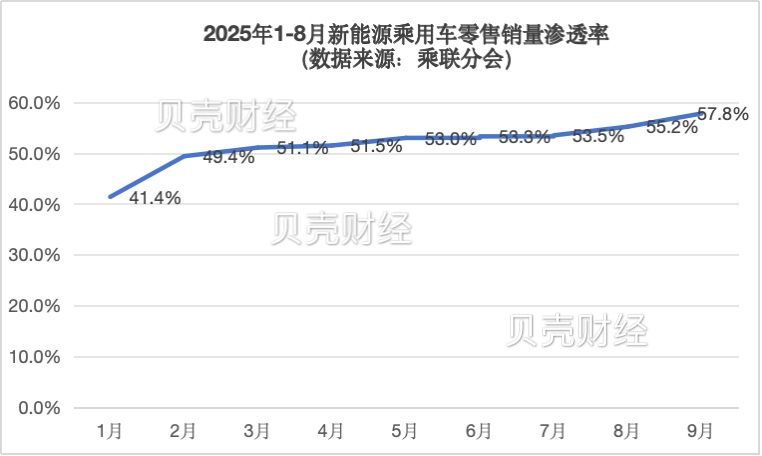
Core Insights - In September, China's passenger car production, retail, and export volumes reached historical highs for the month, with retail sales at 2.241 million units, a year-on-year increase of 6.3% [1] - The retail penetration rate of new energy passenger vehicles rose to 57.8%, up 5 percentage points from the same period last year, indicating stable growth supported by policies such as tax exemptions [2][4] Group 1: Market Performance - The retail sales of new energy passenger vehicles in September increased by 15.5% year-on-year to 1.296 million units, maintaining a penetration rate above 50% for the seventh consecutive month since March [2] - The sales of pure electric passenger vehicles reached 826,000 units in September, showing a year-on-year growth of 28.5% and a month-on-month increase of 19.8% [5] - The overall passenger car market in the first nine months of the year saw cumulative retail sales of 17.005 million units, a year-on-year increase of 9.2% [7] Group 2: Segment Analysis - The market share of pure electric vehicles has significantly increased, while the growth rates of plug-in hybrid and range-extended vehicles have slowed down, indicating a shift in consumer preference [4][5] - The sales distribution for September was approximately 64% for pure electric vehicles, 28% for plug-in hybrids, and 8% for range-extended vehicles [5] Group 3: Company Performance - Among the top domestic automakers, Geely, BYD, and SAIC have achieved over 70% of their sales targets for the year, with Geely's cumulative sales reaching 2.17 million units, achieving a target completion rate of 72% [8] - New energy vehicle startups have shown a clear differentiation in sales target completion rates, with companies like XPeng and Leap Motor exceeding 75% [8] - The market share of domestic brands in retail reached 64.8%, an increase of 5.9 percentage points compared to the previous year, highlighting the growth of domestic brands in both the new energy and export markets [8]

紧抓科技主线,寻找低估成长新机
Shenwan Hongyuan Securities· 2025-10-13 12:39
Investment Rating - The report maintains a positive investment rating for the automotive industry, highlighting potential opportunities in companies with strong performance and growth potential, particularly in the technology and high-end sectors [3][11]. Core Insights - The report emphasizes that the fourth quarter will see a surge in market demand due to tightening subsidy limits, with a focus on companies capable of effectively releasing supply, such as Geely, BYD, Great Wall, Li Auto, and NIO [3]. - It suggests that in an uncertain consumer environment, attention should be directed towards "future industries" where technology continues to create excess returns, recommending companies in robotics, AI, and low-altitude economy sectors [3]. - The report also notes significant changes due to state-owned enterprise reforms, particularly in companies like SAIC and Dongfeng, which should be monitored closely [3]. Industry Situation Update - In the 39th week of 2025, retail sales of passenger cars reached 650,000 units, a month-on-month increase of 27.95% but a year-on-year decrease of 1.02%. Traditional energy vehicle sales were 280,000 units, up 32.70% month-on-month but down 15.07% year-on-year, while new energy vehicle sales were 370,000 units, up 24.58% month-on-month and up 13.15% year-on-year, with a penetration rate of 56.92% [3]. - The report indicates that raw material prices for traditional and new energy vehicles have risen recently, with traditional vehicle raw material price index increasing by 0.8% week-on-week and decreasing by 1.3% month-on-month, while the new energy vehicle raw material price index increased by 1.2% week-on-week and 1.8% month-on-month [3][47]. Market Situation Update - The total transaction value of the automotive industry this week was 266.97 billion yuan, with a daily average decrease of 29.72%. The automotive industry index closed at 8141.23 points, down 1.26% for the week, which is a larger decline compared to the Shanghai and Shenzhen 300 index, which fell by 0.51% [3][11]. - Among individual stocks, 132 rose while 135 fell, with the largest gainers being Meili Technology, Jinlong Automobile, and Kabeiyi, which increased by 18.9%, 13.7%, and 13.2% respectively. The largest decliners were Mingxin Xuteng, Meichen Technology, and Hengshuai Co., which fell by 18.5%, 17.1%, and 10.6% respectively [3][16]. Important Events - The report highlights several key events, including the announcement of the 400th batch of new car approvals by the Ministry of Industry and Information Technology, which includes models from Anhui Volkswagen, Leap Motor, and others [4][29]. - It also notes the joint announcement by three departments regarding the technical requirements for the exemption of vehicle purchase tax for new energy vehicles from 2026 to 2027 [7][8]. - Additionally, the Shanghai government has adjusted the rules for the vehicle trade-in subsidy program, which will be implemented from October 13, 2025, to December 31, 2025 [9][10]. Investment Analysis Recommendations - The report recommends focusing on domestic leading manufacturers such as NIO, Xiaomi, Xiaopeng, and Li Auto, as well as companies that exemplify the trend towards smart technology, such as Jianghuai Automobile and Seres [3]. - It suggests monitoring state-owned enterprise consolidations, particularly with SAIC Group, Dongfeng Group, and Changan Automobile [3]. - The report also highlights component manufacturers with strong performance growth and overseas expansion capabilities, recommending companies like Fuyao Glass, New Spring, and others [3].


乘用车板块10月13日跌2.23%,赛力斯领跌,主力资金净流出25.79亿元
Zheng Xing Xing Ye Ri Bao· 2025-10-13 12:38
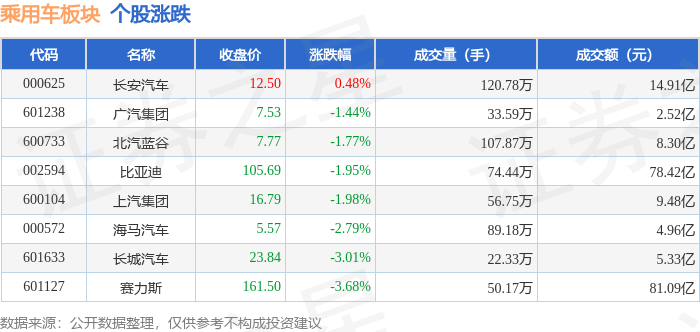
| 代码 | 名称 | 主力净流入(元) | 主力净占比 游资净流入 (元) | | 游资净占比 散户净流入 (元) | | 散户净占比 | | --- | --- | --- | --- | --- | --- | --- | --- | | 000625 长安汽车 | | 1.39亿 | 9.32% | -6276.59万 | -4.21% | -7623.45万 | -5.11% | | 601633 长城汽车 | | 869.50万 | 1.63% | -1432.68万 | -2.69% | 563.18万 | 1.06% | | 601238 广汽集团 | | -1711.84万 | -6.81% | 558.62万 | 2.22% | 1153.22万 | 4.59% | | 000572 海马汽车 | | -2191.08万 | -4.41% | 433.56万 | 0.87% | 1757.51万 | 3.54% | | 600733 北汽蓝谷 | | -6190.11万 | -7.46% | -1702.93万 | -2.05% | 7893.04万 | 9.51% | | 600104 ...


华为“车友圈”扩列,重塑中国汽车中场战事
2 1 Shi Ji Jing Ji Bao Dao· 2025-10-13 12:21
Core Insights - The collaboration between major Chinese automotive companies and Huawei marks a significant shift towards smart transformation in the automotive industry, with a focus on deep integration and co-creation of products [1][4][10] Group 1: Collaboration Models - Huawei's partnerships with automotive companies can be categorized into three main models: component supply, HI model (HUAWEI INSIDE), and the most integrated "Hongmeng Intelligent Travel" model, which involves deep collaboration across the product lifecycle [2][3] - The "HI Plus" model has emerged, allowing automotive companies to retain brand sovereignty while Huawei deeply integrates its technology throughout the product lifecycle [3] Group 2: Strategic Partnerships - Major state-owned automotive companies, including Dongfeng, GAC, and SAIC, are increasingly collaborating with Huawei, redefining the competitive landscape of the Chinese automotive industry [1][4] - Dongfeng's partnership with Huawei is central to its smart transformation strategy, contributing significantly to its electric vehicle sales [4][5] Group 3: Product Development and Innovation - Dongfeng's new project with Huawei, the DH project, emphasizes joint development and marketing, showcasing a collaborative approach to product innovation [3][6] - GAC's collaboration with Huawei has led to the launch of several smart vehicles, including the A800 sedan, which integrates Huawei's advanced driving and cockpit technologies [5][6] Group 4: Market Impact and Sales Performance - The collaboration has resulted in significant sales growth for companies like Lantu, which saw an 85% year-on-year increase in deliveries, highlighting the effectiveness of the partnerships [4][8] - The cumulative sales of vehicles developed in collaboration with Huawei have surpassed 3 million units, indicating a successful shift from isolated efforts to ecosystem collaboration [8] Group 5: Challenges and Cultural Integration - The partnerships face challenges related to resource allocation, cultural integration, and maintaining brand identity amidst deep collaboration [9][10] - Companies like Chery have experienced internal resource conflicts due to overlapping projects with Huawei, emphasizing the need for clear strategic alignment [9][10] Group 6: Future Outlook - The ongoing collaboration between state-owned automotive companies and Huawei is expected to evolve, focusing on balancing innovation with brand uniqueness and operational efficiency [10][11] - The competition in the automotive industry will increasingly hinge on finding optimal solutions between independent innovation and open collaboration [11]
北京汽车集团有限公司入围《经济观察报》2024—2025年度受尊敬企业
Jing Ji Guan Cha Wang· 2025-10-13 09:57
Core Insights - Beijing Automotive Group Co., Ltd. has demonstrated outstanding performance in quality operations, innovative breakthroughs, and social contributions, leading to its preliminary evaluation for inclusion in the "2024-2025 Most Respected Enterprises" by Economic Observer [1] Group 1 - The company has excelled in various metrics such as quality operations, innovation, and social contributions [1]
时隔5个月,上汽重夺“销冠”
财联社· 2025-10-13 09:44
Core Viewpoint - The Chinese passenger car market experienced significant growth in September, with retail sales reaching 2.241 million units, a year-on-year increase of 6.3% and a month-on-month increase of 11.0%. Cumulatively, retail sales for the year reached 17.005 million units, marking a 9.2% year-on-year growth and setting a new historical peak [1]. Group 1: Market Performance - In September, 11 out of 14 listed car companies reported year-on-year sales growth, accounting for 78.6% of the sample. New energy vehicles (NEVs) were the primary driver of this growth, with total sales exceeding 1.32 million units among the 14 major companies [1]. - The penetration rate of NEVs in the overall passenger car retail market reached 57.8% in September, an increase of 5 percentage points compared to the same period last year. Among domestic brands, the penetration rate for NEVs reached 78.1% [1]. Group 2: Company-Specific Sales Data - SAIC Motor Corporation achieved sales of 439,777 units in September, a year-on-year increase of 40.39%, reclaiming the title of monthly sales champion among Chinese listed car companies after five months. Cumulative sales for the first nine months reached 3.193 million units, up 20.53% year-on-year [2]. - BYD's sales in September were 396,270 units, marking a year-on-year decline of 5.52%, ending an 18-month growth streak. The sales of pure electric models were 205,000 units, up 24.31%, while plug-in hybrid models saw a significant drop of 25.58% [3]. - Geely Automobile reported sales of 273,125 units in September, a year-on-year increase of 35.24%. NEV sales reached 165,201 units, up 81.27%, with a market penetration rate of 60.49% [3]. - Chery Automobile's sales reached 255,584 units in September, a year-on-year increase of 8.90%, with NEV sales at 83,498 units, up 17.24% [4]. - New force in the automotive sector, Leap Motor, achieved a record monthly delivery of 66,657 units in September, a year-on-year increase of 97.4% [4]. Group 3: Market Trends and Future Outlook - The automotive market in September saw the launch of over 70 new models, driven by government subsidies and local purchase incentives, which boosted consumer purchasing enthusiasm [5]. - The Secretary-General of the China Passenger Car Association, Cui Dongshu, indicated that the rapid release of new models, particularly from domestic brands, is enhancing competitiveness in the NEV market. The fourth quarter is expected to maintain stable growth due to policy guidance and a strong growth foundation [5].