HEILAN HOME(600398)

Search documents
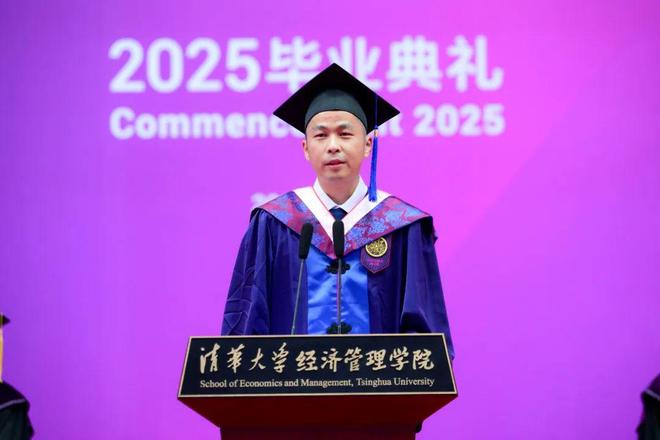
清华富二代掌舵要IPO了!市值一度逼近900亿!
Xin Lang Cai Jing· 2025-11-09 00:13
Core Viewpoint - Haier Home, a prominent name in the Chinese men's clothing sector, is planning to go public in Hong Kong to enhance its global presence and diversify its capital platform [1][9]. Company Background - The story of Haier Home began in 1988 when founder Zhou Jianping invested 300,000 yuan to take over a struggling woolen factory, transforming it into a profitable business [2]. - In 2002, inspired by Japan's Uniqlo, Zhou established Haier Home, introducing a self-selection and affordable pricing model that disrupted traditional men's clothing sales [2]. Leadership Transition - Zhou Jianping transferred 23.1% of his shares to his son Zhou Licheng in November 2020, increasing his stake to 27% [4]. - Zhou Licheng, a Tsinghua University graduate, took over in 2020 and faces challenges such as online competition, brand aging, and high inventory levels [6]. Business Challenges - The main brand still accounts for 70% of revenue, while new ventures have not yet significantly contributed [6]. - Revenue is projected at 21 billion yuan for 2024, down from 29 billion yuan in net profit [6]. - Inventory issues are significant, with over 10 billion yuan in stock and an average turnover period of 330 days [6]. IPO Plans - This is not Haier Home's first attempt at capital markets; it previously attempted an A-share IPO in 2012 but was rejected due to concerns over independence [7]. - The company later went public via a reverse merger in 2014, reaching a market value close to 90 billion yuan, but its current market cap has dropped to approximately 30 billion yuan [8]. Market Positioning - The upcoming Hong Kong IPO aims to support global expansion, enhance international branding, and create a diversified capital platform [9]. - Compared to competitors, Haier Home's gross margin of about 46% is lower than that of peers like Youngor (over 72%) and Seven Wolves (47%-53%) [10]. Industry Context - Haier Home's IPO is part of a broader trend, with other companies like Lens Technology and Luxshare Precision also pursuing listings in Hong Kong amid market challenges [11]. - The Hong Kong market has seen a mix of successes and failures, with recent IPOs facing difficulties, indicating a cooling investor sentiment [12]. Strategic Questions - Haier Home must address whether it can attract younger consumers, manage its substantial inventory, and successfully expand internationally to create a second growth curve [14].


共创数字新范式:海澜之家与京东共筑服装产业智慧未来
Xin Hua She· 2025-11-07 15:30
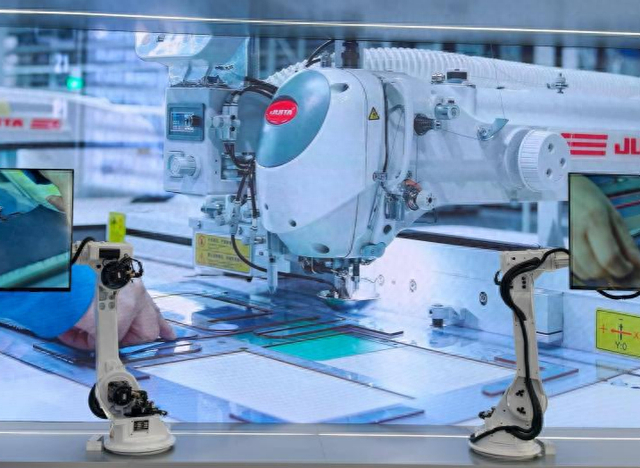
Core Insights - The textile and apparel industry in China is accelerating its transition from "manufacturing" to "intelligent manufacturing" through digital transformation initiatives led by Hai Lan [1][8] - Hai Lan's collaboration with JD.com has created a co-creation model that enhances quality and upgrades the industry [1][8] Digital Transformation - Hai Lan initiated the construction of smart factories in 2022, achieving a model of "one piece order, delivery within 7 working days" by 2023, which restructured the production process [1] - The smart factory's core innovation is the "butterfly system" flexible production line, which allows dynamic allocation of materials to idle workstations, achieving a daily capacity of 400 suits (800 garments) [3] Data Collaboration - Hai Lan's digital transformation spans the entire supply chain from R&D to sales, with over 5,000 stores integrated into JD.com's rapid delivery system by June 2025 [3][4] - The collaboration with JD.com has enabled effective inventory management and reduced production delays during peak seasons [4] Innovation Drive - Hai Lan increased R&D investment, with expenses reaching 157 million yuan in the first three quarters of 2025, focusing on technological innovation to enhance product strength [5] - The company collaborates with universities to explore traditional Chinese clothing and color systems, aiming to reshape contemporary national brand aesthetics [5] Channel Integration - Hai Lan is promoting deep integration of online and offline channels, adapting to the shift from single-day promotions to normalized daily sales [6] - The company has transformed its supply chain from "experience-based stocking" to "algorithm-driven" processes through system integration and data sharing [8]

京东助力海澜之家向“超级国货品牌”迈进的数智化之旅
Xin Hua Wang· 2025-11-07 11:56
Core Insights - The transformation of traditional textile industry into "smart manufacturing" is exemplified by the operations at Hai Lan Yun's smart factory, showcasing advanced technologies like laser cutting and intelligent body measurement systems [1][2] - The competitive landscape of the apparel industry is shifting from price wars to supply chain resilience, as highlighted by the collaboration between Hai Lan Zhi Jia and JD.com, which has enhanced inventory turnover efficiency by over three times [1][6] - The rise of domestic brands is reflected in the increasing engagement of younger consumers, with a notable growth in active female users online [3] Group 1: Supply Chain Innovations - Hai Lan Zhi Jia has implemented a "Deep Sea Data Model" in collaboration with JD.com, allowing for real-time monitoring of new products against historical bestsellers, leading to rapid identification of potential hits [1][4] - The partnership has resulted in a significant improvement in inventory management, with initial order quantities controlled between 500-1000 pieces, enabling dynamic replenishment to achieve sales of millions of units [1][6] Group 2: Technological Advancements - The Hai Lan Yun factory has achieved a custom order capability of one piece with a seven-day delivery time, significantly reducing the production cycle from 15 days to 4 days [2][6] - The factory's innovations include a laser cutting precision of millimeter-level and a cost-saving of over 20 million yuan annually through advanced fabric technologies [2] Group 3: Brand Development and Cultural Integration - Hai Lan Zhi Jia is diversifying its brand portfolio to include various segments such as men's, women's, and professional attire, while also enhancing brand value through cultural initiatives [4][6] - The company aims to instill national confidence in consumers by promoting comfort and dignity in clothing, as part of its long-term vision [4] Group 4: E-commerce and Consumer Trust - The collaboration with JD.com has led to a relatively low return rate for Hai Lan Zhi Jia, attributed to the quality perception and trust built through a robust membership system [5] - The continuous increase in self-operated sales on JD.com indicates a healthy channel ecosystem for the brand [5]
重要调整!16只A股遭剔除
Shen Zhen Shang Bao· 2025-11-06 13:39
Group 1 - MSCI announced the results of its November index review, which includes the addition of 17 new A-shares and the removal of 16 A-shares [2][3] - The newly added A-shares include companies such as Qianli Technology, Dongyangguang, and Changchuan Technology, while the removed A-shares include companies like Zhongzhi Co., Bertley, and Dong'a Ejiao [1][3] - The adjustments will take effect after the market closes on November 24 [2] Group 2 - In addition to A-shares, MSCI also included 9 new Hong Kong stocks in its indices, such as Zijin Mining International and GF Securities, while removing 4 Hong Kong stocks [3][4] - The largest new additions to the MSCI Global Standard Index include companies like CoreWeave, Nebius Group, and Insmed, indicating a focus on sectors like cloud services and biopharmaceuticals [4] - MSCI conducts four routine adjustments to its indices each year, with the November review being one of the two major semi-annual assessments [5]


重要指数调整!新纳入17只A股标的
Shang Hai Zheng Quan Bao· 2025-11-06 06:19
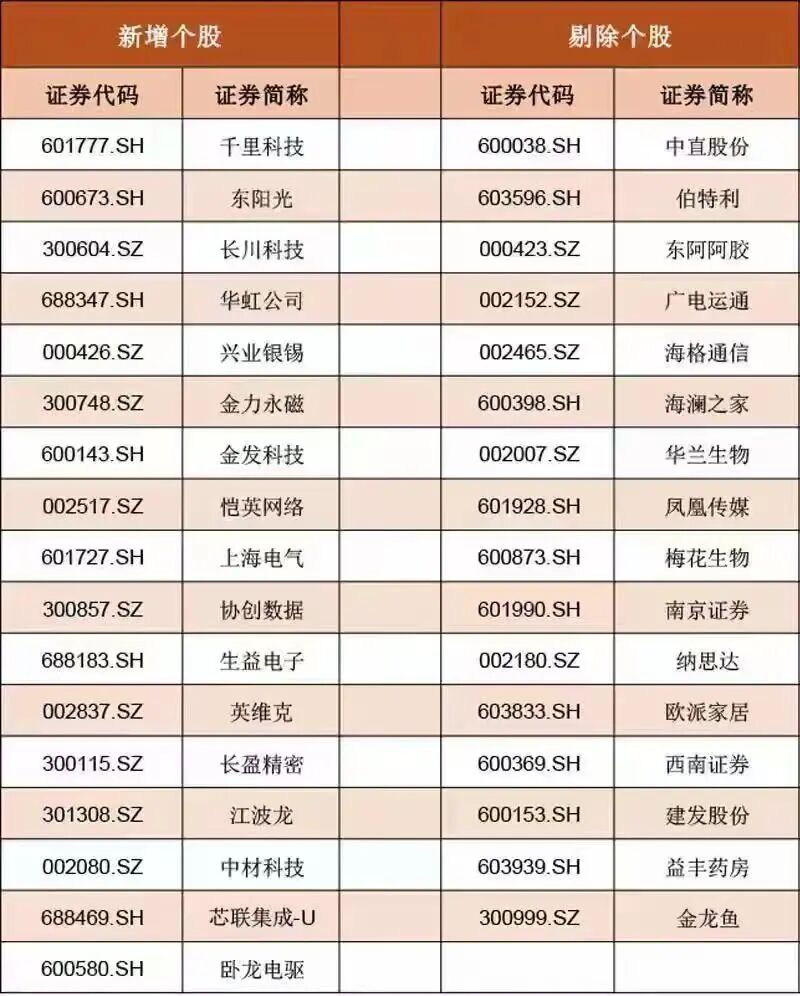
Core Insights - MSCI announced the results of its November index review, which includes the addition of 17 new stocks to the MSCI China A-share index and the removal of 16 stocks. The changes will take effect after the market closes on November 24, 2025 [1][6]. Summary of Adjustments - **Newly Added Stocks**: The list includes stocks such as Qianli Technology (601777.SH), Dongyangguang (600673.SH), and Changchuan Technology (300604.SZ) among others [4]. - **Removed Stocks**: Stocks such as Zhongzhi Co., Ltd. (600038.SH), Bertli (603596.SH), and Dong'e Ejiao (000423.SZ) are among those being removed from the index [4]. - **Hong Kong Stocks**: In addition to A-share stocks, the MSCI China index also added nine Hong Kong stocks including Zijin Mining International and GF Securities, while removing four stocks such as Beijing Enterprises Water Group [4]. Global Index Adjustments - **Global Standard Index Changes**: MSCI's global standard index (ACWI) added 69 stocks and removed 64 stocks, with notable additions including CoreWeave, Nebius Group, and Insmed [5]. - **Emerging Markets Index**: The largest new additions to the MSCI Emerging Markets Index include Barito Renewables Energy from Indonesia, Zijin Mining International, and GF Securities [5]. Adjustment Frequency and Impact - MSCI conducts four routine adjustments annually, with the May and November adjustments typically being more significant. Adjustments are based on objective quantitative metrics such as market capitalization and liquidity [6].
利好!多只A股、港股被纳入→
Zheng Quan Shi Bao· 2025-11-06 04:47
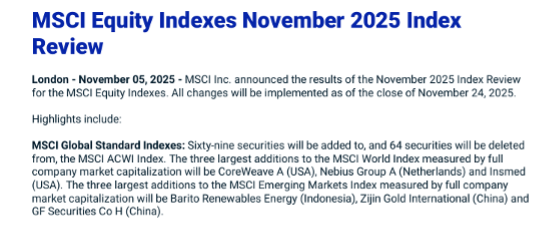
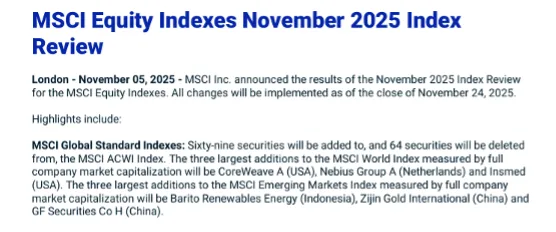
Core Insights - MSCI announced the results of its index review for November 2025, with adjustments effective after the market close on November 24 [1] - A total of 69 stocks were added to the MSCI Global Standard Index, while 64 stocks were removed [1] - The largest new additions to the MSCI Global Index by market capitalization include CoreWeave, Nebius Group, and Insmed [1] - The largest new additions to the MSCI Emerging Markets Index include Barito Renewables Energy, Zijin Mining International, and GF Securities H shares [1] China Market Updates - The MSCI China Index added 26 Chinese stocks and removed 20 [3] - New additions to the MSCI China Index include resource stocks and technology companies such as China Gold International, Zijin Mining International, and Ganfeng Lithium [3][5] - Stocks removed from the MSCI China Index include Haige Communications, Dong-E E-Jiao, and Hailan Home [3][5] A-Shares Adjustments - The MSCI China A-Shares Index added 17 stocks and removed 16 [7] - New additions to the MSCI China A-Shares Index include Qianli Technology, Dongyangguang, and Changchuan Technology [7] - The MSCI China A-Shares Onshore Index added 18 stocks and removed 24 [7][8] Fund Flow Implications - The adjustments in MSCI indices will lead to rebalancing in related index funds, resulting in increased capital allocation to newly added companies and forced selling of removed companies [9] - Historical trends indicate that passive funds tend to adjust their holdings on the last trading day to minimize tracking error, often leading to significant trading volume in affected stocks [9] - Active funds are not bound by this constraint and can choose their timing for allocation [9] Market Sentiment - Several foreign investment institutions have expressed positive views on the Chinese market, with Fidelity Fund favoring emerging markets over developed ones [9][10] - Despite mixed opinions on the Chinese stock market due to geopolitical risks and economic slowdown, there is recognition of the growth potential within the second-largest economy [10]



MSCI中国A股指数:新纳入17只A股
Sou Hu Cai Jing· 2025-11-06 01:13
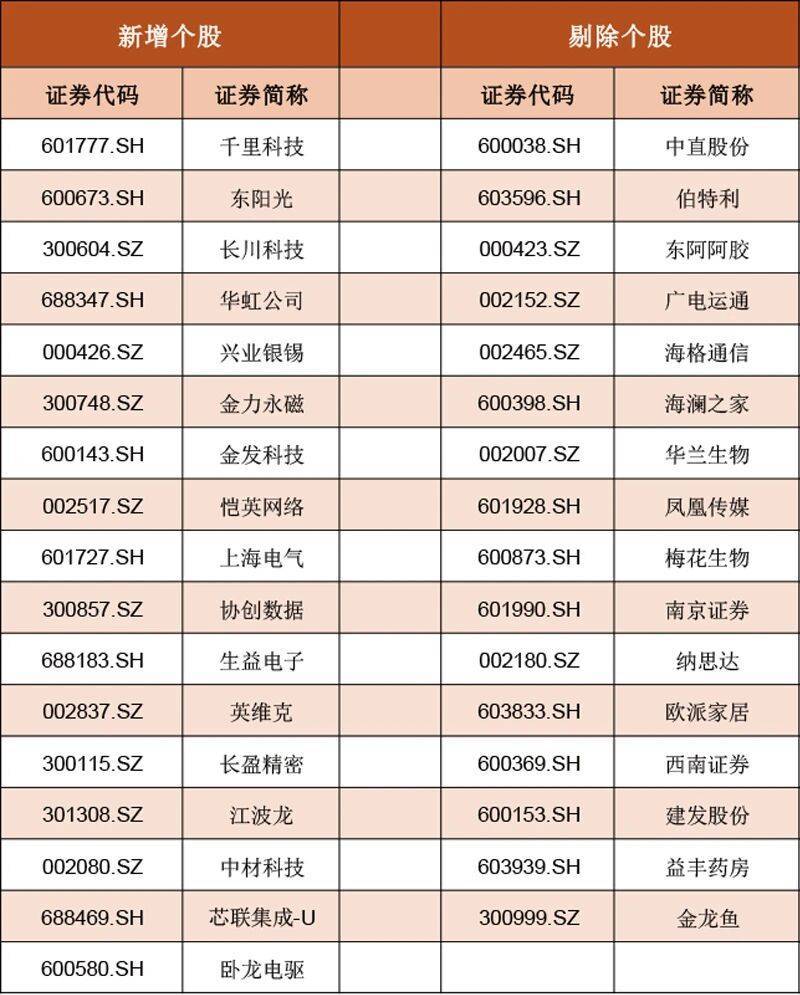
Group 1 - MSCI announced changes to its indices, including the addition of 17 new A-share stocks and the removal of 16 stocks, effective after the market close on November 24, 2025 [1] - The newly added A-share stocks include 千里科技 (601777.SH), 东阳光 (600673.SH), and 长川科技 (300604.SZ), while stocks like 中直股份 (600038.SH) and 海澜之家 (600398.SH) were removed [1] - In addition to A-shares, 9 Hong Kong stocks were added to the MSCI China Index, including 紫金黄金国际 and 广发证券, while 4 stocks were removed [1] Group 2 - MSCI's global standard index (ACWI) added 69 stocks and removed 64, with notable additions including CoreWeave and Nebius Group [2] - The largest new additions to the MSCI Emerging Markets Index include Barito Renewables Energy, 紫金黄金国际, and 广发证券 [2] - MSCI conducts four routine adjustments to its indices annually, with May and November adjustments typically being more significant [2]
重要指数刚刚宣布:新纳入17只A股(附名单)
Shang Hai Zheng Quan Bao· 2025-11-06 00:50
Core Insights - MSCI announced the results of its November index review, which includes the addition of 17 new stocks to the MSCI China A-share index and the removal of 16 stocks. The changes will take effect after the market closes on November 24, 2025 [1][4]. Group 1: A-Share Index Adjustments - New additions to the MSCI China A-share index include stocks such as Qianli Technology (601777.SH), Dongyangguang (600673.SH), and Changchuan Technology (300604.SZ) [4]. - Stocks removed from the index include Zhongzhi Co., Ltd. (600038.SH), Berteli (603596.SH), and Dong'a Ejiao (000423.SZ) [4]. Group 2: Hong Kong Stock Adjustments - In addition to A-share stocks, the MSCI China index also added nine Hong Kong stocks, including Zijin Mining International and GF Securities, while removing four stocks such as Beijing Enterprises Water Group [4]. Group 3: Global Index Adjustments - MSCI's global standard index (ACWI) added 69 stocks and removed 64, with notable new additions including CoreWeave, Nebius Group, and Insmed [5]. - The largest new additions to the MSCI Emerging Markets Index include Barito Renewables Energy, Zijin Mining International, and GF Securities [5]. Group 4: Adjustment Frequency and Impact - MSCI conducts four routine adjustments to its indices annually, with the May and November adjustments typically having a larger impact compared to the February and August adjustments [6]. - Adjustments are based on objective quantitative indicators such as market capitalization and liquidity, and historical analysis suggests that the overall market impact of MSCI's routine adjustments is manageable [6].
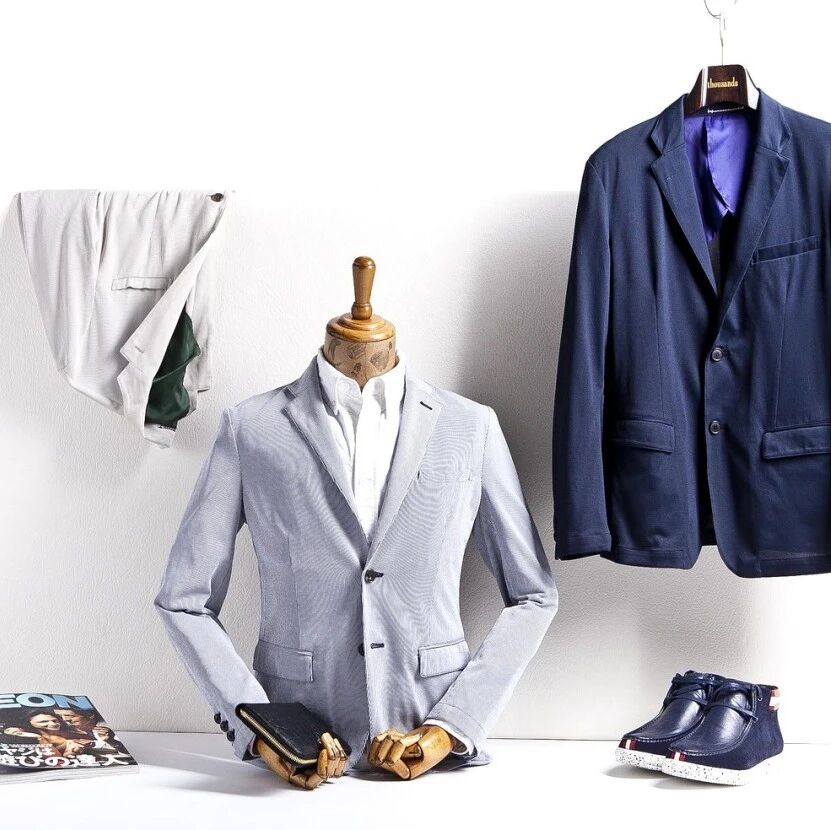
为什么男装“又贵又丑”,却卖得那么好?
首席商业评论· 2025-11-05 05:08
Core Insights - The men's clothing market has become a "safe zone" compared to the highly competitive women's clothing sector, with brands like Hailan Home and Baoxiniro leveraging brand strength and operational efficiency to maintain their leading positions [4][12]. - The Chinese men's clothing market has matured, focusing on brand power, product quality, and operational efficiency as core competitive factors [4][12]. - Despite social media criticisms regarding the lack of variety and design in men's clothing, companies in this sector often enjoy high profit margins and customer loyalty [4][12]. Group 1: Market Dynamics - The men's clothing market is characterized by high repurchase rates and profitability, with brands benefiting from a stable customer base and lower inventory pressure compared to women's clothing [12][13]. - Brands like Hailan Home are projected to achieve revenues exceeding 20 billion yuan and net profits around 2.2 billion yuan in 2024, showcasing strong profitability [13][15]. - The consumption behavior of male customers is highly task-oriented, leading to strong brand loyalty and high repurchase rates, which benefits retailers [12][13]. Group 2: Consumer Behavior - Male consumers prioritize functionality and social signaling over aesthetic appeal, often viewing clothing as a means to convey status rather than a form of self-expression [6][10]. - The majority of male clothing purchases are influenced by women, who tend to focus on brand reliability rather than design [19][20]. - Younger male consumers are increasingly seeking personalized and fashionable options, posing a challenge to traditional brands that have relied on classic designs [20][21]. Group 3: Competitive Landscape - The competition in the men's clothing sector is less about rapid fashion cycles and more about building brand equity, making it difficult for new entrants to disrupt established players [15][19]. - Traditional brands face pressure to innovate and adapt to changing consumer preferences, particularly as younger generations become the primary market [20][21]. - The market is witnessing a shift as brands explore new styles and collaborations to attract younger consumers while maintaining their core customer base [20][21].
纺织服饰2022Q3行业总结:下游运动板块稳健,上游订单期待改善
GOLDEN SUN SECURITIES· 2025-11-05 02:09
Investment Rating - The report maintains an "Accumulate" rating for the textile and apparel industry [6] Core Insights - The textile and apparel industry is experiencing a weak recovery, with the jewelry sector showing better growth compared to clothing [14] - The domestic sportswear market is expected to maintain long-term growth resilience despite short-term fluctuations in offline sales [1] - The report highlights the importance of inventory management and the impact of promotional events on sales performance [1][2][26] Summary by Sections 1. Sports Footwear and Apparel - The sports footwear and apparel sector showed weaker performance in Q3 2025 compared to Q2 but still outperformed the overall apparel market [1] - Offline sales for domestic sports brands remain weak, while e-commerce channels are performing better [1] - Inventory levels for domestic sports brands increased in Q3 due to preparations for the National Day holiday and Double Eleven sales [1] - Adidas reported a 6% year-on-year revenue growth in Greater China for Q3 2025, while Nike's sales in the region declined [1][18] 2. Brand Apparel - The brand apparel sector showed improvement in Q3 2025, with revenue and net profit growth of 3.1% and 23.2% respectively, driven by a low base effect [2] - The home textile segment benefited from product updates, while the fashion apparel category faced weak demand due to low consumer confidence [2] - The report anticipates continued reasonable expense management and stable profit growth for some companies in Q4 2025 [2] 3. Textile Manufacturing - Revenue for key textile manufacturing companies remained relatively stable, with a slight decline in net profit [3] - Companies with different customer structures showed varied performance, with some like Huayi Group achieving a 7% revenue growth by expanding their client base [3] - The report suggests that as inventory levels normalize, there may be a recovery in orders from upstream manufacturing companies [3] 4. Gold and Jewelry - The gold and jewelry sector experienced performance differentiation, with retail sales of gold and silver jewelry increasing by 11.5% year-on-year in the first nine months of 2025 [4] - Companies with fewer stores or a direct sales model reported excellent revenue growth, with some like Chao Hong Ji and Man Ka Long achieving revenue increases of 28.3% and 29.3% respectively [4] - The report recommends focusing on companies with strong product and channel capabilities in the jewelry sector [4] 5. Investment Recommendations - The report recommends several companies based on their performance and market positioning, including Shenzhou International, Anta Sports, Li Ning, and Chow Tai Fook, highlighting their respective PE ratios for 2025 [4][9]