HAIER SMART HOME(600690)

Search documents
中国家电行业已迈入以高质量转型为核心的下半场
Bei Jing Shang Bao· 2025-09-02 01:58
Industry Overview - The Chinese home appliance industry is transitioning from a phase of rapid scale expansion to a focus on high-quality transformation, emphasizing "value competition" over price wars [1] - Traditional categories like televisions and refrigerators are experiencing short-term adjustments, while new categories such as dryers and dishwashers are gaining market share, indicating a shift towards future growth opportunities [1] Company Performance - Midea reported revenue of 251.12 billion yuan for the first half of 2025, a year-on-year increase of 15.58%, with net profit rising by 25.04% to 26.01 billion yuan, driven by synergy across diverse business lines [2] - Haier achieved revenue of 156.49 billion yuan, a 10.2% increase, with net profit growing by 15.6% to 12.03 billion yuan, benefiting from a focus on high-end products [2] - Gree's revenue was 97.33 billion yuan, a slight decline of 2.46%, with net profit increasing by 1.95% to 14.41 billion yuan, indicating a period of transition despite strong growth in overseas and industrial product segments [2] Competitive Landscape - The competition in the home appliance sector is shifting towards detailed market engagement and innovation, focusing on personalized solutions rather than merely competing for existing market share [3] - The overseas market is becoming essential for growth, with companies moving from product exports to local operations [3] Gree's Business Dynamics - Gree's reliance on air conditioning remains significant, with this segment accounting for 78.38% of total revenue, although this dependency poses risks in a saturated market [4] - Gree's non-air conditioning segments, such as industrial products and green energy, showed positive growth, but their overall contribution to revenue remains limited [5] Midea's Diversification - Midea's diversified business model has proven resilient, with its new energy and industrial technology segments generating 22 billion yuan in revenue, a 28.61% increase [5] - The combination of stable core business and breakthroughs in emerging sectors has led to a net profit of 26 billion yuan, reflecting a growth rate of 25% [5] Haier's High-End Strategy - Haier has focused on high-end markets, with its Casarte brand leading in premium appliance sales, capturing significant market shares in various categories [6] - Despite its high-end positioning, Haier's profit margins have not seen substantial growth, with a slight increase in gross margin to 26.9% [6]



中国白电“三巨头”半年报PK:美的营收2511亿狂奔,海尔1564亿稳健,格力973亿垫底!格力利润增幅明显放缓
Sou Hu Cai Jing· 2025-09-02 01:42
Core Viewpoint - The performance of major home appliance companies in China, specifically Midea Group, Haier Smart Home, and Gree Electric Appliances, shows significant differences in revenue and profit growth for the first half of 2025, with Midea leading the pack. Group 1: Company Performance - Midea Group reported revenue of 251.12 billion yuan, a year-on-year increase of 15.58%, and a net profit of 26.01 billion yuan, up 25.04% [2][5] - Haier Smart Home achieved revenue of 156.49 billion yuan, growing 10.22% year-on-year, with a net profit of 12.03 billion yuan, an increase of 15.59% [2][8] - Gree Electric Appliances saw revenue decline to 97.32 billion yuan, down 2.46%, while net profit grew slightly to 14.43 billion yuan, up 1.95% [2][15] Group 2: Market Trends - The domestic home appliance market (excluding 3C products) reached a retail value of 453.7 billion yuan, growing 9.2% year-on-year in the first half of 2025 [4] - The air conditioning sector saw retail sales of 38.45 million units, a 15.6% increase, with a retail scale of 126.3 billion yuan, up 12.4% [4] - The washing machine market reported retail sales of 47.6 billion yuan, growing 11.5%, while the refrigerator market reached 67.28 billion yuan, up 3.5% [4] Group 3: Competitive Landscape - Midea has established itself as a dominant player, nearly matching the combined revenue of Haier and Gree, indicating its capability to "compete against two" [6][8] - Gree's air conditioning business, a core revenue driver, has shown signs of decline, with a 5.09% drop in the consumer electronics segment [13][15] - The competitive environment is intensifying, with new entrants like Xiaomi gaining market share, prompting established players to adjust strategies [17][18]


中国白电“三巨头”半年报PK:美的营收2511亿狂奔,海尔1564亿稳健,格力973亿再垫底!格力利润增幅明显放缓
Sou Hu Cai Jing· 2025-09-02 01:36
Core Viewpoint - The performance of major home appliance companies in the first half of 2025 shows significant differences, with Midea Group leading in both revenue and profit growth, while Gree Electric experienced a decline in revenue and slower profit growth [2][3][11]. Group 1: Company Performance - Midea Group reported revenue of 251.12 billion yuan, a year-on-year increase of 15.58%, and a net profit of 26.01 billion yuan, up 25.04% [6][9]. - Haier Smart Home achieved revenue of 156.49 billion yuan, a growth of 10.22%, and a net profit of 12.03 billion yuan, increasing by 15.59% [9][11]. - Gree Electric's revenue was 97.32 billion yuan, down 2.46%, with a net profit of 14.43 billion yuan, a modest increase of 1.95% [11][13]. Group 2: Market Trends - The domestic home appliance market (excluding 3C products) reached a retail value of 453.7 billion yuan, growing by 9.2% year-on-year [6]. - The air conditioning sector saw retail sales of 38.45 million units, up 15.6%, with a retail scale of 126.3 billion yuan, increasing by 12.4% [6]. - The washing machine market had a retail value of 47.6 billion yuan, growing by 11.5%, while the refrigerator market reached 67.28 billion yuan, up 3.5% [6]. Group 3: Competitive Landscape - Midea Group is positioned to "compete with two" due to its significant revenue and profit margins compared to Haier and Gree [8][9]. - Gree Electric has shown a noticeable decline in revenue growth since 2021, with a negative growth trend emerging this year [13][16]. - The competitive landscape is changing, with new entrants like Xiaomi increasing their market share, prompting established players to adjust their strategies [18][19].

白电三巨头PK:美的狂奔 海尔稳健 格力再垫底
Xin Lang Ke Ji· 2025-09-02 01:00
Core Insights - The article discusses the performance of major home appliance companies in China, specifically Midea Group, Haier Smart Home, and Gree Electric, as they release their half-year reports for 2025 [2][3][4]. Group 1: Financial Performance - Midea Group reported a revenue of 251.12 billion yuan, a year-on-year increase of 15.58%, and a net profit of 26.01 billion yuan, up 25.04% [2][7]. - Haier Smart Home achieved a revenue of 156.49 billion yuan, with a growth of 10.22%, and a net profit of 12.03 billion yuan, increasing by 15.59% [2][10]. - Gree Electric's revenue was 97.32 billion yuan, showing a decline of 2.46%, while its net profit was 14.43 billion yuan, up by 1.95% [2][13]. Group 2: Market Trends - The domestic home appliance market (excluding 3C products) reached a retail value of 453.7 billion yuan, growing by 9.2% year-on-year [6]. - The air conditioning sector saw a retail volume of 38.45 million units, a growth of 15.6%, with a retail scale of 126.3 billion yuan, up 12.4% [6][21]. - The washing machine market's retail value was 47.6 billion yuan, increasing by 11.5%, while the refrigerator market reached 67.28 billion yuan, growing by 3.5% [6]. Group 3: Competitive Landscape - Midea Group is positioned to "compete against two" with its revenue nearly matching the combined revenue of Haier and Gree [7][8]. - Gree Electric has shown a noticeable decline in growth, with its revenue growth turning negative for the first time since 2021 [12][15]. - The competitive dynamics are shifting, with companies like Xiaomi gaining market share, prompting major players to adjust their strategies [22][23]. Group 4: Business Adjustments - Midea Group has made operational adjustments to enhance efficiency and streamline its business [22]. - Gree Electric is focusing on diversifying its product lines beyond air conditioning to improve its market presence [22]. - Haier Smart Home is actively expanding through investments and acquisitions to broaden its business scope [22].
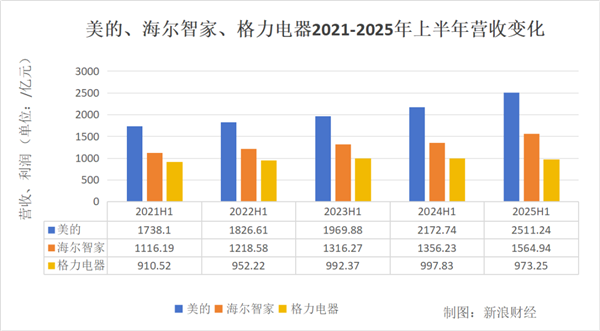
白电「三巨头」PK:美的狂奔,海尔稳健,格力再垫底丨BUG
Xin Lang Ke Ji· 2025-09-02 00:55
Core Viewpoint - The performance of major home appliance companies in the first half of 2025 shows significant differences, with Midea Group leading in both revenue and profit growth, while Gree Electric experienced a decline in revenue [2][3][4]. Revenue and Profit Performance - Midea Group reported revenue of 251.12 billion yuan, a year-on-year increase of 15.58%, and a net profit of 26.01 billion yuan, up 25.04% [2][6]. - Haier Smart Home achieved revenue of 156.49 billion yuan, growing 10.22%, with a net profit of 12.03 billion yuan, increasing by 15.59% [2][9]. - Gree Electric's revenue was 97.32 billion yuan, down 2.46%, with a net profit of 14.43 billion yuan, up 1.95% [2][11]. Market Trends - The domestic home appliance market (excluding 3C products) reached a retail value of 453.7 billion yuan, growing by 9.2% year-on-year in the first half of 2025 [6]. - The air conditioning sector saw retail sales of 38.45 million units, a 15.6% increase, with a retail scale of 126.3 billion yuan, up 12.4% [6][14]. Business Dynamics - Midea Group's smart home business generated revenue of 167.2 billion yuan, growing 13.31% [15]. - Gree Electric's consumer electronics segment reported revenue of 76.28 billion yuan, down 5.09% [16]. - The air conditioning market is experiencing price competition, with a significant shift towards lower-priced models, impacting mid-to-high-end demand [17]. Strategic Adjustments - Midea Group has made operational adjustments to enhance efficiency and streamline its business model [18]. - Gree Electric is focusing on diversifying its product offerings beyond air conditioning to strengthen its market position [18]. - Haier Smart Home is actively expanding through investments and acquisitions to broaden its business scope [18]. Competitive Landscape - The competitive environment in the home appliance industry is intensifying, with new entrants and existing players adjusting strategies to capture market share [19].

白电“三巨头”PK:美的狂奔,海尔稳健,格力再垫底丨BUG
Xin Lang Cai Jing· 2025-09-02 00:53
Core Insights - The article discusses the performance of major home appliance companies in China, specifically Midea Group, Haier Smart Home, and Gree Electric, based on their half-year reports for 2025, highlighting their revenue and profit growth rates [2][5][7]. Group 1: Company Performance - Midea Group leads in both revenue and profit growth, achieving a revenue of 251.12 billion yuan, a year-on-year increase of 15.58%, and a net profit of 26.01 billion yuan, up 25.04% [5][7]. - Haier Smart Home reported a revenue of 156.49 billion yuan, a 10.22% increase, and a net profit of 12.03 billion yuan, growing by 15.59% [7][9]. - Gree Electric experienced a revenue decline of 2.46%, totaling 97.32 billion yuan, while its net profit grew by 1.95% to 14.43 billion yuan [9][11]. Group 2: Market Trends - The domestic home appliance market (excluding 3C products) saw a retail sales increase of 9.2% in the first half of 2025, reaching 453.7 billion yuan [5]. - The air conditioning sector experienced a retail volume growth of 15.6%, with sales reaching 38.45 million units, and a retail scale of 126.3 billion yuan, up 12.4% [5][15]. - The washing machine market grew by 11.5%, while the refrigerator market saw a 3.5% increase in retail sales [5]. Group 3: Competitive Landscape - Midea Group is positioned to "compete against two" with its revenue nearly matching the combined total of Haier and Gree [5][7]. - Gree Electric's core air conditioning business, which traditionally contributed over 70% of its revenue, is facing challenges with a 5.09% decline in the consumer electronics segment [12][14]. - The competitive landscape is intensifying, with companies like Xiaomi gaining market share, prompting major players to adjust their strategies [16][17].

挖存量与谋出海 家电三巨头求解增长空间
Bei Jing Shang Bao· 2025-09-01 16:31
Core Viewpoint - The Chinese home appliance industry is transitioning from rapid growth to a focus on high-quality transformation, as evidenced by the mid-year performance of major players like Gree, Haier, and Midea [1] Group 1: Company Performance - Midea's net profit increased by 25.04% year-on-year, while Haier's net profit grew by 15.6%, and Gree's net profit saw a modest increase of 1.95% [1] - Gree's reliance on air conditioning is evident, with air conditioning revenue at 76.279 billion yuan, accounting for 78.38% of total revenue, despite a 5.09% year-on-year decline [3] - Midea's diversified business model showed resilience, with revenue from new energy and industrial technology reaching 22 billion yuan, up 28.61% year-on-year, and smart building technology revenue at 19.5 billion yuan, up 24.2% [4] - Haier's high-end product strategy is reflected in its market share, with Casarte refrigerators holding 59.2% in the high-end segment, but overall profit growth remained limited with a gross margin of 26.9% [5] Group 2: International Expansion - Midea's overseas revenue reached 107.2 billion yuan, growing by 17.7% year-on-year, making up 42.69% of total revenue, supported by global production bases [6] - Haier's overseas revenue surpassed 52%, with a gross margin exceeding 30%, leveraging local brands and production to penetrate high-end markets [7] - Gree's overseas revenue was 16.335 billion yuan, growing by 10.19% year-on-year, but still accounted for less than 20% of total revenue, indicating a need for improvement in international strategy [7] Group 3: Market Trends - The Chinese smart home market is projected to reach 281 million units shipped, growing by 7.8%, signaling a shift towards precision and quality in the industry [8] - The "old-for-new" policy is accelerating the high-end and quality transformation of traditional appliances, with over 90% of sales now in first-level energy-efficient products [8] - The competition in the overseas market is shifting towards localization, with companies needing to adapt to local demands and reduce costs through local operations [8]

家电三巨头半年考:格力独木难支,海尔美的多元破局
Bei Jing Shang Bao· 2025-09-01 15:21
Core Viewpoint - The Chinese home appliance industry is transitioning from a phase of rapid scale expansion to a focus on high-quality transformation, emphasizing value upgrades over price wars [3][15]. Industry Overview - The competition logic in the home appliance sector is shifting from scale expansion to value enhancement, with companies needing to find new growth drivers in this new cycle [3][5]. - Traditional categories like televisions and refrigerators are facing short-term adjustments, while emerging categories such as dryers and dishwashers are gaining market share, indicating a shift in industry dynamics [3][4]. Company Performance - Midea reported revenue of 251.12 billion yuan for the first half of 2025, a year-on-year increase of 15.58%, with net profit rising by 25.04% to 26.01 billion yuan, driven by diversified business synergies [4]. - Haier's revenue reached 156.49 billion yuan, up 10.2%, with net profit increasing by 15.6% to 12.03 billion yuan, supported by its high-end market strategy [4]. - Gree's revenue was 97.33 billion yuan, a slight decline of 2.46%, but net profit increased by 1.95% to 14.41 billion yuan, with growth in overseas and industrial products [4][7]. Competitive Landscape - The competition is evolving from merely capturing existing market share to focusing on detailed, scenario-based, and personalized innovations to extract incremental growth from existing markets [5][14]. - The overseas market is becoming a critical battleground for growth, with companies needing to adapt their strategies to local market characteristics [5][10]. Emerging Trends - Gree's reliance on air conditioning remains high, with this segment accounting for 78.38% of its revenue, highlighting the risks of dependence on a single product category [7]. - Midea's diversified business model has shown resilience, with its new energy and industrial technology segments generating significant revenue growth [8][9]. - Haier has successfully positioned itself in the high-end market, with its Casarte brand leading in market share for premium appliances [9]. Global Expansion - Midea's overseas revenue reached 107.2 billion yuan, a 17.7% increase, with a focus on global distribution and local production to reduce costs [12]. - Haier's overseas revenue was 79.08 billion yuan, up 11.66%, with over 50% of its total revenue coming from international markets, showcasing its global strategy [13]. - Gree's overseas revenue was 16.34 billion yuan, a 10.19% increase, but its market share remains significantly lower compared to Midea and Haier [13]. Future Outlook - The smart home market in China is expected to grow steadily, with a projected shipment of 281 million units in 2025, indicating a shift towards refined operations and product upgrades [14]. - The industry is moving towards a "value war," where companies must focus on demand insights and technological advancements rather than just cost control [15].
开源证券晨会纪要-20250901
KAIYUAN SECURITIES· 2025-09-01 14:43
Core Insights - The report highlights a recovery in real estate transactions, with a 33% increase in average transaction area in 30 major cities compared to the previous two weeks, although still lower than historical levels [10] - Manufacturing PMI shows a slight recovery but remains below seasonal expectations, with a production index increase of 0.3 percentage points to 50.8% [14] - The report emphasizes the importance of structural growth over overall economic recovery, focusing on high-growth sectors such as technology manufacturing and consumer goods [19][21] Macro Economic Overview - Real estate transactions are showing signs of recovery, with a narrowing decline in new housing sales compared to previous years [10] - Industrial production remains at a historically high level but has shown marginal decline recently, particularly in the chemical and automotive sectors [7][8] - The demand side for construction materials has turned negative year-on-year, with a notable drop in steel and building materials demand [8] Industry Performance - The report identifies the top-performing sectors, with telecommunications leading at a 5.22% increase, followed by comprehensive and non-ferrous metals sectors [3] - Conversely, the non-bank financial sector and banks have shown declines of -1.28% and -1.03% respectively, indicating potential weaknesses in these areas [4] - The report suggests that sectors like technology manufacturing and consumer goods are experiencing high growth, while real estate and construction are in a bottoming phase [22] Investment Strategy - The report recommends focusing on sectors with high growth potential, particularly in technology manufacturing and consumer goods, while being cautious of sectors like real estate that are still recovering [19][22] - It highlights the importance of identifying industries with improving profit margins and those that are in a recovery phase, such as power equipment and defense [22] Company Updates - Companies like Yongtai Energy and Sanofi are noted for their positive performance, with significant growth contributions and share buybacks [5] - The report also mentions the potential of companies involved in vocational education and eSIM technology, indicating a shift towards international collaboration and domestic production capabilities [39][44]


中期分红稳定性不断提升 近六成沪市公司连续两年派发“年中红包”
Zheng Quan Ri Bao Wang· 2025-09-01 14:06
Core Viewpoint - The introduction of the new "National Nine Articles" has led to an increase in the frequency and stability of interim dividends among listed companies in the Shanghai market, with a record number of companies announcing dividend plans in 2025 [1][3]. Group 1: Dividend Trends - As of August 30, 2025, 406 companies in the Shanghai market have announced interim dividend plans, setting new records for both the number of companies and the total dividend amount [1]. - Nearly 60% of these companies have consistently paid interim dividends for two consecutive years, with 233 companies accounting for 58% of the total, distributing a combined dividend of 488.4 billion yuan, which is nearly 90% of this year's interim dividends [2][3]. - The average cash dividend payout ratio for the 2025 interim reports is approximately 57.42%, a significant increase from 40.95% in 2024 [6]. Group 2: High Dividend Companies - Among the 233 companies, 55 have announced dividends exceeding 500 million yuan, with 76% maintaining or increasing their dividend amounts compared to the previous period [4]. - Notable companies with substantial interim dividends include China Mobile, which plans to distribute over 54 billion yuan, and China Telecom, which announced a dividend of 16.581 billion yuan, reflecting an 8% year-on-year increase [3][8]. Group 3: New Entrants to Dividend Payments - Of the 406 companies, 173 are making interim dividend payments for the first time since the introduction of the new policy, indicating a broadening of the dividend distribution landscape [5]. - Companies like Haier Smart Home and WuXi AppTec have initiated interim dividends, with Haier distributing over 2.5 billion yuan, representing 20.83% of its net profit [5]. Group 4: Exceptional Dividend Ratios - Fourteen companies have reported dividend payout ratios exceeding 100%, with over half of the listed companies having payout ratios between 30% and 100% [7]. - For instance, Henan Siwei Automation Equipment Co., Ltd. plans to distribute 8.01 billion yuan, which is 263.77% of its net profit for the period [7].