Bank Of Jiangsu(600919)

Search documents
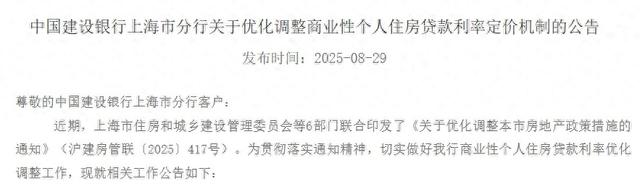
上海多家银行房贷利率细则落地 新增房贷利率不再区分首套、二套
Mei Ri Jing Ji Xin Wen· 2025-09-01 00:25
Core Viewpoint - The introduction of the "825 New Policy" in Shanghai has led to multiple banks adjusting their commercial personal housing loan interest rate pricing mechanisms, eliminating the distinction between first and second homes, allowing banks to set rates based on market conditions and individual risk profiles [1][2]. Group 1: Policy Changes - Several banks in Shanghai have announced adjustments to their commercial personal housing loan interest rate pricing mechanisms, following the issuance of a notification by six departments in Shanghai [1]. - The new pricing mechanism allows banks to determine specific interest rates based on the Shanghai market interest rate pricing self-discipline mechanism, as well as their operational conditions and customer risk profiles [2]. Group 2: Implementation Details - Different banks have varying procedures for borrowers to apply for interest rate adjustments, including in-person applications, phone notifications, and mobile banking options [3]. - The effective dates for these adjustments vary, with some banks implementing changes as early as September 1, while others may start on September 5 [3]. Group 3: Interest Rate Adjustments - For existing second-home loans, if the current interest rate exceeds the average new loan interest rate by 30 basis points, borrowers can apply for a rate adjustment [2]. - The minimum interest rate for first-time home loans is currently 3.05%, while some banks are offering a minimum of 3.09% for new second-home loans [3]. Group 4: Recommendations - It is suggested that relevant departments enhance their communication regarding the new policies to clarify the specifics of loan interest rates and ensure effective implementation to stimulate housing demand [4].

券商二季度重仓股出炉 青睐基础化工、机械设备、汽车、医药生物等行业
Shang Hai Zheng Quan Bao· 2025-08-31 23:55
Group 1 - The core viewpoint of the article highlights the significant changes in stock holdings by securities firms during the second quarter, with a focus on industries such as basic chemicals, machinery, automotive, and pharmaceuticals [1] - Securities firms collectively increased their positions in 63 stocks during the second quarter, with notable additions including Zhongke Titanium White, New Mileage, Jiangzhong Pharmaceutical, and Yuntianhua [1] - Several companies, including Chuanheng Co., Furan Energy, Ruida Futures, and Zhejiang Huaye, received attention from at least three securities firms, indicating strong interest [1] Group 2 - In terms of holding scale, data from Choice shows that Jiangsu Bank, Yong'an Futures, CITIC Securities, and Sinopec have the highest total shareholdings among securities firms [1] - As of the closing price on June 30, 2025, Jiangsu Bank leads with a holding market value of 11.026 billion yuan, followed by CITIC Securities and Yong'an Futures with 9.208 billion yuan and 6.507 billion yuan respectively [1] - Other companies such as Muyuan Foods, Cangge Mining, Sinopec, and Guangqi Technology also have significant market values in securities holdings [1]





江苏银行全面超越,城商行“一哥”易主
Bei Jing Shang Bao· 2025-08-31 14:55
Core Insights - The competitive landscape among city commercial banks in China has shifted, with Jiangsu Bank surpassing Beijing Bank to become the new leader in asset size [1][2][9] - Jiangsu Bank's asset total reached 4.79 trillion yuan, growing at a rate of 21.16%, while Beijing Bank's assets totaled 4.75 trillion yuan with a growth rate of 12.53% [2][3] - The rise of Jiangsu Bank reflects a broader trend of differentiation within the city commercial banking sector, which has formed a clear three-tier competitive structure [1][9] Asset Growth Comparison - Jiangsu Bank's asset growth has consistently outpaced that of Beijing Bank over recent years, narrowing the gap significantly from 2020 to 2024 [3][4] - By the end of 2024, Jiangsu Bank's assets reached 3.95 trillion yuan, with a year-on-year growth of 16.12%, compared to Beijing Bank's 4.22 trillion yuan and 12.61% growth [3] Financial Performance Metrics - In 2022, Jiangsu Bank achieved operating income of 70.57 billion yuan and net profit of 25.39 billion yuan, surpassing Beijing Bank's figures [4] - For the first half of 2025, Jiangsu Bank reported operating income of 44.86 billion yuan and net profit of 20.24 billion yuan, while Beijing Bank's figures were 36.22 billion yuan and 15.05 billion yuan, respectively [4] Business Strategy and Focus - Jiangsu Bank's growth is attributed to its deep integration with regional economic development, particularly in sectors like high-end manufacturing and infrastructure [5][6] - The bank has focused on specific customer segments and tailored financial services, moving away from a broad retail strategy [5][10] Competitive Landscape - The city commercial banking sector has seen a clear tiered structure, with Jiangsu Bank, Beijing Bank, Ningbo Bank, and Shanghai Bank forming the top tier, all exceeding 3 trillion yuan in assets [9] - The second tier includes banks like Nanjing Bank and Hangzhou Bank, while the third tier consists of smaller regional banks that are growing at slower rates [9] Future Directions - To remain competitive, city commercial banks must adopt differentiated strategies, focusing on local economic needs and enhancing their service offerings [10][11] - There is a need for banks to improve their capital bases and risk management practices to support sustainable growth [10][11]

金融中报观|江苏银行全面超越,城商行“一哥”易主
Bei Jing Shang Bao· 2025-08-31 14:37
Core Insights - Jiangsu Bank has surpassed Beijing Bank to become the largest city commercial bank in China, with total assets of 4.79 trillion yuan and a growth rate of 21.16% in the first half of 2025, compared to Beijing Bank's 4.75 trillion yuan and 12.53% growth rate [1][3][5] - The shift in leadership reflects a broader trend of differentiation within the city commercial banking sector, where 17 listed banks have formed a clear three-tier competitive structure [1][11] Group 1: Historical Context - Beijing Bank, established in 1996, held the top position in city commercial banks for many years, leveraging its geographical advantages and early market entry to grow from 354.22 billion yuan in 2007 to 4.75 trillion yuan [3][4] - Jiangsu Bank, founded later in 2007, has focused on regional economic development and retail banking, leading to significant growth in its asset scale [3][5] Group 2: Growth Trajectory - Jiangsu Bank's asset growth has accelerated in recent years, with total assets reaching 2.34 trillion yuan at the end of 2020, 2.62 trillion yuan in 2021, and 2.98 trillion yuan in 2022, ultimately surpassing Beijing Bank in 2025 [4][5] - In 2022, Jiangsu Bank achieved operating income of 70.57 billion yuan and net profit of 25.39 billion yuan, exceeding Beijing Bank's figures [5] Group 3: Business Strategy - Jiangsu Bank's rapid growth is attributed to its deep integration with regional economic development, particularly in sectors like smart manufacturing and new energy vehicles, which have generated strong deposit and credit demand [6][7] - The bank has shifted its focus from a broad retail strategy to targeting specific customer segments and industries, enhancing its competitive edge [7][11] Group 4: Financial Performance - As of mid-2025, Jiangsu Bank's corporate loans reached approximately 1.63 trillion yuan, with significant growth in manufacturing and infrastructure loans [7][8] - Retail deposits and assets under management (AUM) have also seen substantial increases, although credit card loan growth has declined [8] Group 5: Competitive Landscape - The city commercial banking sector is increasingly competitive, with Jiangsu Bank, Beijing Bank, Ningbo Bank, and Shanghai Bank forming the first tier, all exceeding 3 trillion yuan in assets [11] - Smaller banks are encouraged to adopt differentiated strategies and collaborate with larger institutions to enhance their market position [12][13]


超17家银行将派发2375亿“红包”,国有大行成绝对主力
Bei Jing Shang Bao· 2025-08-31 14:05
Core Viewpoint - The mid-term profit distribution plans of listed banks in A-shares for 2025 show a significant increase in total dividends, reaching 237.54 billion yuan, with state-owned banks being the primary contributors [2][3][4]. Group 1: Dividend Distribution Overview - Among 42 listed banks, 17 have announced their mid-term dividend plans for 2025, with a total dividend amount of 237.54 billion yuan [2][3]. - The six major state-owned banks contributed 204.66 billion yuan, accounting for 86% of the total dividends announced by the 17 banks [3][4]. - Industrial and Commercial Bank of China leads with a dividend of 50.40 billion yuan, followed by China Construction Bank and Agricultural Bank of China with 48.61 billion yuan and 41.82 billion yuan respectively [3][4]. Group 2: Factors Influencing Dividend Decisions - The ability of state-owned banks to distribute dividends is supported by their strong capital strength, stable profitability, and ample cash flow, allowing them to maintain high dividend payouts [4][9]. - The decision to distribute dividends is influenced by a balance of capital adequacy, business expansion needs, regulatory requirements, and shareholder return expectations [4][9][10]. - Some banks, such as Zhengzhou Bank and Qingdao Rural Commercial Bank, have explicitly stated they will not distribute dividends for the first half of 2025, citing performance pressures and capital replenishment needs [8][9]. Group 3: Trends in Dividend Distribution - The trend of increasing mid-term and quarterly dividends among listed banks has been noted since the introduction of the new "National Nine Articles" policy, which encourages multiple dividend distributions within a year [2][4]. - Several joint-stock banks, including CITIC Bank and Minsheng Bank, have announced their mid-term dividend plans, with CITIC Bank aiming for a dividend payout ratio of 30.7% [4][6]. - The distribution landscape shows a clear differentiation, with some banks actively pursuing dividends while others pause due to various operational challenges [8][9].




江苏银行争取个人消费贷财政贴息支持
Bei Ke Cai Jing· 2025-08-30 16:47
Core Insights - Jiangsu Bank is actively seeking policy support for personal consumption loans from central and provincial financial departments [1][2] - The recent implementation of the national subsidy scheme for personal consumption loans aims to boost consumer spending and enhance the overall scale of the consumer credit market [2] Summary by Categories Company Developments - Jiangsu Bank's President Yuan Jun announced the bank's efforts to communicate with relevant authorities to secure support for personal consumption loans [1] - The bank is focusing on balancing growth in both efficiency and scale while emphasizing customer-centric development and digital transformation [2] Financial Performance - As of June 30, Jiangsu Bank's personal consumption loan balance reached approximately 340.58 billion yuan, reflecting a year-on-year growth of 13.20% [2] - The personal operating loan balance was about 62.56 billion yuan, with the highest year-on-year growth rate of approximately 14.50% [2] - However, the credit card loan balance decreased slightly by 0.50% year-on-year, amounting to around 34.81 billion yuan [2] Market Context - The national subsidy scheme involves 19 banks and 4 consumer finance companies focusing on eight consumer sectors, but Jiangsu Bank is currently not included in the list of institutions benefiting from the 1% interest subsidy [1] - The government encourages local financial departments to provide fiscal support to other institutions engaged in personal consumption loan business, aiming to broaden the policy's coverage [1]
上海大消息!20多家银行宣布:调整
Zhong Guo Ji Jin Bao· 2025-08-30 01:53
Core Viewpoint - Shanghai's new housing policy has led to a reduction in mortgage rates for existing loans and a minimum rate of 3.09% for new second-home loans, aligning them with first-home rates [1][3]. Group 1: New Mortgage Rates - The new policy eliminates the distinction between first and second home mortgage rates in Shanghai, with the specific rate determined by the market rate pricing mechanism and individual bank conditions [2][10]. - The minimum mortgage rate for new second-home loans in Shanghai is set at 3.09%, which is consistent with the first-home loan rate [3][2]. Group 2: Existing Mortgage Adjustments - Existing mortgage rates can be adjusted for eligible borrowers, particularly if their current rate exceeds the national average by more than 30 basis points [4][11]. - For example, a second-home loan with a current rate of 3.45% could potentially be reduced to 3.36% [6][4]. - The adjustment process will not incur any fees and will begin on September 1, 2025 [7][14]. Group 3: Implementation and Communication - Banks in Shanghai, including major institutions like ICBC and Bank of China, have issued announcements regarding the new mortgage rate adjustments [1][9]. - Borrowers can check their eligibility for rate adjustments through their respective banks starting September 1, 2025 [12][13].




沪上银行集体调整房贷利率 9月1日起可进行线上查询
Huan Qiu Wang· 2025-08-30 00:49
Core Viewpoint - The new housing loan policy in Shanghai aims to optimize the pricing mechanism for commercial personal housing loans, impacting both new and existing loans [1][3] Group 1: Policy Adjustments - The first major adjustment is the elimination of the interest rate difference between first and second home loans, with future rates determined by the market rate pricing self-discipline mechanism in Shanghai [3] - The second adjustment expands the scope for interest rate adjustments on existing housing loans, allowing borrowers to apply for a reduction in the additional interest rate if it exceeds the average new loan rate by 30 basis points [3] Group 2: Implementation Details - The new policy will take effect from September 1, allowing borrowers to check their loan eligibility for interest rate reductions through online banking channels [3] - The People's Bank of China has set a reference benchmark, with the weighted average interest rate for new commercial personal housing loans at 3.09% for the second quarter of 2025 [3]



上海房贷新政,多家银行公告
Guan Cha Zhe Wang· 2025-08-30 00:14
Group 1 - The core viewpoint of the news is the recent adjustments in housing loan policies by several banks in Shanghai following the city's new real estate policy announcement on August 25 [1] - Major banks including China Construction Bank, Bank of Communications, Industrial and Commercial Bank of China, Bank of China, China Merchants Bank, Agricultural Bank of China, Ping An Bank, China Everbright Bank, Beijing Bank, and Jiangsu Bank have released announcements regarding the optimization of commercial personal housing loan interest rate pricing mechanisms [1][2] - The new policies indicate that there will no longer be a distinction between first and second home loan interest rates, with rates determined based on the Shanghai market interest rate pricing self-discipline mechanism and other factors [2] Group 2 - Some existing housing loan rates may also be adjusted for eligible borrowers, with specific rules for adjustments based on the average interest rates of newly issued loans [2] - According to the People's Bank of China, the weighted average interest rate for newly issued commercial personal housing loans in the second quarter of 2025 is 3.09% [2] - Starting September 1, borrowers can check their eligibility for interest rate reductions through the banks' mobile banking channels, and applications can be made online without additional fees [3]

信用卡“缩量”背后:加速出清不良谋转型
Zhong Guo Jing Ying Bao· 2025-08-29 19:16
Core Insights - The credit card business of banks is undergoing a significant contraction, with a shift from expansion to value reconstruction, indicating a transformation in the industry [1][5][7] Group 1: Industry Trends - The overall credit card loan scale is declining across multiple banks, despite some growth in personal loan business [1][2] - Many banks are closing credit card centers, signaling a move towards a more refined and high-value development phase [1][4] - The total number of credit cards and combined credit and loan cards has decreased, with a notable drop of 6 million cards in Q2 compared to the previous quarter [4][9] Group 2: Bank Performance - CITIC Bank reported a credit card issuance of 126 million cards, with a loan balance of 458.45 billion yuan, but a 12.54% decline in transaction volume and a 14.61% drop in business revenue [2] - Ping An Bank's credit card receivables decreased by 9.2% to 394.87 billion yuan, with a significant drop in the number of active credit card users [3] - Smaller banks like Jiangsu Bank and Chongqing Bank also reported declines in credit card loan scales, with reductions of 7.51% and 10.23% respectively [3][4] Group 3: Strategic Shifts - Banks are focusing on improving asset quality and risk management, with CITIC Bank emphasizing a shift from scale to quality in its credit card business [5][6] - The trend of integrating credit card and consumer loan products is emerging, with banks like Chongqing Bank adapting their strategies to maintain competitiveness [6][9] - Experts suggest that the future of credit card business will focus on high-end customer needs and basic customer demands, moving away from merely acquiring new customers [7][8]