Bank Of Jiangsu(600919)

Search documents
银行股再现普涨,已有银行年内涨幅超30%,未来行情如何演绎
Bei Jing Shang Bao· 2025-07-28 09:56
Core Viewpoint - The banking sector in A-shares is experiencing a "small bull market" with 29 out of 42 listed banks showing gains as of July 28, driven by multiple positive factors and expected to present a structural market trend in the future [1][3][7] Group 1: Market Performance - On July 28, banks like Qilu Bank and Qingdao Bank saw significant intraday gains, with Qilu Bank rising over 5% and Qingdao Bank over 3% [1][3] - Year-to-date, the banking sector has shown a steady upward trend, with banks like Qingdao Bank, Shanghai Pudong Development Bank, and Xiamen Bank achieving over 30% gains [3][4] - Despite a brief fluctuation in July, the overall upward trend remains supported by low valuations and high dividend yields [3][4] Group 2: Fundamental Improvements - The banking sector's asset quality has improved significantly, with a decrease in non-performing loan ratios and stable provision coverage ratios [4][6] - The economic recovery expectations have alleviated net interest margin pressures, leading to a steady rebound in profitability [4][6] Group 3: Policy and Valuation Support - Regulatory support for the banking sector, including liquidity release and optimized regulatory assessments, has created a favorable external environment [4][5] - Long-standing low valuations of bank stocks, with price-to-book ratios generally below 1, are expected to undergo a correction as market risk appetite increases [4][5] Group 4: Capital Inflows - Continuous inflows of long-term funds, particularly from insurance capital seeking stable returns, have bolstered the banking sector [5][6] - The expansion of passive funds and foreign capital inflows since Q2 have further supported the upward movement of bank stocks [5][6] Group 5: Positive Feedback Loop - Rising bank stock prices enhance banks' financing capabilities, reducing equity financing costs and improving credit image [6][7] - The increase in core capital through convertible bonds can enhance banks' credit expansion capabilities, ultimately benefiting the real economy [7] Group 6: Future Outlook - Analysts predict a structural market trend for the banking sector, with a focus on banks with strong asset quality and profitability [7][8] - The second half of 2025 is expected to see a fluctuating upward trend in the banking sector, with particular attention on low-valuation banks and those with strong fundamentals [7][8]




固收专题报告:信用赎回可控,把握波段机会
CAITONG SECURITIES· 2025-07-28 03:23
1. Report Industry Investment Rating - No information provided in the content 2. Core Views of the Report - Anti - involution policies affect commodity prices, shock the market's inflation expectations, and cause a significant adjustment in the bond market. Credit bond yields rise with interest rates, and most credit spreads widen, with secondary and perpetual (二永) bonds showing large fluctuations and high spread increases. Fund companies with the most unstable liability ends sell significantly, while insurance companies increase their buying efforts, and bank wealth management remains relatively stable. The trading enthusiasm for medium - and long - term bonds such as urban investment bonds, industrial bonds, and 二永 bonds remains high [2]. - It is too early to worry about negative feedback, with a very low probability. Market learning has improved the ability to respond, and there has been no change in macro - expectations. Moreover, bank wealth management's increasing consideration of liquidity in its configuration can prevent negative feedback [3]. - The asset shortage pattern remains unchanged and may even intensify. Interest rates may have short - term adjustments but do not support continuous and significant adjustments. Once interest rates stabilize, credit is likely to stabilize. After the market adjustment, it will be more difficult to further compress credit spreads compared to previous lows, and credit spreads are more likely to fluctuate. Investors need to seize phased trading opportunities [4]. - Investors should focus on coupon - bearing assets, and consider both coupon and trading operations for long - term bonds. For trading strategies, medium - and long - term 二永 bonds are recommended; for allocation strategies, sinking investment in urban investment bonds is still recommended. Wait for trading opportunities for ultra - long - term bonds [5]. 3. Summary by Relevant Catalogs 3.1 Market Review: Significant Correction, Noticeable Widening of 二永 Bond Spreads 3.1.1 Market Performance - This week, the credit bond market significantly corrected, and credit spreads widened. The stock market strengthened, and the bond market significantly corrected. Credit bond yields generally rose, especially for medium - and long - term 二永 bonds, which increased by over 10bp, with the 10Y 二永 bond correcting by up to 14.5bp. Most credit spreads widened, with 二永 bonds seeing more significant increases, while spreads of some medium - and long - term notes, enterprise bonds, and urban investment bonds of certain grades slightly narrowed [10]. - From a daily perspective, urban investment bond yields generally rose, with the adjustment amplitude first increasing and then decreasing, reaching a daily correction high on Thursday. From Monday to Tuesday, long - term 二永 bonds led the yield increase, but the overall amplitude was relatively small. From Wednesday to Thursday, the yield increase continued to expand, with long - term 二永 bonds correcting by over 5bp on Thursday and short - term bonds increasing by about 4bp. The long - and short - term yields of urban investment bonds and medium - term notes also increased by 3.5bp - 5bp. On Friday, the market continued to decline, but the amplitude narrowed. Credit spreads showed a divergent trend. Affected by the different adjustment speeds of credit bonds and interest - rate bonds, the spreads of 二永 bonds, known as "interest - rate amplifiers," generally widened, while the spreads of less - liquid urban investment bonds and medium - term notes were still slightly compressed in the early stage and widened on Friday [16]. 3.1.2 Insurance Continues to Allocate, Funds Sell on a Large Scale - Insurance companies' credit bond allocation remains strong. This week, insurance companies continued to be net buyers, with a net buying scale of 12.563 billion yuan, a 38.7% increase from the previous week. The net buying volume of ultra - long - term credit bonds over 5 years was 6.75 billion yuan, with the increase intensity remaining basically the same as last week [18]. - Funds sold credit bonds significantly this week, with a selling scale of 22.578 billion yuan. The net selling volume within 5Y was 12.738 billion yuan, and the net selling volume over 5Y was 7.474 billion yuan [18]. - Bank wealth management scale slightly increased. As of July 20, the bank wealth management scale was 31.02 trillion yuan, an increase of 0.06 trillion yuan from the previous weekend. This week, the net buying scales of wealth management and other product categories for credit bonds were 15.301 billion yuan and 13.078 billion yuan respectively, with month - on - month changes of 15.80% and 39.13% [21][22]. 3.1.3 Transaction Proportion: Decrease in Low - Rating Transaction Proportion - The transaction proportion of urban investment bonds, industrial bonds, and 二永 bonds with a remaining term of over 3 years was 30%, 29%, and 72% respectively, indicating that the transaction proportion of medium - and long - term bonds remained high. For urban investment bonds, the proportion of transactions under 3 years remained basically the same as last week, with the 3 - 5Y transaction proportion decreasing by 2 percentage points and the over - 5Y proportion increasing by 2 percentage points. For industrial bonds, the proportion of transactions within 1 year decreased by 1 percentage point, the 1 - 3Y proportion decreased by 2 percentage points, and the 3 - 5Y proportion increased by 3 percentage points. For 二永 bonds, the proportion of transactions within 1 year decreased by 1 percentage point, the 1 - 3Y proportion increased by 2 percentage points, and the 3 - 5Y proportion decreased by 3 percentage points [28]. - The proportion of low - rating transactions of non - financial credit bonds decreased this week. The proportion of transactions of urban investment bonds with a rating of AA(2) and below decreased by 1 percentage point from last week, the proportion of industrial bonds with a rating of AA and below decreased by 1 percentage point month - on - month, and the proportion of 二永 bonds with a rating of AA and below decreased by 3 percentage points from last week [29]. 3.2 Market Outlook: Redemption is Controllable, Seize Trading Opportunities 3.2.1 Redemption is Controllable, Seize Trading Opportunities - Reasons for market adjustment: With the continuous implementation of anti - involution policies, commodity futures prices have risen significantly, affecting the market's inflation expectations. The Nanhua Industrial Products Index, which reflects commodity price trends, has also risen significantly. Historically, this index has a certain forward - looking predictive effect on PPI. By observing the term structure of interest - rate swaps, indicators such as IRS FR007 5 - year - 1 - year and 1 - year - FR007 have quickly turned positive, indicating a change in the market's inflation expectations [31][33]. - Regarding the concern of negative feedback: It is too early to worry about negative feedback, with a very low probability. Market adjustments in September 2024 and March 2025 were more significant than the current one, but no obvious negative feedback occurred. The key lies in the increasing consideration of liquidity in bank wealth management's configuration. Since April this year, the absolute amount and proportion of inter - bank certificate of deposit (NCD) allocation have been at historically high levels, enabling wealth management to handle market fluctuations. As long as bank wealth management remains stable, the key link of market negative feedback can be stopped [38][40]. - Analysis of tight funds: The funding situation tightened on Thursday this week, leading to a higher market adjustment amplitude. The tightening on Thursday may be due to banks' liability - side issues. From the perspective of large banks' deposit - loan spreads, the deposit - loan spreads of large banks generally decline seasonally in July. After the significant reduction of deposit interest rates in May, large banks face the pressure of term - deposit maturity transfer, resulting in relatively large liability pressure. A low deposit - loan spread means reduced stability of funding rates, which are more dependent on the central bank's liquidity injection. Any daily misalignment in the central bank's liquidity injection can significantly impact funding rates [41][42]. - Future trends: The asset shortage pattern remains unchanged and may even intensify. Interest rates may have short - term adjustments, but the current macro - environment does not support continuous and significant interest - rate adjustments. The impact of anti - involution policies on inflation expectations has been fully priced in the short term through the significant rise in commodity prices. For credit bonds, it will be more difficult to further compress credit spreads below previous lows this year. Credit spreads are more likely to fluctuate, and investors need to seize phased small - band opportunities [50][56]. 3.2.2 Science and Technology Innovation Bonds Continue to Contribute Net Financing to the Market - In July, non - financial credit bond financing performed well, with the net financing exceeding the levels of the same month in the previous two years, reaching 347.9 billion yuan. The supply of long - term credit bonds has increased. Recently, the sentiment for extending the duration of credit bonds has been positive. Although the issuance duration in July has decreased month - on - month, there is still room for extending the duration [57][59]. 3.3 What to Buy in Credit? 3.3.1 Focus on High - Grade 二永 Bonds for Trading, Weak - Quality Urban Investment Bonds for Coupon - The price - comparison of short - term 二永 bonds is positive, while that of medium - and long - term 二永 bonds is negative. Considering different investor needs, high - grade trading strategies are recommended to focus on 二永 bonds, and low - grade coupon strategies are recommended to focus on urban investment bonds. This week, the price - comparison advantage of short - term AAA second - tier capital bonds over medium - term notes remained positive, and the price - comparison of long - term AAA second - tier capital bonds with medium - term notes fluctuated around 0. The price - comparison of short - term urban investment bonds with medium - term notes is positive, and the price - comparison of long - term low - grade urban investment bonds has quickly recovered to the historical central level. Urban investment bonds still have a price - comparison advantage over medium - term notes, but the difference is not significant. Considering the bond - selection scope, urban investment bonds are still preferred [62][64]. 3.3.2 General Credit Coupon is More Advantageous - Currently, the proportion of urban investment bonds with a valuation above 2.3% is 19.8%, that of non - financial industrial bonds is 10.8%, and that of 二永 bonds is 6.8%. From the perspective of coupon - based bond selection, general credit offers a wider bond - selection space. For urban investment bonds, investors can consider both coupon and trading operations for the long - term, and can continue to participate in short - term high - coupon varieties. For industrial bonds, investors can focus on important local state - owned real - estate enterprises among real - estate developers, such as Shoukai and Jianfa Real Estate; among non - real - estate entities, focus on China Minsheng Bank, Jizhong Energy, and Bohai Bank [68][72]. 3.3.3 Statistics of Primary Issuance - Relevant data shows the weekly net financing and cumulative net financing of various credit bonds, including urban investment bonds, industrial bonds, 二永 bonds, and other financial bonds from December 30, 2024, to July 27, 2025 [77]. 3.3.4 Details of Secondary Valuation Changes - No detailed information provided in the content






A股银行板块持续走强,青岛银行、齐鲁银行涨超3%,江苏银行涨超2%,北京银行、上海银行等跟涨。
news flash· 2025-07-28 02:33
A股银行板块持续走强,青岛银行、齐鲁银行涨超3%,江苏银行涨超2%,北京银行、上海银行等跟 涨。 ...

散装的江苏和“最强”城农商行军团
3 6 Ke· 2025-07-27 23:34
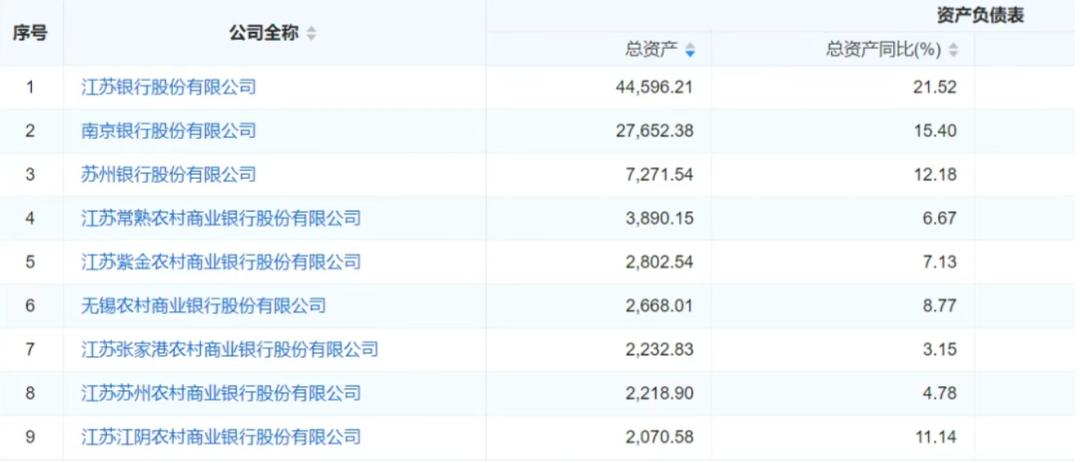
Core Insights - The financial sector in Jiangsu is experiencing intense competition, highlighted by the success of local banks during the "Soo Super" league, which has garnered significant public interest and engagement [1] - Jiangsu has the highest number of banks listed on A-shares in China, with nine banks demonstrating strong operational performance [1][4] Group 1: Performance of Jiangsu Banks - Among the 64 city and rural commercial banks in Jiangsu, 13 made it to the 2025 World Bank's top 1000 list, the highest in the country [1] - The three leading city commercial banks—Jiangsu Bank, Nanjing Bank, and Suzhou Bank—are all publicly listed and show strong growth metrics [2] - In 2024, Jiangsu Bank achieved a net profit of 31.843 billion, leading the profit rankings, while Nanjing Bank and Suzhou Bank reported net profits of 20.177 billion and 5.068 billion, respectively [7][18] Group 2: Financial Metrics - Jiangsu Bank's total assets reached 3952.042 billion, with a year-on-year growth of 16.12%, while Nanjing Bank and Suzhou Bank reported total assets of 2591.4 billion and 693.714 billion, respectively [9][21] - The revenue growth rates for 2024 were 8.78% for Jiangsu Bank, 11.32% for Nanjing Bank, and 3.01% for Suzhou Bank, indicating a competitive landscape [17][20] - The net profit growth rates for these banks were 10.76% for Jiangsu Bank, 9.05% for Nanjing Bank, and 10.16% for Suzhou Bank, all surpassing Jiangsu's GDP growth rate of 5.8% [7][9] Group 3: Market Position and Strategy - Jiangsu's banking sector benefits from a robust regional economy, with a GDP of 13.7 trillion and a diverse industrial base, fostering a strong demand for financial services [22][24] - The establishment of the Jiangsu Rural Commercial Bank aims to enhance the efficiency of the rural financial system and support the growth of small and medium-sized banks [14][16] - Local banks are focusing on differentiated strategies, with city banks emphasizing comprehensive services and rural banks targeting small and micro enterprises [23][24]


青力而为 京彩绽放
Bei Jing Qing Nian Bao· 2025-07-27 18:59
Core Viewpoint - Jiangsu Bank's Beijing branch has been committed to serving the real economy and improving people's livelihoods over the past fifteen years, embodying the mission of "creating a better life" and integrating with the capital's economic and social development [1][9]. Group 1: Youth Empowerment and Innovation - The youth employees at Jiangsu Bank are seen as vital to the branch's high-quality development, embodying values of innovation, professionalism, and teamwork [1][9]. - A digital craftsman, after 15 years of experience, has significantly improved customer experience by optimizing operational processes, reducing manual data entry by 80% and document information capture by 99.2% [2]. Group 2: Inclusive Finance and Support for Enterprises - The Inclusive Finance Department aims to provide financial solutions to small and micro enterprises, addressing their funding needs through tailored financial products [3][4]. - A case study highlights how the department helped a core enterprise in a supply chain overcome funding challenges by creating an embedded financial solution, showcasing the importance of digitalization in inclusive finance [3][4]. Group 3: Technology-Driven Financial Solutions - Jiangsu Bank's approach to serving technology-driven enterprises involves understanding their unique needs and developing innovative financing solutions, such as the "Talent Innovation Loan" [5][6]. - The bank's customer manager has successfully transitioned into a role that supports tech enterprises by employing a three-dimensional evaluation method for assessing their value [5][6]. Group 4: Customer-Centric Services - The bank emphasizes the importance of customer relationships, as demonstrated by a wealth manager who actively protects clients from fraud and provides personalized financial planning [7][8]. - The bank's service philosophy focuses on creating value for customers, highlighting the significance of human interaction in financial services despite technological advancements [8]. Group 5: Commitment to Future Development - Jiangsu Bank's Beijing branch is dedicated to continuing its mission of serving the economy and society, with youth employees poised to contribute to high-quality development in the capital [9].
2Q25主动型公募基金持仓更分散,银行股持仓占比环比上升
Huachuang Securities· 2025-07-27 11:15
Investment Rating - The report maintains a "Buy" rating for the banking sector [1] Core Insights - The proportion of bank stocks held by active equity funds increased to 4.88% in Q2 2025, marking a 1.13 percentage point increase from the previous quarter, driven by both volume and price increases [2][3] - The banking sector's performance outpaced the broader market, with A-share banks rising by 11.23% in Q2 2025, outperforming the CSI 300 and Wind All A indices by 10.7 and 8.25 percentage points respectively [2] - The report highlights a significant increase in holdings of joint-stock banks and quality regional banks, with notable increases in positions for institutions like China Merchants Bank, Minsheng Bank, and others [2][3] Summary by Sections Fund Holdings - In Q2 2025, the number of bank stocks held by active funds reached 4.88%, the second highest since Q1 2021 [2] - The total number of bank shares held by active funds increased by 6.64 billion shares, reaching 48.17 billion shares [2] - The market capitalization of index funds holding bank stocks rose by 27.7% to 133.385 billion yuan, with an increase of 16.3 billion shares [3] Sector Performance - The active fund's allocation to bank stocks saw a quarter-on-quarter increase, although the sector still has the largest allocation gap among 31 sectors, with a shortfall of 7.8% [3] - The report notes that while state-owned banks saw a slight decrease in allocation, joint-stock and regional banks experienced significant increases due to improved fundamentals and lower valuations [2][3] Investment Recommendations - The report suggests a diversified investment strategy focusing on state-owned banks and stable joint-stock banks, recommending specific banks such as China Merchants Bank and CITIC Bank for their long-term investment value [8] - It emphasizes the importance of banks with high dividend yields and strong asset quality, indicating that these banks still offer absolute returns [8] - The report also highlights the potential for banks with low valuations to improve their return on equity, suggesting a focus on banks like Pudong Development Bank [8] Key Company Forecasts - The report provides earnings per share (EPS) and price-to-earnings (PE) ratios for several banks, with recommendations for Ningbo Bank, Jiangsu Bank, and others based on their projected performance [9]



银行业周度追踪2025年第29周:如何展望银行股调整空间和节奏?-20250727
Changjiang Securities· 2025-07-27 09:46
Investment Rating - The investment rating for the banking sector is "Positive" and maintained [11] Core Insights - The recent adjustment in bank stocks reflects a combination of overheated trading sentiment since June and a shift in market risk appetite, leading to active funds flowing out of the banking sector [2][6] - The core investment logic for bank stocks remains solid, with expectations for stabilization supported by mid-term performance reports and dividend distributions [6][7] Summary by Sections Market Performance - The Yangtze Bank Index fell by 2.9% this week, underperforming the CSI 300 by 4.6% and the ChiNext Index by 5.7% [2][8] - Most bank stocks experienced declines, with notable exceptions like Ningbo Bank, which rose by 7% due to better-than-expected performance [8][20] Dividend Value Perspective - Jiangsu Bank, a leading city commercial bank, has shown a consistent adjustment pattern of around 10% since 2024, with the current expected dividend yield rising to 4.9%, the highest among A-share listed banks [6][40] - The adjustment from the peak in late June has reached 8%, indicating that the adjustment space is likely complete, enhancing the attractiveness of further investments if prices decline [6][36] Time Rhythm Perspective - Mid-term performance reports from banks like Hangzhou Bank and Qilu Bank show stable and better-than-expected core performance indicators, which are crucial for the revaluation of bank stocks [7][37] - The mid-term dividend distribution is expected to start soon, with August and September identified as key periods for investment positioning [7][37] Convertible Bonds - Qilu Bank is currently managing the pressure from its convertible bonds, with the balance reduced to 1.7 billion yuan, and is expected to accelerate the conversion process following positive mid-term performance [27][29] - The adjustment in the banking sector has also affected other banks nearing convertible bond redemption, expanding the distance to redemption prices [27][29] Trading Activity - The turnover rate and transaction volume for various bank stocks have decreased, indicating a significant recovery in market risk appetite, while trading heat for previously high-performing bank stocks has notably declined [29][32] - The core investment logic for bank stocks remains intact, with expectations for continued upward adjustments in institutional allocations [29][32]

本周聚焦:银行理财2025H1半年报:存续规模达30.67万亿,母行代销占比降至65%左右
GOLDEN SUN SECURITIES· 2025-07-27 06:56
Investment Rating - The report does not explicitly provide an investment rating for the banking sector Core Insights - The banking wealth management market showed stable growth in the first half of 2025, with a total scale of 30.67 trillion yuan, a year-on-year increase of 7.53% [1] - Cash management products continued to decline, with a scale of 6.4 trillion yuan, down 14.55% year-on-year, attributed to lower deposit rates and regulatory policies [1] - The market share of wealth management companies increased, with 32 companies holding 89.61% of the market by the end of Q2 2025, up 1.8 percentage points from the end of the previous year [2] - The asset allocation in wealth management products shifted, with a decrease in credit bond allocation and a notable increase in public fund allocation, which rose to 4.2% [3] - The average annualized yield of wealth management products was 2.12%, a decrease of 53 basis points compared to 2024, indicating a low-interest-rate environment [4] - The proportion of sales through parent banks has decreased to around 65%, as companies expand their distribution channels [5][8] Summary by Sections 1. Wealth Management Market Overview - As of the end of Q2 2025, the total scale of wealth management products reached 30.67 trillion yuan, with a year-on-year growth of 7.53% [1] - Cash management products saw a significant decline, with a scale of 6.4 trillion yuan, down 14.55% year-on-year [1] 2. Market Structure - The market share of wealth management companies increased to 89.61%, reflecting a concentration of market power among leading firms [2] 3. Asset Allocation - The allocation to credit bonds decreased, while public funds saw a significant increase, indicating a shift in investment strategy [3] 4. Yield Trends - The average annualized yield of wealth management products fell to 2.12%, continuing a downward trend since 2023 [4] 5. Distribution Channels - The share of sales through parent banks has decreased to approximately 65%, as firms diversify their distribution strategies [5][8] 6. Sector Outlook - The banking sector is expected to benefit from policy catalysts, with specific banks like Ningbo Bank, Postal Savings Bank, and others highlighted as potential investment opportunities [9]
解锁“南京军团”上榜“密码”
Nan Jing Ri Bao· 2025-07-27 02:48
Group 1 - The 2025 Fortune China 500 list includes 8 companies based in Nanjing, with notable rankings such as Jiangsu Bank at 162nd and Suzhou Industrial Park Holding Group at 181st [1] - Six of the listed companies improved their rankings compared to the previous year, with Huatai Securities experiencing a significant rise of 93 places [1] Group 2 - Jiangsu Bank launched a promotional campaign linked to the "Su Super" sports event, resulting in a 112% year-on-year increase in dining and tourism transaction volumes [5] - Su Ning's MAX Super Experience Store opened in Nanjing, achieving sales of over 500 million yuan on its first day, showcasing a successful integration of technology and consumer experience [6] Group 3 - Nanjing Pharmaceutical is advancing its digital transformation with a fully digitalized herbal medicine preparation system, achieving a revenue of 53.696 billion yuan in 2024, a 0.20% increase year-on-year [7] - Huitongda is promoting the digital transformation of rural stores with its "AI Super Store Manager" system, enhancing operational efficiency [8] Group 4 - Suhao Holding Group is focusing on high-end textile and hardware trade, leveraging technology to enhance cross-border e-commerce services for small and medium enterprises [9] - Nanjing Bank is innovating financial services with a focus on supporting technology enterprises, having provided over 700 billion yuan in credit support to more than 70,000 tech companies [9] Group 5 - Jiangsu Guoxin is accelerating its transformation by developing new asset management and trust services, enhancing its capability to serve the economy [10] - The Nanjing government is continuously improving the business environment, emphasizing a user-centric approach to create a high-quality service system for enterprises [10]



二季度公募基金大幅增持银行股
Cai Jing Wang· 2025-07-25 10:45
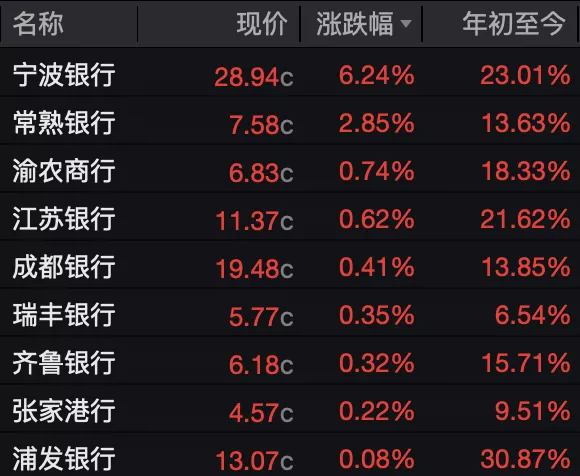
Core Viewpoint - Ningbo Bank's revenue and profit are accelerating, leading to a stock price increase of over 6%, reaching a nearly two-year high, with other city commercial banks also experiencing gains [1] Group 1: Stock Performance - Ningbo Bank's current price is 28.94c, with a year-to-date increase of 23.01% [2] - Other banks such as Changshu Bank, Chongqing Rural Commercial Bank, and Jiangsu Bank also saw price increases, with year-to-date gains of 13.63%, 18.33%, and 21.62% respectively [2] - The banking sector has cumulatively risen over 12% this year, significantly outperforming the broader market [2] Group 2: Institutional Investment - As of the end of Q2 2025, public funds held a total market value of approximately 25.837 billion yuan across 2,917 A-share companies, with significant investments in the banking sector [3] - Public funds increased their holdings in banks and telecommunications by over 40 billion yuan, leading the industry [3] - Major banks like China Merchants Bank, Industrial Bank, and Jiangsu Bank have seen substantial public fund investments, with China Merchants Bank leading at 75.9 billion yuan [3] Group 3: ETF Inflows - In the first half of the year, a total of 12.2 billion yuan flowed into the banking sector through ETFs, primarily from the CSI 300 ETF and dividend ETFs [4] - Individual banks such as Industrial Bank, Agricultural Bank, and China Merchants Bank benefited from significant net inflows exceeding 500 million yuan [4] Group 4: Future Outlook - The banking sector's weight in active equity funds is currently 3.35%, while the CSI 300 index has a weight of 15.71%, indicating potential for increased allocation [5] - The recent reforms in public funds are expected to align fund allocation closer to benchmark weights, benefiting the underweighted banking sector [5] - Insurance capital is also anticipated to further support inflows into the banking sector [5]