CNOOC(600938)

Search documents
南向资金今日净买入超66亿港元 中国海洋石油获净买入居前
Mei Ri Jing Ji Xin Wen· 2025-11-10 09:48
Group 1 - Southbound funds recorded a net purchase of approximately 66.54 billion HKD today [1] - China National Offshore Oil Corporation (CNOOC) and Pop Mart received net purchases of about 13.13 billion HKD and 5.19 billion HKD respectively [1] - Alibaba-W experienced a net sell-off of 6.53 billion HKD [1] Group 2 - Southbound funds have maintained a net inflow for 14 consecutive trading days, with a cumulative purchase of 927.72 billion HKD during this period [1]



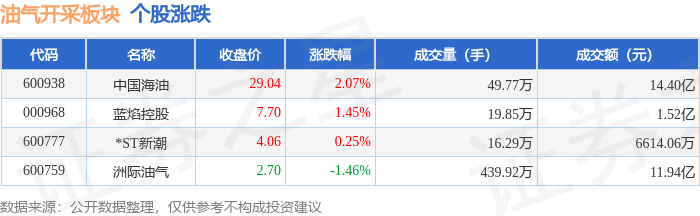
油气开采板块11月10日涨1.37%,中国海油领涨,主力资金净流入1.36亿元
Zheng Xing Xing Ye Ri Bao· 2025-11-10 08:49
Group 1 - The oil and gas extraction sector increased by 1.37% compared to the previous trading day, with China National Offshore Oil Corporation (CNOOC) leading the gains [1] - On the same day, the Shanghai Composite Index closed at 4018.6, up 0.53%, while the Shenzhen Component Index closed at 13427.61, up 0.18% [1] - The main capital inflow in the oil and gas extraction sector was 136 million yuan, while retail investors saw a net outflow of 1.03 billion yuan [1] Group 2 - CNOOC had a net inflow of 1.68 billion yuan from main capital, representing 11.68% of its total capital [2] - Blue Flame Holdings experienced a net inflow of 3.41 million yuan from main capital, with a net outflow of 11.46 million yuan from retail investors [2] - ST Xinchao saw a significant net outflow of 13.36 million yuan from main capital, while retail investors had a net inflow of 5.67 million yuan [2]


PTA检修计划增多,减产预期有所提升:石油化工行业周报(2025/11/3—2025/11/9)-20251110
Shenwan Hongyuan Securities· 2025-11-10 06:30
Investment Rating - The report maintains a cautious outlook on the PTA industry, indicating a potential for recovery but highlighting ongoing challenges in profitability [4][10]. Core Insights - The PTA industry has been experiencing prolonged losses, with a significant decline in profitability expected in 2025 due to increased production capacity and a negative gross margin of -319 RMB/ton as of November 7 [4][6]. - An increase in maintenance schedules for PTA facilities is anticipated, which may lead to a tightening of supply and a potential recovery in profitability if production cuts are realized [6][8]. - The report suggests that the polyester sector may see a recovery in profitability as supply and demand dynamics improve, particularly for leading companies like Tongkun Co. and Wankai New Materials [10]. Summary by Sections 1. Industry Overview - The PTA industry has been in a state of oversupply since 2022, leading to consistent losses across the sector, with only a few companies managing to achieve marginal profits [4][6]. - Recent data indicates that the industry operating rate is at 78%, reflecting a weak market environment [8]. 2. Maintenance and Supply Dynamics - Several PTA facilities are undergoing planned maintenance, including major players like Yisheng Dihua and Sichuan Energy Investment, which may further restrict supply in the short term [6][7]. - The report notes that if leading PTA companies continue to implement production cuts, the industry could see a return to breakeven profitability levels, with potential profit margins of 200-300 RMB per ton [8]. 3. Investment Recommendations - The report recommends focusing on leading polyester companies and high-quality refining firms, suggesting that companies like Hengli Petrochemical and Rongsheng Petrochemical may benefit from improved market conditions [10]. - It also highlights the potential for recovery in the oil and gas sector, particularly for offshore service companies, as capital expenditures remain high [10].



石油化工行业周报:PTA检修计划增多,减产预期有所提升-20251110
Shenwan Hongyuan Securities· 2025-11-10 05:49
Investment Rating - The report maintains a positive outlook on the petrochemical industry, particularly regarding the PTA sector, due to increased maintenance schedules and anticipated production cuts [3][4]. Core Insights - The PTA industry has been in a prolonged state of loss since 2022, exacerbated by rapid capacity expansion. As of November 7, 2025, the PTA industry's gross profit reached -319 CNY/ton, indicating a loss across the sector [3][4]. - Recent increases in PTA maintenance schedules are expected to tighten supply, with major companies like Tongkun and Hengli yet to announce maintenance plans. If these companies proceed with production cuts, industry profitability may return to breakeven levels, with potential profit per ton increasing by 200-300 CNY [3][8]. - The upstream sector is experiencing a decline in oil prices, with Brent crude closing at 63.63 USD/barrel, down 2.21% from the previous week. This decline is coupled with an increase in drilling day rates for self-elevating platforms, indicating a recovery trend in the oil service sector [15][33]. Summary by Sections PTA Sector - The PTA industry is facing a significant downturn, with losses expected to continue into 2025. The increase in maintenance schedules is anticipated to reduce supply and support a recovery in profitability [3][4][8]. - Current PTA operating rates are at 78%, reflecting weak industry conditions, but with no significant inventory pressure, a quicker recovery is expected as maintenance plans are realized [8][10]. Upstream Sector - Brent crude oil prices have decreased, with a closing price of 63.63 USD/barrel, while WTI prices also fell to 59.75 USD/barrel. The overall trend suggests a potential for further price declines, although OPEC's production cuts may provide some support [15][17]. - The number of active drilling rigs in the U.S. has increased slightly, indicating a potential uptick in exploration and production activities despite a year-over-year decline [25][30]. Refining Sector - The refining sector is seeing improved margins, with the Singapore refining margin rising to 23.18 USD/barrel. This improvement is attributed to a recovery in demand and a tightening of supply due to maintenance activities [46][48]. - The domestic refining sector's product price differentials have also improved, suggesting a favorable environment for refining profitability moving forward [46][48]. Polyester Sector - The polyester chain is showing signs of recovery, with expectations for improved profitability as supply and demand dynamics shift. Key companies to watch include Tongkun and Wankai New Materials [10][11].


石油股午后涨幅扩大 OPEC+暂停增产及俄油制裁有望支撑油价 三桶油业绩韧性凸显
Zhi Tong Cai Jing· 2025-11-10 05:47
Core Viewpoint - Oil stocks are experiencing an upward trend, with significant gains reported for major companies such as CNOOC, PetroChina, and Sinopec, following OPEC+'s announcement of increased production and the impact of U.S. sanctions on Russian oil producers [1] Group 1: Market Reactions - As of the report, CNOOC (00883) rose by 3.68% to HKD 21.96, PetroChina (00857) increased by 2.94% to HKD 8.76, and Sinopec (00386) gained 2.1% to HKD 4.38 [1] - The market sentiment has improved due to OPEC+'s decision to pause production increases in Q1 2026, which was beyond market expectations, alongside the effects of U.S. sanctions on Russia [1] Group 2: Industry Outlook - Despite the positive sentiment, there are still concerns regarding weak demand and oversupply, leading to expectations of oil prices remaining volatile in the short term [1] - The "Three Oil Giants" (CNOOC, PetroChina, Sinopec) are focusing on enhancing reserves and production while strengthening cost control to navigate external uncertainties [1] - The production growth plans for 2025 are as follows: PetroChina aims for a 1.6% increase, Sinopec targets a 1.5% increase, and CNOOC plans a 5.9% increase in oil and gas equivalent production [1] Group 3: Strategic Initiatives - The "Three Oil Giants" are accelerating their transformation in the midstream and downstream refining businesses, promoting low-cost "oil conversion" and high-value "oil-to-specialty" initiatives [1] - The sales divisions are actively transitioning towards becoming comprehensive energy service providers, integrating oil, gas, hydrogen, and electricity [1] - The chemical business is steadily increasing the proportion of high-value-added products, indicating a long-term growth potential that can withstand oil price cycles [1]

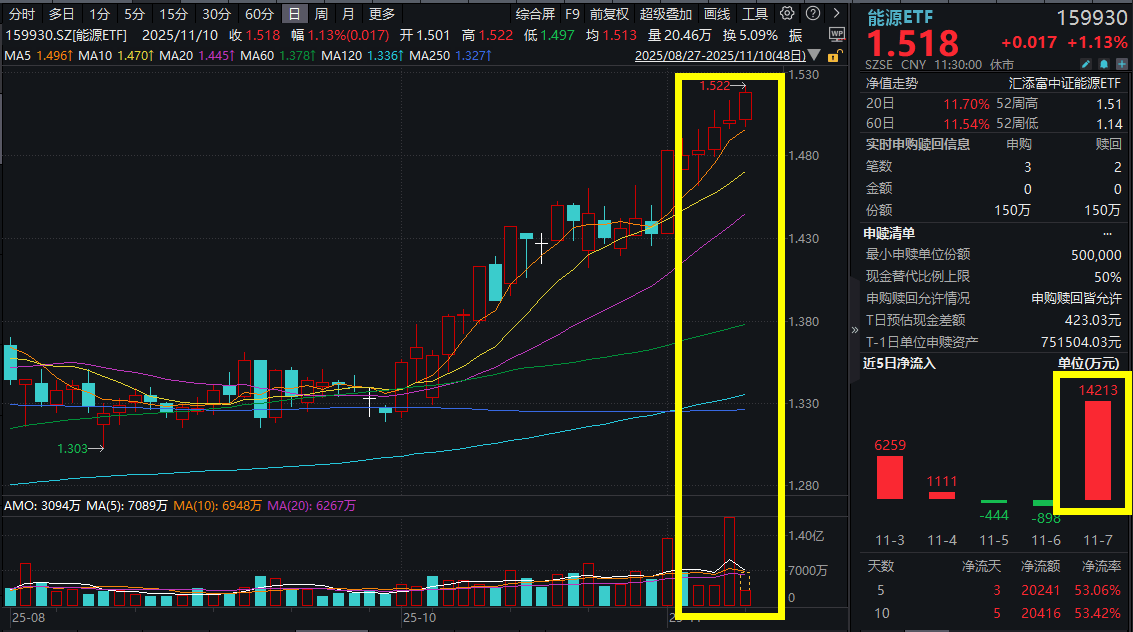
超700亿美元,"三桶油"接连斩获大单!中国石油涨超2%,能源ETF(159330)涨超1%,上一交易日大举吸金超1.4亿元,份额、规模齐创上市以来新高
Sou Hu Cai Jing· 2025-11-10 05:19
Core Viewpoint - The A-share market showed weakness on November 10, with the Shanghai Composite Index slightly down and the ChiNext Index dropping over 2%, while the coal and oil sectors experienced upward movement, particularly the Energy ETF (159330), which rose over 1% and attracted significant capital inflow [1][3]. Group 1: Market Performance - The Energy ETF (159330) saw a substantial inflow of over 140 million yuan in the previous trading day and over 200 million yuan in the last five days, reaching new highs in both share and scale since its inception [1]. - Among the 25 component stocks of the Energy ETF, 20 stocks increased in value, with notable gains from major oil companies such as China National Offshore Oil Corporation (CNOOC) rising over 2% and China Petroleum and China Petrochemical both rising over 1% [3]. Group 2: Industry News - During the China International Import Expo, major oil companies signed procurement agreements totaling approximately 71.385 billion USD, with China Petroleum alone signing contracts worth 17.485 billion USD [3]. - A new round of domestic refined oil price adjustments is set to take place on November 10 at 24:00 [4]. Group 3: Coal Market Insights - The price of thermal coal at northern ports increased to 817 yuan/ton, a week-on-week rise of 47 yuan/ton, with significant price increases at mining sites in Shanxi, Inner Mongolia, and Shaanxi [5]. - Analysts predict a tightening supply-demand balance for coal, with expectations of sustained strong demand as the coal consumption peak season approaches, making price increases likely [5]. Group 4: Oil Market Insights - OPEC+ announced a pause in production increases starting January 2026, which is expected to alleviate concerns over oil supply excess [6]. - The International Energy Agency (IEA) forecasts a global oil supply increase of 2.4 million barrels per day by 2026, with non-OPEC+ countries contributing 1.2 million barrels per day [7]. Group 5: Investment Perspective - The energy sector is highlighted for its high dividend yields, with coal and oil sectors ranking among the top in dividend rates, making them attractive for investors seeking stable returns [8][9]. - The Energy ETF (159930) is noted for its low valuation at a price-to-book ratio of 1.34, positioning it as a preferred investment choice amid market volatility [10].
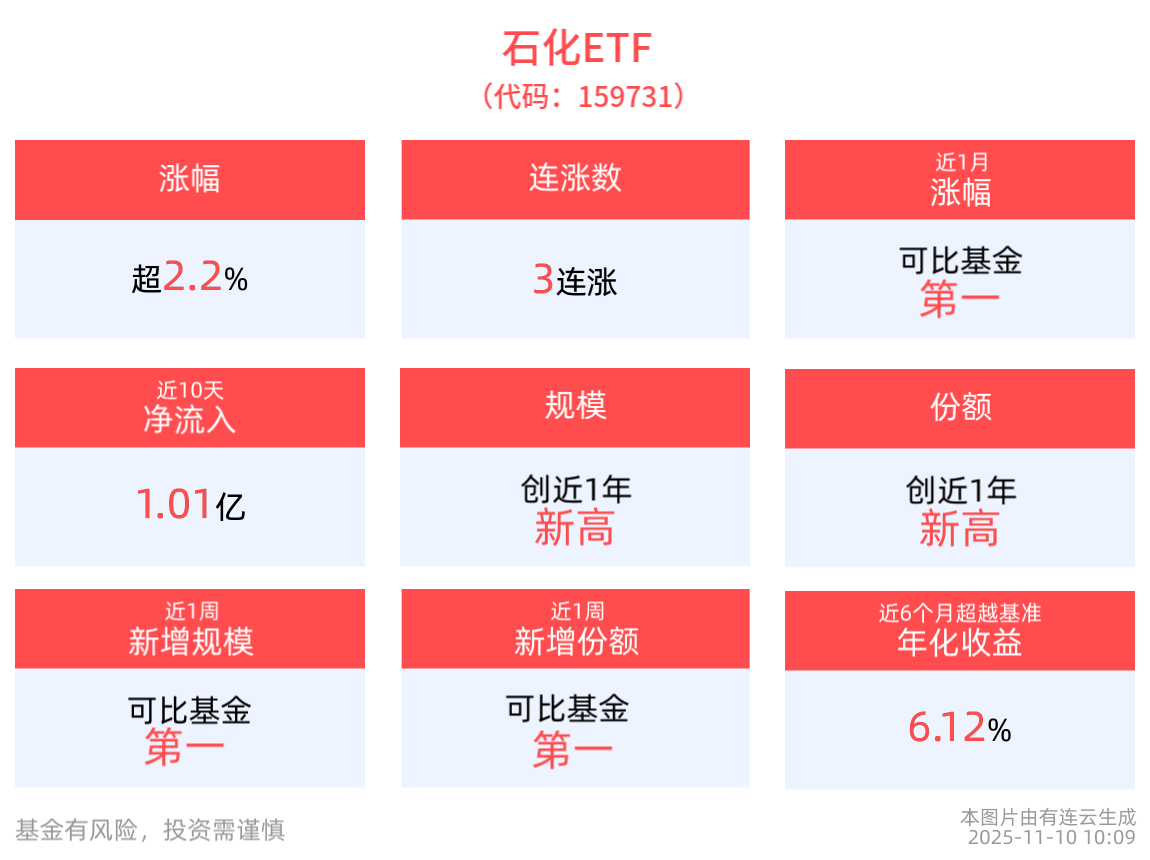
涨超2.2%,石化ETF(159731)冲击3连涨
Xin Lang Cai Jing· 2025-11-10 02:37
Core Viewpoint - The petrochemical sector is experiencing significant growth, with the China Securities Petrochemical Industry Index rising by 2.3% and notable gains in individual stocks, indicating strong investor interest and capital inflow into the sector [1][3]. Group 1: Market Performance - As of November 10, 2025, the China Securities Petrochemical Industry Index has increased by 2.3%, with stocks like Luxi Chemical hitting the daily limit and Hualu Hengsheng rising by 9.63% [1]. - The Petrochemical ETF (159731) has also seen a rise of 2.29%, marking its third consecutive increase, with the latest price at 0.85 yuan [1]. - Over the past 10 trading days, the Petrochemical ETF has recorded net inflows on 9 days, totaling 101 million yuan, with its latest share count reaching 193 million and total assets at 160 million yuan, both hitting a one-year high [1]. Group 2: ETF Performance Metrics - As of November 7, 2025, the Petrochemical ETF has achieved a net value increase of 25.33% over the past six months [3]. - The ETF's highest single-month return since inception was 15.86%, with the longest streak of consecutive monthly gains being 6 months and a maximum increase of 23.51% [3]. - The average monthly return during the rising months is 5.06%, and the ETF has outperformed its benchmark with an annualized excess return of 6.12% over the last six months [3]. Group 3: Risk and Tracking Precision - The maximum drawdown for the Petrochemical ETF over the past six months is 6.47%, with a relative benchmark drawdown of 0.14%, indicating the lowest drawdown among comparable funds [3]. - The recovery time after drawdown is 21 days, showcasing the ETF's resilience [3]. - The tracking error for the ETF over the past month is 0.034%, which is the highest tracking precision among comparable funds [3]. Group 4: Top Holdings - As of October 31, 2025, the top ten weighted stocks in the China Securities Petrochemical Industry Index account for 56.05% of the index, with Wanhua Chemical, China Petroleum, and Salt Lake Industry being the top three [3]. - The weightings and recent performance of key stocks include Wanhua Chemical at 10.47% with a 4.40% increase, China Petroleum at 7.63% with a 1.54% increase, and Salt Lake Industry at 6.44% with a 2.01% increase [5].



近5日合计“吸金”2.6亿元,同类规模最大的自由现金流ETF(159201)冲击4连涨
Sou Hu Cai Jing· 2025-11-10 02:25
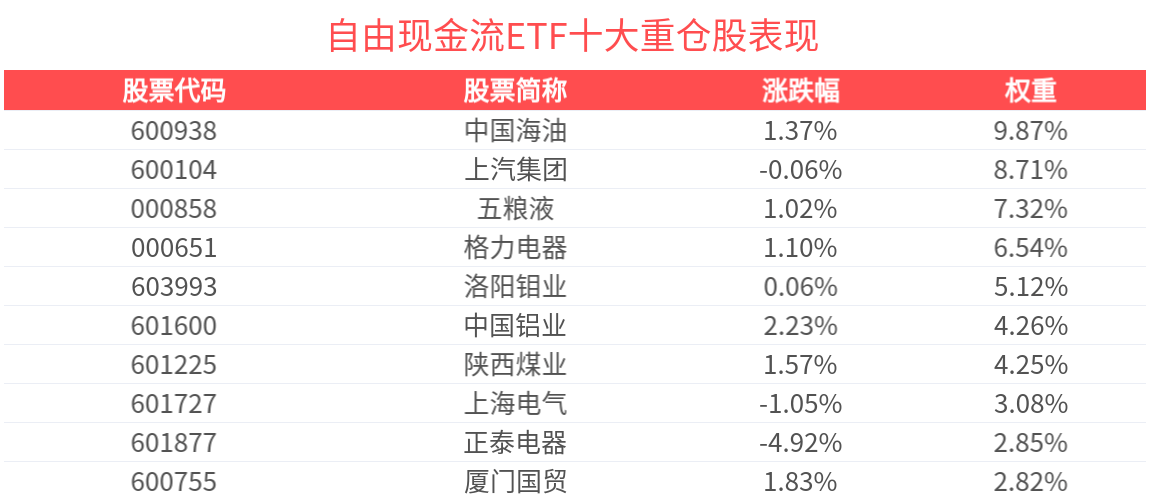
Core Insights - The Guozheng Free Cash Flow Index has increased by 0.56% as of November 10, 2025, with leading stocks including Yuntianhua, Shoulv Hotel, Changbao Co., Huaren Health, and Baiyin Nonferrous Metals [1] - The Free Cash Flow ETF (159201) has seen a 0.5% rise, marking its fourth consecutive increase, with the latest price at 1.22 yuan [1] - The Free Cash Flow ETF has recorded a net inflow of 260 million yuan over the past five trading days, with a total share count reaching a new high of 4.706 billion shares [1] Performance Metrics - As of November 7, 2025, the Free Cash Flow ETF has achieved a net value increase of 24.13% over the past six months [2] - The ETF's highest single-month return since inception is 7%, with the longest consecutive monthly increase being six months and a maximum increase of 22.69% [2] - The ETF has a historical six-month profit probability of 100% and an average monthly return of 3.2% [2] Risk and Recovery - The maximum drawdown for the Free Cash Flow ETF in the last six months is 3.65%, which is the smallest among comparable funds [2] - The recovery time after drawdown is 35 days, indicating the fastest recovery among similar funds [2] Fee Structure and Tracking Accuracy - The management fee for the Free Cash Flow ETF is 0.15%, and the custody fee is 0.05%, both of which are the lowest among comparable funds [3] - The tracking error over the past two months is 0.052%, demonstrating the highest tracking accuracy among similar funds [3] Top Holdings - The top ten weighted stocks in the Guozheng Free Cash Flow Index account for 54.79% of the index, with major holdings including China National Offshore Oil Corporation, SAIC Motor, Wuliangye, and Gree Electric Appliances [3][5]






中国海油进博会签约超130亿美元 抗周期韧性凸显前三季盈利逾千亿
Chang Jiang Shang Bao· 2025-11-09 23:27
Core Viewpoint - China National Offshore Oil Corporation (CNOOC) has achieved a record high of over $13 billion in contracts during the 8th China International Import Expo, showcasing its strong global partnerships and commitment to optimizing its procurement structure [2][3]. Group 1: Contract Achievements - CNOOC signed contracts exceeding $13 billion at the 8th China International Import Expo, marking the highest signing amount in the company's history for a single expo [2][3]. - The contracts cover a wide range of products, including crude oil, natural gas, deepwater oil and gas equipment, and advanced technology services, indicating a shift towards integrated cooperation in energy, technology, and equipment [3][5]. Group 2: Financial Performance - For the first three quarters of 2025, CNOOC reported a net profit attributable to shareholders of 101.97 billion yuan, with oil and gas net production increasing by 6.7% year-on-year [5][6]. - The company achieved operating revenue of 312.5 billion yuan, with oil and gas sales revenue reaching 255.48 billion yuan, outperforming the Brent oil price, which fell by 14.56% during the same period [5][6]. Group 3: Production and Exploration - CNOOC's oil and gas net production reached 57.83 million barrels of oil equivalent, with natural gas business growth at 11.6%, highlighting its strategic value as a second growth curve [5][6]. - The company made five new discoveries and successfully evaluated 22 oil and gas structures in the first three quarters, with significant contributions from key oil and gas fields [6][7]. Group 4: Cost Management and Investment - CNOOC maintained a leading cost control level with a major cost of $27.35 per barrel, reflecting effective project management and technological innovation [6][7]. - Capital expenditure was approximately 86 billion yuan, indicating improved investment efficiency and operational precision [6][7]. Group 5: Green Transition and Shareholder Returns - CNOOC is accelerating its transition to green and low-carbon energy, initiating offshore wind power projects and advancing carbon capture, utilization, and storage (CCUS) technology [7]. - The company plans to distribute a cash dividend of 0.73 HKD per share for the mid-2025 period, maintaining a high payout ratio of 45.5% [7].
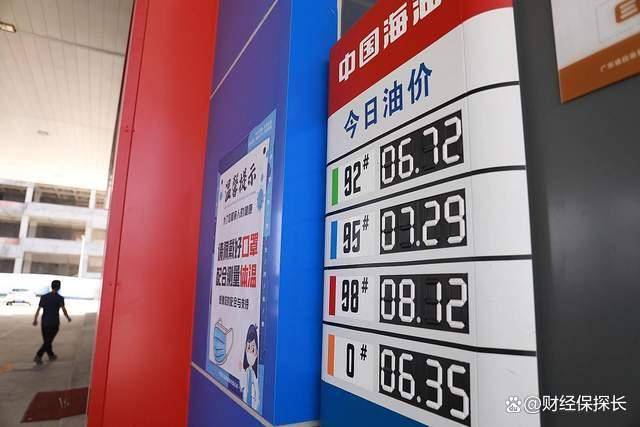
油价跌了,三桶油却各有各的难处
Sou Hu Cai Jing· 2025-11-09 22:42
Core Viewpoint - The domestic oil giants, referred to as the "Three Oil Companies" (China National Petroleum Corporation, Sinopec, and CNOOC), are facing profit pressures due to fluctuating international oil prices, but they are responding to transformation and change in different ways [1][4]. Group 1: International Oil Price Trends - International oil prices have generally declined, with Brent crude oil averaging $70.93 per barrel, down 14.3% year-on-year, and West Texas Intermediate crude oil down 14.1% [3]. - The drop in oil prices has significantly impacted corporate profits, akin to an invisible constraint on their earnings [3]. Group 2: Financial Performance of the "Three Oil Companies" - China National Petroleum Corporation reported a profit of 126.29 billion yuan, a year-on-year decline of 4.9% [4]. - Sinopec's profit was 29.98 billion yuan, marking the most significant decline among the three [4]. - CNOOC's performance was relatively stable, with a profit of 101.97 billion yuan, down 12.6% year-on-year [4]. Group 3: Net Profit Margin Differences - CNOOC boasts a net profit margin of 32.63%, significantly higher than China National Petroleum's 5.82% and Sinopec's 1.42% [6]. - The differences in profit margins are attributed to each company's unique business structure, which influences their risk resilience [6]. Group 4: Business Models and Challenges - CNOOC focuses on upstream exploration and production, with oil and gas sales accounting for over 80% of its total revenue, allowing it to maintain high profit margins despite price fluctuations [8]. - In contrast, China National Petroleum and Sinopec have a full industry chain layout, facing challenges from refining profitability and chemical sector pressures due to market demand and oversupply [8]. - Sinopec's chemical sector reported a loss of 7.43 billion yuan in the first three quarters, exceeding last year's losses, while China National Petroleum's chemical profits were nearly halved [8]. Group 5: Future Outlook and Strategies - Despite challenges, Sinopec remains optimistic about the chemical industry's recovery, anticipating market balance as the economy stabilizes and outdated capacities are eliminated [9]. - Both China National Petroleum and Sinopec are pursuing transformations towards higher-end refining and chemical production, which will require time and investment [9]. - The sales of refined oil products have also declined, with China National Petroleum's gasoline sales down 3.1% and Sinopec's domestic refined oil sales down 3.6% year-on-year, influenced by the rise of electric vehicles [9]. - CNOOC is utilizing futures and derivatives trading for hedging to stabilize earnings and mitigate risks from price volatility [10]. Group 6: Industry Challenges and Opportunities - The performance of the "Three Oil Companies" reflects the broader challenges and opportunities facing the oil industry amid energy transition [11]. - Traditional oil companies must actively seek new growth points to remain competitive in a rapidly changing market [11].