
CNOOC(600938)

Search documents
近2600只个股下跌
第一财经· 2025-11-03 03:49
Core Viewpoint - The article discusses the performance of the A-share market, highlighting fluctuations in major indices and sector performances, with a focus on the impact of recent OPEC+ decisions on oil and gas stocks. Market Performance - The Shanghai Composite Index rose by 0.05%, while the Shenzhen Component Index and the ChiNext Index fell by 1.06% and 1.37%, respectively [3] - The total trading volume in the Shanghai and Shenzhen markets reached 1.38 trillion yuan, a decrease of 175.5 billion yuan compared to the previous trading day, with nearly 2,600 stocks declining [4] - The oil and gas sector saw significant gains, with companies like China National Offshore Oil Corporation and China Petroleum rising over 4% following OPEC+ decisions to maintain production increases [4][7] Sector Highlights - The Hainan Free Trade Port concept stocks were active, with notable gains in companies like Ronniu Mountain and Hainan Development, driven by positive commentary on the alignment of the China-ASEAN Free Trade Area 3.0 with Hainan's development [7] - The storage chip sector experienced declines, with major players like Shikong Technology hitting the daily limit down, and other companies like Dwei Co. and Weicai Technology also seeing significant drops [11] - Precious metals stocks faced downward pressure, with companies like Hunan Gold and Xiaocheng Technology dropping over 2% [11] Individual Stock Movements - BYD's stock price fell below the 100 yuan mark, declining by 1.30% during the trading session [9] - The banking sector showed short-term gains, with Shanghai Bank rising over 2% and other major banks also experiencing upward movements [7]




中国海油(600938):2025年三季报点评:成本同比优化,圭亚那Yellowtail项目投产
Huachuang Securities· 2025-11-03 03:46
Investment Rating - The report maintains a "Strong Buy" rating for China National Offshore Oil Corporation (CNOOC) with a target price of 36.24 CNY [2][10]. Core Insights - CNOOC's Q3 2025 revenue reached 1048.95 billion CNY, showing a year-on-year increase of 5.68% and a quarter-on-quarter increase of 4.11%. However, the net profit attributable to shareholders decreased by 12.10% year-on-year to 324.38 billion CNY [2][9]. - The company has optimized costs, with the main cost per barrel at 27.35 USD, a reduction of 0.79 USD compared to the same period in 2024, enhancing its competitive edge [9][10]. - Significant exploration achievements were noted, with four oil and gas structures evaluated and multiple projects launched, including the Guyana Yellowtail project, which is expected to contribute to production growth [9][10]. - The report forecasts CNOOC's net profit attributable to shareholders for 2025-2027 to be 1382, 1436, and 1469 billion CNY, respectively, with a consistent PE ratio of 9 [9][10]. Financial Summary - For 2025, the total revenue is projected to be 431,353 million CNY, with a year-on-year growth rate of 2.6% [4]. - The net profit attributable to shareholders is expected to be 138,166 million CNY in 2025, reflecting a minimal growth rate of 0.2% [4]. - The earnings per share (EPS) is projected to be 2.91 CNY for 2025, with a price-to-earnings (P/E) ratio of 9 [4][10]. Market Performance - CNOOC's stock has shown a performance of -13% over the past year, compared to the CSI 300 index [7]. Company Overview - CNOOC has a total market capitalization of approximately 1,288.54 billion CNY, with a circulating market value of 81.06 billion CNY [5]. - The company has a debt-to-asset ratio of 30.09% and a net asset value per share of 16.53 CNY [5]. Future Outlook - The report emphasizes the potential for increased shareholder returns, with a commitment to a dividend payout ratio of no less than 45% for 2025-2027, an increase of 5 percentage points from previous years [9][10].
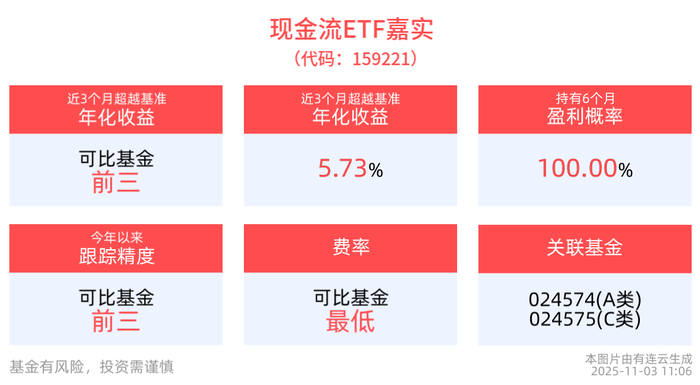
A股三季报核心指标环比改善,现金流ETF嘉实(159221)红盘蓄势,成分股亚翔集成、海陆重工10cm涨停
Xin Lang Cai Jing· 2025-11-03 03:29
Core Insights - The National Index of Free Cash Flow has increased by 0.15% as of November 3, 2025, with notable stock performances from companies like Yaxing Integration and Hailu Heavy Industry reaching the daily limit up [1] - The Cash Flow ETF from Harvest has seen a net value increase of 20.15% over the past six months, indicating strong performance and investor interest [3] Group 1: Cash Flow ETF Performance - As of October 31, 2025, the Cash Flow ETF from Harvest has achieved a maximum monthly return of 6.91% since its inception, with an average monthly return of 3.13% [3] - The top ten weighted stocks in the National Index of Free Cash Flow account for 54.79% of the index, with China National Offshore Oil Corporation (CNOOC) being the largest at 9.80% [3][5] Group 2: Market Environment and Trends - Global monetary and fiscal easing expectations have positively influenced risk assets, creating a favorable macro environment for A-shares [5] - A-share third-quarter reports show improvements in key metrics such as profit, revenue, and ROE compared to the first half of the year, suggesting a potential transition to a fundamental bull market [5]




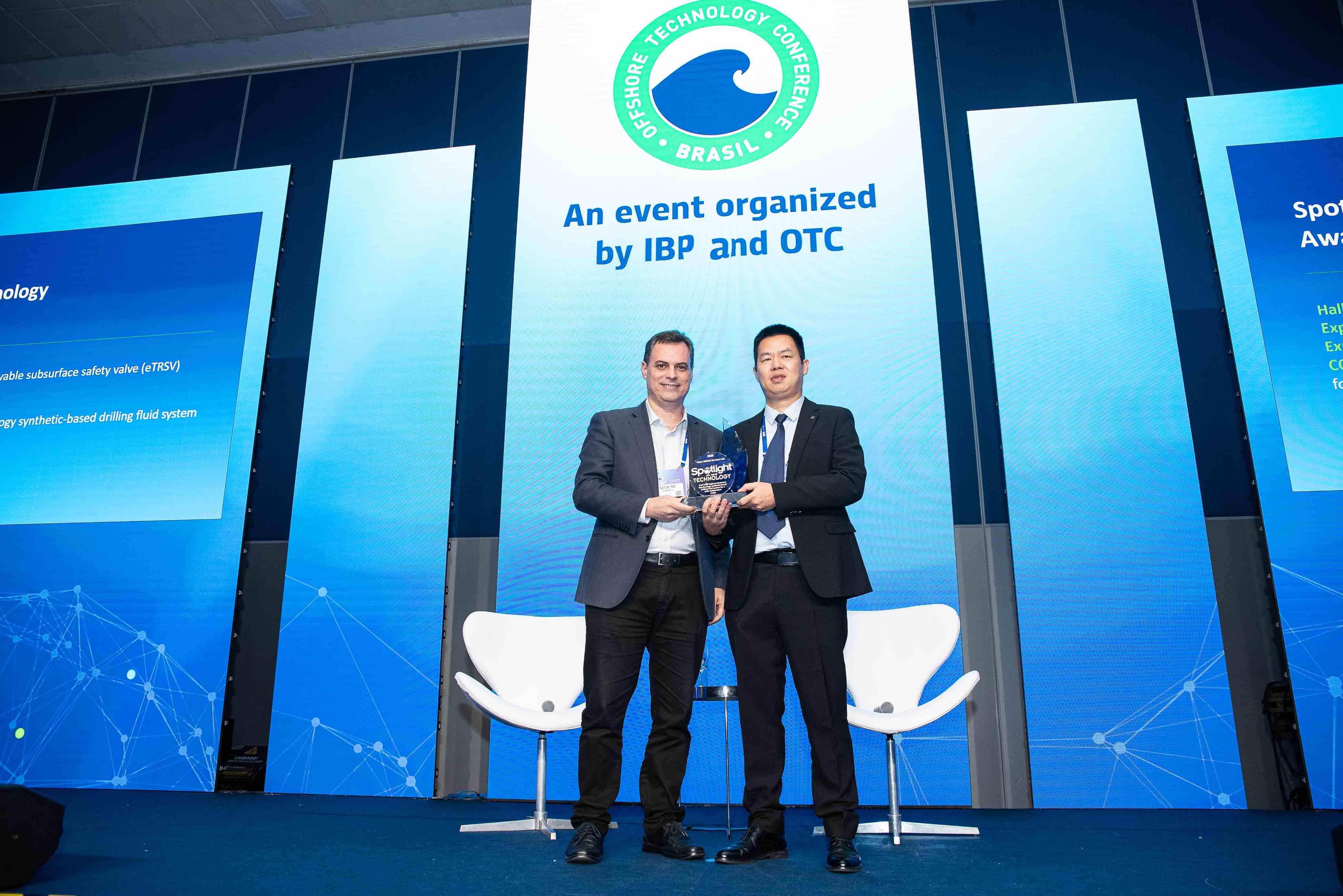
中国海油“海恒”深水钻井液体系获国际大奖
Ke Ji Ri Bao· 2025-11-03 03:09
Core Viewpoint - China National Offshore Oil Corporation (CNOOC) has achieved a significant milestone in deepwater drilling technology with its "Haiheng" FLAT PRO high-performance synthetic drilling fluid system, winning the OTC Brazil New Technology Award, marking a transition from following to keeping pace with global advancements in deepwater drilling technology [1][5]. Group 1 - The "Haiheng" deepwater drilling fluid system can maintain stable flow performance in extreme conditions, with a temperature range from -10°C to 180°C, enabling safe exploration and development in complex environments such as over 3000 meters of water depth and over 10,000 meters of well depth [5][6]. - The OTC Technology Award is regarded as the "Oscar" of the international offshore oil and gas technology sector, and this recognition highlights CNOOC's enhanced competitiveness and brand influence in the global market [5][6]. - The "Haiheng" series technology has been widely applied in global deepwater drilling operations, with an average operational water depth exceeding 1500 meters and a maximum depth record of 2619 meters in the Western Pacific [5][6]. Group 2 - The technology leader of CNOOC stated that "Haiheng" has overcome challenges in wellbore stability for deep displacement wells, maintaining records for the deepest offshore drilling at 9508 meters and a horizontal displacement of 8689 meters [6]. - CNOOC has been actively promoting technological upgrades in ultra-high temperature, ultra-high pressure, and ultra-deepwater fields, focusing on original and leading technological advancements [6]. - The OTC International Offshore Technology Conference is one of the largest and most influential oil and gas exhibitions globally, with over 5000 representatives and more than 200 top oil and gas companies participating [6].
油气ETF(159697)涨近2%,原油价格持续走高
Xin Lang Cai Jing· 2025-11-03 02:53
Core Insights - The National Petroleum and Natural Gas Index (399439) has seen a strong increase of 1.54%, with significant gains in constituent stocks such as Lanstone Heavy Industry (603169) up 9.99%, Intercontinental Oil and Gas (600759) up 9.70%, and China National Offshore Oil Corporation (600938) up 4.54% [1] - OPEC+ has agreed to maintain a production increase of 137,000 barrels per day in December, consistent with the planned increases for October and November, while pausing production increases from January to March due to expected seasonal demand slowdown [1] - Brent crude oil prices have surpassed $65 per barrel, marking the longest consecutive increase since late September, while WTI crude oil prices have crossed the $61 mark [1] Industry Analysis - Long-term, oil-producing countries prioritize "value over volume," and OPEC+ is expected to balance pressures that may lead to a new round of cooperation, supported by North American shale oil cost impacts [2] - The Brent crude oil price is anticipated to find long-term support around $60 per barrel before the influence of South American supply and global energy transition accelerates [2] - The top ten weighted stocks in the National Petroleum and Natural Gas Index, which includes major companies like China National Petroleum (601857) and Sinopec (600028), account for 65.09% of the index [2]


煤价、油价双飞!OPEC明年将暂停增产,三桶油飙涨,中国神华涨超2%,能源ETF(159930)放量涨超3%!能源板块攻防兼备,周期与红利双逻辑演绎
Sou Hu Cai Jing· 2025-11-03 02:48
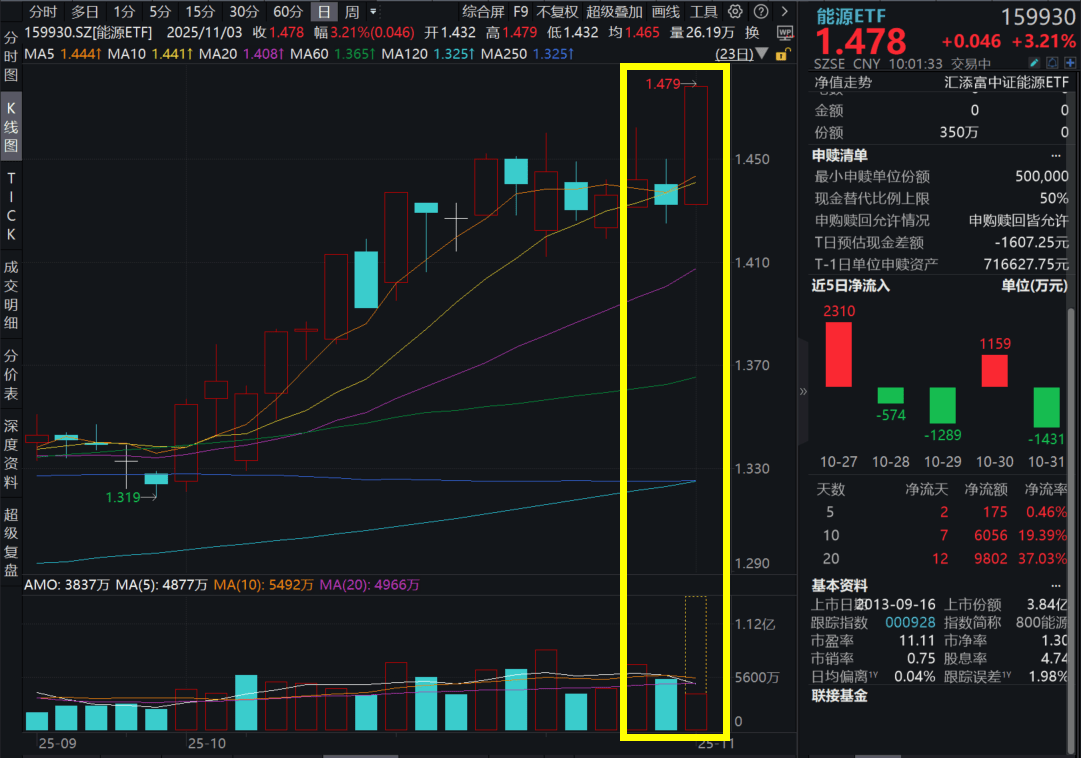
Core Viewpoint - The A-share market shows a mixed trend with the coal sector leading the gains, driven by a strong rebound in coal prices and positive market sentiment towards energy stocks [1][5]. Group 1: Market Performance - As of 10:01, the energy ETF (159930) surged over 3%, recovering from the previous day's losses with a trading volume exceeding 45 million yuan [1]. - Major coal and oil stocks, including Shaanxi Coal and China Shenhua, saw increases of over 4% and 2% respectively, indicating a broad-based rally in the energy sector [2][3]. Group 2: Price Dynamics - OPEC+ announced a pause in production increases for the first quarter of next year, which has positively impacted oil prices [5]. - Coal prices are experiencing a strong rebound due to tight supply and insufficient inventory ahead of the peak demand season [5]. - The price of thermal coal is expected to rise, with a target of around 750 yuan per ton by 2025, as the market moves towards a balance between coal and power generation profitability [6]. Group 3: Investment Logic - The coal sector is characterized by both cyclical elasticity and stable dividends, making it an attractive investment option as coal prices remain at historical lows [8]. - The energy sector is highlighted for its high dividend yields, with coal and oil sectors ranking among the top in terms of dividend rates [9]. - The energy ETF (159930) is noted for its low valuation (PB of 1.34), presenting a compelling opportunity for investors seeking to capitalize on the rebound in traditional energy stocks [10].

A股“三桶油”持续走高
第一财经· 2025-11-03 02:48
Core Viewpoint - The A-share market is experiencing a rise in the "three oil giants" of China, indicating positive market sentiment towards the oil sector [1] Group 1 - China National Offshore Oil Corporation (CNOOC) saw its stock price increase by over 5% [1] - China Petroleum & Chemical Corporation (Sinopec) experienced a stock price rise of over 2% [1] - China National Petroleum Corporation (PetroChina) had a stock price increase of over 4% [1]

中海油(00883.HK)盘中涨超4%
Mei Ri Jing Ji Xin Wen· 2025-11-03 02:37
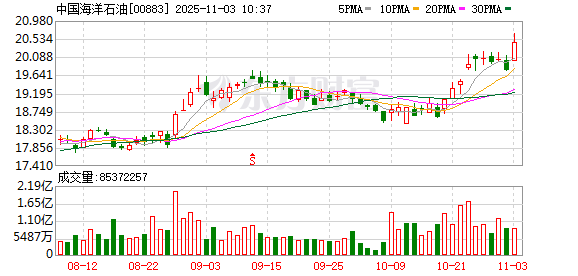
每经AI快讯,中海油(00883.HK)盘中涨超4%,截至发稿,涨3.89%,报20.52港元,成交额13.79亿港 元。 (文章来源:每日经济新闻) ...
港股异动 | 中海油(00883)盘中涨超4% 三季度净利胜于市场预期 重点项目有序推进
智通财经网· 2025-11-03 02:20
Core Viewpoint - CNOOC's stock price increased by over 4% during trading, reflecting market optimism despite a decline in oil and gas sales revenue and net profit for the first three quarters of 2025 [1] Financial Performance - CNOOC reported oil and gas sales revenue of approximately RMB 255.48 billion for the first three quarters of 2025, a year-on-year decrease of 5.9% primarily due to falling oil prices [1] - The net profit attributable to shareholders was RMB 101.97 billion, down 12.6% year-on-year [1] - In Q3, the net profit was RMB 32.4 billion, a 12% decline year-on-year and a 2% decline quarter-on-quarter, although it exceeded expectations by 6% due to higher-than-expected trading profits [1] Production and Exploration - CNOOC achieved five new discoveries in Chinese waters and successfully evaluated 22 oil and gas structures in the first three quarters [1] - Four new projects were put into production in Q3, including the Kenli 10-2 oilfield group (Phase I), Dongfang 1-1 gas field 13-3 area, Wenchang 16-2 oilfield, and Guyana's Yellowtail [1] - Capital expenditures for the first three quarters totaled RMB 86 billion, a 10% decrease year-on-year, with exploration, development, and production capital expenditures at RMB 14.4 billion, RMB 53.2 billion, and RMB 17.5 billion, reflecting year-on-year changes of +4%, -14%, and -3% respectively [1]
油价下跌致“三桶油”前三季度 减利超350亿元
Sou Hu Cai Jing· 2025-11-02 16:33
中国海油高管在会上表示,公司始终把天然气业务作为重要发展方向。一方面,天然气项目相较于原油 项目而言,稳产期较长,收采率更高,作业成本相对偏低,且天然气销售以长期协议为主,能给公司带 来较稳定的现金流。 [ 中国石油前三季度原油平均售价同比下降14.7%至65.55美元/桶,拖累公司油气和新能源业务分部营业 收入同比下滑8.3%至6223.9亿元。 ] 国际油价下跌的阴霾持续蔓延至整个行业,作为产业链龙头,"三桶油"业绩因此承受较大影响。 前三季度,中国石化(600028.SH)、中国石油(601857.SH)、中国海油(600938.SH)分别实现归母 净利润299.84亿元、1262.79亿元、1019.71亿元,同比下跌32.2%、4.9%、12.6%。净利润共比上年同期 减少了350多亿元,相当于每天少赚约3.8亿元。 石油业务是"三桶油"最主要收入来源,因此,三家公司均在财报中着重提及国际石油市场形势对公司业 绩负面影响。综合"三桶油"统计口径,今年前三季度国际原油市场供需总体宽松,国际油价震荡下行, 布伦特(Brent)原油现货均价同比跌幅在14%左右。 受此影响,中国石油前三季度原油平均售价同比 ...