
Longi(601012)

Search documents
隆基绿能涨2.03%,成交额12.67亿元,主力资金净流入2980.92万元
Xin Lang Cai Jing· 2026-01-22 03:00
Group 1 - The core viewpoint of the news is that Longi Green Energy's stock has experienced fluctuations, with a recent increase in share price despite a year-to-date decline [1][2] - As of January 22, Longi Green Energy's stock price was 17.57 yuan per share, with a market capitalization of 133.15 billion yuan and a trading volume of 1.267 billion yuan [1] - The company has seen a net inflow of 29.81 million yuan from major funds, with significant buying and selling activity from large orders [1] Group 2 - Year-to-date, Longi Green Energy's stock has decreased by 3.46%, with a 5-day decline of 5.03%, a 20-day decline of 2.50%, and a 60-day decline of 7.04% [2] - The company, established in 2000 and listed in 2012, specializes in the research, production, and sales of monocrystalline silicon rods, wafers, cells, and modules, contributing 93.51% of its revenue from photovoltaic product sales [2] - As of December 19, the number of shareholders was 821,800, a decrease of 0.84%, with an average of 9,220 circulating shares per person, an increase of 0.85% [2] Group 3 - Longi Green Energy has distributed a total of 9.271 billion yuan in dividends since its A-share listing, with 4.32 billion yuan distributed in the last three years [3] - As of September 30, 2025, the top ten circulating shareholders include Hong Kong Central Clearing Limited and several ETFs, with notable reductions in holdings among these entities [3]

业绩反转!“光伏黑马”2025年业绩预计扭亏为盈,光伏ETF华夏(515370)上涨0.2%
Mei Ri Jing Ji Xin Wen· 2026-01-22 02:21
Group 1 - The core viewpoint of the news highlights the performance of the photovoltaic sector, particularly the rise of the Huaxia Photovoltaic ETF and its constituent stocks, indicating a positive trend in the market [1] - On January 21, Hongyuan Green Energy announced its 2025 annual performance forecast, expecting a net profit attributable to shareholders of 180 million to 250 million yuan, marking a turnaround from losses [1] - The company anticipates a non-recurring gain of approximately 291 million yuan from the transfer of part of its stake in Inner Mongolia Xinyuan Silicon Material Technology Co., which is crucial for achieving positive overall performance [1] Group 2 - According to Zheshang Securities, 2026 is expected to be a turning point for the industry, driven by factors such as a rebound in prices, with a 47% quarter-on-quarter increase in polysilicon prices in Q3 2025 [1] - Leading companies like Longi Green Energy and JA Solar have announced equity incentive plans aimed at achieving profitability by 2026 [1] - The proportion of fund allocations has decreased to levels seen before the 2020 market rally, indicating potential for recovery, alongside the establishment of silicon material storage platforms expected to drive supply contraction and demand recovery [1]




中信建投:预计白银供需长期紧平衡 银价高企倒逼产业变革
Zhi Tong Cai Jing· 2026-01-22 01:52
Core Viewpoint - The recent increase in silicon and silver prices has intensified profit pressure on photovoltaic (PV) cell and module companies, making the reduction of silver consumption a pressing issue for these firms [1][3]. Supply and Demand Analysis - Silver has been in a supply-demand gap since 2019, with a long-term expectation of tight balance due to rigid supply and emerging applications [2]. - The supply side is constrained by limited mining output and slow growth in recycling, with over 80% of silver supply coming from mining [2]. - On the demand side, the resilience of photovoltaic demand, along with growth in AI computing and automotive electronics, is expected to influence silver supply-demand balance significantly [2]. Cost Pressure and Alternatives - The cost of silver paste has reached 19.3% of module costs, making it the largest cost component [2]. - Copper is identified as the most suitable alternative to silver, although challenges such as oxidation and diffusion need to be addressed [3][4]. - Current advancements in silver-coated copper and electroplated copper are promising, with silver-coated copper showing rapid progress and lower capital expenditure [4][5]. Technological Developments - Silver-coated copper has been successfully tested in HJT cells, reducing metallization costs significantly [5]. - The TOPCon cell technology is exploring a dual printing and sintering approach to mitigate the risks associated with high-temperature processes [5]. - Electroplated copper technology is advancing, with significant production progress reported by leading companies [6]. Investment Opportunities - The rapid increase in the penetration of silver-coated copper and copper paste is expected to provide substantial profit elasticity for paste and metal powder companies [7]. - Companies like Juhua Materials and Dike Co., which focus on silver paste, are well-positioned to benefit from the transition to copper alternatives [8]. - Metal powder companies such as BQian New Materials are also expected to see significant growth due to their unique offerings in the copper powder market [8].



趋势研判!2026年中国绿氨行业技术路线、产业链全景、企业布局及未来发展趋势分析:绿电氢氨一体协同,绿氨加速商业化落地进程[图]
Chan Ye Xin Xi Wang· 2026-01-22 00:55
Core Insights - Green ammonia is a zero-carbon ammonia product synthesized from renewable energy-driven green hydrogen, reducing emissions by approximately 95% compared to gray ammonia [1][3] - The green ammonia industry in China is supported by multiple policies, particularly promoting its application in inland shipping, indicating significant growth potential [1][6] - The industry structure consists of three layers: upstream supply, midstream conversion, and downstream demand, with a focus on cost reduction and technological integration for future development [1][6] Industry Overview - Ammonia (NH3) is a key raw material for nitrogen fertilizers and is widely used in various industrial applications, making it an essential chemical in the industrial system [2] - Green ammonia is produced through renewable energy sources, with a lifecycle carbon emission intensity of less than 0.8 tons CO₂ equivalent per ton of ammonia, distinguishing it from gray and blue ammonia [3][4] Policy Background - China has implemented several policies to support the development of green ammonia, including plans for renewable energy development and low-carbon transformation of coal power [6] - The promotion of green ammonia in inland shipping is expected to open new commercial application spaces, facilitating the transition from demonstration projects to large-scale applications [6] Industry Chain Structure - The green ammonia industry chain in China is structured into upstream supply (renewable energy generation and equipment manufacturing), midstream conversion (green hydrogen production and ammonia synthesis), and downstream demand (agricultural fertilizers and energy applications) [6][9] - Upstream challenges include the volatility of renewable energy output and reliance on imported components for PEM electrolyzers [8] Current Development Status - China's synthetic ammonia industry is mature, with a production capacity of 5,954.2 million tons expected to reach 8,247 million tons by 2025, with green ammonia becoming a core growth driver [10] - As of 2025, 125 green ammonia projects are planned, with a total capacity exceeding 2,335.72 million tons per year, marking a shift towards small-scale commercial demonstration [10] Company Landscape - The green ammonia industry in China features a diverse competitive landscape, with state-owned enterprises leading large-scale projects and private companies focusing on technology and system integration [11] - Key players include China Energy Engineering, Sinopec, and Longi Green Energy, with regional production bases in the northwest and transportation hubs in the southeast [11] Future Development Trends - The green ammonia industry is expected to focus on technological innovation for cost reduction and efficiency, with an emphasis on upgrading electrolyzer technology and optimizing synthesis processes [12] - There will be a trend towards vertical integration of the industry chain, enhancing collaboration between renewable energy and chemical sectors [12] - Application scenarios will expand from green fertilizers to energy sectors, driven by policy support and market demand, facilitating the transition from demonstration to large-scale commercialization [13]






又一光伏龙头交出“成绩单”
Shang Hai Zheng Quan Bao· 2026-01-21 23:05
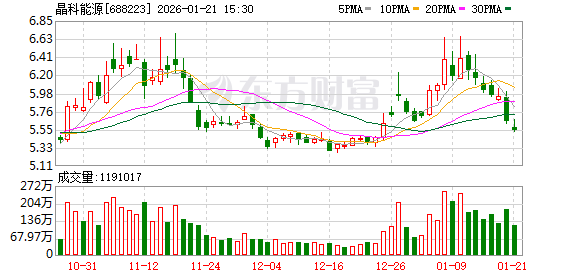
又一光伏龙头交出2025年度"成绩单"预告! 1月21日晚间,晶科能源披露2025年度业绩预告,预计2025年归母净利润亏损59亿元至69亿元。公司表示,报告期内,全球光伏产业链价格波动加剧,光 伏组件一体化各环节的盈利水平总体承压。展望2026年,行业将迈向以技术和质量为核心的高质量发展阶段,行业供需关系有望加速平衡。 据统计,截至发稿,晶科能源、天合光能、隆基绿能等多家头部光伏企业已相继交出年度"成绩单"预告。从整体业绩表现来看,光伏产业链各环节企业延 续了此前的亏损态势。 中国光伏行业协会咨询专家吕锦标在接受上海证券报记者采访时分析称:"行业亏损的核心原因,在于产品价格反弹至成本线仍需一定周期,叠加企业低 负荷生产推高了单位成本,这其中又以折旧及费用摊销的影响最为显著。" 在普遍亏损的背景下,一部分企业实现了显著减亏。弘元绿能、亿晶光电、爱旭股份、大全能源等企业的减亏幅度位居前列,最高同比减亏达109.27%、 78.47%、77.44%、63.21%,均超六成。 谈及业绩变动原因,大全能源表示,报告期内公司持续深化精细化管理,推进技术工艺创新,有效降低了生产成本、提升了运营效率,为盈利水平改善提 供了 ...



【转|太平洋新能源-光伏26年度策略】反内卷加速供需重塑,重视新技术、新场景
远峰电子· 2026-01-21 13:02
Group 1 - The core viewpoint of the article emphasizes that the "anti-involution" trend is reshaping supply and demand in the photovoltaic (PV) industry, accelerating the parity of solar storage in core markets and opening up new scenarios for future demand [1][3][5] - Global demand for solar energy is expected to grow significantly, with projected new installations of approximately 600GW in 2025 and 610GW in 2026, reflecting year-on-year growth rates of about 13.21% and 1.67% respectively [3][6] - The domestic and overseas production capacity is rapidly increasing, leading to a significant oversupply in the PV industry, which has resulted in continuous price declines and losses for many companies [5][6] Group 2 - The penetration rate of low-silver and silver-free technologies is expected to rise quickly, with leading companies likely to recover profitability ahead of the industry [1][22] - The article highlights that the profitability of auxiliary material companies is expected to improve as they diversify their business, with a focus on non-PV sectors [1][36] - The article identifies key beneficiaries in the market, including companies that lead in low-silver and silver-free technology iterations, such as Longi Green Energy and JinkoSolar, which are expected to benefit from cost advantages [1][46] Group 3 - The article discusses the impact of rising silver prices on the cost structure of solar cell manufacturers, indicating that the cost of silver paste is becoming a critical factor for cost reduction [22][23] - The introduction of new technologies, such as high-copper and pure copper solutions, is accelerating in the industry, which is expected to enhance efficiency and reduce costs [25][27] - The demand for space photovoltaics is anticipated to grow due to an increase in space launch missions, with a projected 263 launches in 2024, indicating a strong short-term demand for solar wings in low Earth orbit [29] Group 4 - The article notes that the profitability of battery materials is expected to improve as the pressure from the main chain eases, with low-silver and silver-free iterations likely to bring new benefits [36][39] - The photovoltaic glass sector is also expected to see a recovery in profitability due to industry self-discipline and a reduction in supply, with prices showing signs of recovery [41][46] - The article concludes with investment recommendations, suggesting that companies leading in low-silver and silver-free technology, as well as those involved in energy storage, are well-positioned to benefit from the ongoing market changes [46]

光伏行业阵痛期:业绩普亏后的生存挑战与破局之路
Xin Lang Cai Jing· 2026-01-21 10:24
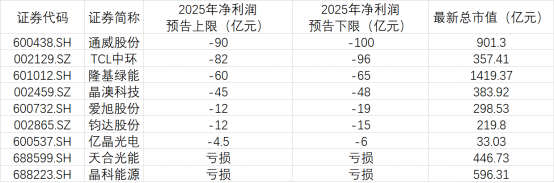
Core Viewpoint - The photovoltaic industry is facing significant challenges, with major companies like Longi Green Energy and Tongwei Co. expected to report substantial losses for 2025, indicating a deepening crisis in the sector [1][17]. Industry Status - Major photovoltaic companies are experiencing severe losses, with Tongwei Co. projected to lose between 90 to 100 billion yuan and Longi Green Energy expected to lose between 60 to 65 billion yuan for 2025 [3][19]. - The overall industry is under pressure, with a notable divergence in performance across different segments; while the polysilicon segment has managed to achieve operational profitability, the battery and module segments are suffering from intensified losses due to low prices [3][19]. - The price structure within the industry is collapsing, with polysilicon prices dropping from a historical peak of 200,000 yuan per ton to around 52,000 yuan per ton, and module prices decreasing by 40% compared to 2023 [4][20]. - The industry is facing overcapacity issues, with low operating rates and a significant decline in the photovoltaic equipment industry index, which fell over 3% in December 2025 [5][21]. Causes of Losses - The core issue in the photovoltaic industry is a severe supply-demand mismatch, driven by irrational capacity expansion and a price war exacerbated by technological homogeneity [6][21]. - Rising raw material costs, particularly silver prices which surged nearly 150% in 2025, are further squeezing profit margins, with silver paste now constituting approximately 17% of the cost structure for photovoltaic components [8][22][23]. - Changes in the policy environment, including adjustments to export tax rebates and stricter capacity controls, are adding complexity to the industry's challenges [9][24]. Path to Resolution - The industry is beginning a difficult process of self-rescue and transformation, with government support aimed at curbing "involution" competition and encouraging capacity reduction [10][25]. - Leading companies are increasing R&D investments to develop higher-efficiency products, such as TOPCon and BC components, to differentiate themselves in the market [10][25]. - There is a push for capacity consolidation within the industry, with new platforms being established to facilitate this process [10][25]. Future Outlook - The industry is expected to enter a phase of consolidation and clearing in 2026, with ongoing policies aimed at reversing involution and gradually reshaping supply-demand dynamics [11][26]. - In the long term, the focus will shift from scale expansion to quality improvement, with leading companies likely to enhance their market share and profitability as weaker players exit the market [11][26].
隆基绿能(601012) - 国信证券股份有限公司关于隆基绿能科技股份有限公司可转换公司债券受托管理事务临时报告
2026-01-21 09:01
1 声 明 本报告依据《公司债券发行与交易管理办法》《公司债券受托管理人执业行 为准则》《隆基绿能科技股份有限公司 2021 年度公开发行可转换公司债券之受 托管理协议》《隆基绿能科技股份有限公司公开发行可转换公司债券募集说明书》 等相关规定、公开信息披露文件以及隆基绿能科技股份有限公司(以下简称"隆 基绿能""发行人"或"公司")出具的相关说明文件以及提供的相关资料等, 由债券受托管理人国信证券股份有限公司(以下简称"国信证券")编制。 本报告不构成对投资者进行或不进行某项行为的推荐意见,投资者应对相 关事宜作出独立判断,而不应将本报告中的任何内容据以作为国信证券所作出 的承诺或声明。 2 股票代码:601012 股票简称:隆基绿能 债券代码:113053 债券简称:隆 22 转债 国信证券股份有限公司 关于隆基绿能科技股份有限公司 2021 年度公开发行可转换公司债券 受托管理事务临时报告 债券受托管理人 (住所:深圳市罗湖区红岭中路 1012 号国信证券大厦十六层至二十六层) 一、本次债券的基本情况 (一)发行主体:隆基绿能科技股份有限公司 (二)债券名称:隆基绿能科技股份有限公司 2021 年度公开发 ...
隆基绿能(601012) - 联合资信评估股份有限公司关于隆基绿能科技股份有限公司2025年度业绩亏损的关注公告
2026-01-21 09:01
联合〔2026〕495 号 联合资信评估股份有限公司关于隆基绿能科技股份有限公司 2025 年度业绩亏损的关注公告 根据公司于 2026 年 1 月 19 日发布的《隆基绿能科技股份有限公司 2025 年度业绩预告》,2025 年,光伏行业供需错配、低价内卷式竞争持续,开工率维持低位,同时国内电力市场化改革不断深 入,海外贸易壁垒持续加剧,光伏企业经营环境严峻复杂。同时,四季度银浆、硅料成本大幅上涨, 显著推升了硅片、电池及组件产品成本,使得公司经营进一步承压。受制于产品价格持续低迷和成 本压力,2025 年度公司经营业绩仍然亏损,预计 2025 年度实现归属于上市公司股东的净亏损为 60 亿元~65 亿元,归属于上市公司股东的扣除非经常性损益的净亏损为 68 亿元~74 亿元。 针对上述事项,联合资信已与公司取得联系并了解相关情况,并将在获取公司 2025 年度经营 财务数据后,对公司偿债能力和信用水平进行全面分析和评估。综合评估,联合资信决定维持上次 评级结果不变,公司个体信用状况为 aaa,主体长期信用等级为 AAA,上述债项信用等级为 AAA, 评级展望为稳定。 特此公告 联合资信评估股份有限公司 二 ...
隆基绿能:2025年预计净亏损60-65亿元,评级维持不变
Xin Lang Cai Jing· 2026-01-21 08:52
隆基绿能公告称,联合资信对公司及其发行的相关债项进行信用评级,公司个体信用等级为aaa,主体 长期信用等级为AAA,评级展望稳定。"隆22转债"余额69.95亿元,到期日为2028年1月5日。2025年, 受行业竞争、成本上涨等因素影响,公司经营业绩亏损,预计2025年度归属于上市公司股东的净亏损为 60-65亿元,扣非净亏损为68-74亿元。联合资信决定维持上次评级结果不变。 ...