Longi(601012)

Search documents
光伏行业遭遇寒冬,触底反弹“风向标”何在?
Guo Ji Jin Rong Bao· 2026-01-20 14:20
Industry Overview - The photovoltaic industry is facing a financial crisis, with nearly ten leading companies reporting significant losses for 2025, indicating a downturn across the entire supply chain [1] - The industry is experiencing overcapacity and intense competition, leading to a decline in profitability despite a surge in installation capacity driven by policy changes [1][8] - The cancellation of export tax rebates starting April 1, 2026, is expected to increase cost pressures on companies, intensifying competition and survival challenges [1][10] Company-Specific Insights - Tongwei Co., Ltd. anticipates a net loss of 90 to 100 billion yuan for 2025, marking a significant increase from a loss of 70.39 billion yuan in the previous year, potentially making it the largest loss among disclosed forecasts [3] - Longi Green Energy expects a net loss of 60 to 65 billion yuan for 2025, showing signs of recovery compared to a loss of 85.92 billion yuan the previous year [6] - JA Solar Technology is projected to incur a net loss of 45 to 48 billion yuan, which may impact its employee incentive plans due to a significant gap between performance targets and actual results [4] - Aiko Solar anticipates a reduced loss of 12 to 19 billion yuan for 2025, down from 53.19 billion yuan, attributed to increased sales of high-value products [6] - Daqo New Energy expects a net loss of 10 to 13 billion yuan, while other companies like Junda and Shichuang Energy also project losses due to supply-demand imbalances [7] Market Dynamics - The solar power sector's new installations reached 274.89 GW from January to November 2025, nearing the total for 2024, with expectations to exceed 300 GW for the year [2] - The industry is witnessing a trend of mergers and acquisitions as companies face survival pressures due to limited funding sources [2][12] - The overall industry is characterized by a significant mismatch between supply and demand, with production capacity far exceeding actual market needs [8] Future Outlook - Analysts predict that the cancellation of export tax rebates will lead to increased operational pressures in the short term but may encourage a shift towards value competition in the long term [10][11] - The industry is expected to undergo a significant restructuring phase in 2026, with potential for a rebound if excess capacity is reduced and supply-demand balance is restored [12][13]




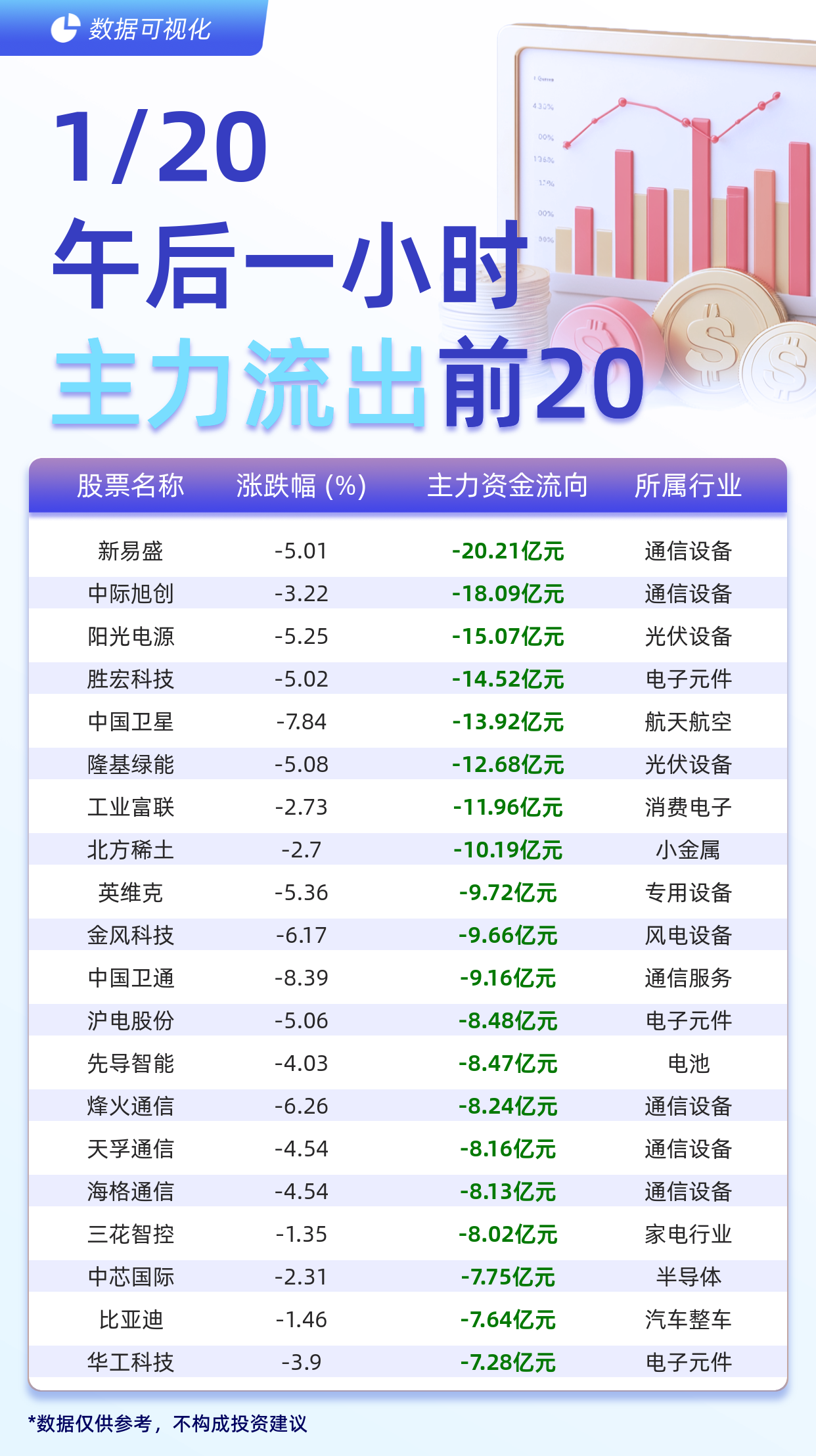
主力个股资金流出前20:新易盛流出20.21亿元、中际旭创流出18.09亿元
Jin Rong Jie· 2026-01-20 06:26
Core Viewpoint - The data indicates significant outflows of main funds from various stocks, particularly in the communication equipment and renewable energy sectors, suggesting a potential shift in investor sentiment and market dynamics [1][2][3] Group 1: Stock Performance and Fund Outflows - The top stock with the largest fund outflow is Xinye Technology, with a decrease of 20.21 billion yuan and a drop of 5.01% [2] - Zhongji Xuchuang follows with an outflow of 18.09 billion yuan and a decline of 3.22% [2] - Yangguang Electric Power experienced an outflow of 15.07 billion yuan, with a decrease of 5.25% [2] - Shenghong Technology saw a fund outflow of 14.52 billion yuan and a drop of 5.02% [2] - China Satellite had an outflow of 13.92 billion yuan, with a significant decline of 7.84% [2] Group 2: Sector Analysis - The communication equipment sector is notably affected, with multiple companies like Xinye Technology, Zhongji Xuchuang, and Fenghuo Communication experiencing substantial fund outflows [2][3] - The photovoltaic equipment sector, represented by Yangguang Electric Power and Longi Green Energy, also shows significant outflows, indicating potential challenges in this industry [2][3] - The electronic components sector, including Shenghong Technology and Huadian Co., is facing similar trends with notable fund withdrawals [2][3]





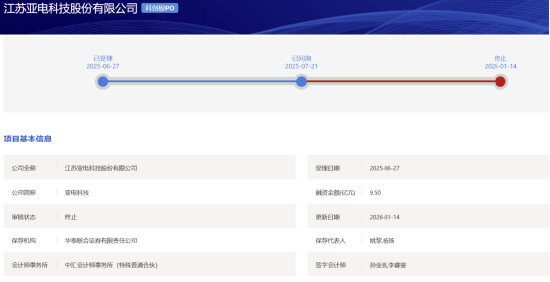
2026年科创板首家撤单:江苏亚电科技终止IPO,在审半年撤回,隆基绿能贡献过半营收
Xin Lang Cai Jing· 2026-01-20 04:04
Group 1 - The first IPO termination on the Sci-Tech Innovation Board in 2026 is marked by the withdrawal of Jiangsu Yadian Technology Co., Ltd. and its sponsor Huatai United Securities, making it the first and only company to terminate its IPO review this year [1][13] - Yadian Technology's IPO process was relatively swift, having been accepted on June 27, 2025, and receiving its first round of inquiries by July 21, but failed to respond to inquiries in a timely manner, leading to the withdrawal six months later [1][13] Group 2 - The company stated that the withdrawal was based on its own business development and strategic planning, in conjunction with suggestions from the exchange, and is currently processing the withdrawal of related application materials [3][15] - Yadian Technology specializes in semiconductor wet cleaning equipment, with products covering both semiconductor and photovoltaic manufacturing sectors, although its revenue structure has shown a significant focus on photovoltaic products during the reporting period [3][16] Group 3 - In the first half of 2025, Yadian Technology generated sales of photovoltaic wet cleaning equipment and related services amounting to 137 million yuan, accounting for 51.91% of its main business revenue, indicating a high concentration of revenue from a single customer [4][17] - The company's revenue concentration is also reflected in its top five customers, which have a high revenue concentration [4][17] Group 4 - As of June 30, 2025, Yadian Technology's total assets amounted to 1.145753 billion yuan, with a net profit of 11.0552 million yuan, and a basic earnings per share of 0.13 yuan [5][18] - The company's asset-liability ratio for the parent company was 46.79%, while the consolidated asset-liability ratio was 53.57% [5][18] Group 5 - The company has experienced fluctuations in cash flow and payment cycles due to its "3331" payment model with major clients, leading to periods of negative net cash flow from operating activities [7][20] - The scale of accounts receivable has significantly increased alongside business expansion [7][20] Group 6 - The withdrawal of the IPO has raised concerns regarding the company's share repurchase obligations, which were previously stated to be irrevocably terminated but would automatically resume if the IPO application is withdrawn or terminated [9][22] - Yadian Technology has also indicated potential risks related to government subsidies, having received a total of 60 million yuan in subsidies contingent on tax and listing assessment conditions, which may need to be returned if future conditions are not met [11][24]
招商证券:光伏巨头通过合资模式破局 加速开拓美国储能市场
Zhi Tong Cai Jing· 2026-01-20 03:49
Group 1 - Longi Green Energy (601012.SH) is advancing in the energy storage sector by participating in a collaboration to support NeoVolta (NEOV.US) and Precision Energy in establishing battery storage systems in the U.S. [1] - The U.S. energy storage demand is driven by weak grid infrastructure, growing data center needs, and manufacturing reshoring, indicating a strong profitability potential [1] - Longi Green Energy plans to acquire approximately 62% voting rights in Precision Energy through equity acquisition and capital increase, with leadership now aligned with Longi [1] Group 2 - Precision Energy and NeoVolta will form a joint venture, NeoValta Power, focusing on the U.S. large-scale and commercial storage market, with NeoVolta holding 60% and Precision Energy 20% [2] - The joint venture aims to achieve a production capacity of 2GWh by mid-2026, expandable to 8GWh, meeting FEOC compliance standards [2] - NeoVolta has seen significant revenue growth, achieving $6.65 million in Q3 2025, a year-over-year increase of 1027% [2] Group 3 - The U.S. energy storage market presents substantial growth potential, with domestic companies exploring innovative models to participate despite trade barriers [3] - Companies such as Longi Green Energy, along with others like Sungrow Power Supply (300274) and Canadian Solar, are suggested for attention in the evolving market landscape [3]


去年中国GDP增长5%,多家手机厂商下调出货预期 | 财经日日评
吴晓波频道· 2026-01-20 00:30
Economic Overview - In 2025, China's GDP reached 1401879 billion yuan, growing by 5% year-on-year, with quarterly growth rates of 5.4%, 5.2%, 4.8%, and 4.5% respectively [2] - The industrial added value increased by 5.9%, while the service sector grew by 5.4%. Retail sales totaled 501202 billion yuan, up by 3.7% [2] - Fixed asset investment decreased by 3.8%, with a notable decline in real estate investment [3] Trade and Investment - Canada has reduced the import tax on Chinese electric vehicles to 6.1%, allowing an annual quota of 49,000 vehicles, which is a significant policy shift aimed at filling market gaps [4][5] - The adjustment in tariffs is expected to enhance the competitiveness of Chinese electric vehicles in the Canadian market, which has seen a decline in sales due to high costs and tariffs [5] Real Estate Market - In December 2025, new home prices in first-tier cities fell by 0.3%, with a notable increase in Shanghai, while overall new home sales area decreased by 8.7% year-on-year [6] - The real estate market is still in a bottoming phase, with a significant reduction in new supply and ongoing inventory pressure [7] Mobile Phone Industry - Several smartphone manufacturers, including Xiaomi and OPPO, have lowered their annual shipment forecasts due to rising storage costs, with reductions exceeding 20% for some brands [8] - The impact of rising storage prices is uneven across manufacturers, with larger firms like Apple and Samsung less affected [9] Solar Industry - Nine leading solar companies, including LONGi Green Energy and Tongwei Co., have announced expected losses for 2025, with Tongwei projecting a loss of 90 to 100 billion yuan [10] - The solar industry is facing significant challenges, including high inventory levels and price competition, leading to a prolonged period of losses [11] Wealth Disparity - The global wealth of billionaires reached a record 18.3 trillion USD in 2025, with a 16% increase in total wealth, highlighting a growing wealth gap amid stagnant poverty reduction efforts [12][13] - The AI sector's growth has significantly contributed to the increase in billionaire wealth, while ordinary residents face declining purchasing power due to inflation [13] Space Tourism - A startup has announced the opening of reservations for the world's first lunar hotel, aiming to begin operations by 2032, although the feasibility of such a project remains uncertain [14][15]



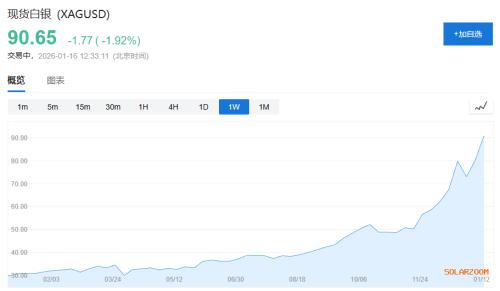
白银价格再创新高 光伏行业成本攀升
Xin Lang Cai Jing· 2026-01-19 18:12
Core Viewpoint - The surge in silver prices is significantly impacting the photovoltaic (PV) industry, leading to increased operational pressures and projected losses for major companies in the sector [1][2]. Group 1: Silver Price Impact - International silver prices have recently surpassed $94 per ounce, contributing to heightened costs for PV companies already facing two years of losses [1]. - The cost of silver has increased over threefold in the past year, now accounting for 29% of the total cost of solar panels, compared to 3.4% in 2023 and 14% last year [2]. Group 2: Company Performance Forecasts - Tongwei Co. anticipates a net loss of approximately 9 billion to 10 billion yuan for 2025, citing rising silver prices and declining product prices as key factors [1]. - TCL Zhonghuan, a leading PV silicon wafer manufacturer, expects a net loss between 8.2 billion to 9.6 billion yuan, attributing this to ongoing supply-demand imbalances despite growth in new installations [2]. - Longi Green Energy forecasts a net loss of 6 billion to 6.5 billion yuan for 2025, with significant cost increases in silver paste and silicon materials further straining operations [2]. Group 3: Industry Response - Some component manufacturers have raised prices to reflect the increased costs of silver, while the industry is also exploring technological adjustments to mitigate these pressures [2]. - Longi Green Energy has completed pilot tests for replacing silver paste with cheaper materials and is beginning large-scale production of these alternatives [2].
储能系列报告(16):隆基绿能进军储能行业,发力美国大储、工商储
CMS· 2026-01-19 14:04
Investment Rating - The investment rating for the companies in the report is "Strong Buy" for Yangguang Electric, Longi Green Energy, Aiko Energy, Trina Solar, Kehua Data, Shenghong Co., and "Hold" for Xidian New Energy [2]. Core Insights - Longi Green Energy is advancing into the energy storage sector by acquiring a controlling stake in Precision Energy and collaborating with NeoVolta to establish a battery storage system in the U.S. [1][7]. - The U.S. energy storage market shows significant growth potential due to weak grid infrastructure and increasing demand from data centers and manufacturing [17]. - The report highlights the importance of innovative participation from domestic manufacturers in the U.S. market, despite trade barriers [17]. Summary by Sections Industry Scale - The industry comprises 308 companies with a total market capitalization of 772.89 billion and a circulating market value of 672.45 billion [3]. Company Financial Metrics - Yangguang Electric: Market Cap 35.45 billion, 2024 EPS 5.3, 2025 EPS 6.6, 2025 PE 26, PB 8, Strong Buy [2]. - Longi Green Energy: Market Cap 14.19 billion, 2024 EPS -1.1, 2025 EPS -0.5, 2025 PE -37, PB 2, Strong Buy [2]. - Aiko Energy: Market Cap 6.16 billion, 2024 EPS 0.6, 2025 EPS 0.5, 2025 PE 33, PB 3, No Rating [2]. - Trina Solar: Market Cap 4.47 billion, 2024 EPS -1.6, 2025 EPS -1.8, 2025 PE -11, PB 2, Strong Buy [2]. - Kehua Data: Market Cap 3.22 billion, 2024 EPS 0.7, 2025 EPS 1.2, 2025 PE 53, PB 5, Strong Buy [2]. - Shenghong Co.: Market Cap 1.29 billion, 2024 EPS 1.4, 2025 EPS 1.5, 2025 PE 27, PB 7, Strong Buy [2]. Company Developments - Longi Green Energy is set to establish a joint venture, NeoValta Power, with NeoVolta, focusing on large-scale and commercial storage in the U.S. [9][21]. - NeoVolta has shown rapid growth, achieving a revenue of 6.65 million in Q3 2025, a significant increase of 1027% year-on-year [9]. - Aiko Energy has seen record shipments in Q3, with a forecasted delivery of 14-17 GWh in 2026, primarily overseas [22]. - Trina Solar aims to ship 8 GWh in 2025, with expectations to double this in 2026 [25]. - Kehua Data has been recognized as a leading supplier in the energy storage sector, ranking first in the first half of 2025 for installed PCS [26]. Market Trends - The report emphasizes the increasing demand for energy storage driven by data centers and the need for renewable energy solutions [20]. - The U.S. energy storage market is projected to grow significantly, with estimates indicating a need for 17.28 GWh to 60.08 GWh of storage by 2030 [20].
喜娜AI速递:今日财经热点要闻回顾|2026年1月19日
Xin Lang Cai Jing· 2026-01-19 12:00
Group 1 - Trump's threat to impose tariffs on Denmark and other European countries has led to significant market volatility, with European stock markets declining and a surge in demand for safe-haven assets like gold and silver [2][7] - The China Securities Regulatory Commission (CSRC) has outlined key tasks for 2026, focusing on market stability, regulatory enforcement, and promoting the development of listed companies [2][7] - Five leading solar companies, including Tongwei Co. and Longi Green Energy, have announced a combined expected loss exceeding 28.9 billion yuan due to industry challenges such as supply-demand imbalances and rising raw material costs [2][7] Group 2 - Tesla's CEO Elon Musk has announced the restart of the Dojo 3 project, with the new AI5 chip expected to have five times the computing power of the current HW4 chip, impacting the rollout of full self-driving capabilities [3][8] - Rare earth prices have been rising, with a projected supply-demand gap of 140,000 tons by 2030, driven by strong demand from the global electric vehicle sector [3][8] - Several small and medium-sized banks have raised deposit rates as part of a strategy to attract deposits amid low net interest margins, although future rates may stabilize or slightly decrease [3][9] Group 3 - Rongbai Technology is under investigation by the CSRC for misleading statements regarding a significant contract, raising concerns about its ability to fulfill orders due to production capacity issues [4][9] - The minimum margin requirement for financing purchases on the Shanghai and Shenzhen stock exchanges has been increased from 80% to 100% for new contracts, aimed at controlling market leverage risks [4][9] - The 2025 Hurun Report has ranked Cambrian as the top AI company in China, valued at 630 billion yuan, with an increasing number of AI chip companies listed, reflecting a shift towards domestic computing power independence [5][10]


超300份预告折射产业冷暖,业绩驱动取代概念博弈成市场主线
第一财经网· 2026-01-19 10:13
Core Viewpoint - The A-share market is experiencing a clear divergence in industry performance as over 350 companies have released their 2025 earnings forecasts, highlighting strong growth in the semiconductor and non-ferrous metals sectors, while the photovoltaic industry faces significant losses due to overcapacity and price competition [1] Semiconductor Industry - The semiconductor sector is benefiting from the global AI infrastructure wave and rising storage chip prices, with leading companies like 澜起科技 (Lianqi Technology) forecasting a net profit of 2.15 billion to 2.35 billion yuan for 2025, representing a year-on-year growth of 52.29% to 66.46% [2] - 佰维存储 (Baiwei Storage) expects to achieve record revenue of 10 billion to 12 billion yuan, with a net profit forecast of 850 million to 1 billion yuan, reflecting a staggering year-on-year growth of 427.19% to 520.22% [2] Photovoltaic Industry - The photovoltaic sector is struggling with overcapacity, low prices, and rising raw material costs, leading to significant losses among leading companies. 通威股份 (Tongwei Co.) anticipates a net loss of 9 billion to 10 billion yuan, while TCL中环 (TCL Zhonghuan) expects a loss of 8.2 billion to 9.6 billion yuan [3] - The total projected losses for major photovoltaic companies have exceeded 32 billion yuan, with several firms reporting substantial deficits [3] Real Estate Industry - The real estate sector is also under pressure, with companies like 华夏幸福 (China Fortune Land Development) forecasting a net loss of 16 billion to 24 billion yuan, attributed to insufficient market demand and weak social expectations [4] Non-Ferrous Metals Industry - The non-ferrous metals sector has seen significant price increases, benefiting from global monetary easing and fiscal expansion, with companies reporting strong earnings growth. For instance, 紫金矿业 (Zijin Mining) expects a net profit of 51 billion to 52 billion yuan, a year-on-year increase of 59% to 62% [5][6] - The performance of the rare earth sector is also notable, with 北方稀土 (Northern Rare Earth) projecting a net profit of 2.176 billion to 2.356 billion yuan, reflecting a year-on-year growth of 116.67% to 134.60% [7] Concept Stocks and Emerging Industries - Emerging sectors like commercial aerospace and AI applications are facing challenges, with many companies reporting losses despite previous market enthusiasm. For example, 上海瀚讯 (Shanghai Hanxun) and 三维通信 (Sanwei Communication) are expected to incur losses in 2025 [8][9] - 中文在线 (Zhongwen Online) anticipates a net loss of 580 million to 700 million yuan, driven by high promotional costs in its overseas short drama business [9]

白银暴涨,光伏流泪
Hua Er Jie Jian Wen· 2026-01-19 03:02
Core Insights - The cost of silver paste in photovoltaic (PV) modules has surged from 3.4% of total costs in 2023 to 29% currently, making it the largest cost component, surpassing silicon materials [1][3] - The rising silver prices have forced PV manufacturers to increase prices and accelerate plans to replace silver with cheaper materials like copper, with an expected 17% reduction in silver usage this year [1][7] Group 1: Cost Impact - A rise of 1000 yuan per kilogram in silver price increases the cost of solar cells by 0.01 yuan per watt, which is critical for the already thin profit margins in the PV industry [2] - The current silver consumption for TOPCon cells is approximately 10-13 mg/W, and if silver prices remain high, the cost from silver paste alone could reach 0.1-0.13 yuan per watt [3] Group 2: Price Adjustments - Chinese module manufacturers have raised prices by 1.4% to 3.8%, with mainstream 500W modules now priced around 400 yuan (approximately 57 USD) [3] - Leading companies like Longi Green Energy and Aiko Solar have recently increased their shipping prices, citing rising raw material costs [3] Group 3: Industry Challenges - Mid-tier companies are facing more severe challenges compared to leading firms, with some forced to halt production due to cash flow issues, financing difficulties, and inventory buildup [4][5] - A notable example includes a battery manufacturer in Hunan that ceased operations, stating there are currently no alternative solutions [6] Group 4: Supply and Demand Dynamics - The surge in silver prices is attributed to a supply-demand imbalance, with industrial demand, including solar energy, accounting for 65% of total silver demand [6] - The silver usage in the PV industry represents over 15% of global silver production, with a projected supply-demand gap of 5,000 tons by 2025 [6] Group 5: Material Substitution Efforts - Companies like Longi Green Energy are accelerating the replacement of silver with cheaper metals, with predictions that the PV industry could reduce silver usage by 17% this year [7] - Some technological routes have the potential to lower silver content to 25%, theoretically achieving a 90% reduction [7] Group 6: Risks of Substitution - The aggressive substitution strategy carries significant risks, as the stability of copper is inferior to silver, leading to potential long-term liabilities for manufacturers if panels fail before the warranty period [8] - Current substitution methods face challenges such as unstable printing of paste and suboptimal yield rates [8]