FII(601138)

Search documents
9月25日银河99(000959)指数跌0.09%,成份股山东黄金(600547)领跌
Sou Hu Cai Jing· 2025-09-25 09:45
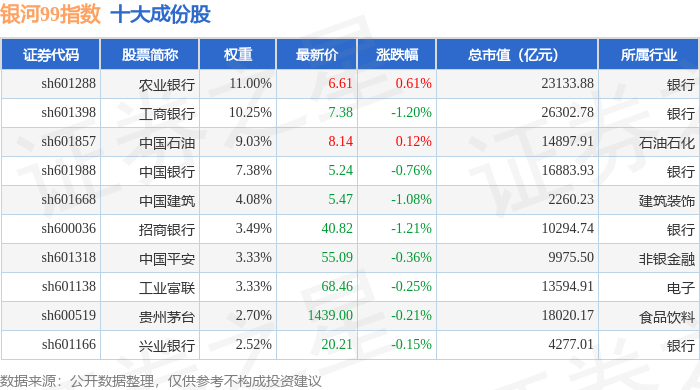
Market Overview - The Galaxy 99 Index closed at 7671.42 points, down 0.09%, with a trading volume of 3590.77 billion yuan and a turnover rate of 0.46% [1] - Among the index constituents, 37 stocks rose while 60 stocks fell, with Inspur Information leading the gainers at a 9.99% increase and Shandong Gold leading the decliners with a 4.75% drop [1] Key Constituents - The top ten constituents of the Galaxy 99 Index include major companies such as Agricultural Bank of China (11.00% weight), Industrial and Commercial Bank of China (10.25% weight), and China Petroleum (9.03% weight) [1] - The total market capitalization of the top ten constituents ranges from 2260.23 billion yuan for China State Construction to 26302.78 billion yuan for Industrial and Commercial Bank of China [1] Capital Flow - The net inflow of main funds into the Galaxy 99 Index constituents was 4.93 billion yuan, while retail investors saw a net inflow of 22.45 billion yuan, and speculative funds experienced a net outflow of 27.37 billion yuan [1] - Specific stocks such as Inspur Information and BYD saw significant net inflows from main funds, indicating strong institutional interest [2] ETF Performance - The Food and Beverage ETF (product code: 515170) has seen a decline of 2.03% over the past five days, with a current PE ratio of 20.26 times and a net outflow of 1972.9 million yuan [4] - The Cloud Computing 50 ETF (product code: 516630) increased by 5.99% over the last five days, with a high PE ratio of 125.24 times and a net outflow of 1077.1 million yuan [5]






新“新三样”来了!为什么是它们?
2 1 Shi Ji Jing Ji Bao Dao· 2025-09-25 03:12
Core Insights - The new "new three items" in China's economy are robotics, artificial intelligence (AI), and innovative pharmaceuticals, which are now driving high-quality economic development [1][2] - The market for these sectors is experiencing significant growth, with A-share companies in robotics and AI seeing substantial increases in market capitalization [2][3] - China's position in these sectors is evolving from "catching up" to "leading," particularly in robotics, while AI is in a competitive position and innovative pharmaceuticals are gaining international recognition [3][4] Robotics Sector - The humanoid robotics field is viewed as a potential game-changer, with leading A-share companies like Huichuan Technology exceeding a market cap of 200 billion and significant first-day gains for companies like Sanxie Electric [2][3] - The robotics industry is advancing rapidly, with China entering the global first tier, although high-end components still require imports [3] Artificial Intelligence Sector - Several companies in the AI sector have market capitalizations exceeding 100 billion, with strong demand for AI computing chips and infrastructure leading to impressive performance [2][3] - China has strong competitiveness in application areas like computer vision and speech recognition, but still faces challenges in foundational chips and ecosystem development [3] Innovative Pharmaceuticals Sector - Companies like Hengrui Medicine are approaching a market cap of 500 billion, with others like WuXi AppTec and Innovent Biologics also exceeding 100 billion [2] - The innovative pharmaceutical sector is experiencing explosive growth in international transactions, indicating improved R&D capabilities, though challenges remain in target discovery and basic research translation [3] Market Dynamics - The shift from traditional growth drivers to technology-intensive, high-value-added production is essential for overcoming the challenges of traditional industries [1][3] - The advantages of a large-scale market, strong engineering capabilities, and an improving policy environment are critical for these sectors [3] Policy Recommendations - There is a need for policies that promote data openness, optimize review processes, and increase investment in computing infrastructure [3] - Focus on interdisciplinary talent development and encourage long-term capital investment in foundational research is essential for sustaining growth [3]






新“新三样”来了!为什么是它们?
21世纪经济报道· 2025-09-25 03:04
Core Viewpoint - The article emphasizes that the new "new three items" for China's economy are robotics, artificial intelligence (AI), and innovative pharmaceuticals, which are now driving high-quality economic growth, surpassing traditional sectors like finance and real estate [1][2]. Group 1: Robotics - The robotics sector, particularly humanoid robots, is seen as the next potential world-changing technology after computers, smartphones, and electric vehicles. Leading companies like Huichuan Technology have a market capitalization exceeding 200 billion, with some stocks experiencing significant price increases [2]. - China is making rapid progress in robotics, moving from "catching up" to "leading" on a global scale, with a complete industrial chain and the largest market, although high-end components still rely on imports [2][3]. Group 2: Artificial Intelligence - The AI sector has several companies with market capitalizations over 100 billion, focusing on AI computing chips and infrastructure. Companies like Cambricon and Industrial Fulian are experiencing explosive growth in orders and performance [2]. - China is competitive in application-level AI, particularly in computer vision and speech recognition, but still lags in foundational chips and ecosystem frameworks [3]. Group 3: Innovative Pharmaceuticals - The innovative pharmaceutical sector is witnessing significant growth, with companies like Hengrui Medicine nearing a market cap of 500 billion. The business model is shifting from "burning money" to "making money," gaining global market recognition [2]. - China's innovative drugs are moving from "following" to "keeping pace," with explosive growth in overseas transactions, although challenges remain in target discovery and basic research translation [3]. Group 4: Advantages and Challenges - China's advantages include a large-scale market providing scenario dividends, strong engineering and industrialization capabilities, and a continuously improving policy environment. However, there are risks of being "choked" if key segments are controlled by external entities [3]. - The article suggests that policy improvements are needed to create an open data ecosystem, optimize review processes, and increase investment in foundational research [4].

电子行业半年报:超七成公司盈利 寒武纪、士兰微等扭亏为盈
Xin Hua Cai Jing· 2025-09-24 23:25
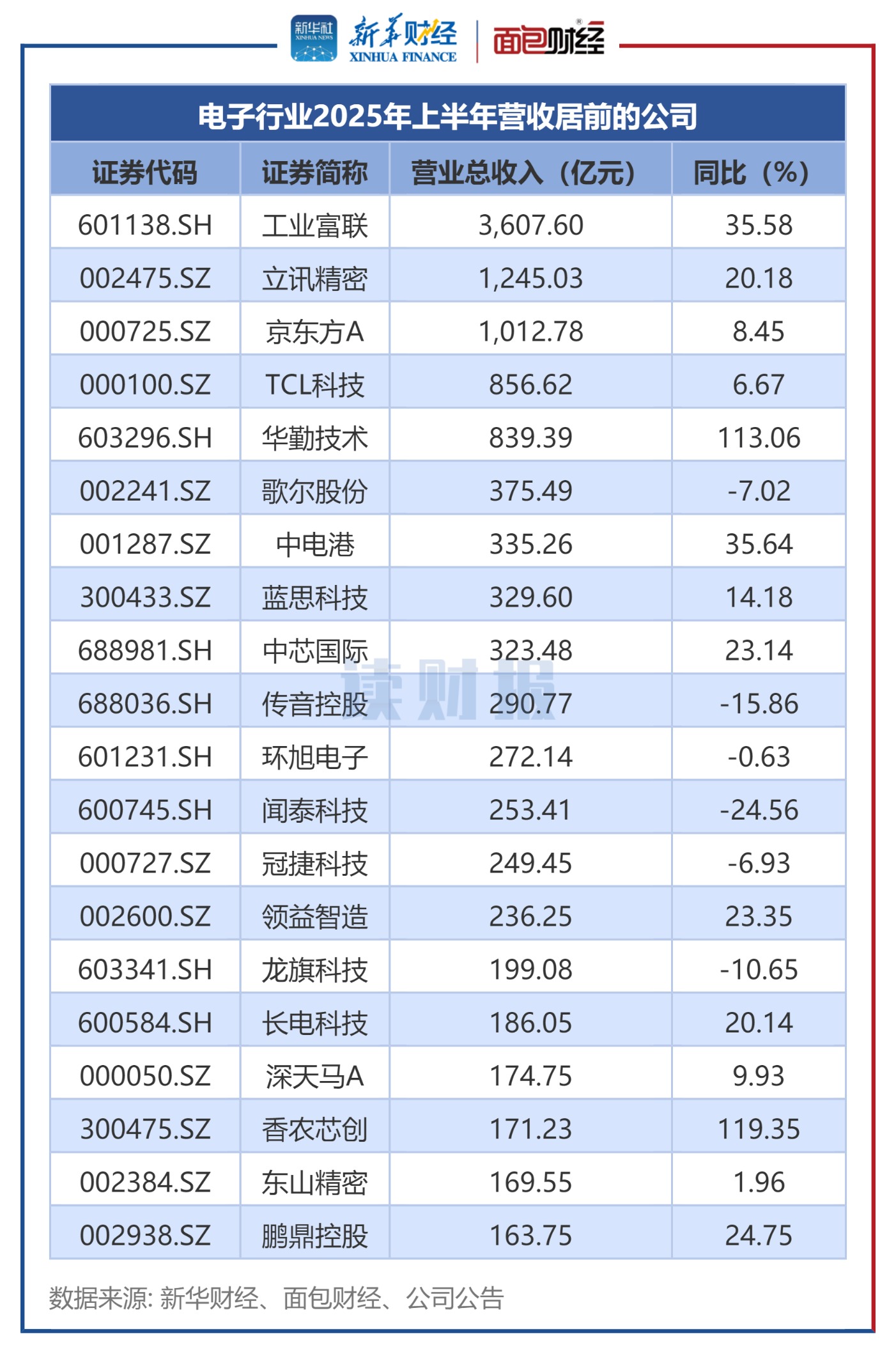
Core Insights - The electronic industry in China is experiencing a significant recovery, with a total revenue of 1,862.283 billion yuan in the first half of 2025, representing a year-on-year growth of 22.11% [1][2] - The net profit attributable to shareholders reached 86.265 billion yuan, marking a year-on-year increase of 33.09% [1][2] - Over 70% of companies in the electronic sector reported profitability, with notable turnarounds from companies like Cambrian and Silan Microelectronics [2][7] Revenue Performance - The top three companies by revenue in the electronic industry for the first half of 2025 are: - Industrial Fulian: 360.76 billion yuan - Luxshare Precision: 124.50 billion yuan - BOE Technology: 101.28 billion yuan [3][4] - Nearly 80% of the companies in the electronic sector achieved year-on-year revenue growth, with Cambrian leading with a staggering growth rate of 4,347.82% [4][5] Profitability Analysis - The average net profit margin for the electronic industry was 25.71%, a slight decrease of 0.37 percentage points year-on-year [1][8] - Industrial Fulian led in net profit with 12.113 billion yuan, significantly higher than its peers [5][6] - More than half of the electronic companies reported a year-on-year increase in net profit, indicating a robust recovery trend [1][2] Margin Trends - The average gross profit margin for the electronic sector decreased to 25.71%, with some companies like Chipone and Zhenray Technology reporting margins exceeding 70% [8][9] - Companies such as Helitai and Nanjiguang showed significant improvements in gross profit margins, indicating operational efficiency [8][10] Turnaround Companies - Several companies successfully turned losses into profits, including: - Cambrian: 2.881 billion yuan in revenue, a turnaround from previous losses - Silan Microelectronics: 6.336 billion yuan in revenue [7][8] - The trend of companies moving from loss to profit reflects a broader recovery in the electronic industry [7][8]



【读财报】电子行业半年报:超七成公司盈利 寒武纪、士兰微等扭亏为盈
Xin Hua Cai Jing· 2025-09-24 23:18
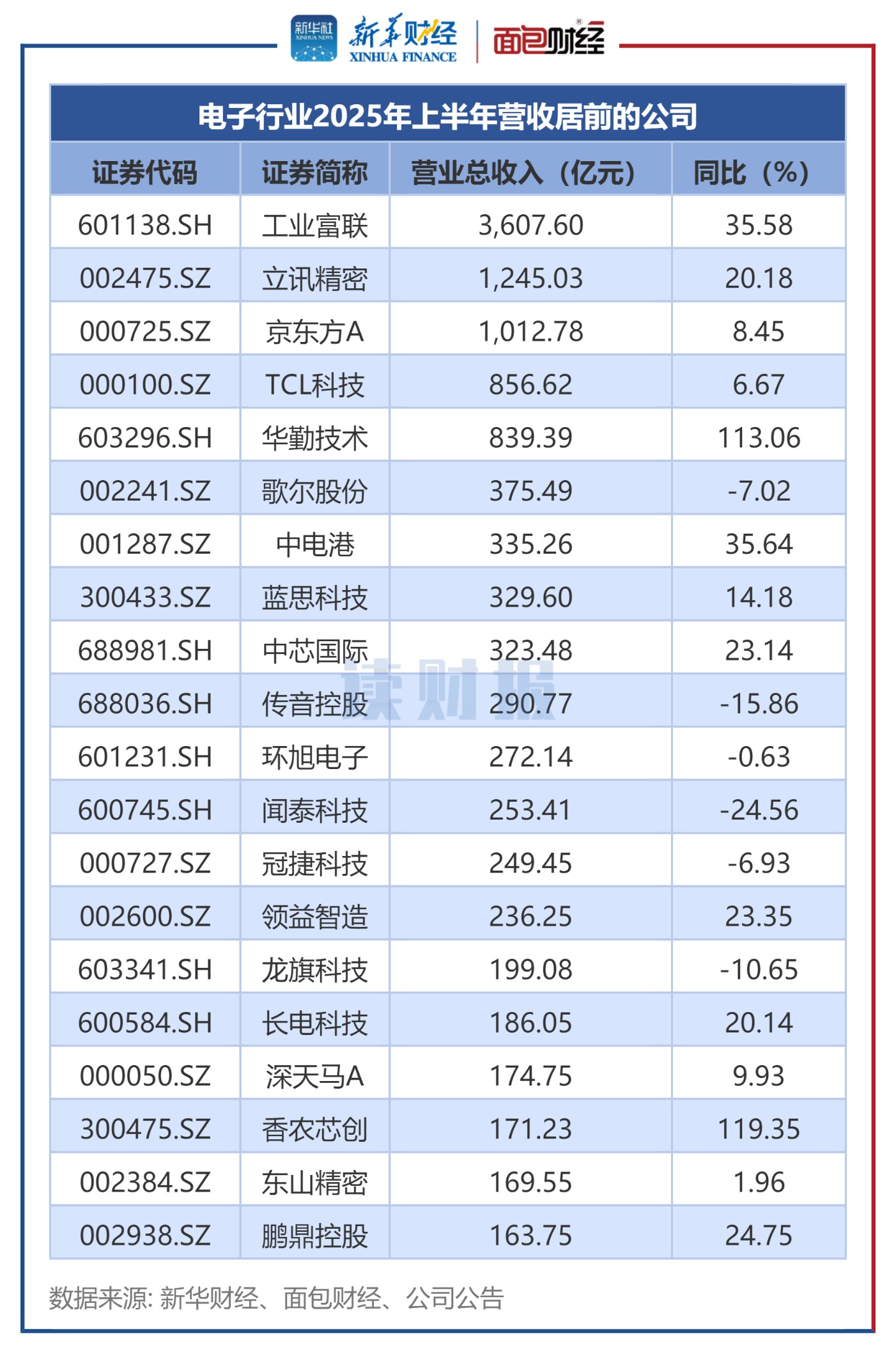
Core Insights - The electronic industry in China is experiencing a significant recovery, with a total revenue of 1862.283 billion yuan in the first half of 2025, representing a year-on-year growth of 22.11% [1][2] - The net profit attributable to shareholders reached 86.265 billion yuan, marking a year-on-year increase of 33.09% [1][2] - Over 70% of companies in the electronic sector reported profitability, with notable turnarounds from companies like Cambrian and Silan Microelectronics [2][7] Revenue Performance - The top three companies by revenue in the electronic industry for the first half of 2025 are: - Industrial Fulian: 360.76 billion yuan - Luxshare Precision: 124.50 billion yuan - BOE Technology: 101.28 billion yuan [3][4] - Nearly 80% of electronic companies reported year-on-year revenue growth, with Cambrian leading with a staggering growth rate of 4347.82%, achieving 2.881 billion yuan in revenue [4][12] Profitability Analysis - The average net profit margin for the electronic industry was 25.71%, a slight decrease of 0.37 percentage points year-on-year [8] - Industrial Fulian led in net profit with 12.113 billion yuan, significantly higher than its peers [5][6] - More than half of the electronic companies reported a year-on-year increase in net profit, indicating a robust recovery trend [1][2] Margin Trends - Companies like Chipone and Zhenray Technology reported exceptionally high gross margins, with Chipone at 86.54%, reflecting a year-on-year increase of 5.36 percentage points [8][9] - Several companies, including Huali Microelectronics and Hu Silicon Industry, reported negative gross margins, highlighting the competitive pressures in the industry [8] Notable Turnarounds - Cambrian and Silan Microelectronics were among over thirty companies that turned losses into profits in the first half of 2025 [1][2][7] - South Polar Light achieved a revenue of 398 million yuan, a year-on-year increase of 244.67%, and a net profit of 73 million yuan, up 982.43% [12]
侃股:大盘股更受青睐是大势所趋
Bei Jing Shang Bao· 2025-09-24 12:11
Group 1 - The trend of large-cap stocks becoming bull stocks is significantly influencing investors' stock selection strategies, shifting focus from speculative trading to performance and growth metrics [1][2] - The market preference is changing, with a growing emphasis on companies with strong industry barriers, stable cash flows, and robust risk resistance, which resonate with both institutional and retail investors [1][2] - The structure of market participants is evolving, with long-term funds like pensions and insurance capital entering the market, favoring predictable performance and solid value investment targets [1][2] Group 2 - Large-cap stocks are not a necessary condition for becoming bull stocks, but their probability of doing so has increased, indicating a shift in market dynamics [2] - Investors should not adopt a mindset of only buying large-cap stocks; quality companies with strong performance and growth potential should be prioritized regardless of market capitalization [2] - The valuation levels of large-cap stocks are generally higher than those of small-cap stocks, but small-cap stocks can still demonstrate significant growth potential if they maintain performance increases [2]
电子行业资金流入榜:通富微电等60股净流入资金超亿元
Zheng Quan Shi Bao Wang· 2025-09-24 09:31
Market Overview - The Shanghai Composite Index rose by 0.83% on September 24, with 28 out of the 31 sectors experiencing gains, led by the power equipment and electronics sectors, which increased by 2.88% and 2.76% respectively [1] - The banking, coal, and telecommunications sectors saw declines of 0.36%, 0.29%, and 0.01% respectively [1] Capital Flow Analysis - The net inflow of capital in the two markets reached 19.725 billion yuan, with 14 sectors experiencing net inflows [1] - The electronics sector had the highest net inflow of capital at 13.046 billion yuan, contributing to its 2.76% increase [1] - The computer sector followed with a daily increase of 2.52% and a net inflow of 5.021 billion yuan [1] Electronics Sector Performance - The electronics sector saw a rise of 2.76%, with 393 out of 467 stocks in the sector increasing in value, including 13 stocks hitting the daily limit [2] - A total of 253 stocks in the electronics sector experienced net capital inflows, with 60 stocks receiving over 100 million yuan in net inflows [2] - The top three stocks by net inflow were Tongfu Microelectronics with 1.273 billion yuan, followed by Northern Huachuang and SMIC with 1.215 billion yuan and 1.137 billion yuan respectively [2] Electronics Sector Capital Outflow - The electronics sector also had stocks with significant capital outflows, with 16 stocks experiencing net outflows exceeding 100 million yuan [3] - The stocks with the highest net outflows included Heertai with 1.799 billion yuan, Industrial Fulian with 1.227 billion yuan, and Shenghong Technology with 1.099 billion yuan [3]





924一周年观察,科技股成主线,工业富联等晋级A股前十
Quan Jing Wang· 2025-09-24 06:46
Group 1 - The A-share market has experienced a significant bull market over the past year, with total market capitalization surpassing 100 trillion yuan and over 1,400 stocks doubling in price [1][2] - The technology sector has emerged as the primary driver of this market rally, with the electronic industry leading the gains, supported by the explosive demand for AI computing and accelerated domestic substitution [2][3] - Industrial Fulian has become the most valuable A-share company, with a market capitalization increase of over 1 trillion yuan and a price increase of nearly 300%, transitioning from a traditional consumer electronics manufacturer to a global leader in AI servers [3] Group 2 - The market has shown a "policy-supported, performance-driven" slow bull characteristic, with a steady increase in index values and a 20% reduction in volatility compared to previous market cycles [4] - Institutions are optimistic about the future market performance, driven by the potential for significant capital inflow and the continued upward trend of technology stocks, particularly in high-growth sectors like AI and advanced manufacturing [5][6] - Policy reforms, including the optimization of the Sci-Tech Innovation Board and support for new productive forces, are expected to continue providing benefits to the market [6]
利和兴:工业富联为公司客户
Mei Ri Jing Ji Xin Wen· 2025-09-24 04:00
(记者 胡玲) 每经AI快讯,有投资者在投资者互动平台提问:公司与工业富联合作如何? 利和兴(301013.SZ)9月24日在投资者互动平台表示,该公司为公司客户。 ...
国产光刻机加速发展,消费电子ETF(561600)涨超1%
Xin Lang Cai Jing· 2025-09-24 03:46
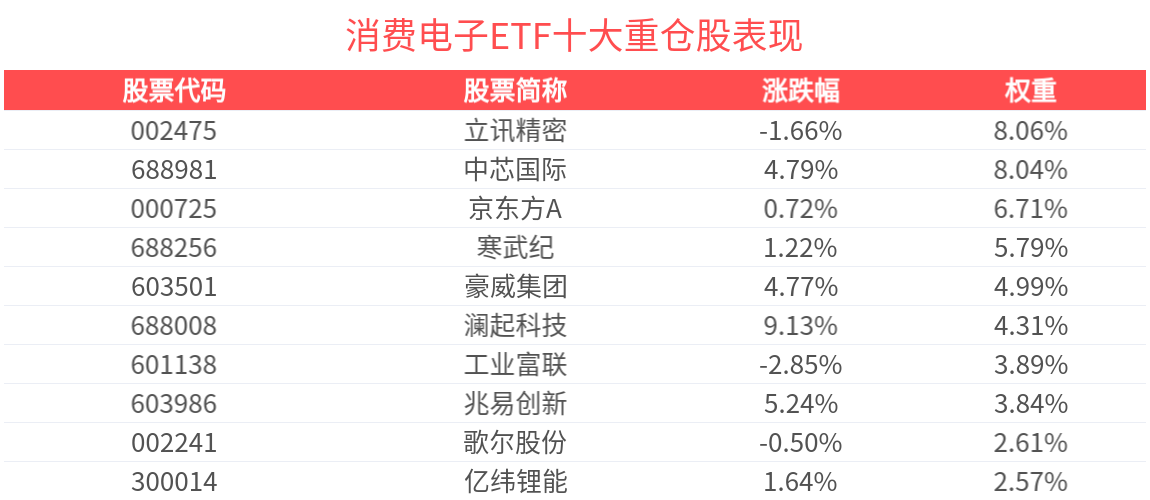
Group 1 - Shenzhen Weiding Juxin Technology Co., Ltd. has successfully assembled and delivered its first high-precision stepper lithography machine, the WS180i series, which targets the growing fields of compound semiconductors and high-end optoelectronic devices [1] - The China Securities Consumer Electronics Theme Index (931494) rose by 1.47% as of September 24, 2025, with notable increases in component stocks such as Changying Precision (300115) up 11.54% and Tongfu Microelectronics (002156) up 10.00% [1] - The Consumer Electronics ETF (561600) increased by 1.18%, reaching a latest price of 1.29 yuan, and has seen a cumulative increase of 6.97% over the past week [1] Group 2 - As of August 29, 2025, the top ten weighted stocks in the China Securities Consumer Electronics Theme Index accounted for 54.8% of the index, including companies like Cambricon (688256) and Luxshare Precision (002475) [2] - The weight and performance of key stocks in the index show varied trends, with Luxshare Precision down 1.66% and SMIC (688981) up 4.79% [4]