INDUSTRIAL BANK(601166)

Search documents
按揭、信用卡、消费贷与经营贷深度:深度银行四大零售资产的风险分析框架
ZHONGTAI SECURITIES· 2026-01-07 11:17
Investment Rating - The report maintains an "Overweight" rating for the banking sector [2] Core Insights - The four categories of retail loans (mortgages, credit cards, consumer loans, and business loans) collectively constitute household liabilities, each with distinct collateral types, duration structures, and policy influences. The report aims to establish a risk framework for these retail assets and assess their impact on banking operations in the future [2][4] - Under stress testing, the non-performing loan (NPL) ratios for mortgages, credit cards, and consumer loans are projected to increase by 11, 12, and 20 basis points respectively in 2026, while the growth in non-performing amounts remains manageable. The overall quality of corporate assets is expected to continue improving, indicating a stable banking sector [2][4] - Retail asset risks are deemed controllable, with policies expected to maintain stability in the near term [2] Summary by Sections Retail Asset Analysis Framework: Collateral Types + Duration Structure + Policy Impact - The overall NPL ratio for retail loans of listed banks is estimated at 1.27% in the first half of 2025, slightly above the corporate NPL ratio of 1.26%, but the increase in NPL ratios is stabilizing. The composition of existing NPLs is 63% corporate and 37% retail, with business loans and mortgages showing higher proportions of both existing and newly added NPLs [2][12] - The report establishes a risk analysis framework for retail assets, highlighting the differences in collateral types, duration structures, and policy impacts among the four categories of retail loans [2][4] Consumer Loans: "High-Risk" Assets - The relationship between consumer loans and consumption trends is closely aligned, with notable deviations occurring during strict property purchase restrictions and regulatory cycles for online loans. The market structure for consumer credit (excluding credit cards and mortgages) shows that listed banks hold over 51.5% of the market, while non-listed banks account for 17% and other players for 31% [2][4] - The risk logic for consumer credit indicates that risk pricing is primarily determined by interest rates, which can be categorized into four tiers based on risk levels. The report estimates that 4.4% of consumer loans fall into the "high-risk" category, with commercial banks' high-risk consumer loans representing only 0.6% of their total consumer loans [2][4] Mortgage Loans: Risk Sources and International Comparisons - The primary sources of mortgage risk include negative cash flow and high loan-to-value (LTV) ratios, with 1.2% of respondents reporting monthly incomes below their mortgage payments. The report anticipates that the current high LTV portion, which constitutes 2.9% of total mortgage balances, will not necessarily lead to increased NPLs [2][4] - International comparisons indicate that mortgage NPL ratios in most countries remain below 2%, suggesting that the risks in the domestic market are manageable [2][4] Business Loans: High-Risk Assets - The report estimates that approximately 2 trillion yuan of high-risk business loans were outstanding at the end of 2021, with nearly one-third of these high-risk assets already exposed. The peak of risk exposure is expected in 2024 and the first half of 2025, with NPL ratios projected to rise by 18 basis points to 1.96% under stress testing conditions [2][4] Credit Cards: Early NPL Exposure - Credit cards have historically shown early exposure to NPLs, with the NPL ratio at 2.44% in the first half of 2025. The report notes that the net increase in credit card NPLs has significantly decreased, indicating that credit cards are not currently a major pressure point for banks [2][4] Investment Recommendations - The report suggests two main investment lines for bank stocks: focusing on regional banks with strong certainty and advantages, particularly in areas like Jiangsu, Shanghai, Chengdu, Shandong, and Fujian, and recommending large banks with high dividend yields such as Agricultural Bank, Construction Bank, and Industrial and Commercial Bank [2][4]




兴业银行济南分行助力健康肉制品产业链提质增效
Zhong Guo Jin Rong Xin Xi Wang· 2026-01-07 10:53
Core Viewpoint - The establishment of a leadership group by Industrial Bank in Linyi aims to support the high-quality development of the health meat products industry chain through a specialized financial service approach [1][2]. Group 1: Financial Support Initiatives - Industrial Bank's Jinan branch has approved a total credit of 4.125 billion yuan for industry chain enterprises in Linyi by 2025, serving nearly 20 core and upstream/downstream enterprises with a loan balance of 1.686 billion yuan [1]. - The bank has implemented a closed-loop management process for financing services, enhancing efficiency in the "due diligence—credit approval—meeting—approval—disbursement" workflow [2]. Group 2: Tailored Financial Solutions - Financial representatives actively engage with enterprises to assess operational conditions, financing needs, and industry chain challenges, creating customized financial service plans [2]. - For leading enterprises, the bank offers diverse products such as working capital loans, project loans, supply chain financing, and bill discounting to support expansion and market development [2]. Group 3: Enhancing Service Efficiency - The financial representatives adopt a "professional, efficient, and precise" service philosophy, facilitating a green approval channel to meet the seasonal funding needs of industry chain enterprises [2]. - The streamlined processes significantly improve fund disbursement efficiency compared to traditional methods, ensuring timely and adequate funding to support stable production and revenue growth [2].
已有十余家银行聘任首席合规官
Jin Rong Shi Bao· 2026-01-07 02:52
Core Viewpoint - The appointment of Chief Compliance Officers (CCOs) in banks is a response to increasing regulatory demands, aiming to enhance compliance management and integrate it into business processes [1][2]. Group 1: Appointment of Chief Compliance Officers - Zhangjiagang Rural Commercial Bank appointed Wu Kai as its Chief Compliance Officer, marking a trend where over ten banks have made similar appointments [1]. - In December 2025 alone, several banks, including Ping An Bank and Industrial Bank, approved the hiring of CCOs [1]. - The rapid appointment of CCOs aligns with the implementation of the "Financial Institutions Compliance Management Measures," which mandates the establishment of CCO positions at the headquarters of financial institutions [2]. Group 2: Responsibilities and Challenges - CCOs are expected to take on more responsibilities, including the formulation and supervision of compliance policies, ensuring that all business activities adhere to regulatory frameworks [5]. - There is a concern that an increase in executive positions may burden banks, particularly smaller financial institutions [2]. - Many currently appointed CCOs are existing senior executives, which helps mitigate potential operational burdens [3]. Group 3: Recruitment Trends - Some banks, such as Jiangxi Bank and Shangrao Bank, have publicly announced recruitment for CCO positions, indicating a proactive approach to compliance management [4].





A股新开户数激增,A500ETF嘉实(159351)一键布局A股核心资产
Xin Lang Cai Jing· 2026-01-07 02:46
Group 1 - The core viewpoint of the news is the optimistic outlook for the Chinese stock market in 2026, with a recommendation from Goldman Sachs to overweight Chinese stocks, particularly A-shares and Hong Kong stocks [1][2] - The A500 index, representing core assets in China, has shown a strong performance with a 0.38% increase, driven by significant gains in stocks such as Wei股份 (up 12.26%) and 南大光电 (up 11.26%) [1] - The number of new A-share accounts opened in 2025 reached 27.44 million, a 9.75% increase from 2024, indicating growing investor interest [1] Group 2 - The A500 index is noted for its balanced representation of both traditional and emerging industries, with a focus on valuation, profitability, and dividends, suggesting an increasing demand for capital allocation towards it [1] - The top ten weighted stocks in the A500 index as of December 31, 2025, include 宁德时代, 贵州茅台, and 中国平安, collectively accounting for 20.33% of the index [2] - The market is expected to continue its upward trend, supported by key sectors such as commercial aerospace, artificial intelligence, and robotics, alongside cyclical sectors like oil and non-ferrous metals [2]




激活古都文旅消费新活力 兴业银行“兴福龙宝藏旅行”登陆南京
Xin Lang Cai Jing· 2026-01-06 19:29
Core Insights - The "Xingfu Long Treasure Travel" event by Industrial Bank aims to enhance cultural tourism consumption in Nanjing, integrating finance with cultural and tourism experiences [1][2] - The initiative is part of a broader strategy to stimulate domestic demand and promote high-quality economic development through cultural tourism [3] Group 1: Event Overview - The event will take place from December 24 to 26, 2025, in the historical cultural district of Laomendong, Nanjing [1] - It features an immersive cultural tourism consumption experience, combining local historical richness with innovative financial services [1][2] Group 2: Activities and Promotions - A themed pop-up store centered around the "Xingfu Long" IP will offer intangible cultural heritage experiences, including paper-cutting and sugar painting demonstrations [2] - The event collaborates with nearly 700 local merchants across key commercial areas, providing various discounts for credit card users [2] Group 3: Digital Engagement - An online component called "Nanjing Cultural Tourism Roadbook" will be launched, integrating food, travel, and shopping content through social media and live streaming [2] - The initiative aims to engage younger audiences and enhance interaction and outreach [2] Group 4: Strategic Focus - Industrial Bank is focusing on the cultural tourism economy as a key area for supporting high-quality economic development, leveraging regional tourism resources [3] - The bank is developing a financial service ecosystem that combines finance with cultural tourism, enhancing consumer engagement and regional economic growth [3]
1月6日信用债异常成交跟踪
SINOLINK SECURITIES· 2026-01-06 15:08
1. Report Industry Investment Rating No relevant content provided. 2. Core Viewpoints of the Report - Credit - related data shows that among discounted - traded bonds, "23 Chanjin 09" has a large deviation in bond valuation price; among bonds with rising clean prices, "22 Vanke 06" ranks high in valuation price deviation; among secondary and perpetual bonds with falling clean prices, "22 Industrial Bank Secondary 01" has a small valuation price deviation; among commercial financial bonds with falling clean prices, "25 Weihai Bank Small - and - Micro - enterprise Bond" has a small valuation price deviation; among bonds with a trading yield higher than 5%, real - estate bonds rank high [2]. - Credit bond valuation yield changes are mainly distributed in the (0, 5] range. Non - financial credit bond trading terms are mainly distributed between 2 and 3 years, with the 3 - to 4 - year variety having the highest proportion of discounted trades; secondary and perpetual bond trading terms are mainly distributed between 4 and 5 years. By industry, bonds in the agriculture, forestry, animal husbandry, and fishery industry have the largest average valuation price deviation [2]. 3. Summary According to Relevant Catalogs 3.1 Discounted - Traded Bond Tracking - Bonds such as "23 Chanjin 09", "24 Chanjin 08", etc. in the non - bank financial industry have relatively large valuation price deviations, with "23 Chanjin 09" having a deviation of - 1.05% and a remaining term of 2.69 years, and a trading volume of 16 million yuan [4]. - Bonds in other industries like "20 Boshui 02" in agriculture, forestry, animal husbandry, and fishery, and "Shaanxi Coal KY13" in the coal industry also have certain valuation price deviations [4]. 3.2 Tracking of Bonds with Rising Clean Prices - "22 Vanke 06", "22 Vanke 04", and "22 Vanke 02" in the real - estate industry have large positive deviations in valuation prices, with "22 Vanke 06" having a deviation of 4.15% and a trading volume of 297 million yuan [5]. - Many urban investment bonds also show positive deviations in valuation prices, such as "20 Zunhe 02" and "25 Raochuang 04" [5]. 3.3 Secondary and Perpetual Bond Trading Tracking - Secondary and perpetual bonds of various banks, including state - owned banks, joint - stock banks, and city commercial banks, have a valuation price deviation of - 0.01%. For example, "22 Industrial Bank Secondary 01" has a trading volume of 112,946 million yuan [6]. 3.4 Commercial Financial Bond Trading Tracking - "25 Weihai Bank Small - and - Micro - enterprise Bond" and "25 Weihai Bank Green Bond" have a valuation price deviation of 0.00%, with trading volumes of 32,901 million yuan and 11,966 million yuan respectively [7]. - Some commercial financial bonds have a valuation price deviation of - 0.01%, such as "23 Beijing Rural Commercial Small - and - Micro - enterprise Bond" and "25 CITIC Baixin Bank Small - and - Micro - enterprise Bond 01" [7]. 3.5 Tracking of Bonds with a Trading Yield Higher than 5% - Real - estate bonds like "22 Vanke 06", "22 Vanke 04", etc., and non - bank financial bonds such as "23 Chanjin 05", "23 Chanjin 13" are among the bonds with a trading yield higher than 5% [8]. 3.6 Distribution of Credit Bond Trading Valuation Deviations on the Day - Credit bond valuation yield changes are mainly distributed in the (0, 5] range [2]. 3.7 Distribution of Non - financial Credit Bond Trading Terms on the Day - Non - financial credit bond trading terms are mainly distributed between 2 and 3 years, and the 3 - to 4 - year variety has the highest proportion of discounted trades [2]. 3.8 Distribution of Secondary and Perpetual Bond Trading Terms on the Day - Secondary and perpetual bond trading terms are mainly distributed between 4 and 5 years [2]. 3.9 Discounted - Trade Ratio and Trading Volume of Non - financial Credit Bonds in Each Industry - Bonds in the agriculture, forestry, animal husbandry, and fishery industry have the largest average valuation price deviation, while different industries have different trading volumes [2][18].

兴业银行助供应链融资投放再提速
Jiang Nan Shi Bao· 2026-01-06 13:32
Core Insights - The article highlights the successful implementation of a payment clearing system by Hengchao Energy Technology Co., Ltd. in collaboration with Industrial Bank's Changzhou branch, which allows for efficient processing of accounts payable through the "Changlian Platform" [1] Group 1: Financial Innovations - The clearing system optimized by Industrial Bank utilizes a SaaS direct connection model, enhancing the efficiency of fund settlement services while minimizing manual operation risks [1] - On December 31, 2025, the bank completed 10 clearing transactions totaling 14.253 million yuan, showcasing the effectiveness of the new system [1] Group 2: Strategic Partnerships - This initiative marks the first collaboration between Industrial Bank and a third-party supply chain digital platform, specifically the Changzhou Supply Chain Public Service Platform [1] - Since August 2024, Industrial Bank has been actively supporting the development of the local economy by becoming the first bank to integrate with the Changzhou Supply Chain Public Service Platform, facilitating financing for local enterprises [1] Group 3: Performance Metrics - The Changlian Platform has established connections with 15 banks, issuing a total of 1.3 billion yuan in "Changlian One Party Digital Debt Certificates" and providing financing of 1 billion yuan [1] - Industrial Bank's Changzhou branch has issued 663 million yuan in financing and recommended 27 core enterprises to join the platform, leading the industry in performance metrics [1]
金融资产提升活动密集来袭,2026年银行零售AUM战火渐起
Bei Jing Shang Bao· 2026-01-06 13:17
Core Viewpoint - The retail wealth management competition among banks has intensified at the beginning of the new year, with various financial institutions launching promotional activities to enhance asset management scale (AUM) by incentivizing users to optimize their asset allocation [1][3]. Group 1: Retail AUM Competition - Multiple banks, including Agricultural Bank of China and Nanjing Bank, have initiated the "Asset Enhancement Gift" campaign, offering tiered rewards to encourage users to increase their financial assets [3][4]. - Agricultural Bank's campaign allows users to participate in a lottery based on their average financial assets from January 2026 compared to December 2025, with rewards ranging from 5,200 to 2.4 million points based on asset tiers [3][4]. - Nanjing Bank targets premium customers with dual campaigns, rewarding them for asset increases and diversified product holdings, with potential rewards of up to 80,000 points monthly [4]. Group 2: Trends in Wealth Management - The competition in wealth management has shifted from product sales to comprehensive management of customer financial assets, reflecting a transformation in retail banking strategies [5]. - Key trends include a transition from interest margin-driven models to those focused on asset management fees, with AUM becoming a critical measure of retail competitiveness [5]. - The focus has moved from comparing single product yields to evaluating customer-centric asset allocation and lifecycle service capabilities [5]. Group 3: Long-term Service Capability - Retail AUM is a key indicator of a bank's ability to attract and manage individual customer wealth, with several banks reporting growth in retail customer numbers and AUM [7]. - For instance, China Merchants Bank reported a retail customer base of 220 million and an AUM of approximately 16.6 trillion yuan, reflecting an 11.19% increase year-on-year [7]. - Banks are encouraged to shift from product promotion to asset allocation assistance, enhancing their service ecosystems to better meet customer needs [8]. Group 4: Sustainable Growth Mechanisms - To achieve sustainable growth in retail AUM, banks must move beyond short-term promotional strategies and focus on systematic capability development [8]. - Strategies include deepening customer segmentation, enhancing investment research capabilities, and fostering channel collaboration to improve customer engagement [8][9]. - Leveraging data and technology for precise marketing and service delivery is essential for creating a comprehensive operational system that supports long-term customer relationships [8].




股份制银行板块1月6日涨0.88%,兴业银行领涨,主力资金净流入6.46亿元
Zheng Xing Xing Ye Ri Bao· 2026-01-06 09:00
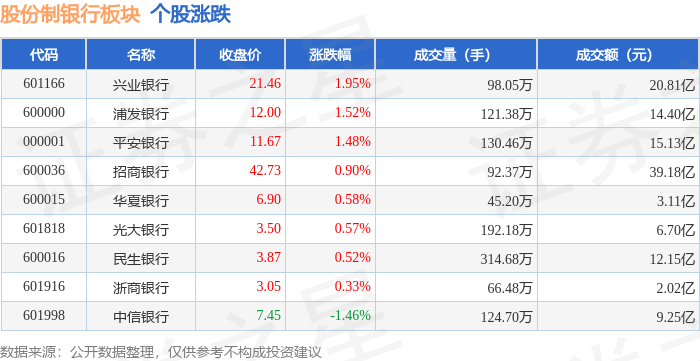
Group 1 - The banking sector saw an increase of 0.88% on January 6, with Industrial Bank leading the gains [1] - The Shanghai Composite Index closed at 4083.67, up 1.5%, while the Shenzhen Component Index closed at 14022.55, up 1.4% [1] - Key stocks in the banking sector and their performance included Industrial Bank (up 1.95% to 21.46), Pudong Development Bank (up 1.52% to 12.00), and Ping An Bank (up 1.48% to 11.67) [1] Group 2 - The net inflow of main funds in the banking sector was 646 million yuan, while retail investors saw a net outflow of 357 million yuan [1] - The main fund inflow for Industrial Bank was 222 million yuan, accounting for 10.65% of its total, while retail investors had a net outflow of 137 million yuan [2] - Ping An Bank experienced a main fund inflow of 209 million yuan (13.79%) but a retail outflow of 65 million yuan [2]


彭博绿金2026值得关注榜成功发布
Sou Hu Wang· 2026-01-06 04:57
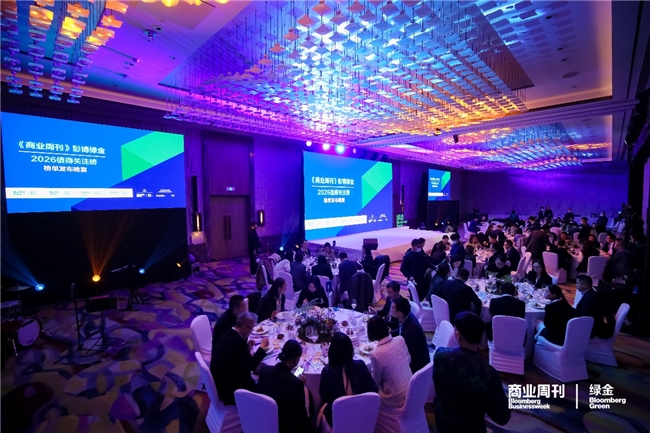
Core Insights - The 2026 Bloomberg Green Finance Awards ceremony was successfully held at the MGM Hotel in Shanghai, emphasizing the importance of aligning with China's "dual carbon" goals and the evolving global business landscape [2] - The event introduced two new evaluation systems: the "Green Finance List" and the "ESG Potential Enterprises" list, alongside existing categories for "ESG Leading Enterprises" and "Outstanding ESG Projects" [2] Green Finance List - The Green Finance List focuses on the green development and innovation within China's financial sector, developed in collaboration with the Central University of Finance and Economics [3] - It aims to respond to national green finance policies and promote the green transformation of financial institutions and enterprises [3] ESG Potential Enterprises - The ESG Potential Enterprises list is based on Bloomberg's proprietary analysis of corporate data, utilizing a comprehensive ESG matrix covering four dimensions, 16 core issues, and 41 sub-issues [4] - The matrix addresses nine major themes, including climate action, energy and ecological management, product safety, employee health, and social responsibility, to identify companies with long-term value and industry leadership potential [4] Complete Lists Released - The ESG Leading Enterprises include CHINT Group Co., Ltd., Tingyi Holding Corp. (Master Kong), Trina Solar Co., Ltd., and several others [5][6][7] - Outstanding ESG Projects feature initiatives from Beijing Fuping Social Venture Capital Co., Ltd., Envision Energy, LONGi Green Energy Technology Co., Ltd., and others [7][8] Green Financial Institutions - The Green Financial Institutions recognized include Bank of China (Hong Kong) Limited, Guotai Junan International Holdings Limited, Industrial Bank Co., Ltd., and others [9][10] Innovation Drivers - The ESG Innovation Drivers include organizations such as the Alliance for Water Stewardship, Climate Bonds Initiative, and Shanghai Advanced Institute of Finance [10] ESG Advocates - The ESG Advocates list features companies like Hydrowell (Taicang) Energy Technologies Co., Ltd., Ningbo Joyson Electronics Corp., and Skyworth Group Limited [11] Future Outlook - Bloomberg Green Finance aims to collaborate with more practitioners to explore core trends and future pathways for sustainable development, accumulating cross-disciplinary wisdom and solutions [13]