GAC GROUP(601238)

Search documents
广汽集团:以“市场+技术”双轮驱动向科技型企业转型
Zhong Guo Zheng Quan Bao· 2026-01-14 20:49
Core Viewpoint - GAC Group is undergoing a transformation towards a technology-driven enterprise through a series of reforms initiated by the "Panyu Action," focusing on "market + technology" as dual engines for growth [1][4]. Group 1: Four Engines of Development - GAC Group has introduced four core development engines: new technology, new products, new services, and new ecology, aiming to create a "new GAC" that is technology-leading, quality-leading, and ecology-leading [2][4]. - In new technology, GAC has launched the "Star Source Range Extender" to address user concerns about battery depletion, and the Quark electric drive motor has achieved over 99% efficiency, with over 1.3 million vehicles equipped with battery technology ensuring safety over 50 billion kilometers [2][3]. - The company plans to release nine new or updated models by 2026, focusing on user-driven product development through a comprehensive R&D system [2][6]. Group 2: Service and Ecosystem Innovations - GAC is expanding its service network by planning to add 600 brand experience stores, covering over 90% of county-level cities in China, and aims to complete 45 OTA updates by 2025, enhancing features for nearly 150,000 vehicle owners [3][4]. - The company is building a comprehensive ecosystem in collaboration with industry partners, including a strategic agreement with CATL for battery swapping and a nationwide charging network covering 204 cities [3][4]. Group 3: Strategic Focus and Future Goals - GAC Group's transformation is characterized by a shift from an engineering mindset to a user-centric approach in product development, integrating user needs into the entire R&D process [4][6]. - The company aims to cultivate a second growth curve during the 14th Five-Year Plan by focusing on local partnerships, strengthening its autonomous brand system, and enhancing strategic capabilities [6][7]. - By 2026, GAC plans to accelerate its reform initiatives, enhance brand leadership, and implement lean management to improve operational efficiency [7].

2025年我国新能源汽车出口达261.5万辆,出口规模再上新台阶
Xin Lang Cai Jing· 2026-01-14 07:19
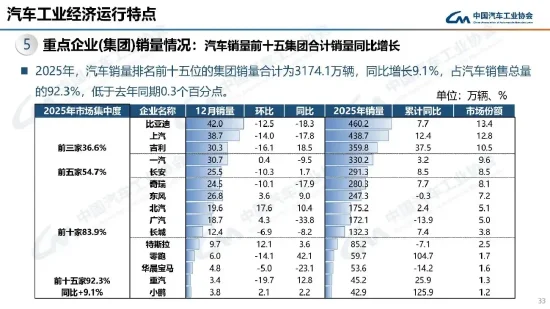
Core Insights - The Chinese automotive industry is projected to achieve record production and sales figures of 34.53 million and 34.40 million vehicles respectively in December 2025, maintaining its position as the world's largest market for 17 consecutive years [1][4]. Group 1: Market Performance - The passenger vehicle market is experiencing steady growth, significantly contributing to the overall automotive market expansion [5]. - The commercial vehicle market is recovering, with production and sales increasing by over 10%, surpassing 4 million units [5]. - New energy vehicles (NEVs) are leading the market, with production and sales exceeding 16 million units, accounting for over 50% of domestic new car sales [5]. Group 2: Export and Trade - The automotive export market shows strong resilience, with total exports exceeding 7 million vehicles, including 2.615 million NEVs, marking a new high in export scale [5]. Group 3: Market Concentration - The top fifteen automotive groups sold a total of 31.741 million vehicles, reflecting a year-on-year growth of 9.1%, which constitutes 92.3% of total vehicle sales, slightly down by 0.3 percentage points from the previous year [5][7]. - The top three groups, BYD, SAIC, and Geely, accounted for 36.6% of total vehicle sales [5][7]. - In the NEV segment, the top fifteen groups sold 15.669 million units, a year-on-year increase of 29.2%, representing 95% of total NEV sales, up by 0.7 percentage points from the previous year [5][7].






四大板块齐头并进——车企2025产销快报解析
Zhong Guo Qi Che Bao Wang· 2026-01-13 09:43
Core Insights - The Chinese passenger car market is projected to retail 23.78 million units in 2025, reflecting a 4% year-on-year growth, supported by policies like "trade-in" [2] - Major domestic automakers such as BYD, Geely, Changan, and Leap Motor have achieved significant progress, while several joint venture companies are showing signs of recovery in China [2] Domestic Automakers Performance - BYD achieved a record annual sales of 4.60 million units in 2025, a 7.73% increase, with pure electric vehicle sales reaching 2.25 million units, up 27.85%, surpassing Tesla in global sales [3] - SAIC Group sold 4.51 million vehicles in 2025, a 12.3% increase, with its new energy vehicle sales growing by 33.1% to 1.64 million units [3] - China FAW's total vehicle sales reached 3.30 million units, a 3.2% increase, with its new energy vehicle sales soaring by 71% to 366,000 units [4] - Geely's total sales reached 3.02 million units, a 39% increase, with new energy vehicle sales hitting 1.69 million units, up 90% [4] - Changan's sales reached 2.91 million units, an 8.5% increase, with new energy vehicle sales growing by 51% to 1.11 million units [5] - Chery Group achieved a record high of 2.81 million units sold, with new energy vehicle sales increasing by 54.9% to 903,800 units [5] Joint Venture Automakers Performance - Joint venture automakers are under pressure but some have found ways to adapt, with FAW-Volkswagen leading in sales with 1.59 million units sold [7] - SAIC Volkswagen achieved sales of 1.06 million units, maintaining a strong position in the market [8] - Toyota's joint ventures in China reported positive growth, with FAW Toyota selling 805,500 units, a 3-year consecutive growth [8] New Energy Vehicle Market - New energy vehicles are a common highlight across major domestic automakers, with significant growth in sales and market penetration [3][4][5] - New entrants like Leap Motor and NIO are also showing strong growth, with Leap Motor achieving 596,600 units sold, a 103% increase [10] - Xpeng Motors delivered 429,400 units, a 126% increase, while NIO delivered 326,000 units, a 46.9% increase [11] Export Growth - China's automobile exports are expected to exceed 7 million units in 2025, marking a historic high [13] - Chery led the export of Chinese passenger cars with 1.34 million units, a 17.4% increase [13] - BYD's overseas sales surpassed 1 million units, a 145% increase, with significant growth in Europe [14] - New energy vehicle exports are also on the rise, with companies like Leap and Xpeng expanding their international presence [16]



乘用车板块1月13日跌0.71%,海马汽车领跌,主力资金净流出6.24亿元
Zheng Xing Xing Ye Ri Bao· 2026-01-13 08:56
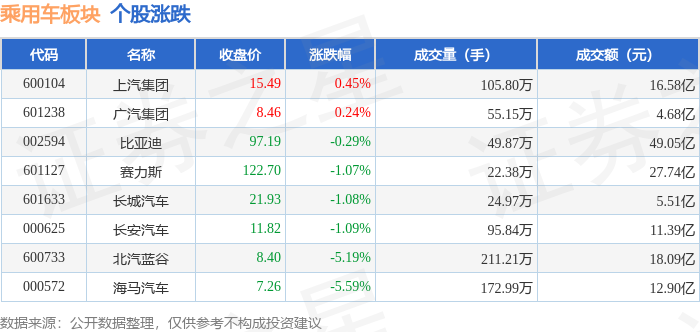
Market Overview - The passenger car sector experienced a decline of 0.71% on January 13, with Haima Automobile leading the drop [1] - The Shanghai Composite Index closed at 4138.76, down 0.64%, while the Shenzhen Component Index closed at 14169.4, down 1.37% [1] Individual Stock Performance - SAIC Motor Corporation (600104) closed at 15.49, up 0.45% with a trading volume of 1.058 million shares and a turnover of 1.658 billion yuan [1] - GAC Group (601238) closed at 8.46, up 0.24% with a trading volume of 551,500 shares and a turnover of 468 million yuan [1] - BYD (002594) closed at 97.19, down 0.29% with a trading volume of 498,700 shares and a turnover of 4.905 billion yuan [1] - Seres (601127) closed at 122.70, down 1.07% with a trading volume of 223,800 shares and a turnover of 2.774 billion yuan [1] - Great Wall Motors (601633) closed at 21.93, down 1.08% with a trading volume of 249,700 shares and a turnover of 551 million yuan [1] - Changan Automobile (000625) closed at 11.82, down 1.09% with a trading volume of 958,400 shares and a turnover of 1.139 billion yuan [1] - BAIC BluePark (600733) closed at 8.40, down 5.19% with a trading volume of 2.112 million shares and a turnover of 1.809 billion yuan [1] - Haima Automobile (000572) closed at 7.26, down 5.59% with a trading volume of 1.729 million shares and a turnover of 1.290 billion yuan [1] Fund Flow Analysis - The passenger car sector saw a net outflow of 624 million yuan from main funds, while retail investors contributed a net inflow of 451 million yuan [1] - The detailed fund flow for individual stocks shows: - SAIC Motor had a net inflow of 1.5 billion yuan from main funds, but a net outflow of 1.01 billion yuan from retail investors [2] - Great Wall Motors had a net inflow of 11.625 million yuan from main funds, with a net outflow of 9.9974 million yuan from retail investors [2] - GAC Group experienced a net outflow of 8.916 million yuan from main funds, with a net inflow of 440,000 yuan from retail investors [2] - BYD had a significant net outflow of 92.804 million yuan from main funds, but a net inflow of 10.8052 million yuan from retail investors [2] - Changan Automobile faced a net outflow of 1.15 billion yuan from main funds, while retail investors contributed a net inflow of 94.9543 million yuan [2] - Haima Automobile had a net outflow of 162 million yuan from main funds, but a net inflow of 143 million yuan from retail investors [2] - Seres had a net outflow of 2.02 billion yuan from main funds, with a net inflow of 178 million yuan from retail investors [2] - BAIC BluePark had a net outflow of 206 million yuan from main funds, while retail investors contributed a net inflow of 135 million yuan [2]



广汽集团入选“2025中国企业ESG百强”榜单
Xin Lang Cai Jing· 2026-01-13 05:40
Group 1 - The core viewpoint of the article emphasizes the growing importance of ESG (Environmental, Social, and Governance) as a key metric for high-quality corporate development and a vital link between corporate value and social value [1][2] - The "2025 China ESG Top 100" list was released by Sina Finance, evaluating over 5,000 A-share listed companies and mainland companies listed in Hong Kong using 18 industry-specific ESG evaluation models and over 150 ESG indicators [1][9] - The list serves as a benchmark for industry development and provides valuable decision-making references for investors [1][2] Group 2 - GAC Group was recognized for its significant contributions in the ESG field, ranking 56th on the "2025 China ESG Top 100" list, highlighting its commitment to sustainable development practices [2][7] - The publication of the list is seen as an authoritative acknowledgment of the sustainable practices of the listed companies and aims to promote the core values of ESG across the industry [2][9] - Companies are encouraged to integrate ESG principles into their strategic planning, operations, and supply chain collaboration to achieve a balance between commercial and social value [2][10]

中欧电动汽车案迎来关键进展,欧盟对华反补贴税有望取消
Jing Ji Guan Cha Wang· 2026-01-13 04:30
Group 1 - The Ministry of Commerce of China reported on the progress of consultations regarding the EU's electric vehicle case, emphasizing mutual respect and the need for general guidance on price commitments for Chinese exporters of pure electric vehicles [2] - The European Commission has issued guidance for Chinese electric vehicle companies to submit price commitment applications, which could replace high anti-subsidy tariffs if agreements are reached [2] - The price commitment is a voluntary promise by exporters to sell products at or above a specific price level to mitigate the adverse effects of subsidies, potentially allowing for more flexible market access [2] Group 2 - In October 2024, the European Commission concluded its anti-subsidy investigation, imposing a five-year anti-subsidy tax of up to 35.3% on electric vehicles imported from China, while expressing willingness to negotiate price commitments as an alternative [3] - Despite the imposition of anti-subsidy taxes, the sales momentum of Chinese cars in the European market remains strong, with projections indicating sales exceeding 700,000 units in 2025, up from 408,000 units in 2024 [3] - Chinese automakers are advancing local production in Europe, with BYD starting construction of factories in Hungary and Turkey, and GAC Group collaborating with Magna for localized production of the AION V SUV in Austria [3] Group 3 - In November 2025, the Madrid City Government's investment promotion office announced that Spain would abstain from voting on tariffs against Chinese electric vehicles, creating a favorable environment for Chinese investments [4] - The European market presents significant potential for Chinese automakers, particularly in the new energy vehicle sector, with sales of new energy passenger vehicles in Europe projected to reach 3.32 million units from January to November 2025, reflecting a 30% year-on-year increase [4]
汽车周报:供应链涨价、购置税兜底驱缓,关注通胀环节投资机会-20260113
Shenwan Hongyuan Securities· 2026-01-13 04:13
Investment Rating - The report maintains a positive outlook on the automotive industry, indicating a favorable investment rating for the sector [2]. Core Insights - The report highlights the impact of rising prices for memory, copper, aluminum, and key components, which are expected to lead to an increase in consumer vehicle prices. It suggests focusing on supply chain companies with good supply-demand dynamics and price transmission capabilities, as well as mid-to-high-end vehicle manufacturers with model cycles [2]. - The report notes that the average daily retail sales of passenger vehicles in China reached 123,000 units in the last week of December, a year-on-year increase of 17% [2]. - The report emphasizes the importance of the recently implemented green consumption policies, which aim to support the purchase of new energy vehicles and enhance the automotive industry's supply chain [11][12]. Market Updates - The automotive industry recorded a total transaction value of 638.35 billion yuan, with a week-on-week increase of 11.27%. The automotive industry index rose by 2.53% during the week [2][13]. - The report indicates that the automotive industry index's growth was lower than that of the Shanghai and Shenzhen 300 index, which increased by 2.79% [13]. - The report lists significant stock movements, with 201 stocks rising and 68 falling, highlighting the top gainers and losers in the automotive sector [19]. Key Events - The Ministry of Industry and Information Technology released the 403rd batch of new vehicle approvals, featuring several notable models from various manufacturers [3][4]. - The report discusses the rising cost pressures in the automotive industry due to increasing memory prices, which are becoming a significant factor affecting profitability [6][8]. - The report mentions a strategic cooperation agreement between CATL and NIO, focusing on battery technology and market collaboration [36]. Financial Metrics - The automotive sector's price-to-earnings ratio stands at 30.20, ranking 18th among all primary industries, indicating a moderate valuation compared to the Shanghai and Shenzhen 300 index's 14.41 [16][18].
乘用车2026 | 2025政策促需 2026高端发力+智能平权+出海提速
汽车琰究· 2026-01-13 00:05
Group 1 - The core viewpoint of the article emphasizes that the demand for automobiles is driven by the continuation of the trade-in policy, leading to an unexpected penetration of new energy vehicles (NEVs) and improved profitability through high-end products and overseas expansion [3][4][5][6][7][8] Group 2 - In 2025, the cumulative wholesale sales of passenger cars reached 24.119 million units, a year-on-year increase of 12.6%, with NEVs growing by 30.7% [3][8] - The penetration rate of NEVs in wholesale sales was 50.4%, up by 7.0 percentage points year-on-year, while the penetration rate for insurance reached 53.3%, an increase of 6.6 percentage points [3][46] - The share of domestic passenger cars in wholesale sales reached 69.3%, a year-on-year increase of 4.9 percentage points, with brands like Geely, Xiaomi, and Leap Motor showing significant growth [3][50] Group 3 - Looking ahead to 2026, the trade-in policy is expected to continue, supporting demand, with projected insurance sales of 22.32 million units, a decrease of 5.0% year-on-year, and wholesale sales of 30.10 million units, an increase of 1.0% [4][5] - The NEV insurance sales are expected to reach 13.8 million units, a year-on-year increase of 6.2%, while wholesale sales are projected to be 17.3 million units, up by 13.4% [4][15] Group 4 - The competitive landscape is shifting, with joint ventures declining and domestic brands accelerating their rise in the mid-to-high-end market [5][10] - In the 5-15 million price range, price-sensitive consumers are expected to drive competition, while brands like Geely, BYD, and Leap Motor are anticipated to gain higher sales growth due to their advantages in intelligence and cost-effectiveness [5][10] Group 5 - The article highlights the acceleration of intelligent driving technology, with major players like Huawei and BYD pushing for the democratization of advanced driving features [6][10] - The L3 commercial deployment is expected to gain momentum in 2026-2027, with various automakers launching new high-level driving systems and models [6][10] Group 6 - The export of passenger cars is projected to reach 6.64 million units in 2026, a year-on-year increase of 15.5%, driven by the technological advantages of domestic NEVs and the expansion of overseas manufacturing [7][11] - Companies like BYD and Geely are expected to increase their export efforts, with BYD establishing overseas factories and Geely accelerating NEV exports [7][11]


年终盘点2025汽车市场的“龙门一跃”:油退电进,全球登顶
3 6 Ke· 2026-01-12 10:37
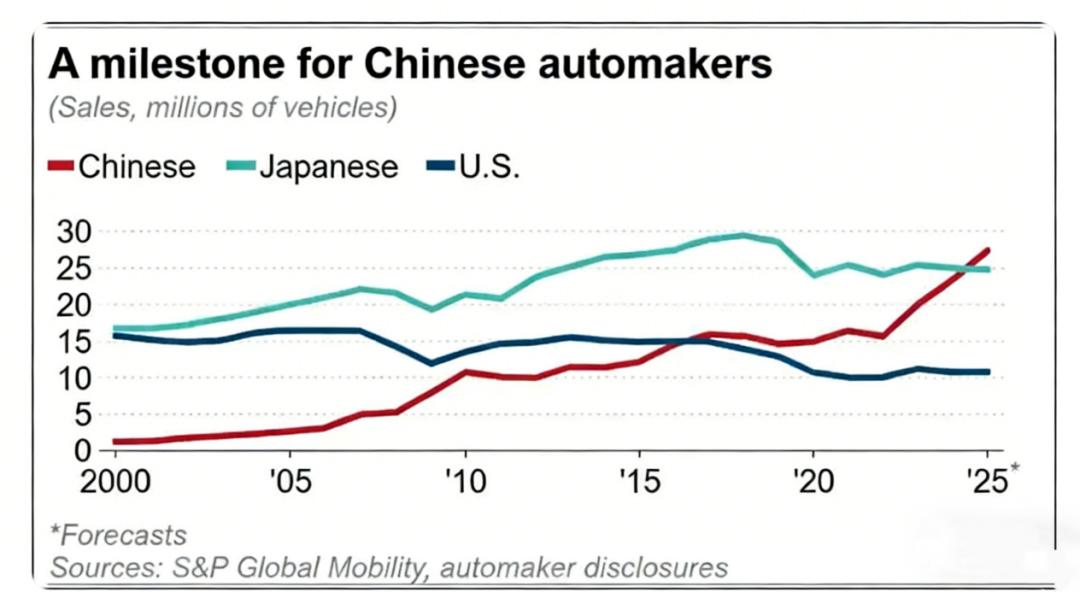
Core Insights - The penetration rate of new energy vehicles (NEVs) in China has surpassed 50%, marking a significant shift in the automotive market dynamics, transitioning from a "policy-driven" to a "product-driven" model [1][10] - The year 2025 is seen as a pivotal moment for the Chinese automotive industry, with the market experiencing a fundamental transformation akin to a "Nokia moment" [1] - The competition is evolving from price wars to value wars, emphasizing technology and product quality over mere volume [11] Industry Overview - In 2025, China's automotive manufacturers are projected to achieve global sales of 27 million vehicles, securing the top position in the global new car sales rankings for the first time [2] - China has overtaken Japan to become the world's largest automobile exporter, with NEVs accounting for a significant portion of this growth [4] - The domestic market's NEV sales are nearing 60%, reflecting a structural change in consumer preferences [4] Sales and Market Penetration - By November 2025, the retail penetration rate of NEVs reached 53.6%, with projections for the full year estimating a rate of 54.0% [6] - The rapid increase in NEV penetration is attributed to a combination of policy support, technological advancements, infrastructure development, and market demand [7] Policy and Technological Developments - The exit of purchase subsidies in 2023 has been offset by continued tax exemptions and various local incentives, which have helped maintain consumer interest in NEVs [7] - 2025 is expected to be a year of technological breakthroughs in NEVs, with advancements in high-voltage platforms, solid-state batteries, and smart driving technologies [8] Infrastructure and Consumer Experience - The expansion of charging infrastructure is crucial for alleviating consumer concerns about range anxiety, with projections of 20 million charging stations by the end of 2025 [9] - The cost advantages of NEVs are becoming increasingly apparent, with electric vehicles offering significantly lower operating costs compared to traditional fuel vehicles [9] Competitive Landscape - The shift from price competition to value competition is reshaping the industry, with companies focusing on technological innovation and profitability [11] - Some companies, like Leap Motor, have emerged as strong competitors, achieving significant sales growth and profitability [13] Global Expansion - In 2025, China's automotive exports are expected to exceed 7 million units, with NEV exports alone projected to reach 2.315 million units, marking a 102.9% increase [21] - Chinese automakers are transitioning to a "global + local" model, emphasizing localized production and R&D to better penetrate international markets [22] Challenges and Future Outlook - Despite rapid growth, challenges such as trade protectionism and compliance costs remain significant hurdles for Chinese automakers in global markets [24] - The automotive industry is expected to continue evolving, with a focus on sustainable growth and value creation as it navigates the transition from a subsidy-driven to a market-driven environment [25]

乘用车板块1月12日涨0.34%,北汽蓝谷领涨,主力资金净流出4.12亿元
Zheng Xing Xing Ye Ri Bao· 2026-01-12 09:04
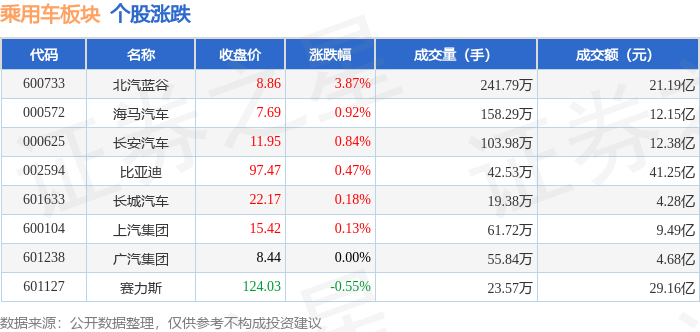
Market Overview - The passenger car sector increased by 0.34% compared to the previous trading day, with Beiqi Blue Valley leading the gains [1] - The Shanghai Composite Index closed at 4165.29, up 1.09%, while the Shenzhen Component Index closed at 14366.91, up 1.75% [1] Individual Stock Performance - Beiqi Blue Valley (600733) closed at 8.86, with a rise of 3.87%, trading volume of 2.4179 million shares, and a transaction value of 2.119 billion [1] - Changan Automobile (000625) closed at 11.95, up 0.84%, with a transaction value of 1.238 billion [1] - BYD (002594) closed at 97.47, up 0.47%, with a transaction value of 4.125 billion [1] - Great Wall Motors (601633) closed at 22.17, up 0.18%, with a transaction value of 428 million [1] - SAIC Motor (600104) closed at 15.42, up 0.13%, with a transaction value of 949 million [1] - GAC Group (601238) remained unchanged at 8.44, with a transaction value of 468 million [1] - Seres (601127) closed at 124.03, down 0.55%, with a transaction value of 2.916 billion [1] Capital Flow Analysis - The passenger car sector experienced a net outflow of 412 million from institutional investors and 218 million from retail investors, while retail investors saw a net inflow of 629 million [1] - Beiqi Blue Valley had a net inflow of 106 million from institutional investors, while retail investors contributed a net inflow of 12.5965 million [2] - Great Wall Motors had a net inflow of 10.2787 million from institutional investors, with retail investors contributing a net inflow of 21.3553 million [2] - BYD experienced a net outflow of 559.3 million from institutional investors, with retail investors contributing a net inflow of 14.6 million [2] - Seres faced a significant net outflow of 344 million from institutional investors, while retail investors had a net inflow of 26.97 million [2]