
PING AN OF CHINA(601318)

Search documents
【华创金融 徐康团队】平安再度增持国寿H,全年行业保费6.12万亿
Xin Lang Cai Jing· 2026-02-02 13:42
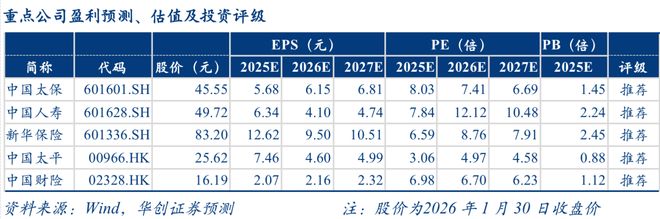
Market Performance - The insurance index increased by 5.55%, outperforming the market by 5.47 percentage points [1] - Individual insurance stocks showed mixed performance, with notable gains from Taiping (+9.96%), AIA (+8.79%), China Life (+8.73%), and others, while ZhongAn experienced a decline of -1.54% [1] Recent Developments - Ping An Life increased its stake in China Life by acquiring 11.891 million H-shares at an average price of HKD 32.0553 per share, totaling approximately HKD 381 million, raising its ownership from 8.98% to 9.14% [2] - Sunshine Life reduced its holdings in Huishang Bank by selling 11.694 million H-shares at an average price of HKD 3.2896 per share, involving funds of approximately HKD 38.4686 million, decreasing its stake from 7.92% to 6.93% [2] - China Life announced plans to establish a pension industry equity investment fund and a private fund in the Yangtze River Delta, with a total commitment of nearly CNY 12.5 billion [2] - The China Securities Regulatory Commission modified regulations to expand the types of strategic investors, including social security funds and commercial insurance funds, with a minimum shareholding requirement of 5% [2] Industry Projections - The insurance industry is projected to achieve a total premium income of CNY 6.12 trillion by 2025, with life insurance accounting for CNY 4.65 trillion and property insurance for CNY 1.47 trillion [3] Investment Recommendations - The report includes investment recommendations for several insurance companies, highlighting their expected earnings per share (EPS) and price-to-earnings (PE) ratios for 2025, with China Life and New China Life receiving a "recommended" rating [6]


券商2月“金股”来了!主线行情有望继续扩散
Zhong Guo Zheng Quan Bao· 2026-02-02 12:21
Group 1 - Over 200 A-shares and H-shares have been included in the February "gold stock" list by brokers, with Alibaba-W, Tencent Holdings, Zijin Mining, and Zhongji Xuchuang being among the most frequently recommended stocks [1][2] - The electronic industry has the highest number of recommended stocks, with 35 stocks being favored by brokers, while sectors like basic chemicals and non-ferrous metals also have multiple stocks recommended [2] - In January, 66% of the 249 stocks recommended by brokers achieved positive returns, with Zhuoyi Information leading with a 98.94% increase [3][4] Group 2 - The market is expected to experience a period of volatility, with better performance anticipated after the Spring Festival, as policy catalysts are expected to emerge [5][6] - The "technology + resources" theme is likely to continue expanding, with a focus on sectors such as optical modules, storage, semiconductor equipment, and industrial metals [6] - Recent fluctuations in international gold prices are attributed to market sentiment and changes in the Federal Reserve's leadership, with expectations of a wide range of fluctuations in the short term [6]


2月度金股:蓄势再出发-20260202
Soochow Securities· 2026-02-02 12:11
Core Insights - The report indicates that after a period of volatility, the market is expected to regain momentum in February, supported by a decrease in the volatility index from a peak of 102 to around 32, which is historically low [2][3] - The report emphasizes the importance of focusing on two main investment themes: technology growth and cyclical recovery, as funds are likely to rotate towards underperforming sectors [3][4] Investment Themes - **Technology Growth**: The AI industry is experiencing significant positive changes, with expectations for OAI listings and advancements in storage, CPU, and packaging sectors. The report highlights the importance of monitoring policy catalysts and industry developments, particularly in emerging sectors like aerospace, new materials, and quantum technology [6][6] - **Cyclical Recovery**: The report suggests that sectors such as chemicals, real estate, and core consumer assets are expected to see a rebound as market sentiment improves. The report notes that these sectors are currently at low points in their economic cycles, with potential for recovery as institutional positions are historically low [6][6] Recommended Stocks - **Jingsheng Electromechanical (300316.SZ)**: The company is positioned to benefit from increasing demand in space and overseas photovoltaic equipment, with a market cap of 58.3 billion and projected EPS growth from 0.95 in 2026 to 1.17 in 2027 [7][7] - **Nuwai Co., Ltd. (603699.SH)**: As a leading industrial valve manufacturer, the company is expected to see growth driven by LNG and marine vessel demand, with a projected EPS increase from 2.51 in 2026 to 3.00 in 2027 [7][7] - **Longjing Environmental Protection (600388.SH)**: The company is focusing on green electricity and energy storage, with a projected EPS growth from 1.20 in 2026 to 1.37 in 2027 [7][7] - **Chip Microelectronics (688630.SH)**: The company anticipates significant profit growth, with EPS expected to rise from 4.18 in 2026 to 6.08 in 2027 [7][7] - **AVIC High-Tech (600862.SH)**: The company is expected to benefit from the increasing demand for aerospace materials, with projected EPS growth from 1.17 in 2026 to 1.29 in 2027 [7][7] - **Ping An Insurance (601318.SH)**: The company is projected to maintain strong growth in new business value (NBV), with EPS expected to rise from 8.59 in 2026 to 9.74 in 2027 [7][7] - **Rabbit Baby (002043.SZ)**: The company is expected to see steady growth in the decorative board industry, with projected EPS growth from 1.05 in 2026 to 1.15 in 2027 [7][7] - **Wanhua Chemical (600309.SH)**: The company is expected to benefit from improving MDI and TDI market conditions, with projected EPS growth from 5.13 in 2026 to 5.79 in 2027 [7][7] - **Tianfu Communication (300394.SZ)**: The company is positioned to benefit from the demand for optical modules, with projected EPS growth from 4.10 in 2026 to 5.38 in 2027 [7][7] - **Shaanxi Tourism (603402.SH)**: The company is expected to see growth driven by its core tourism operations, with projected EPS growth from 6.65 in 2026 to 7.61 in 2027 [7][7]



中国平安(601318) - 中国平安H股公告
2026-02-02 09:45
股份發行人及根據《上市規則》第十九B章上市的香港預託證券發行人的證券變動月報表 截至月份: 2026年1月31日 狀態: 新提交 致:香港交易及結算所有限公司 公司名稱: 中国平安保险(集团)股份有限公司 呈交日期: 2026年2月2日 I. 法定/註冊股本變動 | 1. 股份分類 | 普通股 | 股份類別 | A | | | 於香港聯交所上市 (註1) | | 否 | | | --- | --- | --- | --- | --- | --- | --- | --- | --- | --- | | 證券代號 (如上市) | 601318 | 說明 | | | | | | | | | | | 法定/註冊股份數目 | | | 面值 | | | 法定/註冊股本 | | | 上月底結存 | | | 10,660,065,083 | RMB | | 1 | RMB | | 10,660,065,083 | | 增加 / 減少 (-) | | | | | | | RMB | | | | 本月底結存 | | | 10,660,065,083 | RMB | | | 1 RMB | | 10,660,065,083 | | ...
保险板块2月2日跌2.14%,新华保险领跌,主力资金净流出4.03亿元
Zheng Xing Xing Ye Ri Bao· 2026-02-02 09:15
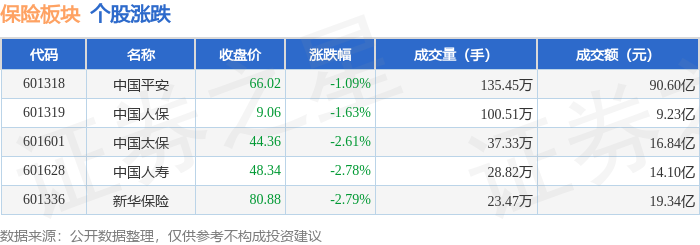
证券之星消息,2月2日保险板块较上一交易日下跌2.14%,新华保险领跌。当日上证指数报收于 4015.75,下跌2.48%。深证成指报收于13824.35,下跌2.69%。保险板块个股涨跌见下表: | 代码 | 名称 | 收盘价 | 涨跌幅 | 成交量(手) | 成交额(元) | | --- | --- | --- | --- | --- | --- | | 601318 | 中国平安 | 66.02 | -1.09% | 135.45万 | 90.60亿 | | 601319 | 中国人保 | 9.06 | -1.63% | 100.51万 | 9.23亿 | | 601601 | 中国太保 | 44.36 | -2.61% | 37.33万 | 16.84亿 | | 601628 | 中国人寿 | 48.34 | -2.78% | 28.82万 | 14.10 Z | | 601336 | 新华保险 | 80.88 | -2.79% | 23.47万 | 19.347 | 以上内容为证券之星据公开信息整理,由AI算法生成(网信算备310104345710301240019号),不构成投资建议。 从资金流向 ...



2月券商金股:机构扎堆推荐福斯特等股,市场短期或震荡整理
2 1 Shi Ji Jing Ji Bao Dao· 2026-02-02 08:59
Market Overview - In February's first trading day, the market experienced fluctuations with all three major indices dropping over 2%, with the Shanghai Composite Index down 2.48%, the Shenzhen Component Index down 2.69%, and the ChiNext Index down 2.46% [1] - The total trading volume in the Shanghai and Shenzhen markets was 2.58 trillion, a decrease of 250.8 billion compared to the previous trading day [1] - Over 4,600 stocks fell, with 123 hitting the daily limit down [1] January Market Recap - The A-share market saw a rise followed by fluctuations, with the Shanghai Composite Index reaching a ten-year high in mid-January before slightly retreating, ultimately closing above 4,100 points [3] - In January, the Shanghai Composite Index rose by 3.76%, the Shenzhen Component Index by 4.17%, and the ChiNext Index by 4.47% [3] - Among 26 primary industries, 18 experienced gains, with the top three sectors being non-ferrous metals (22.59%), media (17.94%), and oil and petrochemicals (16.31%) [3] Short-term Market Outlook - Many institutions believe the market is in an upward trend in the medium to long term but may experience short-term fluctuations [4] - Guolian Minsheng Securities noted that the market is currently undergoing a narrow range of fluctuations, with pressure from ETF outflows affecting broad indices [4] - The market is expected to continue to provide investment opportunities under various themes and narratives, despite the need for adjustments [4] Sector Analysis - Zhejiang Securities indicated that the technology growth sector is entering a phase of high-level fluctuations after a strong three-week performance [5] - Zhongyin Securities highlighted that the nomination of Kevin Warsh as the next Federal Reserve Chairman may tighten global liquidity expectations, leading to asset price reassessments [5] - Institutions suggest focusing on sectors related to technology, such as robotics, gaming, AI applications, and core AI hardware, as well as "anti-involution" sectors like chemicals and photovoltaics [5] Recommended Stocks for February - Among the stocks recommended by over 30 brokerages for February, Foster, China Ping An, Zijin Mining, and Zhongji Xuchuang received four recommendations each [7] - The recommended stocks include: - Foster (603806.SH) in the power equipment sector - China Ping An (601318.SH) in non-bank financials - Zijin Mining (601899.SH) in non-ferrous metals - Zhongji Xuchuang (300308.SZ) in communications [8] Detailed Stock Insights - Foster is noted for its comprehensive layout in solar wing packaging and strong cost control capabilities, with expectations for steady profitability [9] - China Ping An is expected to benefit from stable long-term interest rates and a favorable sales environment for its insurance products, leading to growth in new business value (NBV) [10] - Zhongji Xuchuang is recognized for its leading position in global optical modules and strong R&D capabilities, with significant growth potential in high-end optical modules [13]


中国平安(02318) - 截至二零二六年一月三十一日止之股份发行人的证券变动月报表
2026-02-02 08:31
股份發行人及根據《上市規則》第十九B章上市的香港預託證券發行人的證券變動月報表 截至月份: 2026年1月31日 狀態: 新提交 致:香港交易及結算所有限公司 公司名稱: 中国平安保险(集团)股份有限公司 呈交日期: 2026年2月2日 I. 法定/註冊股本變動 | 1. 股份分類 | 普通股 | 股份類別 | A | | | 於香港聯交所上市 (註1) | | 否 | | | --- | --- | --- | --- | --- | --- | --- | --- | --- | --- | | 證券代號 (如上市) | 601318 | 說明 | | | | | | | | | | | 法定/註冊股份數目 | | | 面值 | | | 法定/註冊股本 | | | 上月底結存 | | | 10,660,065,083 | RMB | | 1 | RMB | | 10,660,065,083 | | 增加 / 減少 (-) | | | | | | | RMB | | | | 本月底結存 | | | 10,660,065,083 | RMB | | | 1 RMB | | 10,660,065,083 | | ...
研报掘金丨东吴证券:维持中国平安“买入”评级,高股息+低估值凸显配置价值
Ge Long Hui· 2026-02-02 08:00
Core Viewpoint - China Ping An's bancassurance business is leading performance growth, with high dividends and low valuations highlighting its investment value [1] Group 1: Business Performance - The company has a stable and reliable dividend, with both A and H shares yielding around 4%, which is relatively high in the industry [1] - The bancassurance business is experiencing rapid growth, supported by deep collaboration with Ping An Bank and a high-quality team [1] - The market share of the "old seven" bancassurance companies is continuously increasing, indicating a positive outlook for Ping An's bancassurance business [1] Group 2: Investment Strategy - The company is expanding its partnerships with state-owned banks, leading joint-stock banks, and quality city commercial banks to enhance its network [1] - The asset allocation strategy is conservative, with controllable risks in real estate investments [1] - The company's stock price corresponds to 0.74x 2026E PEV, which is at the 43% and 72% percentile levels of the past ten and five years, respectively [1] Group 3: Future Outlook - The expected reforms in public fund management are likely to further highlight the company's high-weight characteristics, enhancing its investment value [1] - The rapid growth of the bancassurance business is anticipated to drive overall performance upward, with potential for valuation recovery [1] - The company maintains a "buy" rating based on these positive indicators [1]
每周宏观经济和资产配置研判:大宗商品风暴如何应对-20260202
Soochow Securities· 2026-02-02 07:59
Group 1: Macro Insights - The report highlights that the recent volatility in gold and silver prices is primarily driven by market momentum reversals, with silver attracting high leverage and speculative funds since November 2025 [2][5] - The report anticipates that after the appointment of the new Federal Reserve Chairman, there will be more interest rate cuts than the market expects, with short-term U.S. Treasury yields likely to decline [2][4] - The report notes that the recent decline in the manufacturing PMI does not indicate a weakening economy, as it reflects a temporary fluctuation rather than a downward trend [10] Group 2: Commodity Market Analysis - The report indicates that the recent crash in silver prices has led to liquidity risks that may spread to other commodities, particularly in the non-ferrous metals sector [5][6] - It emphasizes the importance of monitoring the support levels for gold prices, particularly the 60-day moving average, which is currently at $4,400 per ounce [5] - The report suggests that the Shanghai Futures Exchange has implemented measures to manage the risk of a one-sided market in silver futures [5] Group 3: Equity Market Outlook - The report predicts a rebound in the A-share market following the Spring Festival, driven by positive sentiment from performance forecasts and new developments in sectors like AI applications and commercial aerospace [6][10] - It advises a balanced ETF allocation in domestic equities, reflecting a cautious yet optimistic outlook for the market [11] Group 4: Bond Market Perspective - The report notes that the bond market is expected to see increased buying activity due to risk aversion and expectations of monetary easing, with 10-year yields projected to decline to around 1.80% [7][10] - It highlights that the recent adjustments in risk appetite have created trading opportunities in government bonds as a hedge against stock market volatility [4][7]



非银金融行业周报:行业周报:战略投资者类型拟扩大,推动耐心资本与上市公司深度对接-20260202
GOLDEN SUN SECURITIES· 2026-02-02 06:36
Investment Rating - The report maintains an "Increase" rating for the non-bank financial sector [5] Core Insights - The China Securities Regulatory Commission (CSRC) is expanding the types of strategic investors to enhance long-term capital engagement with listed companies, including pension funds, insurance funds, and public funds [1][2] - The report highlights a stable regulatory environment for the insurance sector, with long-term benefits expected from trends in deposit migration and increasing demand for healthcare and retirement security [3] - The securities sector is experiencing heightened market risk appetite and active trading, benefiting both IT companies and brokerages [3] Summary by Sections Industry Dynamics - Non-bank financial, securities II, insurance II, and fintech indices experienced fluctuations of +1.04%, -0.69%, +5.50%, and -5.78% respectively, while the Shanghai Composite Index decreased by -0.44% [10] - China Life Insurance led the insurance sector with an increase of +8.73% [10] Insurance - Ping An Life increased its stake in China Life H shares by purchasing 11.891 million shares at an average price of 32.0553 HKD, raising its holding to 9.14% [14] - The registered capital of China Life Property Insurance has increased from 18.8 billion RMB to 27.8 billion RMB, a growth of approximately 48% [14] - As of December, the original premium income for property insurance reached 1,470.3 billion RMB, a year-on-year increase of 2.60%, while life insurance premiums reached 4,649.1 billion RMB, up 9.05% [15] Securities - The A-share market was active in 2025, with daily average trading volume of 2.08 trillion RMB, a year-on-year increase of 70.36% [24] - The number of IPO approvals surged by 109.43% year-on-year, with fundraising amounts increasing by 208.01% [24] - Listed brokerages that have released earnings forecasts expect a net profit growth of 59%-66% year-on-year [24] Investment Recommendations - The report suggests a positive outlook for the insurance sector, despite short-term pressures on capital and sentiment, due to long-term trends in liabilities and stable interest rates [3][37] - In the securities sector, the report recommends focusing on companies like China Ping An A/H, China Life H, Guotai Junan, and Huatai Securities [3][37]