
NCI(601336)

Search documents
新华保险个险大动作:推出全生命周期规划师培训体系及万人创业计划;港险“报行合一”将落地 | 慧保日报8.5
Sou Hu Cai Jing· 2025-08-05 14:37
Group 1: Regulatory Changes - The Ministry of Finance and the State Taxation Administration announced the resumption of value-added tax on interest income from newly issued government bonds, local government bonds, and financial bonds starting from August 8, 2023 [1] - The tax exemption for interest income from bonds issued before August 8, 2023, will continue until the bonds mature [1] Group 2: Financial Support for Manufacturing - A joint guideline was issued by the central bank and several ministries encouraging insurance institutions to provide long-term stable funding support for advanced manufacturing through various financial instruments [2] - The guideline aims to promote collaboration between insurance institutions and pilot organizations to innovate insurance products and services [2] Group 3: Insurance Industry Developments - The Vice Chairman of the National Financial Regulatory Administration emphasized the importance of timely insurance claims processing to enhance the insurance industry's role as an economic stabilizer [3] - The Hubei Financial Regulatory Bureau is promoting comprehensive export credit insurance coverage for small and micro enterprises to help them manage commercial risks [4] Group 4: Corporate Actions - Sunshine Life announced a plan to reduce its stake in Victory Shares by 0.5%, decreasing its ownership from 5.22% to 4.72% [5] - China Pacific Insurance announced it will no longer establish a supervisory board, allowing the board of directors to perform the supervisory functions [6] Group 5: New Product Launches - Xinhua Insurance launched a comprehensive training system for life cycle planners and a plan to support 10,000 entrepreneurs, focusing on high-net-worth clients [7] - Sunshine Life introduced a new product system aimed at elderly care, including various insurance products to fill coverage gaps for older populations [8] Group 6: Market Research Initiatives - Dajia Insurance Group, in collaboration with Nielsen, initiated a survey to assess the demand for commercial elderly care services in urban China [10] Group 7: International Collaborations - Several insurance companies, including China Re and PICC, reached a cooperation intention for special risk management projects related to the Belt and Road Initiative [11] Group 8: Commission Structure Changes - The Hong Kong Insurance Authority announced a reform in the commission structure for participating insurance policies, limiting the first-year commission to a maximum of 70% [12] Group 9: Financial Performance Reports - Berkshire Hathaway reported a net profit of $16.973 billion for the first half of 2025, a 60.6% decrease year-on-year, attributed to increased investment losses and reduced insurance underwriting income [13] - AXA reported a net profit of €4.6 billion for the first half of 2025, an 8.1% increase year-on-year, driven by growth in property insurance and improved investment returns [14] - AXA acquired a 51% stake in the Italian digital insurance company Prima for €500 million, which specializes in auto insurance [15]

红利板块成“资产荒”下最优解?政策+估值+资金三重催化,价值ETF(510030)上探1.46%!
Xin Lang Ji Jin· 2025-08-05 13:02
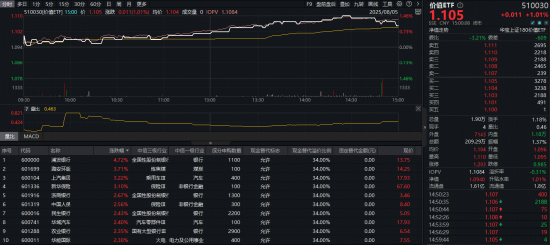
Group 1 - High dividend stocks showed strong performance on August 5, with the value ETF (510030) rising by 1.01% at close, peaking at a 1.46% increase during the day [1] - Key sectors contributing to the rise included finance, coal, and automotive, with notable gains from stocks like Pudong Development Bank (+4.72%) and others exceeding 3% [1] Group 2 - Starting from August 8, 2025, interest income from newly issued government bonds, local government bonds, and financial bonds will be subject to VAT, while previously issued bonds will remain exempt until maturity [3] - Analysts suggest that the attractiveness of high dividend assets is expected to slightly increase due to a minor decline in bond cost-effectiveness [4] Group 3 - The current market liquidity is relatively abundant, and the positive feedback effect of retail investors entering the market is anticipated to strengthen [4] - The value ETF (510030) tracks the 180 Value Index, focusing on "high dividend + low valuation" large-cap blue-chip stocks, which include major companies like China Ping An and CITIC Securities [4][6] Group 4 - China Galaxy Securities predicts that the market will maintain a fluctuating high level, with structural opportunities to be monitored, particularly in high dividend sectors like banking [5] - The demand for dividend assets is increasing due to their stable cash flow and defensive characteristics in a declining risk-free interest rate environment [5]




分红险红利实现率陆续出炉!突破100%的产品增多
Zhong Guo Zheng Quan Bao - Zhong Zheng Wang· 2025-08-05 12:25
Core Viewpoint - The dividend realization rate of various insurance companies has shown a year-on-year increase, with many products exceeding 100%, a significant improvement compared to the previous year when few products achieved this level [1][2]. Group 1: Dividend Realization Rate Trends - Multiple insurance companies, including China Life, New China Life, and Ping An Life, have reported their latest dividend realization rates, indicating a notable recovery in these rates compared to last year [2]. - For instance, New China Life reported that 56 out of 59 participating dividend products achieved a dividend realization rate of 100%, with an average of 152% [2]. - The increase in dividend realization rates is attributed to rising investment returns and the relaxation of the "high limit" policy for dividend insurance [1][2]. Group 2: Industry Shift Towards Dividend Insurance - The insurance industry is accelerating its transition towards dividend insurance, driven by a lower guaranteed interest rate cap and the need to mitigate "interest spread loss" risks [4]. - The latest research indicates that the preset interest rate for life insurance is now 1.99%, with adjustments leading to a reduction in the upper limit for guaranteed rates [4]. - Companies are aiming for a significant increase in the proportion of dividend insurance products, with one leading insurer targeting at least 30% of its business portfolio to be dividend insurance by 2025 [4]. Group 3: Market Dynamics and Competitive Landscape - Insurers with strong investment performance and substantial special reserves for dividends are expected to have greater flexibility in offering higher dividends, enhancing their competitive edge in the market [5][6]. - The long-term sustainability of dividend insurance will be tested on both liability and asset sides, requiring insurers to balance dividend distribution with future expectations and operational performance [6].


寿险公司的保单未来盈余
13个精算师· 2025-08-05 09:34
Core Viewpoint - The article discusses the implementation of the second phase of the solvency regulatory framework in China's insurance industry, focusing on the concept of future policy surplus as a key indicator of a company's future profitability [1][2]. Group 1: Future Policy Surplus - The future policy surplus is introduced under the second phase of solvency regulations and is crucial for assessing a company's future profitability [1]. - The future policy surplus is defined as the difference between accounting reserves and solvency reserves, adjusted for potential tax provisions and cash value guarantees [2]. - As of 2024, the future policy surplus for 66 insurance companies is projected to be 2.26 trillion, accounting for 8.8% of total assets, a decrease of approximately 150 billion from the end of 2022 [14]. Group 2: Impact of Accounting Standards - Starting in 2023, insurance companies began implementing the new accounting standard IFRS 17, which affects how insurance reserves are reported [3]. - The article highlights the importance of consistency in reporting deferred tax liabilities (DTL) and actual capital across different accounting standards [7][8]. - Companies that do not maintain consistency in their reporting may face challenges in validating their solvency reports [9]. Group 3: Analysis of Companies - The article provides a detailed analysis of various insurance companies, noting that the future policy surplus varies significantly among them, with some companies like AIA Life exceeding 15% of total assets [14]. - The article identifies that companies with a high proportion of participating insurance products tend to have lower future policy surplus compared to traditional insurance products [16]. - The future policy surplus for major players like China Life and Ping An has shown a noticeable decline, attributed to their historical focus on participating insurance products [15]. Group 4: Factors Influencing Future Policy Surplus - The decline in future policy surplus can be attributed to several factors, including a high proportion of participating insurance, adjustments in risk premiums, and changes in actuarial assumptions [19]. - Conversely, an increase in future policy surplus may result from a lower proportion of participating insurance and the successful generation of new business [19][22]. - The article emphasizes that the future policy surplus is a critical indicator but does not fully reflect a company's overall asset-liability management (ALM) status [16].


保险板块8月5日涨1.64%,新华保险领涨,主力资金净流入7.75亿元
Zheng Xing Xing Ye Ri Bao· 2025-08-05 08:37
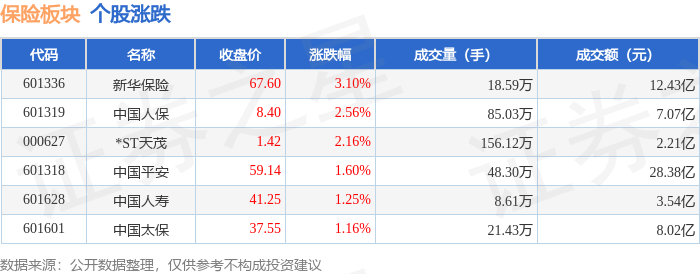
证券之星消息,8月5日保险板块较上一交易日上涨1.64%,新华保险领涨。当日上证指数报收于3617.6, 上涨0.96%。深证成指报收于11106.96,上涨0.59%。保险板块个股涨跌见下表: 从资金流向上来看,当日保险板块主力资金净流入7.75亿元,游资资金净流出3.61亿元,散户资金净流出 4.14亿元。保险板块个股资金流向见下表: | 代码 | 名称 | 主力净流入 (元) | 主力净占比 游资净流入 (元) | | 游资净占比 散户净流入 (元) | | 散户净占比 | | --- | --- | --- | --- | --- | --- | --- | --- | | 601318 中国平安 | | . 4.55亿 | 16.03% | -2.80亿 | -9.87% | -1.75亿 | -6.16% | | 601601 | 中国太保 | 1.70亿 | 21.15% | -1.19亿 | -14.87% | -5029.93万 | -6.27% | | 601319 中国人保 | | 1.03亿 | 14.56% | -3739.75万 | -5.29% | -6556.27万 | -9. ...
财税新政策对保险公司净利润影响点评:短期测算对利润影响在1%以内,长期或可通过资产配置转向高股息来对冲
Hua Yuan Zheng Quan· 2025-08-05 07:05
Investment Rating - The industry investment rating is "Positive" (maintained) [4][6] Core Viewpoints - The new fiscal and tax policies announced on July 31 will have a limited impact on the net profits of insurance companies, with a short-term effect estimated to be within 1% [4][6] - Insurance companies can mitigate the impact of the new VAT on newly issued government bonds through asset allocation strategies, such as shifting towards high-dividend equities [6] Summary by Relevant Sections - **Impact of New Tax Policies**: The announcement to restore VAT on interest income from newly issued government bonds starting August 8, 2025, will not significantly affect the actual revenue and profits of insurance companies due to the continued exemption from corporate income tax [4][5] - **Quantitative Analysis**: Using China Pacific Insurance as an example, the report estimates that the VAT payment on new bonds could amount to approximately 2.3 million yuan, which is about 0.51% of the net profit for the year [5][6] - **Long-term Projections**: In an extreme scenario where all bonds are new after ten years, the VAT payment could rise to 23.5 million yuan, representing 5.2% of the net profit, but the financial impact remains manageable as companies can adjust their asset allocations [5][6] - **Recommended Companies**: The report recommends companies with ideal asset-liability duration matching, such as China Life, Ping An, and China Pacific Insurance, as well as New China Life for its favorable equity returns [6]
巴南监管分局同意新华保险巴南支公司变更营业场所
Jin Tou Wang· 2025-08-05 05:54
2025年8月1日,巴南金融监管分局发布批复称,《新华人寿保险股份有限公司重庆分公司关于巴南支公 司经营场所变更的请示》(新保渝发〔2025〕50号)收悉。经审核,现批复如下: 一、同意新华人寿保险股份有限公司巴南支公司将营业场所变更为:重庆市巴南区渝南大道297号2幢 15-1。 二、新华人寿保险股份有限公司应按照有关规定及时办理变更及许可证换领事宜。 ...
年内举牌21次 险资正跑步入市
2 1 Shi Ji Jing Ji Bao Dao· 2025-08-04 12:56
Core Insights - Insurance funds have made a total of 21 stake acquisitions in A-shares and H-shares as of August 4, surpassing the total for the entire previous year [2][4] - Major insurance companies involved include China Life, Ping An Life, and Taikang Life, with acquisitions spanning banks, energy, and public utility sectors [2][3] - The trend is driven by a combination of high dividend yields and new accounting standards that allow for smoother profit fluctuations [4][6] Stake Acquisitions - The insurance institutions that have made stake acquisitions this year include China Life, Ping An Life, Xinhua Insurance, and others [2] - Notable targets for these acquisitions include Agricultural Bank of China, Postal Savings Bank, and various energy companies [2][3] - Hong Kong-listed companies are particularly favored due to lower valuations and higher dividend yields [3] Investment Drivers - The decline in interest rates has increased investment pressure on insurance companies, prompting them to seek stable long-term returns through stake acquisitions [4][5] - The new accounting standards encourage insurance companies to invest in high-yield stocks to reduce profit volatility [6][7] Regulatory Environment - The Chinese government has implemented policies to extend the assessment period for state-owned insurance companies, allowing for a more stable investment approach [7][8] - Recent regulations have increased the upper limit for equity asset allocation, providing more room for insurance funds to invest in the stock market [9] Long-term Investment Strategy - Insurance funds are increasingly seen as a stabilizing force in the market, aligning with national strategies and supporting economic development [7][9] - The establishment of private equity funds by insurance companies aims to enhance their long-term investment capabilities and deepen their engagement with capital markets [9]
年内举牌21次,险资正跑步入市
2 1 Shi Ji Jing Ji Bao Dao· 2025-08-04 12:44
南方财经全媒体记者 林汉垚 北京报道 截至8月4日,保险资金年内在A股及H股市场累计举牌达21次,一举超越去年全年水平。中国人寿、平 安人寿、泰康人寿等十余家机构密集出手,举牌标的涵盖银行、能源、公共事业等领域。 华泰证券分析指出,险资正通过高息股填补现金收益缺口,并借新会计准则下FVOCI(以公允价值计量 且其变动计入其他综合收益的金融资产)计量平滑利润波动。 与此同时,财政部拉长国有险企考核周期、国家金融监管总局上调权益资产配置上限等政策组合拳,推 动"耐心资本"保险资金与实体经济深度协同。 年内举牌量超去年全年 根据原中国保监会于2015年发布的《保险公司资金运用信息披露准则第3号:举牌上市公司股票》,保 险公司举牌上市公司股票,是指保险公司持有或者与其关联方及一致行动人共同持有一家上市公司已发 行股份的5%,以及之后每增持达到5%时,按照相关法律法规规定,在3日内通知该上市公司并予以公 告的行为。 中国保险行业协会网站信息显示,截至8月4日,保险资金年内在A股及H股市场已累计举牌上市公司达 21次,已超过去年全年举牌次数。 据统计,今年以来举牌上市公司的保险机构有中国人寿、平安人寿、新华保险、瑞众人寿 ...
中证ECPI ESG可持续发展40指数上涨0.38%,前十大权重包含新华保险等
Jin Rong Jie· 2025-08-04 10:55
数据统计显示,中证ECPI ESG可持续发展40指数近一个月上涨3.14%,近三个月上涨5.81%,年至今下 跌0.29%。 据了解,中证ECPI ESG可持续发展40指数根据 ECPI ESG 评级方法,从上证180公司治理指数样本中选 取ESG评级较高的40只上市公司证券作为指数样本,以反映上证180公司治理指数中ECPI ESG评级较高 上市公司证券的整体表现。该指数以2010年06月30日为基日,以1000.0点为基点。 从指数持仓来看,中证ECPI ESG可持续发展40指数十大权重分别为:生益科技(3.34%)、恒瑞医药 (2.9%)、万华化学(2.74%)、中煤能源(2.66%)、新华保险(2.66%)、三一重工(2.64%)、复 星医药(2.63%)、中国中免(2.62%)、农业银行(2.59%)、中国交建(2.56%)。 从中证ECPI ESG可持续发展40指数持仓的市场板块来看,上海证券交易所占比100.00%。 金融界8月4日消息,上证指数低开高走,中证ECPI ESG可持续发展40指数 (ESG 40,000970)上涨 0.38%,报1695.71点,成交额379.45亿元。 从中证E ...