GWMOTOR(601633)

Search documents
长城汽车入选“2025中国企业ESG百强”榜单
Xin Lang Cai Jing· 2026-01-12 10:05
Group 1 - The core viewpoint of the article emphasizes the growing importance of ESG (Environmental, Social, and Governance) as a key metric for high-quality corporate development and a vital link between corporate value and social value [1][2] - The "2025 China Enterprise ESG Top 100" list was released by Sina Finance, evaluating over 5,000 A-share listed companies and mainland enterprises listed in Hong Kong using 18 industry ESG evaluation models and over 150 ESG indicators [1][2] - The list serves as a benchmark for industry development and provides valuable decision-making references for investors [1][2] Group 2 - Great Wall Motors was recognized for its outstanding ESG performance, ranking 37th on the "2025 China Enterprise ESG Top 100" list [2] - The publication of the list is a significant acknowledgment of the sustainable development practices of the listed companies and promotes the core values of ESG across the industry [2] - Companies are encouraged to integrate ESG principles into their strategic planning, operations, and supply chain collaboration to achieve a symbiotic relationship between commercial and social value [2] Group 3 - The ESG rating center by Sina Finance is the first Chinese professional platform for ESG information and ratings, aimed at promoting sustainable development and responsible investment [11] - The center also aims to establish ESG evaluation standards suitable for China's characteristics and promote the development of ESG investment in the asset management industry [11]



汽车行业周报:英伟达发布自动驾驶模型平台,Robotaxi产业化持续推进-20260112
CHINA DRAGON SECURITIES· 2026-01-12 10:04
Investment Rating - The report maintains a "Recommended" investment rating for the automotive industry [2]. Core Insights - Nvidia has launched a new open-source AI model platform, Alpamayo, aimed at enhancing the capabilities of autonomous vehicles and facilitating the industrialization of Robotaxi services [5][15]. - The first fully autonomous vehicle utilizing Nvidia's system is set to undergo road testing in the US in Q1 2026, with plans for L4 level autonomous taxi services to commence in 2027 [5][25]. - The report highlights significant growth opportunities for companies involved in the autonomous driving ecosystem, including hardware suppliers and Robotaxi operators, due to reduced development costs and shorter timelines [5][16]. Industry Dynamics - Key industry news includes the announcement that China aims to achieve 18.3 million vehicle trade-ins from 2024 to 2025, with nearly 60% expected to be electric vehicles [18]. - Geely has received a license for L3 level autonomous driving road tests, marking a significant step in the development of smart driving technologies [21]. - The report notes that the automotive sector's performance has been mixed, with the automotive index underperforming compared to the broader market [5][35]. Market Performance - From January 5 to January 9, 2026, the automotive sector's index increased by 2.53%, lagging behind the Shanghai Composite Index, which rose by 2.79% [5][35]. - The report provides detailed performance metrics for various automotive sub-sectors, indicating a positive trend in automotive services and parts, with the automotive services sector seeing a 6.01% increase [5][35]. Data Tracking - In December 2025, retail sales of passenger vehicles reached 2.261 million units, reflecting a year-on-year decline of 14.15% but a month-on-month increase of 1.60% [46]. - The penetration rate of new energy vehicles in retail sales reached 59.1%, with retail sales of new energy passenger vehicles totaling 1.337 million units in December 2025, marking a year-on-year increase of 2.68% [60]. - The report also highlights the increasing adoption of advanced driving assistance systems, with L2.5 and above penetration rates reaching 37.96% in November 2025 [73].



【月度排名】2025年12月厂商销量排名快报
乘联分会· 2026-01-12 09:28
Core Viewpoint - The article highlights the performance of the Chinese automotive market in December 2025, noting a decline in retail sales for traditional vehicles while emphasizing growth in the new energy vehicle (NEV) sector and exports. The market is expected to transition into 2026 with a focus on new energy vehicles and a recovery in demand [4]. Sales Performance - In December 2025, the domestic narrow passenger car market retail sales reached 2.261 million units, a year-on-year decrease of 14.0% but a month-on-month increase of 1.6%. Cumulative sales for the year totaled 23.744 million units, reflecting a year-on-year growth of 3.8% [2]. - The wholesale sales ranking for December 2025 shows BYD leading with 414,784 units sold, followed by Geely and Chery with 236,817 and 234,736 units, respectively. Notably, BYD's sales decreased by 12.7% month-on-month and 18.6% year-on-year [5]. - For the entire year of 2025, BYD also topped the wholesale sales with 4.545 million units, marking a 6.9% increase year-on-year, while Geely's sales surged by 39.0% to 3.025 million units [6]. New Energy Vehicle Market - In December 2025, the NEV wholesale sales ranking was led by BYD with 414,784 units, despite a month-on-month decline of 12.7% and a year-on-year drop of 18.6%. Geely followed with 154,264 units, showing a year-on-year increase of 38.7% [9]. - The retail sales for NEVs in December 2025 also saw BYD at the forefront with 339,854 units sold, a month-on-month increase of 10.9% but a year-on-year decrease of 15.7% [13]. - For the full year, BYD maintained its dominance in the NEV sector with 3.485 million units sold, although this represented a year-on-year decline of 6.3% [14]. Market Trends and Future Outlook - The article notes that the end of the year typically sees a surge in vehicle purchases, but the depletion of subsidy funds across provinces has tempered this effect, leading to a more stable demand outlook heading into 2026 [4]. - The performance of various manufacturers indicates a competitive landscape, with traditional automakers facing challenges while NEV manufacturers like BYD and Geely continue to show resilience and growth potential [6][9].



【快讯】每日快讯(2026年1月12日)
乘联分会· 2026-01-12 09:28
Domestic News - Hong Kong's Transport Department will promote unmanned testing of autonomous vehicles this year, having issued 6 pilot licenses for 62 autonomous private cars and minibuses, with over 80,000 kilometers driven safely [2] - BAIC Blue Valley's L3 vehicles have officially started road trials, with plans to gradually open to individual users in the second quarter of this year [3] - Tongji University has restructured its Mechanical and Energy Engineering College into a Mechanical Engineering and Robotics College and an Automotive and Energy College, aligning with the national "dual carbon" strategy and the trend of electrification and intelligence in the automotive industry [4] - Shanghai's government has launched a three-year action plan to support advanced manufacturing, focusing on new energy vehicles and innovative products like eVTOLs to overcome industrial bottlenecks [5] - Great Wall Motors will officially launch its new platform, "Guiyuan," on January 16, which supports multiple power forms and aims to simplify vehicle offerings [7] - Lantu Automotive has signed a strategic cooperation agreement with Huawei's subsidiary, focusing on smart driving and software operations to enhance user experience [8] - Xiaomi's new generation SU7 will be equipped with the Xiaomi Super Motor V6s Plus, which will improve production efficiency and shorten delivery times [9] - Firefly has delivered its 40,000th vehicle, offering limited-time purchase benefits to customers [10] International News - India's electric vehicle sales are projected to reach 2.3 million units by 2025, accounting for 8% of new car registrations, driven by policy incentives and increased consumer demand [11] - Stellantis will stop offering plug-in hybrid vehicles in North America starting with the 2026 model year, focusing on more competitive electrification solutions [12] - The UK Treasury is looking to reduce electric vehicle charging costs due to concerns that a new mileage tax policy could harm market demand [13] - Malaysia has implemented a new road tax policy for electric vehicles, requiring all EVs to pay annual road tax based on motor output power [14] Commercial Vehicles - A new strategy called "30111" was launched by a commercial vehicle company, aiming for significant sales growth and transforming commercial vehicles into "super intelligent entities" through AI technology [15] - The Xiangling V5 gas engine product has been launched in Xinjiang, targeting local logistics needs with efficient and environmentally friendly solutions [16] - Great Wall's commercial vehicle has won an innovation award for its dual-motor hybrid architecture, highlighting its technological advancements in the hybrid truck market [17] - The number of operational functional unmanned vehicles in Shenzhen has surpassed 1,000, marking a 22.5% increase and indicating a new phase in the city's unmanned vehicle development [18]



乘用车板块1月12日涨0.34%,北汽蓝谷领涨,主力资金净流出4.12亿元
Zheng Xing Xing Ye Ri Bao· 2026-01-12 09:04
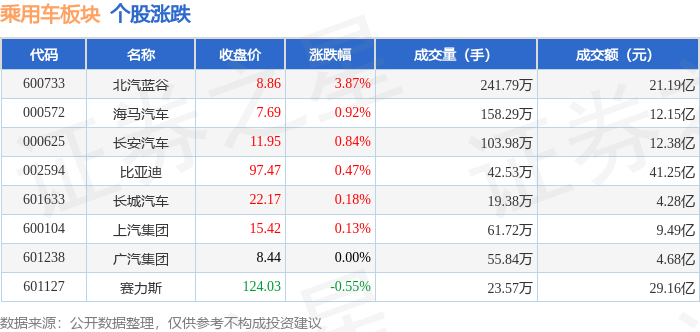
Market Overview - The passenger car sector increased by 0.34% compared to the previous trading day, with Beiqi Blue Valley leading the gains [1] - The Shanghai Composite Index closed at 4165.29, up 1.09%, while the Shenzhen Component Index closed at 14366.91, up 1.75% [1] Individual Stock Performance - Beiqi Blue Valley (600733) closed at 8.86, with a rise of 3.87%, trading volume of 2.4179 million shares, and a transaction value of 2.119 billion [1] - Changan Automobile (000625) closed at 11.95, up 0.84%, with a transaction value of 1.238 billion [1] - BYD (002594) closed at 97.47, up 0.47%, with a transaction value of 4.125 billion [1] - Great Wall Motors (601633) closed at 22.17, up 0.18%, with a transaction value of 428 million [1] - SAIC Motor (600104) closed at 15.42, up 0.13%, with a transaction value of 949 million [1] - GAC Group (601238) remained unchanged at 8.44, with a transaction value of 468 million [1] - Seres (601127) closed at 124.03, down 0.55%, with a transaction value of 2.916 billion [1] Capital Flow Analysis - The passenger car sector experienced a net outflow of 412 million from institutional investors and 218 million from retail investors, while retail investors saw a net inflow of 629 million [1] - Beiqi Blue Valley had a net inflow of 106 million from institutional investors, while retail investors contributed a net inflow of 12.5965 million [2] - Great Wall Motors had a net inflow of 10.2787 million from institutional investors, with retail investors contributing a net inflow of 21.3553 million [2] - BYD experienced a net outflow of 559.3 million from institutional investors, with retail investors contributing a net inflow of 14.6 million [2] - Seres faced a significant net outflow of 344 million from institutional investors, while retail investors had a net inflow of 26.97 million [2]



汽车股继续走低,元旦以来超20家车企降价促销
Ge Long Hui· 2026-01-12 02:25
Group 1 - The core viewpoint of the article highlights the ongoing weakness in Hong Kong's automotive stocks, with significant declines observed in companies such as Geely Auto and Li Auto, among others [1] - As of January 12, 2026, over 20 automotive companies have launched promotional activities for more than 75 models, employing various strategies such as cash subsidies and interest-free financing [1] - The Secretary-General of the National Passenger Car Market Information Association, Cui Dongshu, suggests that the current price reductions by car manufacturers are a rational return to pricing rather than a price war, although the trend of price cuts is expected to continue into 2026 [1] Group 2 - Analysts predict that the promotional activities may stimulate sales, potentially leading to a strong start for the automotive market in January 2026, but these promotions are likely to compress profit margins for companies and create significant operational pressure for dealers [1] - It is widely anticipated that the number of automotive companies will decrease by 2026, with market concentration (CR5) expected to rise from 65% to 80%, indicating that brands lacking core competitiveness may face elimination or consolidation [1]


长城汽车1月9日获融资买入3653.47万元,融资余额6.51亿元
Xin Lang Cai Jing· 2026-01-12 01:32
Core Viewpoint - On January 9, Great Wall Motors experienced a slight increase in stock price by 0.14%, with a trading volume of 344 million yuan, indicating active market engagement and investor interest [1]. Financing Summary - On January 9, Great Wall Motors had a financing buy-in amount of 36.53 million yuan, with a net financing purchase of 5.33 million yuan after accounting for repayments [1]. - The total financing and securities balance for Great Wall Motors reached 655 million yuan, with the financing balance accounting for 0.47% of the circulating market value, indicating a high level compared to the past year [1]. - In terms of securities lending, 4,700 shares were repaid, while 19,300 shares were sold, resulting in a selling amount of 427,100 yuan, with a securities lending balance of 5.67 million yuan, also reflecting a high level compared to the past year [1]. Financial Performance - As of September 30, Great Wall Motors reported a total revenue of 153.58 billion yuan for the first nine months of 2025, representing a year-on-year growth of 7.96%, while the net profit attributable to shareholders decreased by 17.20% to 8.64 billion yuan [2]. - Cumulatively, Great Wall Motors has distributed a total of 34.70 billion yuan in dividends since its A-share listing, with 8.95 billion yuan distributed over the past three years [3]. Shareholder Information - As of September 30, 2025, the number of shareholders for Great Wall Motors was 137,500, a decrease of 22.95% from the previous period [2]. - The top ten circulating shareholders include China Securities Finance Corporation, holding 197 million shares, and Hong Kong Central Clearing Limited, which reduced its holdings by 27.42 million shares [3].
贾可吴伯凡吴声张晓亮,4万字2025-2026跨年对谈全文(下)
汽车商业评论· 2026-01-11 23:06
Core Viewpoint - The article discusses the evolving landscape of the Chinese automotive industry, focusing on the impact of personal branding (IP) of industry leaders, the rise of Huawei in automotive technology, and the trends in global expansion and regulatory changes in autonomous driving [4][5][6]. Group 1: Personal Branding in Automotive Industry - The debate on whether automotive leaders like Lei Jun and Wei Jianjun should develop personal brands (IP) has intensified, with differing opinions on its effectiveness and potential backlash [5][25]. - Lei Jun's recent challenges with Xiaomi's automotive ventures highlight the risks of personal branding, while Wei Jianjun's successful IP development reflects a more grounded approach [26][30]. - The article emphasizes the need for automotive leaders to focus on product quality and strategic management rather than solely on personal branding [31][35]. Group 2: Huawei's Role in Automotive Technology - Huawei's positioning as a service provider rather than a car manufacturer allows it to play a unique role in the automotive industry, focusing on empowering car manufacturers with advanced technologies [7][10]. - The introduction of Huawei's "Jing" and "Jie" series vehicles indicates a strategic expansion into the automotive market, with a focus on high-end segments [9][10]. - Huawei's technology capabilities, including smart cockpit and driving technologies, are seen as critical to its success in the automotive sector, potentially reshaping the competitive landscape [12][15]. Group 3: Trends in Global Expansion - The article notes a significant trend of Chinese automotive companies pursuing IPOs in Hong Kong, reflecting a renewed interest in capital markets and the need for ongoing funding in a capital-intensive industry [38][39]. - The global expansion of Chinese automotive brands is characterized by a shift towards local production and partnerships, moving beyond simple export strategies to more integrated approaches [43][45]. - The necessity for Chinese companies to adapt to local markets and consumer behaviors is emphasized, indicating a more mature approach to globalization [47][49]. Group 4: Regulatory Changes in Autonomous Driving - The Chinese government has implemented stricter regulations on L2 autonomous driving systems, reflecting a growing emphasis on safety following recent incidents [58][60]. - The approval of L3 autonomous driving systems indicates a positive regulatory environment for advanced driving technologies, with companies like Deep Blue and BAIC leading the way [58][61]. - The article suggests that the development of Robotaxi services is gaining momentum, with a focus on subscription-based models as a viable business strategy [61][63].



在CES看懂长城汽车,一次体系能力的集中释放
Tai Mei Ti A P P· 2026-01-11 06:02
Core Insights - The role of automobiles is evolving at CES, transitioning from a focus on consumer electronics to a significant emphasis on automotive technology [2] - Great Wall Motors stands out as a representative Chinese automaker, showcasing a comprehensive narrative around technology, product, and culture rather than just individual products [2][5] - The competition in smart technology is shifting from "function demonstration" to "system capability" [2] Product and Technology - Great Wall Motors presented a product matrix rather than a single flagship model, exemplified by the WEY brand's Gaoshan 9, which integrates smart cockpit, assisted driving, safety systems, and Hi4 performance hybrid four-wheel drive as a holistic solution [2] - The Coffee Pilot Ultra assisted driving system and Coffee OS smart cockpit have entered mass production, indicating the maturity of Chinese automakers in integrated vehicle intelligence [3] - The ASL 2.0 multi-agent architecture, showcased at CES, allows vehicles to understand scenarios, reason risks, and provide proactive services, supported by the Coffee EEA 4.0 electronic architecture [3] Power Technology - Great Wall's Hi4 technology system is central to its strategy, focusing on optimal distribution based on different scenarios rather than opposing physical laws, akin to the wisdom of Dujiangyan in water management [4] - The Hi4 system includes various configurations like Hi4, Hi4 performance version, Hi4-Z for off-road, and Hi4-T for extreme off-road, balancing performance, energy consumption, and reliability [4] Cultural Expression - The S2000 CL motorcycle, featuring a unique horizontally opposed 8-cylinder engine, combines Eastern aesthetics with top-tier engineering, showcasing China's design and manufacturing capabilities [4] - Great Wall aims to convey a message of sustainable technological ecosystems, moving from internal combustion engines to hybrid and electric solutions, alongside software systems and cultural expression [5] - The presence at CES signifies that Chinese automakers are no longer mere followers of technology but are actively defining global technological directions with their methodologies [5]
2025年汽车以旧换新超1150万辆,全年乘用车零售2374.4万辆
Xinda Securities· 2026-01-10 11:06
Investment Rating - The industry investment rating is "Positive" [2] Core Insights - The report highlights that in 2025, over 11.5 million vehicles will be replaced under the vehicle trade-in program, leading to a total retail of 23.744 million passenger cars, with approximately 54% being new energy vehicles [20][3] - The report indicates a projected growth in the automotive market, with a U-shaped sales trend expected for passenger vehicles in 2026, maintaining overall sales levels similar to 2025 [20] - Key companies to watch include BYD, Geely, Great Wall Motors, and others in the passenger vehicle sector, as well as major players in commercial vehicles and auto parts [3][20] Industry Performance - The A-share automotive sector underperformed the market, with a weekly increase of 2.53% compared to the 2.79% rise in the CSI 300 index, ranking 24th among A-share industries [3][9] - The report notes that the passenger vehicle segment saw a 3.8% year-on-year increase in retail sales, while new energy vehicles experienced a 17.6% growth [20] Key Industry News - The Ministry of Commerce announced that the vehicle trade-in program will exceed 11.5 million vehicles in 2025, contributing to over 1.6 trillion yuan in new car sales [20] - Geely received the largest L3 autonomous driving test license in China, covering an area of 9,224 square kilometers [20] - Baidu's autonomous driving platform, "萝卜快跑," obtained the first full unmanned testing license in Dubai, paving the way for commercial operations [20] Upstream Data Tracking - The report includes tracking of key material prices such as steel, aluminum, and lithium carbonate, which are crucial for automotive manufacturing [23][24]