
BANK OF CHINA(601988)

Search documents
商业银行纷纷调整积存金业务并提示风险
Zheng Quan Ri Bao· 2025-11-04 15:40
Core Insights - Several commercial banks have recently adjusted their gold accumulation businesses, with major banks like Industrial and Commercial Bank of China and China Construction Bank announcing suspensions and subsequent resumption of certain services [1][2] Group 1: Business Adjustments - On November 3, Industrial and Commercial Bank of China and China Construction Bank announced the suspension of certain gold accumulation services, including "Ruyi Gold Accumulation" and "Easy Gold" [1] - Later that same day, Industrial and Commercial Bank of China announced the resumption of its "Ruyi Gold Accumulation" services, including account openings and physical gold withdrawals [1] - Other banks, such as Bank of China, Ping An Bank, and Industrial Bank, have also raised the minimum investment thresholds for their gold accumulation products since October [1] Group 2: Reasons for Adjustments - The adjustments in gold accumulation services are influenced by macroeconomic policies, market risk management, and compliance requirements [2] - Global uncertainties, including fluctuations in the US dollar, shifts in monetary policy, and geopolitical risks, have led to price volatility in precious metals, prompting banks to adopt a more cautious approach to asset safety and liquidity management [2] - The rapid growth in customer numbers for gold accumulation services has raised operational, liquidity, and compliance risks, leading banks to pause new business and physical withdrawals as a preventive measure [2] Group 3: Future Outlook - If market volatility increases or regulatory scrutiny tightens, other banks may implement similar measures, although these adjustments typically target new or high-risk businesses, ensuring that existing customer rights are protected [3] - Recent communications from multiple banks have highlighted the need to mitigate risks associated with fluctuations in precious metal prices [3] - Investors are advised to maintain a balanced approach to gold investments, considering the asset's volatility and the influence of international economic data, monetary policy, and geopolitical factors [3]


第四届国际金融领袖投资峰会在香港举行:中国消费引擎提振发力,投资潜力不断释放
Mei Ri Jing Ji Xin Wen· 2025-11-04 15:18
11月3日至5日,第四届国际金融领袖投资峰会在香港举行。 此次峰会由香港金融管理局主办,主题为"驾驭变局,砥砺前行",吸引了银行、证券、资产管理、主权 财富基金、私募股权和风险投资、对冲基金等全球金融行业领军人物齐聚。 东方汇理首席执行官Valérie Baudson表示,从全球范围来看,亚洲资产的估值极具吸引力,因此对其而 言,亚洲资产是必配项。此外,欧洲优质企业债券非常值得关注。"股票方面,我们如今更看重优质企 业和估值水平。"她表示,如果要给出一个核心建议,那就是从市值加权配置转向GDP加权配置,这是 当前环境下更明智、更合理的投资选择。 美国道富集团主席兼行政总裁Ronald P.OHanley表示,人工智能领域将会涌现出新的行业领军者。"人工 智能的应用目前仍处于早期阶段,这是有原因的。我的投资重点就是发掘这些未来能颠覆现有行业格局 的新冠军。" 张辉表示,从银行的角度来讲,将会更关注业务的区域布局,尤其是通过境外业务有效实现对境内银行 利差收窄不利影响的对冲。 "我们将以中银香港为依托,向全球辐射业务,尤其是东南亚地区。经过多年深耕,东南亚已成为支撑 我们业务增长的重要力量,也获得了当地监管部门的 ...
近4万亿“国家队”持仓曝光,重仓金融,加码科技
2 1 Shi Ji Jing Ji Bao Dao· 2025-11-04 14:55
Core Insights - The "national team" has heavily invested in over 222 A-share stocks, with a total market value approaching 4 trillion yuan, primarily favoring financial stocks [2][5] - The top three holdings by the "national team" are Agricultural Bank of China, Bank of China, and Industrial and Commercial Bank of China, with respective market values of 1.03 trillion yuan, 967.73 billion yuan, and 930.27 billion yuan [4][5] - The total market value of the "national team's" holdings increased to 3.911 trillion yuan by the end of Q3, with financial stocks contributing significantly to this growth [5][6] Financial Sector Focus - The "national team" maintains a strong preference for financial stocks, with 9 out of the top 10 holdings being from this sector, accounting for over 83.9% of the total market value of their top holdings [5][6] - The Agricultural Bank of China saw a 23.52% increase in stock price during Q3, contributing over 180 billion yuan in floating profits for the "national team" [5] Investment in Emerging Sectors - In addition to financial stocks, the "national team" is diversifying into sectors such as AI, semiconductors, and renewable energy, aligning with national strategic goals [5][6] - Notable technology stocks in the "national team's" portfolio include Ultrasonic Electronics, Puxin Co., and Micron Technology, indicating a shift towards innovation-driven investments [5] ETF Investments - The "national team" has also increased its investment in ETFs, with a total holding of A-share ETFs exceeding 40% of the total ETF market size by the end of Q3 [9] - Central Huijin Investment has emerged as a significant player in the ETF market, holding substantial stakes in multiple ETFs, which has contributed to market stabilization [8][9] Performance of Specific ETFs - Key ETFs held by the "national team" have shown significant floating profits, with the Huatai-PineBridge CSI 300 ETF gaining over 55 billion yuan in Q3 [10] - The technology-focused ETFs, such as the Huaxia CSI 5G Communication Theme ETF, experienced remarkable growth, with a quarterly increase exceeding 80% [10]



银行业2025年三季报综述:业绩稳健性凸显,引领银行价值回归
Shenwan Hongyuan Securities· 2025-11-04 14:41
Investment Rating - The report maintains a positive outlook on the banking sector, indicating a potential return to a valuation of 1 times net asset value [4][7]. Core Insights - The banking sector has demonstrated steady performance, with a year-to-date revenue growth of 0.8% and a net profit growth of 1.5% for the first nine months of 2025, reflecting a stable regulatory environment supporting bank profitability [10][14]. - The report highlights a shift in focus from scale to balance in credit growth, with banks increasingly pursuing a "quantity-price balance" strategy [4][7]. - The cost of liabilities has improved more significantly than the decline in asset pricing, leading to a stabilization of net interest margins, which is expected to continue into the next year [4][7]. - Asset quality remains stable but shows signs of divergence, particularly with rising risks in small and micro businesses [4][7]. - The report suggests that the current dividend yield of the banking sector has returned to an attractive range, indicating a significant disconnect between stable earnings and stock holdings, which could lead to a value recovery [4][7]. Summary by Sections Performance Overview - The banking sector's performance has been characterized by a steady increase in revenue and profit, with state-owned banks showing better-than-expected stability and regional banks leading in performance [11][12][15]. - The report notes that the revenue growth of state-owned banks has turned positive, with non-interest income contributing significantly to this growth [12][15]. Credit Growth and Strategy - The report indicates a gradual abandonment of scale-driven growth, with banks focusing on achieving a balance between volume and pricing in their lending practices [4][7]. - The credit growth rate for listed banks decreased by 0.3 percentage points to 7.7% in Q3 2025, with state-owned banks maintaining a growth rate of approximately 8.5% [4][7]. Profitability and Asset Quality - The net interest margin for listed banks remained stable at 1.5%, with a slight quarter-on-quarter increase of 3 basis points in Q3 2025 [4][7]. - The overall non-performing loan ratio remained stable at 1.22%, indicating manageable risk levels across the sector [4][7]. Investment Recommendations - The report recommends focusing on leading banks and undervalued regional banks as key investment opportunities, suggesting that the recovery in valuations is supported by stable earnings and attractive dividend yields [4][7].


近4万亿“国家队”持仓曝光,重仓金融,加码科技
21世纪经济报道· 2025-11-04 14:39
Group 1 - The core viewpoint of the article highlights the significant presence of "national team" funds in the A-share market, with a total holding value nearing 4 trillion yuan and a strong preference for financial stocks [1][2][4] - As of the end of Q3, the "national team" held over 222 A-share stocks, with the top three holdings being Agricultural Bank of China, Bank of China, and Industrial and Commercial Bank of China, collectively valued at over 3 trillion yuan [2][4] - The "national team" has also diversified its portfolio by investing in sectors such as AI, semiconductors, and new energy, aligning with national strategic goals [4][8] Group 2 - The total market value of the "national team's" holdings increased to 3.911 trillion yuan by the end of Q3, with financial stocks contributing significantly to this growth [4][8] - The "national team" has been actively using ETFs as a tool for indirect market investment, with a notable increase in ETF holdings amounting to over 1.55 trillion yuan [6][8] - The performance of technology stocks has been strong, with certain ETFs experiencing significant gains, such as the 华夏中证5G通信主题ETF, which saw a quarterly increase of over 80% [8][9]

上市公司前三季度“成绩单”出炉!
Jin Rong Shi Bao· 2025-11-04 11:35
Core Insights - The overall performance of listed companies in China has shown continuous improvement in the first three quarters of 2025, with significant growth in both revenue and net profit [2][3] Group 1: Overall Performance - Total revenue for listed companies reached 53.46 trillion yuan, with a net profit of 4.70 trillion yuan, representing year-on-year growth of 1.36% and 5.50% respectively [2] - In the third quarter alone, revenue and net profit increased by 3.82% and 11.45% year-on-year, and by 2.40% and 14.12% quarter-on-quarter, indicating a solid upward trend [2] - Approximately 4183 companies reported profits, with nearly 80% of the market achieving positive earnings [2] Group 2: Industry Performance - The semiconductor and hardware equipment sectors experienced the fastest revenue growth at 20.9% and 16.8% respectively, while several other industries, including non-bank financials and automotive, saw growth rates above 7% [3] - In terms of net profit growth, the steel, software services, and semiconductor industries led with increases of 402.0%, 121.6%, and 46.6% respectively [3] Group 3: Major Companies - China National Petroleum Corporation topped the revenue list with 2.17 trillion yuan, followed closely by Sinopec at 2.11 trillion yuan and China State Construction at 1.56 trillion yuan [3] - Excluding financial and oil companies, China Mobile led with a net profit of 1154 billion yuan, followed by Kweichow Moutai with 646 billion yuan [3] Group 4: High-Quality Development - The role of technology innovation has become more prominent, with significant revenue and profit growth reported by companies in the ChiNext, STAR Market, and Beijing Stock Exchange [4] - The total market capitalization reached 107.32 trillion yuan, with the electronics sector leading, accounting for 12.42% of the total market [4] Group 5: R&D Investment - Listed companies collectively invested 1.16 trillion yuan in R&D, marking a year-on-year increase of 3.88%, with 168 companies investing over 1 billion yuan [6] - The overall R&D intensity across the market was 2.16%, with the ChiNext and STAR Market showing higher intensities of 4.54% and 11.22% respectively [6] Group 6: Shareholder Returns - A total of 1033 companies announced cash dividend plans, with a total cash dividend amounting to 734.9 billion yuan, an increase from the previous year [7] - The market has seen a total of 1525 share repurchase plans announced, with completed repurchases amounting to 92.3 billion yuan [7]




未势能源获中国银行常熟分行2亿元研发授信
Xin Lang Cai Jing· 2025-11-04 11:30
Core Insights - The collaboration between Weishi Energy Technology Co., Ltd. and Bank of China Changshu Branch involves a total R&D credit facility of 200 million yuan [1] - The loan has a duration of 3 years, indicating a long-term commitment to support the company's research and development efforts [1] Group 1 - Weishi Energy has signed a research and development credit cooperation agreement with Bank of China Changshu Branch [1] - The total amount of the R&D credit facility is 200 million yuan [1] - The loan term is set for 3 years, providing financial stability for ongoing projects [1]
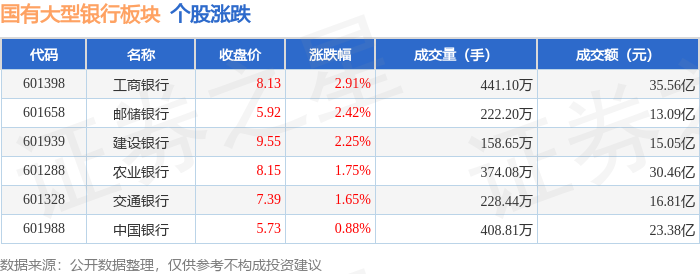
国有大型银行板块11月4日涨2.01%,工商银行领涨,主力资金净流入10.82亿元
Zheng Xing Xing Ye Ri Bao· 2025-11-04 08:48
Core Insights - The state-owned large bank sector experienced a 2.01% increase on November 4, with Industrial and Commercial Bank of China (ICBC) leading the gains [1] - The Shanghai Composite Index closed at 3960.19, down 0.41%, while the Shenzhen Component Index closed at 13175.22, down 1.71% [1] Bank Performance - ICBC's closing price was 8.13, up 2.91%, with a trading volume of 4.41 million shares and a transaction value of 35.56 billion [1] - Postal Savings Bank closed at 5.92, up 2.42%, with a trading volume of 2.22 million shares and a transaction value of 1.309 billion [1] - Construction Bank closed at 9.55, up 2.25%, with a trading volume of 1.5865 million shares and a transaction value of 15.05 billion [1] - Agricultural Bank closed at 8.15, up 1.75%, with a trading volume of 3.7408 million shares and a transaction value of 30.46 billion [1] - Bank of Communications closed at 7.39, up 1.65%, with a trading volume of 2.2844 million shares and a transaction value of 16.81 billion [1] - Bank of China closed at 5.73, up 0.88%, with a trading volume of 4.0881 million shares and a transaction value of 2.338 billion [1] Fund Flow Analysis - The state-owned large bank sector saw a net inflow of 1.082 billion in main funds, while retail funds experienced a net outflow of 565 million [1] - The main fund inflow for ICBC was 605 million, representing 17.00% of its total, while retail funds saw a net outflow of 274 million [2] - Agricultural Bank had a main fund inflow of 210 million, accounting for 6.88%, with retail funds experiencing a net outflow of 36.73 million [2] - Postal Savings Bank recorded a main fund inflow of 130 million, with retail funds seeing a net outflow of 74.73 million [2] - Construction Bank had a main fund inflow of 116 million, while retail funds experienced a net outflow of 122 million [2] - Bank of Communications saw a main fund inflow of 113 million, with retail funds experiencing a net outflow of 91.44 million [2] - Bank of China had a net outflow of 91.14 million in main funds, while retail funds saw a net inflow of 80.96 million [2]

中国银行行长张辉:消费拉动给中国银行发展带来非常好的支撑
Xin Lang Cai Jing· 2025-11-04 05:42
Core Insights - The International Financial Leaders Investment Summit was held on November 4, 2025, highlighting the importance of domestic consumption in China's economic growth [1] - Zhang Hui, Vice Chairman and President of the Bank of China, stated that domestic final consumption expenditure contributed 53.5% to economic growth in the first three quarters, driving GDP growth by 2.8 percentage points [1] - The Bank of China's research institute predicts that this contribution could rise to 60% in the future, indicating a significant role of consumption in the economy [1] - Zhang emphasized that China's consumption has a solid foundation, and with the growth of residents' income, the consumption potential will gradually expand, particularly in the service sector [1]
上市公司三季报的几点债市信号:A股上市公司三季报分析
Hua Yuan Zheng Quan· 2025-11-04 05:17
Report Industry Investment Rating - The report is bullish on the bond market, predicting that the yield of the 10Y Treasury bond will return to around 1.65% this year, the 30Y Treasury bond to 1.9%, and the 5Y Tier 2 capital bonds of large banks to 1.9% (for bonds without VAT) [74]. Core Viewpoints - The revenue growth rate of the entire A-share market and the net profit growth rate of the parent company are at a low level, indicating that the economic growth rate may have stabilized at a low level but still faces downward pressure. The yield of the 10-year Treasury bond is more closely related to the revenue growth rate of the entire A-share market than the nominal GDP growth rate [1][4]. - The loan growth rate has been declining, and the proportion of loans in the bank's asset side is decreasing. The demand for personal and corporate loans may be weak in the long term, while the scale of government bonds may significantly expand. The asset structure of the banking system may face long-term changes, with the proportion of loans likely to decline significantly [21][24]. - Since the beginning of 2023, the proportion of financial investments of large banks has rebounded, and the growth rate of bond investments has increased. The cost rate of interest-bearing liabilities of listed banks has been decreasing quarter by quarter, and it is expected to further decline in the future [1][49]. - The decline in bank liability costs will support the downward oscillation of bond yields. Given the current economic situation, the rapid decline in bank liability costs, and the loose capital situation, the report is bullish on the bond market [70][74]. Summary by Directory 1. Analyzing Economic and Bank Operating Pressures from the Q3 Reports of the Entire A-share Market - **Economic Insights from the Entire A-share Performance**: The revenue growth rate of the entire A-share market can reflect the nominal GDP growth rate to some extent. The revenue growth rate of the entire A-share market and the 10-year Treasury bond yield have a similar trend. The performance growth rate of the entire A-share market is still under pressure, and the growth rate of the real economy also faces significant pressure [5][6][9]. - **Economic Insights from the Bank Sector Performance**: The performance of the banking sector is closely related to the economy. In recent years, the performance growth of the banking sector has been under significant pressure, and the net interest margin of commercial banks has been continuously declining [11][12][15]. - **Financing Demand from the Entire A-share Liabilities**: Since Q1 2024, the long-term borrowing growth of the entire A-share market (excluding finance, petroleum, and petrochemicals) has almost stagnated, reflecting the weak financing demand of market-oriented enterprises. The social financing growth rate generally leads the nominal GDP growth rate by 1 - 2 quarters, but its guiding role may decline in the future [18][20]. 2. Changes in Bank Asset and Liability Situations - **Declining Loan Growth Rates of Large and Small Banks**: The loan growth rate has significantly declined. The growth of personal housing loans is facing negative growth pressure, which significantly drags down the growth rate of personal loans. The loan growth rates of both large and small banks have declined, and the proportion of loans is also decreasing. In the long term, the asset structure of the banking system may change, with the proportion of loans likely to decline and the proportion of bond investments likely to increase [21][25][36]. - **Decreasing Deposit Proportion on the Liability Side of Large Banks and Stable Deposit Proportion of Small Banks**: The growth of corporate deposits of large banks has slowed down. In recent years, the proportion of deposits on the liability side of large banks has decreased, while the average deposit proportion of listed joint-stock banks has increased [37][48]. 3. Banks with Significant Financial Investment Growth in Q3 2025 - Since the beginning of 2023, the proportion of financial investments of large banks has rebounded. In Q3 2025, the financial investments of some banks, such as ICBC and CCB, increased significantly, while those of a few banks decreased. The financial investment increments of large banks, joint-stock banks, and city and rural commercial banks were all significant, and the bond investment growth rates of the Big Four banks and small and medium-sized banks were also relatively high [49][56][59]. 4. Decrease in Bank Interest-Bearing Liability Costs - In 2025, the decline of the current deposit proportion slowed down. Since the beginning of 2024, the deposit interest payment rate has significantly decreased, and the interest-bearing liability cost rate has been decreasing quarter by quarter. It is expected to further decline in the future [60][63][66]. 5. Investment Recommendations - The decline in bank liability costs will support the downward oscillation of bond yields. In the future, the liability costs of commercial banks are expected to decline year by year, which will drive the yield of the 10-year Treasury bond to decline. Given the current economic situation and the value of government bond allocation, it is recommended that commercial bank self-operated departments increase the allocation of government bonds. The report is bullish on the bond market [70][73][74].

