SMIC(688981)

Search documents
科技股涨停潮,发生了什么?
天天基金网· 2026-01-21 05:20
有色金属、新能源、油气开采等板块也上涨。截至上午收盘,上证指数上涨0.16%,深证成指上涨 0.76%,创业板指上涨0.85%。 科技股反弹 今天上午,科技股反弹,半导体产业链、算力产业链、消费电子等板块上涨。新易盛、通富微电、 澜起科技、中芯国际、中科曙光等龙头股上涨,且成交额居前。 | V | 半导体 | | | | --- | --- | --- | --- | | | 14245.55 1.70% | | | | 成分股 基金 | 简况(F10) | 资金 | 板块分 | | 名称代码 | 最新 | 涨幅 ◆ | 流通市值 | | 龙芯中科 | 177.72 | 20.00% | 713亿 | | 融 688047 | | | | | 首板涨停 最终涨停 09:38 | | | | | 束龄股份 | 26.27 | 12.70% | 67.91Z | | 融 920139 | | | | | 海光信息 | 285.74 | 12.40% | 6642 Z | | 融 688041 | | | | | 杰华特 | 52.12 | 11.97% | 235亿 | | 融 688141 | | | | | ...




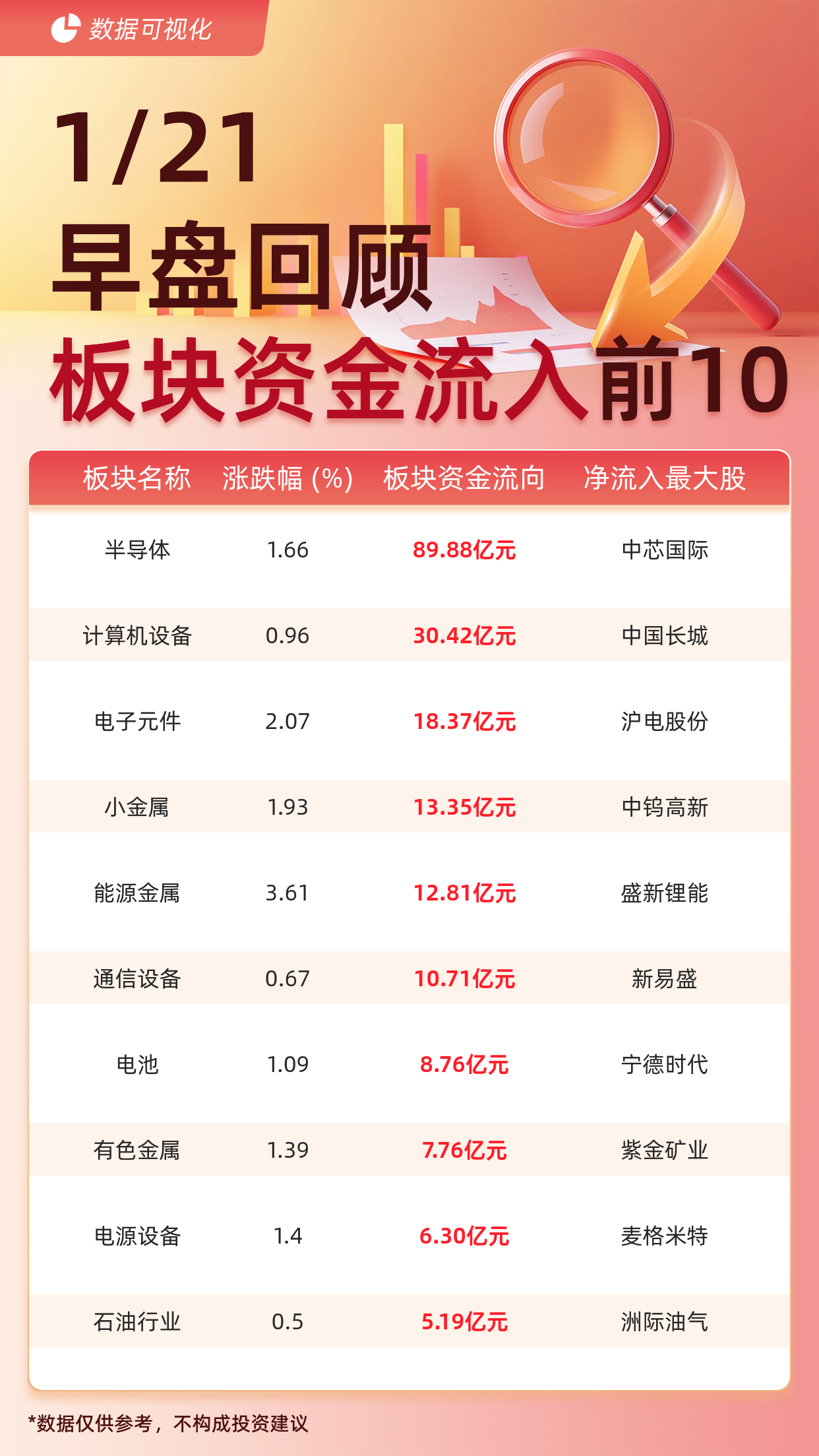
主力板块资金流入前10:半导体流入89.88亿元、计算机设备流入30.42亿元
Jin Rong Jie· 2026-01-21 04:04
Core Insights - The main market saw a net inflow of 77.65 billion yuan as of January 21, with significant investments in various sectors [1] Sector Summaries - **Semiconductors**: Experienced a net inflow of 89.88 billion yuan with a price increase of 1.66%, led by companies like SMIC [2] - **Computer Equipment**: Saw a net inflow of 30.42 billion yuan and a price increase of 0.96%, with China Great Wall Technology as a notable performer [2] - **Electronic Components**: Recorded a net inflow of 18.37 billion yuan and a price increase of 2.07%, highlighted by Huadian Technology [2] - **Minor Metals**: Achieved a net inflow of 13.35 billion yuan with a price increase of 1.93%, driven by Zhongtung High-tech [2] - **Energy Metals**: Noted a significant net inflow of 12.81 billion yuan and a price increase of 3.61%, with Shengxin Lithium Energy leading the sector [2] - **Communication Equipment**: Had a net inflow of 10.71 billion yuan and a price increase of 0.67%, with Xinyi Technology as a key player [2] - **Batteries**: Experienced a net inflow of 8.76 billion yuan and a price increase of 1.09%, with CATL being a major contributor [3] - **Non-ferrous Metals**: Recorded a net inflow of 7.76 billion yuan and a price increase of 1.39%, with ZD Technology as a notable company [3] - **Power Equipment**: Saw a net inflow of 6.30 billion yuan and a price increase of 1.4%, with Magpower as a significant player [3] - **Oil Industry**: Experienced a net inflow of 5.19 billion yuan and a price increase of 0.5%, with Intercontinental Oil and Gas leading the sector [3]
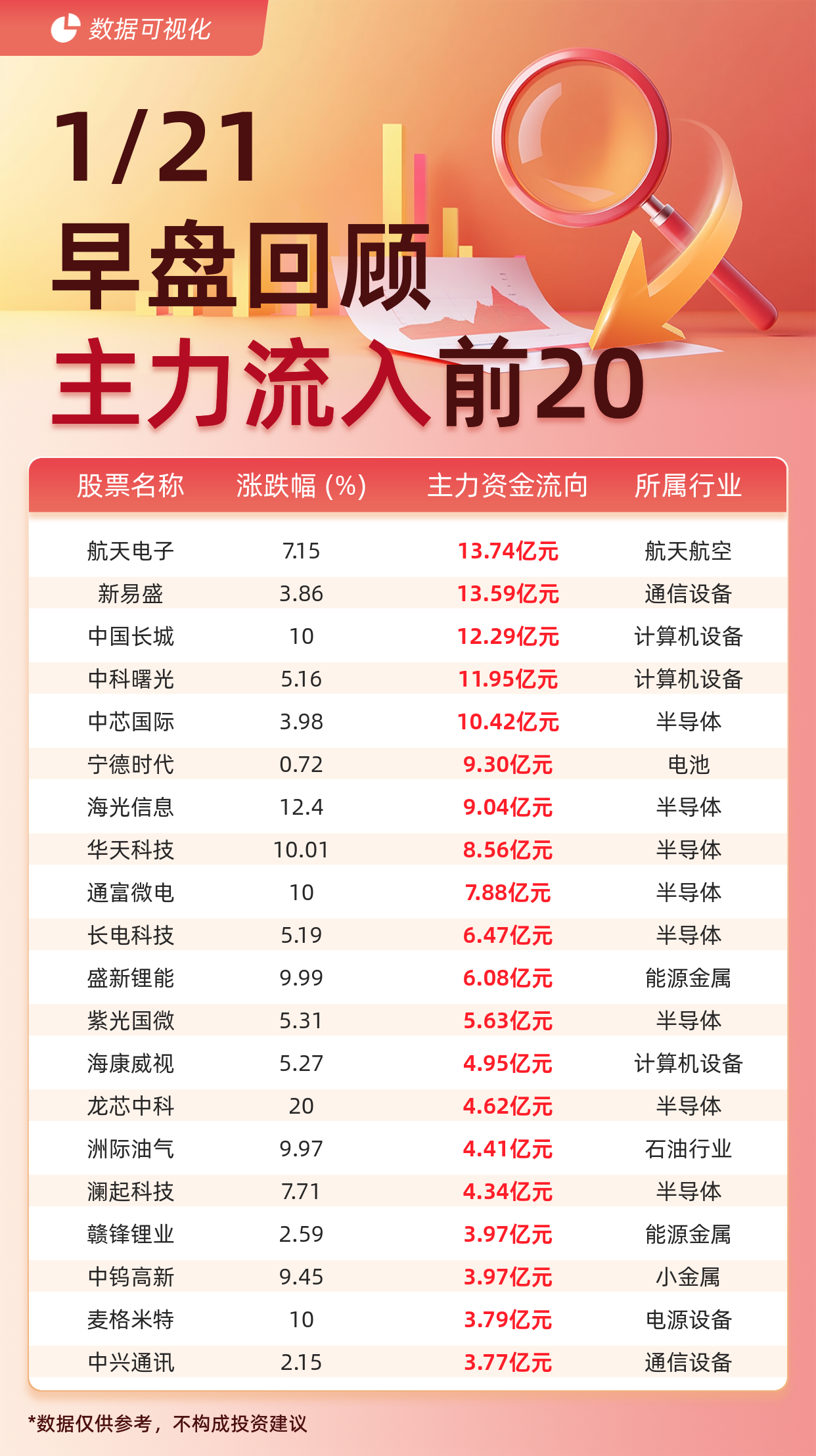
主力资金流入前20:航天电子流入13.74亿元、新易盛流入13.59亿元
Jin Rong Jie· 2026-01-21 04:04
Core Insights - The main focus of the news is on the significant inflow of capital into specific stocks, indicating strong investor interest and potential growth in these companies. Group 1: Stock Performance and Capital Inflow - Aerospace Electronic (航天电子) saw a capital inflow of 1.374 billion yuan with a price increase of 7.15% [1][2] - New Yisheng (新易盛) experienced a capital inflow of 1.359 billion yuan and a price rise of 3.86% [1][2] - China Great Wall (中国长城) had a capital inflow of 1.229 billion yuan, with a notable increase of 10% in its stock price [1][2] - Zhongke Shuguang (中科曙光) attracted 1.195 billion yuan in capital, reflecting a 5.16% increase [1][2] - SMIC (中芯国际) received 1.042 billion yuan with a stock price increase of 3.98% [1][2] - CATL (宁德时代) had a capital inflow of 930 million yuan, with a modest increase of 0.72% [1][2] - Haiguang Information (海光信息) saw a significant capital inflow of 904 million yuan and a price increase of 12.4% [1][3] - Huatian Technology (华天科技) attracted 856 million yuan with a stock price increase of 10.01% [1][3] - Tongfu Microelectronics (通富微电) had a capital inflow of 788 million yuan and a price increase of 10% [1][3] - Changdian Technology (长电科技) received 647 million yuan with a 5.19% increase in stock price [1][3] - Shengxin Lithium Energy (盛新锂能) saw a capital inflow of 608 million yuan and a price increase of 9.99% [1][3] Group 2: Additional Stocks and Their Performance - Unigroup Guowei (紫光国微) had a capital inflow of 563 million yuan with a price increase of 5.31% [3] - Hikvision (海康威视) attracted 495 million yuan with a stock price increase of 5.27% [3] - Loongson Technology (龙芯中科) saw a significant capital inflow of 462 million yuan and a remarkable price increase of 20% [3] - Intercontinental Oil and Gas (洲际油气) had a capital inflow of 441 million yuan with a price increase of 9.97% [3] - Lanke Technology (澜起科技) received 434 million yuan with a stock price increase of 7.71% [3] - Ganfeng Lithium (赣锋锂业) attracted 397 million yuan with a modest price increase of 2.59% [3] - Zhongtung High-tech (中钨高新) saw a capital inflow of 397 million yuan and a price increase of 9.45% [3] - Magpow (麦格米特) had a capital inflow of 379 million yuan with a price increase of 10% [3] - ZTE Corporation (中兴通讯) attracted 377 million yuan with a stock price increase of 2.15% [3]



AI算力需求持续爆发拉动存储涨价潮,科创芯片ETF(588200)一键布局国产芯片投资机遇
Xin Lang Cai Jing· 2026-01-21 02:39
Group 1 - The semiconductor and chip sector experienced a significant rally, with the STAR Market chip index rising by 3.92% as of 10:14 AM on January 21, 2026, driven by strong performances from companies like Loongson Technology (up 20.00%) and Haiguang Information (up 12.46%) [1] - CITIC Securities believes that the storage chip market is currently in a price uptrend due to the explosive demand from AI and supply-side contractions, leading to a performance surge for global storage industry enterprises [1] - The construction of storage production lines and the increase in domestic production rates are expected to accelerate, creating investment opportunities in domestic semiconductor equipment and packaging/testing sectors [1] Group 2 - TSMC is projected to achieve record-high revenue in Q4 2025, with advanced process technology (7nm and below) accounting for 77% of its revenue, and 3nm process shipments reaching 28% [1] - The company anticipates a significant increase in capital expenditure for 2026, estimated between $52 billion and $56 billion, aimed at enhancing its technological advantages and capacity expansion in the high-end wafer foundry sector [1] - The ongoing demand for AI computing power is expected to strongly drive the semiconductor manufacturing sector [1] Group 3 - As of December 31, 2025, the top ten weighted stocks in the STAR Market chip index accounted for 57.76% of the index, including companies like SMIC, Haiguang Information, and Cambrian [2] - The STAR Chip ETF (588200) serves as a convenient tool for investors looking to gain exposure to the STAR Market chip sector [2] Group 4 - Investors without stock accounts can explore investment opportunities in domestic chips through the STAR Chip ETF linked fund (017470) [3]


龙芯中科封板,科创50ETF涨超3%,冲击前期高点
Mei Ri Jing Ji Xin Wen· 2026-01-21 02:15
Market Performance - The A-share market showed signs of recovery in the early session, with all three major indices rising: the Shanghai Composite Index increased by 0.17%, the Shenzhen Component Index rose by 0.54%, and the ChiNext Index climbed by 1.15% [1] - The Kweichow Moutai ETF (588000) surged by 3.46%, with the latest price at 1.614 yuan, and the intraday trading volume reached 2.121 billion yuan, resulting in a turnover rate of 2.67% [1] Semiconductor Sector - The semiconductor sector experienced a significant rally, with notable stocks such as Longxin Technology hitting the limit up, Haiguang Information rising by 14.07%, Lanke Technology increasing by 6.80%, Zhongwei Company up by 3.97%, and SMIC gaining 3.04% [1] - The domestic semiconductor equipment sector is witnessing dual catalysts: the successful launch of the first high-energy hydrogen ion implanter developed by China National Nuclear Corporation, breaking foreign monopolies in key semiconductor manufacturing processes, and TSMC's financial report indicating a projected 35% increase in net profit by Q4 2025 and a gross margin of 62% [1] Industry Outlook - The dual catalysts are expected to accelerate the localization of domestic equipment, combined with AI-driven technological upgrades and capacity expansion, suggesting that the industry may enter a "golden period" of expansion cycles and technological breakthroughs [1] - The Kweichow Moutai ETF (588000) tracks the Sci-Tech 50 Index, which has a 70.35% allocation in the electronics sector, aligning well with the current development trends in artificial intelligence and robotics [1] - The ETF also covers multiple sub-sectors, including semiconductors, medical devices, software development, and photovoltaic equipment, indicating a high content of hard technology, and investors optimistic about the long-term development prospects of China's hard technology are encouraged to continue monitoring [1]


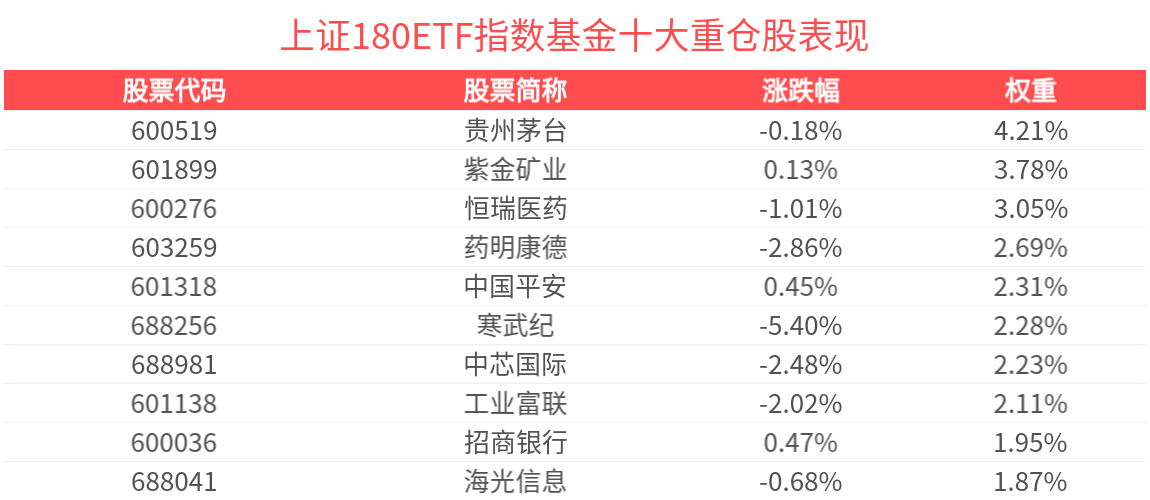
上证180指数上涨0.08%,上证180ETF指数基金(530280)实现4连涨
Sou Hu Cai Jing· 2026-01-21 01:55
Core Viewpoint - The Shanghai 180 ETF Index Fund closely tracks the Shanghai 180 Index, which reflects the overall performance of 180 large-cap and liquid stocks in the Shanghai securities market [2] Group 1: Index Performance - As of January 20, 2026, the Shanghai 180 Index rose by 0.08%, with notable increases in constituent stocks such as China Chemical (+10.01%), China Power Construction (+7.02%), and Hengli Petrochemical (+6.62%) [1] - The Shanghai 180 ETF Index Fund achieved a four-day consecutive increase, with the latest price reported at 1.26 yuan [1] - The fund's average daily trading volume over the past year was 256.26 million yuan, with a turnover rate of 0.11% on January 20, 2026 [1] Group 2: Fund Metrics - The fund's Sharpe ratio since inception is 2.13, indicating a favorable risk-adjusted return [1] - The maximum drawdown for the fund year-to-date is 1.30%, with a relative benchmark drawdown of 0.06% [1] - The management fee for the fund is 0.15%, and the custody fee is 0.05% [1] Group 3: Top Holdings - As of December 31, 2025, the top ten weighted stocks in the Shanghai 180 Index account for 25.29% of the index, including Kweichow Moutai, Zijin Mining, and China Ping An [2] - The top ten stocks by weight are Kweichow Moutai (4.21%), Zijin Mining (3.78%), and China Ping An (2.31%), among others [3]





中芯国际等巨头集体提价 8英寸芯片最高涨20%
Ge Long Hui· 2026-01-21 01:11
格隆汇1月21日|据21财经,集邦咨询报告显示,全球8英寸晶圆供需正步入失衡期。受台积电、三星电 子战略性削减产能影响,2026年全球8英寸代工总产能将萎缩2.4%。而AI驱动的电源管理芯片(Power IC)等产品需求维持强劲,正拉动行业平均产能利用率回升至90%的高位。在此背景下,中国大陆晶圆 代工厂正在崛起,成为满足8英寸芯片需求的替代方案。晶圆代工厂正提高报价,预计调价幅度在5%至 20%之间。 具体来看,目前台积电在中国台湾有4座8英寸晶圆厂和1座6英寸晶圆厂,若要在2027年全 面退出,2026年就需要持续削减产能。目前台积电的8英寸晶圆代工月产能约为52.8万片。 三星电子同 样于2025年下半年启动8英寸晶圆厂减产,且态度更为积极,希望将更多的资源投入到12英寸晶圆市场 的竞争当中。此前,三星为了应对持续亏损的晶圆代工业务以及8英寸晶圆厂的低产能利用率,就已经 计划削减8英寸晶圆厂规模,并传闻对8英寸代工制造和技术团队裁员30%以上。目前三星电子的8英寸 晶圆代工月产能亦约为52.8万片。 联电旗下8英寸晶圆月产能曾超36万片,现阶段产能利用率约70%。 展望后市,联电正向看待2026年营运有 ...
中芯国际等巨头集体提价,8英寸芯片最高涨20%
2 1 Shi Ji Jing Ji Bao Dao· 2026-01-21 00:59
记者丨彭新 在此背景下,中国大陆晶圆代工厂正在崛起,成为满足8英寸芯片需求的替代方案。同时,晶圆代工厂 正提高报价,预计调价幅度在5%至20%之间。 8英寸晶圆供需失衡 编辑丨骆一帆 8英寸晶圆主要用于生产电源管理芯片(PMIC)、驱动IC、微控制器(MCU)及功率器件(IGBT、 MOSFET)等。长期以来,该市场因工艺成熟、设备折旧完毕,被视为先进制程巨头资产组合中的"现 金奶牛",利润丰厚。 人工智能(AI)浪潮之下,先进制程芯片难求、身价飙升。与此同时,曾被晶圆厂加速剥离的8英寸晶 圆产线,正因国际巨头集体转向12英寸以及AI外围芯片需求的增长,上演了一场从产能过剩到提价满 载的结构性反转。在此变局下,中国大陆晶圆代工厂正承接这一全球产能真空,其角色变化引起市场瞩 目。 1月13日,市场调研机构集邦咨询(TrendForce)发布最新报告显示,全球8英寸晶圆供需正步入失衡 期。受台积电、三星电子战略性削减产能影响,2026年全球8英寸代工总产能将萎缩2.4%。与此同时, AI驱动的电源管理芯片(Power IC)等产品需求维持强劲,正拉动行业平均产能利用率回升至90%的高 位。 然而,随着制程节点向3 ...

中芯国际等巨头集体提价,8英寸芯片最高涨20%
21世纪经济报道· 2026-01-21 00:52
记者丨彭新 编辑丨骆一帆 人工智能(AI)浪潮之下,先进制程芯片难求、身价飙升。与此同时,曾被晶圆厂加速剥离的 8英寸晶圆产线,正因国际巨头集体转向12英寸以及AI外围芯片需求的增长,上演了一场从产 能过剩到提价满载的结构性反转。在此变局下,中国大陆晶圆代工厂正承接这一全球产能真 空,其角色变化引起市场瞩目。 1月13日,市场调研机构集邦咨询(TrendForce)发布最新报告显示, 全球8英寸晶圆供需正 步入失衡期。 受台积电、三星电子战略性削减产能影响,2026年全球8英寸代工总产能将萎缩 2.4%。与此同时,AI驱动的电源管理芯片(Power IC)等产品需求维持强劲,正拉动行业平 均产能利用率回升至90%的高位。 在此背景下,中国大陆晶圆代工厂正在崛起,成为满足8英寸芯片需求的替代方案。同时, 晶 圆代工厂正提高报价,预计调价幅度在5%至20%之间。 8英寸晶圆供需失衡 8英寸晶圆主要用于生产电源管理芯片(PMIC)、驱动IC、微控制器(MCU)及功率器件 (IGBT、MOSFET)等。长期以来,该市场因工艺成熟、设备折旧完毕, 被视为先进制程巨 头资产组合中的"现金奶牛",利润丰厚。 然而,随着制程 ...

中国大陆晶圆代工厂,抓住8英寸代工机会
2 1 Shi Ji Jing Ji Bao Dao· 2026-01-20 12:37
Core Insights - The rise of China's wafer foundries is addressing the demand for 8-inch chips as global giants shift focus to 12-inch wafers and AI-related chip needs increase [1][6] - A structural reversal in the 8-inch wafer market is occurring due to a combination of reduced capacity from major players and strong demand for power management chips driven by AI [4][5] Group 1: Market Dynamics - The global supply and demand for 8-inch wafers is entering a state of imbalance, with a projected 2.4% decline in total global 8-inch foundry capacity by 2026 due to strategic capacity reductions by TSMC and Samsung [4][6] - The average capacity utilization rate in the industry is expected to rise to 90% by Q4 2025, reflecting a year-on-year increase of approximately 7 percentage points, driven by AI applications and recovery in automotive and industrial control sectors [4][6] Group 2: Chinese Foundries' Position - Chinese wafer foundries are positioned to fill the global capacity vacuum left by TSMC and Samsung, with companies like SMIC and Hua Hong Semiconductor showing strong performance in 8-inch production [6][7] - SMIC's monthly production capacity for logic chips (equivalent to 8-inch) has reached a historic high of 1.023 million wafers, with a capacity utilization rate of 95.8% as of Q3 2025 [7] - Hua Hong Semiconductor's 8-inch production lines are nearing full capacity, benefiting from orders redirected from international power semiconductor giants [7] Group 3: Pricing Trends - Due to the surge in demand, Chinese wafer foundries have raised prices for 8-inch chip processes by approximately 10%, with some orders seeing increases of up to 20% [8][9] - The price increase trend is expected to continue into 2026, as the supply-demand tightness persists [9] Group 4: Long-term Outlook - Despite the current boom in 8-inch wafer production, the long-term trend indicates a migration of power management and display driver chips towards 12-inch nodes, necessitating Chinese manufacturers to accelerate their 12-inch specialty process development [9] - The global semiconductor manufacturing sector anticipates an increase in 12-inch wafer production capacity to a historical high of 9.6 million wafers per month by 2026, driven by sustained strong demand [9]