TCL TECH.(000100)

Search documents
TCL科技(000100) - 关于子公司TCL中环下属公司签订专利许可协议的公告
2026-02-06 13:00
证券代码:000100 证券简称:TCL 科技 公告编号:2026-010 TCL 科技集团股份有限公司 关于子公司 TCL 中环下属公司签订专利许可协议的公告 本公司及董事会全体成员保证信息披露内容的真实、准确、完整, 没有虚假记载、误导性陈述或重大遗漏。 一、交易概述 TCL 科技集团股份有限公司(以下简称"公司")下属子公司 TCL 中环新 能源科技股份有限公司(以下简称"TCL 中环")控股子公司 Maxeon Solar Technologies,Ltd.(以下简称"Maxeon")的全资子公司 Maxeon Solar Pte. Ltd. (以下简称"MSPL")与上海爱旭新能源股份有限公司(以下简称"爱旭股份") 于近日签署了《专利许可协议》(以下简称"许可协议"),MSPL 拟向爱旭股 份授权其"背接触"太阳能电池及组件相关的专利(以下简称"BC 专利"), 授权其在全球范围内(美国地区除外)使用,授权期自协议签署之日起五年,许 可费用总计人民币 165,000 万元,按照协议约定分五年支付。 本次专利许可事项不构成关联交易,亦不构成《上市公司重大资产重组管理 办法》规定的重大资产重组。许可协 ...

群智咨询:2025年全球智能手机面板出货量同比增长约3.4%至23.1亿片
智通财经网· 2026-02-06 11:20
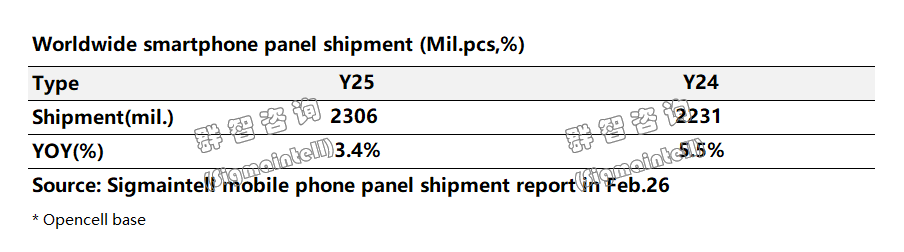
Core Insights - The global smartphone panel shipment is projected to reach approximately 2.31 billion units in 2025, reflecting a year-on-year growth of about 3.4%, despite a slowdown in growth rate [1] - The growth is primarily driven by the continued scale expansion of a-Si LCD capacity and the ongoing penetration and shipment growth of flexible OLED models [1] Structure Insights - **a-Si LCD**: The total shipment is expected to be around 1.33 billion units in 2025, marking a year-on-year increase of 10.2%, showcasing strong resilience against economic uncertainties [3] - **LTPS LCD**: The shipment is projected to be about 87 million units, a significant decline of 51.4%, falling below 100 million units for the first time [3] - **Rigid OLED**: Shipment is estimated at 200 million units, down 7.7%, accounting for 22.4% of total AMOLED shipments [3] - **Flexible OLED**: Expected shipment is around 690 million units, with a year-on-year growth of 9.6%, driven by the penetration of mid-range smartphone models [4] Market Dynamics - The top five smartphone panel manufacturers are expected to hold a combined market share of 72.7% in 2025, an increase of 3.5 percentage points [6] - **BOE**: Maintains the largest market share at 23.8%, with total shipments of approximately 550 million units, primarily driven by a-Si LCD [6][8] - **Samsung Display (SDC)**: Holds a 16.4% market share with total shipments of about 380 million units, focusing on high-end flexible OLED [6][8] - **CSOT**: Achieves a market share of 12.3% with total shipments of around 280 million units, driven by a-Si LCD's cost advantages [7][8] Outlook Insights - The industry faces pressure from economic uncertainties and rising costs, leading to potential weakening demand for smartphone panels in 2026 [10] - Panel manufacturers are advised to optimize capacity structure, focusing on high-margin high-end models while reducing low-value mid-range capacity [10] - There is an emphasis on enhancing supply chain management and cost control to mitigate risks associated with market dependency [10]



“湾区智造‘新地标落地冬奥会!TCL米兰冬奥主题馆开馆
Nan Fang Du Shi Bao· 2026-02-06 10:34
Group 1 - The Milan Winter Olympics will showcase TCL's advanced technologies, including the world's first printed OLED foldable portable display and a 4K 120Hz printed OLED display, highlighting China's manufacturing capabilities in global events [2] - TCL's CEO emphasized that these technological advancements will enhance the vibrancy and excitement of the Winter Olympics, showcasing the importance of display technology in making the events visually appealing [3] - Chinese brands, including Anta and Li Ning, are providing high-tech sports equipment for multiple national teams, indicating China's ability to offer core services in global sporting events [3] Group 2 - The founder of TCL stated that Chinese enterprises have entered the 3.0 era of globalization, shifting from mere product exports to the output of industrial capabilities, emphasizing the need for localized operations abroad [3] - The role of Chinese technology companies in the Winter Olympics reflects a trend of exporting "Chinese solutions" for large-scale event services through technological innovation and industry chain collaboration [3]
电视行业,为什么总被科技潮流“遗忘”?
Xin Lang Cai Jing· 2026-02-06 07:20
Core Viewpoint - The traditional television industry is facing significant challenges, highlighted by contrasting announcements from TCL and Skyworth, with TCL acquiring Sony's television business while Skyworth plans to privatize and focus on solar energy [1] Group 1: Market Trends - The Chinese television market is projected to see a decline in brand shipments, with an expected drop to 32.895 million units in 2025, a decrease of 8.5% year-on-year, marking a 16-year low [1] - Retail sales are also anticipated to fall to 27.63 million units in 2025, down 10.4% year-on-year, reverting to levels seen a decade ago [1] Group 2: Technological Integration - Television manufacturers are attempting to leverage emerging technologies like AI to revitalize the market, with AI televisions becoming a focal point at industry events [2] - Despite initial enthusiasm for AI integration, the actual market impact of AI televisions has been minimal, with a noticeable decline in marketing efforts within a year [2] Group 3: Historical Context - Previous technological trends, such as IoT and AI, have not significantly benefited the television industry, as manufacturers have struggled to create impactful products [3][4] - The industry's slow response to technological advancements, particularly in comparison to internet companies, has hindered its ability to innovate [5] Group 4: Strategic Challenges - Traditional television manufacturers have often relied on third-party technologies rather than developing their own, leading to a lack of significant innovation [6] - Companies like Skyworth have diversified into other sectors, such as real estate and semiconductors, which has diluted their focus on core television technology [6] Group 5: Consumer Experience - The stagnation in user experience and lack of revolutionary innovations in television have contributed to the industry's decline, with many consumers feeling that television lacks interactivity [10][11] - The reliance on display technology has limited the potential for meaningful product innovation, as many new features do not resonate with consumers [9][10]


深市规模最大的光伏ETF(159857)标的指数涨超2%,机构:白银价格高位回落有助于缓解电池片环节的成本压力
Mei Ri Jing Ji Xin Wen· 2026-02-06 07:08
Group 1 - The photovoltaic sector showed strong performance with the photovoltaic ETF (159857) rising over 2% during trading, with a transaction volume of 268 million yuan [1] - The ETF has seen a net inflow of 260 million yuan over the last ten trading days, with a current fund size of 2.322 billion yuan, making it the largest in its category in the Shenzhen market [1] - The ETF closely tracks the photovoltaic industry index, with major allocations in photovoltaic equipment (61.53%), grid equipment (13.3%), and electricity (8.57%) [1] Group 2 - Recent discussions by the Ministry of Industry and Information Technology emphasized guiding the photovoltaic industry towards healthy competition and avoiding "involution" [1] - The Ministry of Finance announced that it will phase out the export tax rebate for photovoltaic products starting April 1, 2026 [1] - The space photovoltaic concept is gaining attention, with Elon Musk's space energy plan bringing new momentum to the industry [1] Group 3 - High silver prices are pushing the photovoltaic metallization sector towards a technological revolution, with copper alternatives like silver-coated copper and electroplated copper becoming key cost-reduction strategies [2] - Successful large-scale application of these alternatives could significantly enhance the performance of related materials and equipment companies [2]





中国厂商掌握6成日本电视市场
3 6 Ke· 2026-02-06 05:16
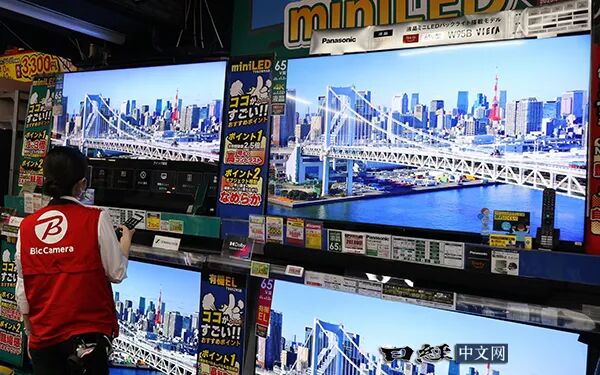
Group 1 - The core viewpoint of the articles highlights the increasing dominance of Chinese companies in the Japanese television market, with projections indicating that they will control 60% of the market share by 2025 due to the withdrawal of Japanese brands like Sony and Toshiba [2][3]. - Sony Group plans to divest its television business by 2027, transitioning it to a joint venture with TCL, which will hold a 51% stake, while Sony retains 49% [2]. - REGZA, a brand associated with Toshiba, is primarily manufactured and sold by TVS REGZA, which is 95% owned by China's Hisense Group, indicating a significant shift in ownership and market dynamics [2]. Group 2 - Chinese companies are outperforming Japanese firms in pricing, with TCL's 43-inch 4K LCD TV priced around 50,000 yen (approximately 2,257.55 RMB), compared to Sony's price of around 100,000 yen (approximately 4,515.1 RMB) [3]. - By 2025, REGZA is projected to lead the Japanese television market, with Chinese brands like Hisense and TCL collectively holding 50% of the market share, which could rise to 60% if Sony's brand is transferred to the TCL-led joint venture [3]. - The global television market is increasingly dominated by companies like Samsung, LG, Hisense, and TCL, which together hold over 50% of the market share, indicating a decline in the presence of Japanese companies [5]. Group 3 - Panasonic is the only major Japanese company pursuing an independent path in the television sector after Sony's divestment, but it is also considering selling or exiting the television business [5]. - Japanese companies are struggling with scale and supply chain issues, making it difficult to compete in the hardware-centric home appliance market [6]. - Companies like Sony and Hitachi are shifting their business models towards digital infrastructure and subscription-based products, indicating a strategic pivot away from traditional home appliances [6].

冬奥会周边打卡新地标!雷鸟狩猎者显示器演绎冰雪电竞狂欢
Zhong Guo Zhi Liang Xin Wen Wang· 2026-02-06 04:51
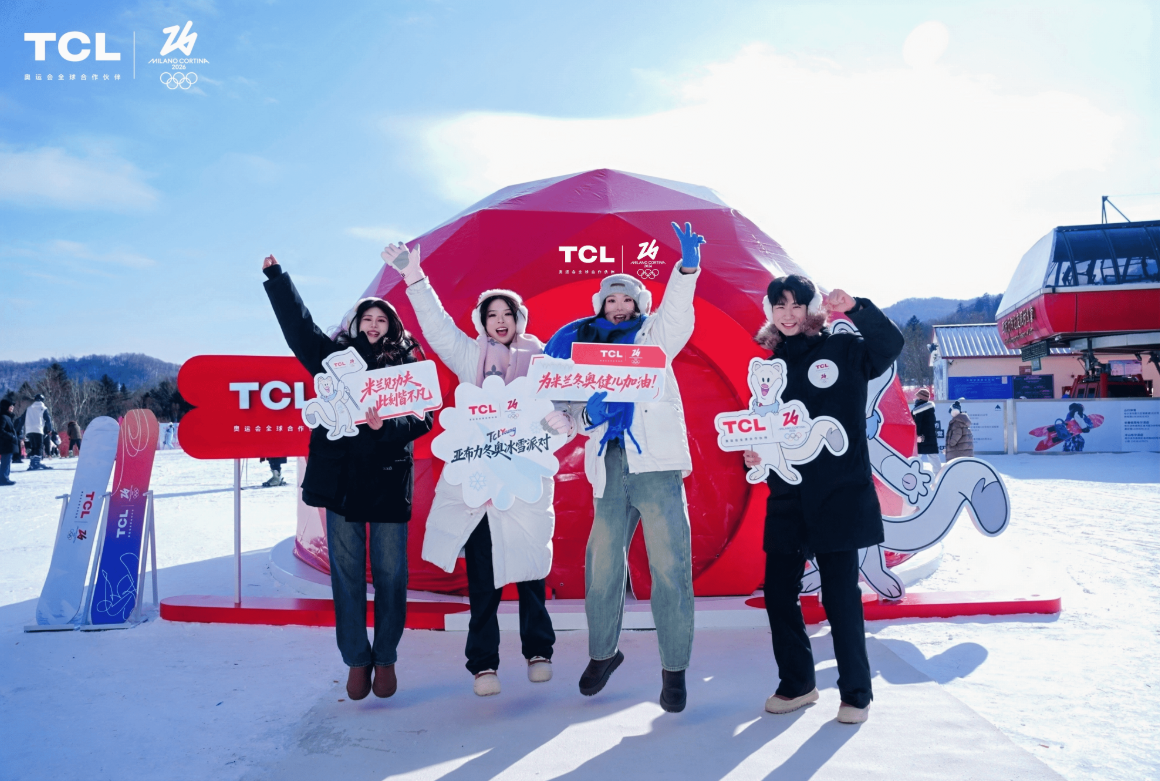
Core Viewpoint - The 25th Milan Winter Olympics serves as a significant platform for brands to connect with younger audiences, with TCL showcasing its "dare to be extraordinary" spirit through various global brand initiatives, including the immersive esports experience at the Yabuli Snow Resort [1] Group 1: Product Performance and Testing - The Thunderbird Hunter 27U8A Pro monitor is designed to withstand extreme conditions, demonstrating its stability and reliability in temperatures as low as -40°C, which is critical for users in northern regions [5][9] - The monitor utilizes QD-MiniLED backlight technology and a wide temperature range compatible FAST IPS panel, ensuring consistent performance and color accuracy even in harsh environments [5][6] - Real-world testing in extreme cold conditions provides a more accurate assessment of a product's industrial design and hardware adaptability compared to controlled laboratory tests [4] Group 2: User Experience and Features - The monitor supports dual-mode 4K technology, allowing seamless switching between 4K 160Hz and FHD 320Hz modes, enhancing the gaming experience across different genres [6] - It includes features such as smart dark area enhancement and customizable game modes, which improve gameplay by providing better visibility and targeting accuracy [6][7] - The monitor's high brightness and contrast levels, along with its wide color gamut, deliver vivid and lifelike visuals, enhancing both gaming and creative applications [7] Group 3: Brand Strategy and Market Positioning - TCL's integration of the Thunderbird monitor into the esports ecosystem at the Yabuli Snow Resort emphasizes a user-first approach, moving beyond mere parameter comparisons to focus on real-world usability and experience [9] - The event showcases a complete esports setup, reinforcing the brand's commitment to providing high-quality, reliable products that meet the demands of extreme environments [4][9]
150美元,TCL出海做了块儿童手表桌面机
3 6 Ke· 2026-02-06 04:07
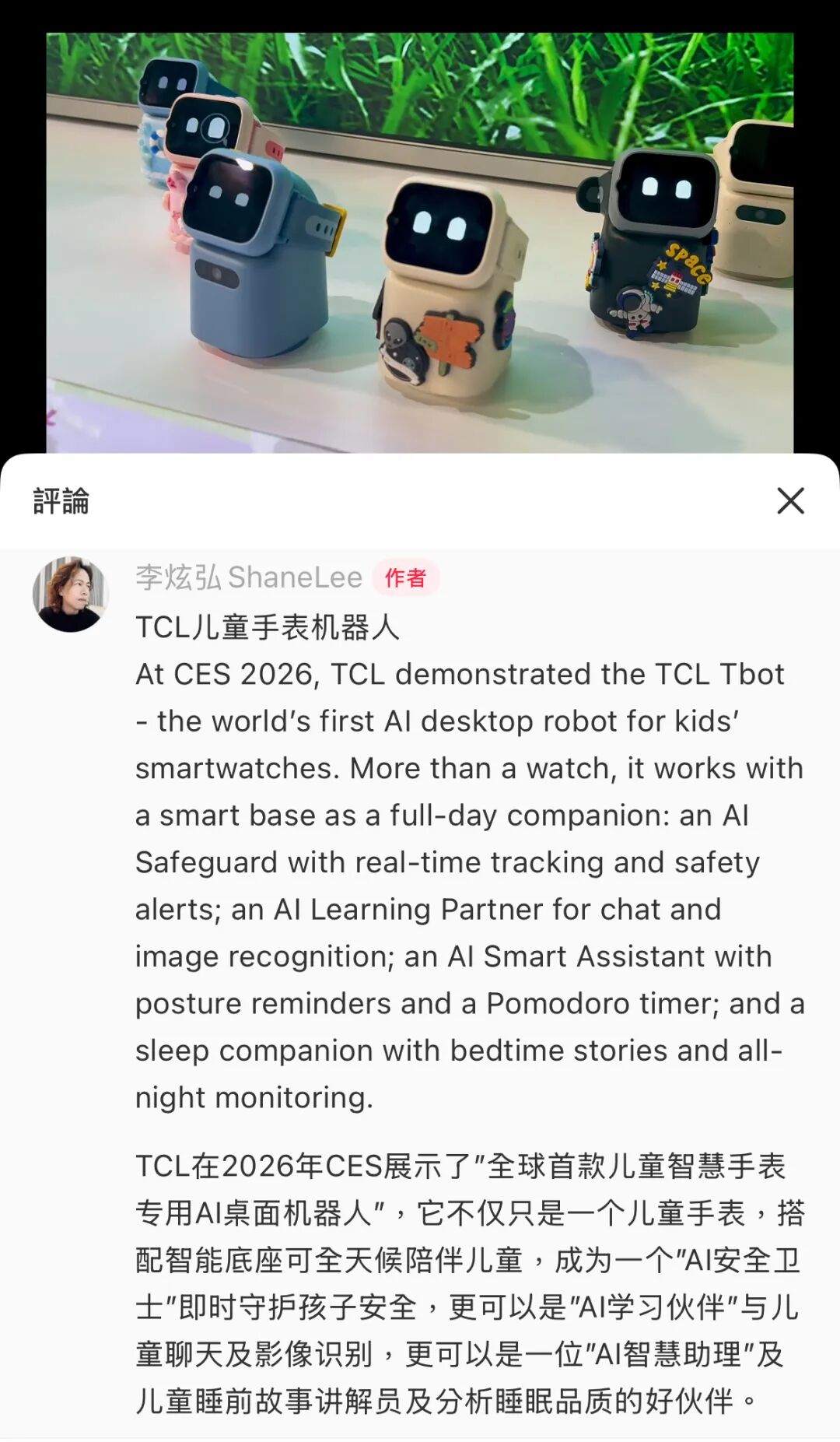
Core Viewpoint - TCL has introduced the "TCL Tbot," a children's smartwatch that functions as a desktop robot, designed to provide companionship and various interactive features for children [1][4]. Product Features - Tbot is not just a smartwatch; it comes with a smart base that allows it to accompany children throughout the day [4]. - It includes functionalities such as AI guardianship, AI learning companion, AI chat interaction, and image recognition [4]. - The device offers features like bedtime story narration and sleep quality analysis [4]. Usage Scenarios - Tbot's application spans both outdoor and indoor environments, fulfilling health and safety needs when outside and serving as a small display inside [5]. - The smartwatch's face acts as a mini display, while the base unit includes a small sensor for user behavior recognition [5]. - The design allows for flexible customization, enabling children to personalize their Tbot [5]. Market Position - Priced at $150 (approximately 1040 RMB), Tbot is positioned in the mid-to-high range of the domestic children's smartwatch market [10]. - Data indicates that the 300-600 RMB price range accounts for 40.7% of sales in the children's smartwatch segment, reflecting consumer demand for functionality and cost-effectiveness [12]. - The high-end market (800 RMB and above) is experiencing rapid growth, with a year-on-year increase of 151.7%, driven by flagship products from brands like Xiaotianci, Huawei, and Xiaomi [13]. Industry Trends - The period from 2024 to 2025 is expected to be transformative for children's smartwatches as they increasingly integrate AI capabilities [13]. - Competitors are also launching AI-enhanced products, such as 360's children's smartwatch featuring the A9 AI model, which includes various educational and social applications [15]. - Xiaotianci is emphasizing its AI voice assistant "Genius Rabbit" in its 2025 product lineup, enhancing user interaction through voice commands [16][18]. Innovation and Development - Motorola has filed a patent for a device that can morph between wearable and handheld modes, indicating a trend towards versatile electronic devices [19][21]. - The evolution of smartwatches is marked by attempts to extend their functionality beyond traditional uses, as seen in TCL's Tbot and previous products like Niuting's "Super Memory Wearable" [21][23]. - TCL's approach to Tbot reflects a consistent understanding of companionship, aiming to create a comprehensive system that meets various needs across different contexts [25].
中国厂商掌握6成日本电视市场
日经中文网· 2026-02-06 02:52
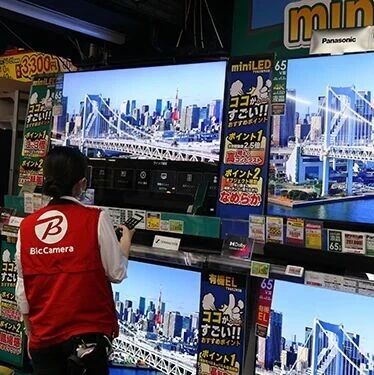
Core Viewpoint - The Japanese consumer electronics industry, particularly in the television sector, is experiencing a significant shift towards Chinese ownership and influence, with projections indicating that Chinese companies will dominate the market share in the coming years [2][5]. Group 1: Market Dynamics - In Tokyo's electronics retail stores, brands like REGZA, BRAVIA, and Viera are prominently displayed, but the capital structure reveals that Chinese companies will control 60% of the market share due to the withdrawal of Japanese firms [2][4]. - Toshiba's REGZA brand is primarily owned by Hisense, a Chinese appliance giant, holding 95% of the shares, while Toshiba retains only 5% [4]. - Sony plans to divest its television business by 2027, transitioning to a joint venture with TCL, where TCL will hold 51% and Sony 49%, effectively placing the Sony brand under Chinese control [4][5]. Group 2: Competitive Landscape - According to BCN Research, REGZA is projected to lead the Japanese television market by 2025, with Chinese brands like Hisense and TCL collectively holding 50% of the market share. If Sony's brand moves to the TCL-led joint venture, the Chinese share will rise to 60% [5]. - In the global television market, Japanese companies are losing ground, with South Korea's Samsung Electronics leading the market, followed by LG, Hisense, and TCL, which together account for over 50% of the global market share [7]. Group 3: Strategic Shifts - Panasonic is the only major Japanese company left pursuing an independent path in the television sector after Sony's divestment. Panasonic is also considering selling or exiting its television business by 2025 [7]. - The restructuring is not limited to televisions; Toshiba sold its refrigerator business to Midea Group in 2016, and Hitachi is contemplating selling its domestic business [7]. - Japanese companies are struggling with scale and supply chain issues, prompting a shift towards digital and subscription-based business models, as seen with Sony's focus on PlayStation and infrastructure digitalization [8].

六名将之外,冬奥中国代表团10组潜力选手值得关注
3 6 Ke· 2026-02-06 02:44
Core Viewpoint - The 2026 Milan Winter Olympics will see the largest Chinese delegation in history, with 126 athletes participating in various events, but the domestic market's attention is less than previous Olympics [1][2]. Group 1: Athlete Participation and Brand Engagement - The Chinese sports delegation for the Milan Winter Olympics consists of 126 athletes, with an average age of 25, competing in 7 major events and 91 sub-events, marking the largest scale for China in an overseas Winter Olympics [1]. - Compared to the Beijing Winter Olympics, the interest in the Milan Winter Olympics is lower, with major streaming platforms like Kuaishou and Douyin yet to announce broadcasting rights [1][2]. - Brands such as TCL, Mengniu, and Alibaba are actively engaging in marketing campaigns ahead of the Winter Olympics, indicating a focus on Olympic marketing despite the overall cautious approach from many brands [1][2]. Group 2: Key Athletes and Their Commercial Value - Gu Ailing and Su Yiming are highlighted as the most prominent athletes, with Gu Ailing achieving significant commercial success, ranking fourth in Forbes' list of highest-earning female athletes with an annual income of $23.1 million (approximately 160 million RMB) [4]. - Su Yiming has also gained considerable brand attention, with 11 endorsements across various sectors, including beverages and luxury goods, following his success at the Beijing Winter Olympics [6]. - Xu Mengtao, another key athlete, has expanded her brand partnerships significantly after her Olympic success, signing with brands like UTO and Geely [8]. Group 3: Emerging Athletes and Marketing Opportunities - The article identifies several emerging athletes with potential for brand partnerships, including Yang Jingru, Wang Ziyang, and Zhang Xiaonan, who have shown promising performances in their respective sports [12][14][16][18]. - The presence of these athletes provides brands with opportunities to engage in Olympic marketing, as they possess both competitive potential and marketability [12][14][16][18]. - The article emphasizes that brands can benefit from associating with both established stars and rising talents to maximize their marketing impact during the Olympics [12][14][16][18].