
LZLJ(000568)

Search documents
敢为人先 铺就享誉中外“驰名路”
Xin Hua Cai Jing· 2025-12-23 09:30
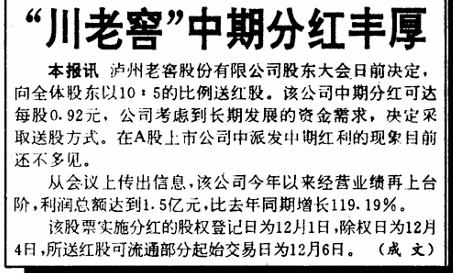
Core Viewpoint - The article highlights the historical development and achievements of Luzhou Laojiao, a prominent Chinese liquor brand, during the transformative years of 1990 to 1998, showcasing its innovative strategies and market positioning that contributed to its success in both domestic and international markets [2][7]. Group 1: Historical Context and Market Positioning - The series "Time Tasting Season 4" focuses on significant events in the history of Luzhou Laojiao, utilizing authentic historical materials to narrate lesser-known stories [1]. - The report from Shanghai Securities Journal in November 1995 noted that Luzhou Laojiao decided to distribute stock dividends at a ratio of 10:5, with a mid-term dividend of 0.92 yuan per share, which was a rare occurrence among A-share listed companies at the time [1][2]. - The 1990s saw rapid growth in China's economy and the liquor industry, with Luzhou Laojiao leading the transformation from premium to more accessible products to meet consumer demand [3][4]. Group 2: Innovations and Brand Development - Luzhou Laojiao launched several products aimed at the mass market, such as 45-degree Tequ, Luzhou Spring, and Chen Nian, emphasizing "premium quality at affordable prices" [3]. - The company received the title of "China Famous Trademark" in 1991, significantly enhancing its brand competitiveness and consumer trust [3][6]. - Since its listing, Luzhou Laojiao has distributed dividends 32 times, totaling 52.059 billion yuan, with a dividend rate of 61.58%, ranking it among the top listed companies [5]. Group 3: Cultural Heritage and International Recognition - Luzhou Laojiao has a strong cultural foundation, with its production facilities recognized as key cultural heritage sites, enhancing its historical significance [6]. - The company achieved numerous international awards from 1990 to 1998, including multiple gold medals at prestigious international food exhibitions, which helped elevate the global perception of Chinese liquor [6][7]. - The brand's commitment to quality and cultural roots has positioned it as a leading representative of Chinese liquor on the international stage, demonstrating the potential for Chinese brands to compete globally [7].


白酒板块12月23日跌0.3%,皇台酒业领跌,主力资金净流出7.43亿元
Zheng Xing Xing Ye Ri Bao· 2025-12-23 09:08
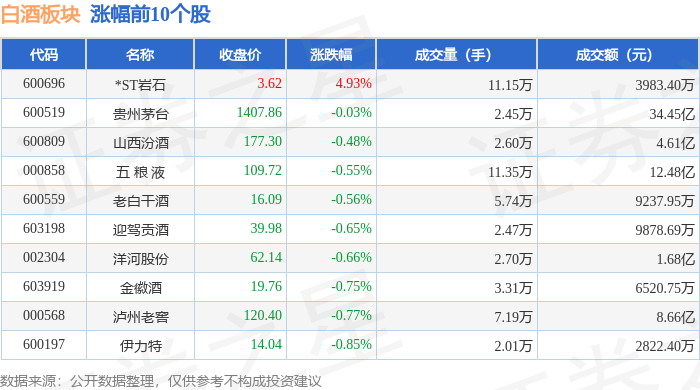
Group 1 - The liquor sector experienced a decline of 0.3% on December 23, with Huangtai Liquor leading the drop [1] - The Shanghai Composite Index closed at 3919.98, up 0.07%, while the Shenzhen Component Index closed at 13368.99, up 0.27% [1] - Notable individual stock performances include ST Yanshi with a closing price of 3.62, up 4.93%, and Kweichow Moutai at 1407.86, down 0.03% [1] Group 2 - The liquor sector saw a net outflow of 743 million yuan from main funds, while retail investors contributed a net inflow of 418 million yuan [2] - The trading volume for major liquor stocks varied, with Wuliangye recording a transaction amount of 1.248 billion yuan and Luzhou Laojiao at 866 million yuan [1][2] - The stock performance of various companies showed a downward trend, with notable declines in shares such as Shede Liquor down 1.39% and Gujing Gongjiu down 1.35% [2] Group 3 - The main fund inflow and outflow data indicates that ST Yanshi had a net inflow of 5.177 million yuan, while Yilite experienced a significant outflow of 5.646 million yuan [3] - The data reflects a mixed sentiment among investors, with retail investors showing a positive net inflow in several stocks despite the overall sector decline [3] - The analysis of fund flows highlights the varying investor interest, with some stocks like Laobai Ganjiu seeing a net outflow of 12.036 million yuan from main funds [3]





19只白酒股下跌 贵州茅台1407.86元/股收盘
Bei Jing Shang Bao· 2025-12-23 08:04
Core Viewpoint - The liquor industry, particularly the baijiu sector, is currently undergoing a deep adjustment period, with demand declining and prices continuing to drop. Companies are shifting from scale expansion to competition based on existing market share, focusing on real consumer demand to redefine market segments [1] Industry Summary - The Shanghai Composite Index closed at 3919.98 points, up 0.07%, while the baijiu sector index closed at 2192.45 points, down 0.99%, with 19 baijiu stocks declining [1] - Major baijiu companies experienced stock price declines: Kweichow Moutai at 1407.86 CNY/share (-0.03%), Wuliangye at 109.72 CNY/share (-0.55%), Shanxi Fenjiu at 177.30 CNY/share (-0.48%), Luzhou Laojiao at 120.40 CNY/share (-0.77%), and Yanghe Distillery at 62.14 CNY/share (-0.66%) [1] Company Strategy - Leading companies in the baijiu industry are moving away from a purely performance-driven approach. Although short-term financial reports are under pressure due to adjustments, these companies are actively working to alleviate channel pressures and optimize supply-demand structures, which is essential for healthy channel development [1]
酒行业周度市场观察-20251223
Ai Rui Zi Xun· 2025-12-23 07:39
Investment Rating - The report does not explicitly provide an investment rating for the industry Core Insights - The Chinese liquor industry is expected to face challenges in the next five years due to demographic changes, technological advancements, and internal adjustments, necessitating a shift from scale expansion to structural optimization [1] - The liquor distribution sector is transitioning from traditional inventory models to user operation and instant retail, with companies like 1919 leading the way by building over 100,000 pre-positioned warehouses [2] - The collaboration between liquor companies and new energy giants aims to reduce high energy costs in production and align with carbon neutrality goals, indicating a trend towards sustainability in the industry [5] - The introduction of e-commerce tax regulations is expected to create a more equitable market environment, benefiting compliant businesses while phasing out non-compliant ones [6] - The industry is witnessing a shift from profit based on price differences to a focus on service capabilities, emphasizing the importance of user engagement and data operations [7] Industry Trends - The liquor industry is projected to grow through three main variables: demographic changes, deepening technological revolutions, and internal adjustments, with a focus on value creation and AI-driven transformations [1] - The transition to instant retail is characterized by the development of core capabilities such as brand management, online customer acquisition, and supply chain efficiency [2] - The success of cross-industry products, like soda water, highlights the need for differentiated offerings in a market facing high inventory and slow sales [5] - The integration of new energy technologies in liquor production aims to lower costs and enhance sustainability, responding to both market pressures and environmental goals [5] - The e-commerce tax reform is set to regulate online sales, promoting fair competition and encouraging a shift from price wars to value-based competition [6] - The traditional liquor retail model is evolving, with a focus on service and user experience becoming critical for survival in a competitive landscape [7] Top Brand News - 1919 is leading the liquor distribution transformation by implementing a "center store + pre-positioned warehouse" model, aiming to enhance local service efficiency [2] - The launch of low-alcohol products like the 38-degree Guojiao 1573 has positioned it as a market leader, reflecting a growing consumer preference for healthier drinking options [16] - The collaboration between Guojiao 1573 and the Australian Open showcases the brand's commitment to cultural resonance and global outreach [19] - The introduction of new products by brands like JunTai emphasizes the importance of aligning with consumer trends in both everyday celebrations and high-end collections [22]
欧盟乳品反补贴落地,国产替代有望加速!消费ETF(159928)回调再获近5亿份净申购,昨日吸金近2亿元!
Sou Hu Cai Jing· 2025-12-23 07:06
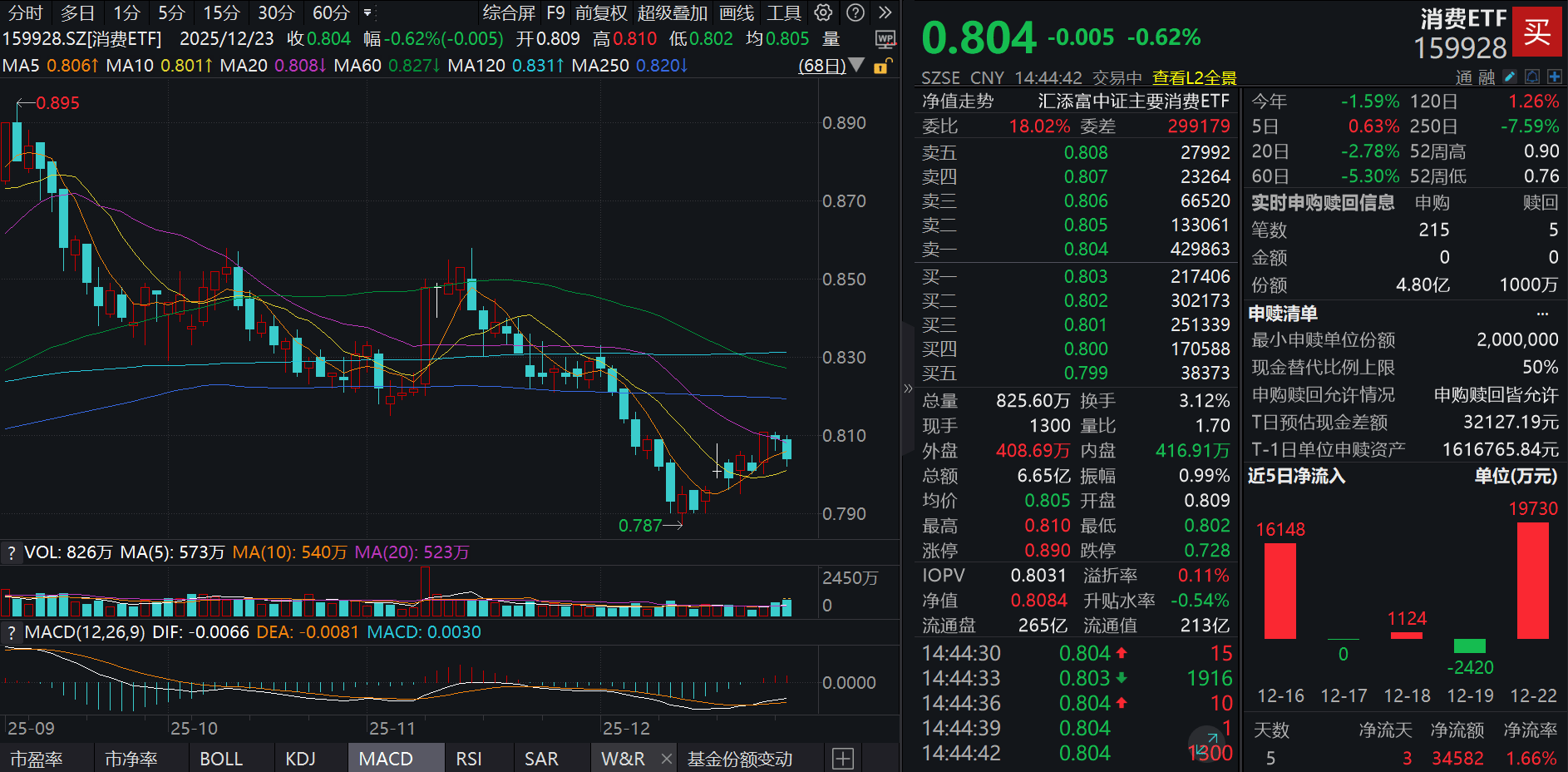
Group 1: Market Performance - A-shares experienced fluctuations and a decline, with the Consumer ETF (159928) dropping by 0.74% and a trading volume exceeding 650 million yuan [1] - The Consumer ETF (159928) has seen a net subscription of over 470 million units during the day, accumulating over 600 million yuan in the last 20 days [1] - As of December 22, the latest scale of the Consumer ETF (159928) exceeded 21.3 billion yuan, leading its peers [1] Group 2: EU Dairy Products Subsidy - The EU has announced a preliminary ruling on dairy products, determining that subsidies exist with a countervailing duty rate ranging from 21.9% to 42.7% [3][7] - Starting December 23, temporary countervailing measures will be implemented on imported dairy products from the EU [3] - The additional countervailing duty is expected to increase import prices, potentially accelerating domestic substitution in the dairy sector [8] Group 3: Domestic Dairy Industry Impact - The countervailing duties are projected to shift the deep processing of dairy products to domestic enterprises, as domestic milk prices are currently lower than international prices [8] - The deep processing sector is anticipated to enhance demand for raw milk, improving the supply-demand balance in the upstream raw milk industry [8] - Domestic dairy companies are actively focusing on deep processing, which is expected to drive demand growth and stabilize the industry [8] Group 4: Consumer Sector Insights - The Consumer ETF (159928) is characterized by its resilience across economic cycles, with the top ten constituent stocks accounting for over 68.55% of its weight [13] - The ETF includes major players such as Yili (10.37%), Kweichow Moutai (9.94%), and Wuliangye (9.50%) [14] - The current valuation of the Consumer ETF (159928) is attractive, with a TTM P/E ratio of 19.4, placing it in the lower 3.13% of the past decade [5] Group 5: Future Consumption Trends - The service consumption sector is expected to grow significantly as China's GDP per capita exceeds $10,000, indicating a shift in consumer spending patterns [11] - Emerging consumer groups, particularly the Z generation and affluent elderly, are likely to drive demand for service-oriented consumption [12] - Investment opportunities in the service sector are anticipated, particularly in areas such as event economy and AI applications [12]



海南封关对酒业产生哪些影响?
Sou Hu Cai Jing· 2025-12-22 15:13
Core Viewpoint - The implementation of the Hainan Free Trade Port represents a significant institutional change that will have profound and multifaceted impacts on the liquor industry, enhancing market dynamics and competition while providing new opportunities for both imported and domestic liquor brands [2][14]. Impact on Imported Liquor - Price advantages are highlighted as Hainan adopts a negative list management for imported goods, expanding the tax categories from 1,900 to approximately 6,600, which constitutes 74% of all goods. This results in a reduction of the comprehensive tax rate from 46.9% to zero, significantly lowering import costs and making imported liquor more competitive [3][14]. - Market competition is intensifying as more international liquor brands enter the Hainan market, leading to a richer supply and lower prices. Notable brands like Penfolds are selling at 20%-30% lower prices than in mainland markets, which is driving substantial sales growth [3][14]. - Supply chain efficiency is improving with logistics enhancements, as the "first-line release" policy reduces customs clearance times by over 40%. Hainan is becoming a liquor distribution center in the Asia-Pacific region, with major international brands establishing bonded warehouses [6][14]. Impact on Domestic Liquor - The Hainan Free Trade Port accelerates the international expansion of domestic liquor brands, allowing leading companies like Moutai and Wuliangye to leverage Hainan's policy advantages to create a global trade network [7][14]. - Domestic liquor brands can enhance their image by establishing display centers and experience halls in Hainan, increasing brand awareness among international consumers [9][14]. - The need for product quality improvement is emphasized as domestic brands must meet international standards to compete effectively. This includes enhancing quality control and standardization across production processes [9][14]. - Innovation in product development is necessary to cater to diverse consumer preferences in different markets, prompting domestic brands to create new products that align with local tastes [9][14]. - Talent cultivation is crucial for international development, requiring domestic liquor companies to train professionals familiar with international trade rules and marketing strategies [9][14]. Impact on Hainan's Local Liquor Market - The consumer market is expanding due to the robust development of Hainan's tourism economy, with increased duty-free allowances and new consumption scenarios driving growth in high-end liquor consumption, which is growing at an annual rate of 18% [10][14]. - As residents' income levels rise, there is a growing demand for high-quality and diverse liquor products, leading to an upgrade in the local liquor consumption market [10][14]. - Local brands face increased competition from external brands entering the Hainan market, necessitating improvements in product quality and marketing strategies to maintain market share [10][14]. - Market segmentation is accelerating, with high-end markets dominated by international and top domestic brands, while mid-to-low-end markets become increasingly competitive [10][14]. Recommendations for Industry Participants - Importers and international brands should leverage Hainan's bonded warehousing and processing policies to establish distribution centers, enhancing supply chain efficiency and cost advantages [11][14]. - Domestic liquor companies can use Hainan as a base for international operations, integrating trade, marketing, and brand display functions to expand their global reach [12][14]. - Enhancing brand experience through the establishment of experience stores in tourist hotspots can help connect with high-quality visitors and promote Chinese liquor culture [13][14]. - Retailers and distributors should explore new consumption trends, such as wine-by-the-glass models and experiential consumption scenarios, to capitalize on evolving consumer preferences [13][14]. - Consumers visiting Hainan will benefit from competitive pricing and a wider variety of imported and domestic liquor options [13][14].

2025,年轻人没有抛弃白酒
Sou Hu Cai Jing· 2025-12-22 12:48
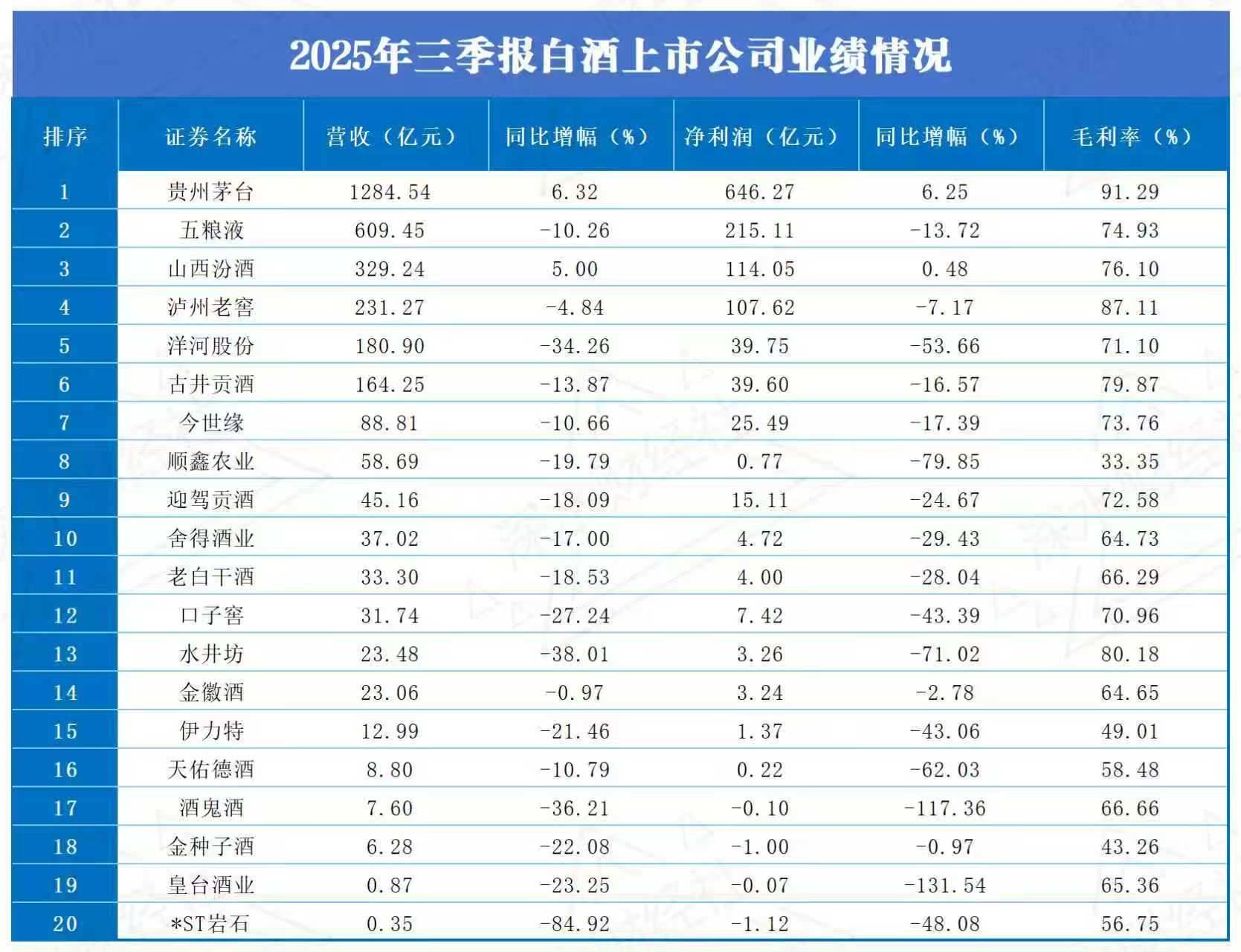
Core Viewpoint - The decline in the price of Moutai below 1499 yuan per bottle is attributed to industry-wide adjustments, including factors like consumption downgrade and inventory issues, while niche brands like Jingjiu are gaining popularity among younger consumers [1][2][3] Industry Overview - The current state of the liquor industry shows a collective downturn among major liquor companies, unable to sustain previous price levels [2][3] - The traditional consumption logic is fading, indicating a shift in consumer preferences towards more personalized and self-satisfying choices [4][5] Company Performance - In the first three quarters of 2022-2024, the liquor industry maintained double-digit revenue growth rates of 12%, 15.37%, and 10.49%, but projections for 2025 suggest negative growth for most companies [7] - In Q3, 20 listed liquor companies reported a total revenue of 317.78 billion yuan, a year-on-year decline of 5.90%, with net profits dropping by 6.93% [7][9] - Major companies like Moutai and Wuliangye are showing signs of "growth fatigue," with Moutai's revenue at 128.45 billion yuan, a growth of 6.32%, while Wuliangye's revenue fell by 10.26% [9][10] Market Dynamics - The market is experiencing a significant shift, with traditional high-end liquor brands facing pressure while niche brands like Jingjiu are thriving, particularly among young female consumers [12][18] - The consumption landscape is evolving, with younger consumers favoring low-alcohol and health-oriented products, leading to a decline in traditional high-end liquor sales [17][32] Consumer Behavior - The younger demographic (post-85 to post-94) is becoming a key market segment, preferring convenient, low-alcohol, and easily mixable products, which is reshaping the liquor market [18][20] - The trend of "self-satisfying consumption" is emerging, where consumers prioritize personal enjoyment over brand prestige, indicating a shift in purchasing motivations [20][21] Product Innovation - Companies are adapting by introducing lower-alcohol and smaller packaging options to meet the new consumer demands for health and convenience [15][24] - Jingjiu's rise in popularity is attributed to its successful marketing as a health-oriented product, appealing to young women and aligning with modern consumption trends [12][32]
超级品牌概念下跌0.48%,7股主力资金净流出超亿元
Zheng Quan Shi Bao Wang· 2025-12-22 08:41
Group 1 - The Super Brand concept index declined by 0.48%, ranking among the top declines in concept sectors, with notable declines in stocks such as Aucma, Zhonggong Education, and TCL Technology [1] - Among the Super Brand concept stocks, 13 stocks saw price increases, with Anfu Technology, SF Holding, and Dong'e Ejiao leading the gains at 2.40%, 1.22%, and 1.11% respectively [1] - The Super Brand concept experienced a net outflow of 1.662 billion yuan from main funds, with 32 stocks facing net outflows, and 7 stocks seeing outflows exceeding 100 million yuan [2] Group 2 - The top net outflow stocks included China Mobile, TCL Technology, and Kweichow Moutai, with net outflows of 359.45 million yuan, 219.80 million yuan, and 155.96 million yuan respectively [2] - Conversely, the stocks with the highest net inflows included SF Holding, Dong'e Ejiao, and Yunnan Baiyao, with net inflows of 89.39 million yuan, 34.34 million yuan, and 14.78 million yuan respectively [2] - The trading volume for China Mobile was 2.28%, while TCL Technology had a turnover rate of 2.06% [3]



年度策略报告姊妹篇:2026年食品饮料行业风险排雷手册-20251222
ZHESHANG SECURITIES· 2025-12-22 08:26
Group 1 - The core view of the report indicates that the capital market in 2026 will focus on "structural transformation and confidence restoration, with a complete turnaround in external demand" [4] - The report emphasizes that the risk排雷 is not a bearish outlook but aims to enhance long positions through contrarian thinking [6] - The annual strategy highlights the importance of identifying risks in various industries to better understand market misjudgments and challenges [5] Group 2 - In the liquor industry, the report suggests that the valuation is at a bottom range, making it a good time for allocation, especially with the upcoming Spring Festival sales [10] - The investment logic for the liquor sector is based on the expectation that performance expectations have bottomed out, and the price of Moutai has also reached a low point, signaling a potential rebound [10] - The report recommends focusing on leading brands like Kweichow Moutai and Shanxi Fenjiu, as well as other brands with lower valuations and growth potential [10] Group 3 - The beer industry is expected to see stable volume and rising prices, but the cost advantages are diminishing, presenting seasonal investment opportunities [15] - The investment strategy for the beer sector emphasizes the importance of high-end upgrades driving revenue growth, while cost control will enhance profitability [17] - Recommended stocks include Yanjing Beer and Qingdao Beer, with a focus on companies that can leverage high-end market trends [17] Group 4 - The snack food industry is viewed positively, with ongoing reforms expected to yield results, suggesting active investment [21] - The report highlights that growth opportunities in the snack sector will come from category expansion and new channel penetration, supported by supply chain improvements [23] - Recommended stocks include Weilian Meishi and Yanjin Puzhi, with a focus on companies that are actively adjusting and innovating [23] Group 5 - The soft drink industry is characterized by significant differentiation among segments, with profitability continuing to improve [28] - The investment strategy emphasizes the importance of strong product categories and channel capabilities for sustained growth [31] - Recommended stocks include Dongpeng Beverage, with a focus on companies that can capitalize on high-growth segments and enhance channel operations [31] Group 6 - The dairy industry is expected to focus on profitability during the current downturn in raw milk prices, with leading companies likely to see improved margins [40] - The report suggests that the recovery of raw milk supply is crucial for the industry's performance, with a focus on companies like Yili and New Hope Dairy [40] - The key risk is that the supply recovery may not meet expectations, impacting revenue performance [40]
14只白酒股下跌 贵州茅台1408.26元/股收盘
Bei Jing Shang Bao· 2025-12-22 07:57
开源证券在其研报中指出,当前白酒行业仍处深度调整期,需求下行驱动价格带持续下移。行业从规模 扩张转向存量竞争,各家酒企围绕真实消费需求重新切分市场"蛋糕"。在此背景下,头部企业均摒弃单 纯业绩导向,短期报表虽受调整影响承压,但主动纾解渠道压力、优化供需结构的举措,是实现渠道健 康发展的必经之路。 北京商报讯(记者 刘一博 冯若男)12月22日尾盘,三大指数集体上涨,沪指3917.36点上涨0.69%。白 酒板块2214.44点收盘上涨0.07%,其中14只白酒股下跌。 从个股来看,贵州茅台收盘价达1408.26元/股,下跌0.12%;五粮液收盘价达110.33元/股,下跌0.18%; 山西汾酒收盘价达178.15元/股,下跌0.25%;泸州老窖收盘价达121.33元/股,下跌0.62%;洋河股份收 盘价达62.55元/股,下跌0.32%。 ...