LZLJ(000568)

Search documents
13只白酒股下跌 贵州茅台1400.90元/股收盘
Bei Jing Shang Bao· 2025-12-24 12:16
Core Viewpoint - The liquor industry is entering a phase of rapid performance clearing, with expectations of a weak recovery in demand as policy pressures ease and consumption expansion policies take effect [1] Industry Summary - The three major indices collectively rose, with the Shanghai Composite Index closing at 3940.95 points, up 0.53% [1] - The liquor sector closed at 2196.49 points, with a slight increase of 0.18%, although 13 liquor stocks experienced declines [1] - The current industry valuation is low, and pessimistic expectations are fully priced in, indicating a clearer direction for industry clearing and a more defined bottom [1] Company Summary - Kweichow Moutai (600519) closed at 1400.90 CNY per share, down 0.49% [1] - Wuliangye (000858) closed at 109.28 CNY per share, down 0.40% [1] - Shanxi Fenjiu (600809) closed at 175.60 CNY per share, down 0.96% [1] - Luzhou Laojiao (000568) closed at 119.94 CNY per share, down 0.38% [1] - Yanghe Brewery (002304) closed at 62.10 CNY per share, down 0.06% [1]





食品饮料2026年投资策略报告:曙光渐显,在分化中前行-20251224
Hua Yuan Zheng Quan· 2025-12-24 12:13
Group 1: Core Insights - The report emphasizes the recovery stage of consumer spending, highlighting that different sectors exhibit both commonalities and differences in their recovery rhythms, driven by supply-demand dynamics and industry structure [4][5] - ROA (Return on Assets) is identified as a leading indicator for the operational recovery of consumer companies, with a focus on analyzing various sub-sectors [4][13] Group 2: Sector Performance - The current recovery sequence indicates that soft drinks and snacks are leading, followed by the catering supply chain, condiments, dairy products, beer, and finally, liquor [5][25] - The report draws parallels with Japan's 1990s consumption differentiation, noting that sectors addressing consumer pain points and with low penetration rates are likely to succeed [5][6] Group 3: Investment Strategy - The report suggests focusing on sectors where ROA is stabilizing, indicating potential valuation recovery opportunities, particularly in traditional sectors like liquor, beer, and dairy [6][8] - It recommends identifying sub-sectors with either price or volume growth, with a preference for price-driven strategies [6][8] Group 4: Detailed Sector Analysis - The frozen food sector is showing signs of marginal improvement, with leading companies enhancing operational efficiency through product innovation and channel reforms [27][28] - The snack sector is experiencing high demand, driven by new channel developments, although competition is intensifying [33][35] - The beer industry is under pressure, with a focus on high-end products, but overall growth is slowing due to external economic factors [39][41] - The dairy sector is nearing the end of its adjustment phase, with expectations of improved performance as raw milk prices rise [41][42] - The liquor sector is currently in a phase of inventory reduction, with performance risks gradually clearing as channels stabilize [43][48]



海南封关启新程,白酒出海正当时,共赴全球飘香新纪元!
Sou Hu Cai Jing· 2025-12-24 11:26
Core Viewpoint - The recent implementation of the Hainan Free Trade Port marks a historic step in China's opening-up strategy, providing a strategic opportunity for the Chinese liquor industry to overcome international market barriers and reshape its global presence [1][3]. Group 1: Hainan's Role in Liquor Export - The "closure" of Hainan is a customs regulatory model that allows for the free flow of goods, capital, and personnel between Hainan and foreign countries, while maintaining regular supervision with the mainland, positioning Hainan as a key hub for connecting domestic and international markets [3]. - Currently, global spirits exports exceed $40 billion, but Chinese liquor accounts for only 2.4% of this market, indicating a significant mismatch between the industry's scale and its international presence [3]. - Hainan's policies, including zero tariffs on foreign goods and a low-cost platform for logistics, significantly reduce operational costs for liquor companies looking to export [5][6]. Group 2: Supply Chain and Logistics Improvements - Hainan's customs policies simplify the clearance process, significantly shortening the time required for liquor exports, while improving warehousing and logistics infrastructure [8]. - Major international liquor companies have established bonded warehouses in Hainan, allowing for rapid release of goods, which can also benefit Chinese liquor companies by enabling pre-processing activities [8]. - The development of cross-border e-commerce policies in Hainan facilitates a new model of "online ordering and bonded direct shipping," providing Chinese liquor companies with new pathways to expand overseas [8]. Group 3: Cultural and Market Challenges - One of the main challenges for Chinese liquor in international markets is the lack of understanding of its unique cultural and flavor profiles, which Hainan can help address through cultural promotion and experiential marketing [9]. - Hainan's international tourism and business attributes allow liquor companies to set up experience centers to enhance consumer understanding and appreciation of Chinese liquor [9]. - The establishment of local channels and partnerships in Hainan can help liquor companies overcome the previous "solo" approach to international expansion [9]. Group 4: Industry Upgrades and Standards - The Hainan Free Trade Port will drive the liquor industry to enhance standards, product innovation, and talent development to meet international market demands [11]. - Hainan can serve as a testing ground for establishing international standards for Chinese liquor, facilitating technical exchanges with global spirits industries [11]. - Companies need to innovate products to cater to diverse global consumer preferences, leveraging Hainan's processing advantages for targeted production [11]. Group 5: Competitive Landscape and Future Outlook - The local liquor market in Hainan is approximately $6 billion, with a high proportion of sauce-flavored liquor, and the influx of international brands post-closure will intensify competition [12]. - Talent shortages remain a critical barrier to internationalization, necessitating the recruitment and training of professionals familiar with international trade and brand management [12]. - The liquor industry must collaborate to build a cooperative mechanism in Hainan, avoiding disordered competition while promoting the global dissemination of Chinese liquor culture [12]. Group 6: Historical Context and Future Prospects - The internationalization of Chinese liquor has historically aligned with national opening strategies, and Hainan's full closure represents a significant milestone in this regard [14]. - The ongoing release of policy benefits and industry upgrades will facilitate the cultural promotion and channel development of Chinese liquor on the global stage [14]. - The expectation is that unique Chinese liquor flavors will reach global markets, enhancing the understanding of Chinese brewing techniques and cultural heritage [14].

泸州老窖(000568) - 北京康达(成都)律师事务所关于泸州老窖股份有限公司2025年第二次临时股东会的法律意见书
2025-12-24 10:45
四川省成都市锦江区东御街 18 号百扬大厦 11 楼 邮编:610011 11F, Square One, No.18 Dongyu St., Jinjiang District, Chengdu, Sichuan, P.R.China 电话/TEL:(028)87747485 传真/FAX:(028)86512848 网址/WEBSITE:www.kangdacdlawyers.com 北京康达(成都)律师事务所 关于泸州老窖股份有限公司 2025 年第二次临时股东会的 法律意见书 康达(成都)股会字【2025】第 0058 号 致:泸州老窖股份有限公司 根据北京康达(成都)律师事务所(以下简称"本所")与泸州老窖股份有 限公司(以下简称"泸州老窖"或"公司")签订的《常年法律顾问协议》,本 所指派律师参加了泸州老窖 2025 年第二次临时股东会(以下简称"本次股东会")。 本所律师根据《中华人民共和国公司法》(以下简称《公司法》)、《中华 人民共和国证券法》(以下简称《证券法》)、《上市公司股东会规则》(以下 简称《股东会规则》)等法律法规、规范性文件及《泸州老窖股份有限公司章程》 (以下简称《公司章程》 ...
泸州老窖(000568) - 2025年第二次临时股东会决议公告
2025-12-24 10:45
2.本次股东会未涉及变更前次股东会已通过的决议。 一、会议召开和出席情况 1.会议召开日期和时间: 证券代码:000568 证券简称:泸州老窖 公告编号:2025-51 泸州老窖股份有限公司 2025 年第二次临时股东会决议公告 本公司及董事会全体成员保证信息披露内容真实、准确和完整, 没有虚假记载、误导性陈述或者重大遗漏。 特别提示: 1.本次股东会未出现否决议案。 (1)现场会议召开时间:2025 年 12 月 24 日(星期三)15:30 (2)股东网络投票时间: ①通过深圳证券交易所系统进行网络投票的具体时间为 2025 年 12 月 24 日 9:15—9:25,9:30—11:30,13:00—15:00; ②通过深圳证券交易所互联网投票系统投票的具体时间为 2025 年 12 月 24 日 9:15 至 15:00 的任意时间。 2.现场会议地点:四川省泸州市龙马潭区南光路 71 号泸州老窖 指挥中心东楼一楼会议室。 3.会议召开方式:现场投票与网络投票相结合。 4.会议召集人:董事会 5.会议主持人:董事长刘淼先生 6.本次会议的召集、召开符合《中华人民共和国公司法》《深圳 证券交易所股票上市 ...
泸州老窖:2025年第二次临时股东会补选两名独立董事
Xin Lang Cai Jing· 2025-12-24 10:35
泸州老窖公告称,2025年第二次临时股东会于2025年召开,会议采用现场与网络投票结合方式。出席股 东代表股份933,645,225股,占总股份63.4295%。会议以累积投票制补选公司第十一届董事会独立董 事,益智、陈国祥分别获99.2821%、86.6672%有效表决权股份支持当选。北京康达(成都)律师事务 所认为会议合法有效。 ...
泸州老窖等在青岛新设股权投资合伙企业
Xin Lang Cai Jing· 2025-12-24 07:21
企查查APP显示,近日,青岛璞众股权投资合伙企业(有限合伙)成立,经营范围包含:以自有资金从 事投资活动。企查查股权穿透显示,该企业由泸州老窖集团有限责任公司旗下四川璞信产融投资有限责 任公司等共同出资。 ...
酒价内参12月24日价格发布 青花郎上涨6元实现三连阳
Xin Lang Cai Jing· 2025-12-24 02:42
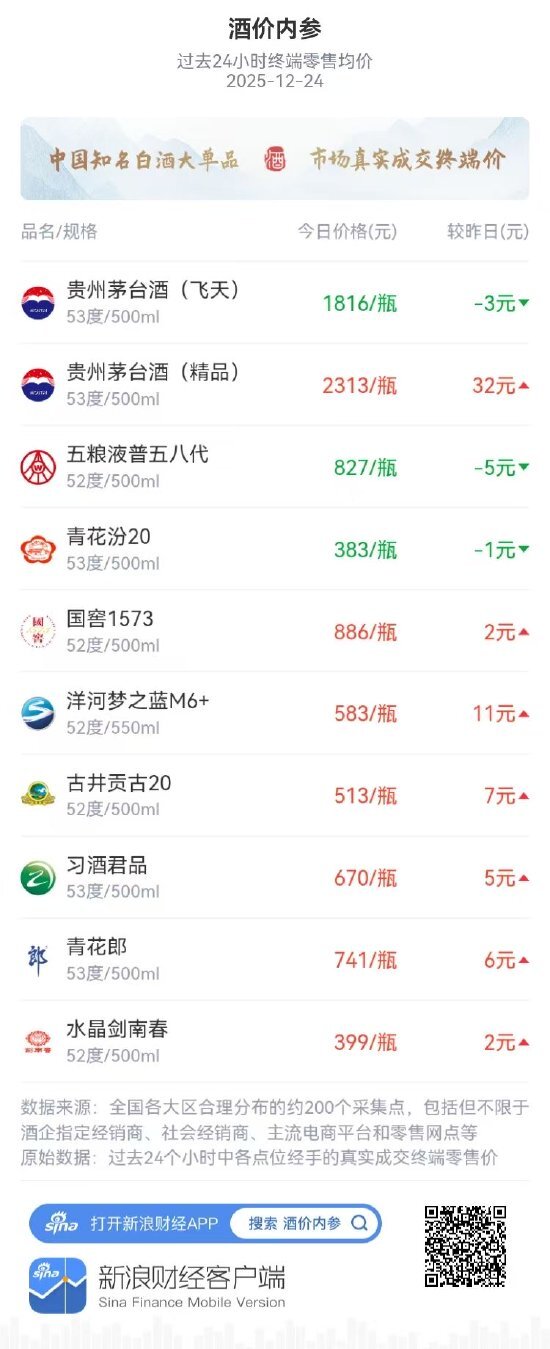
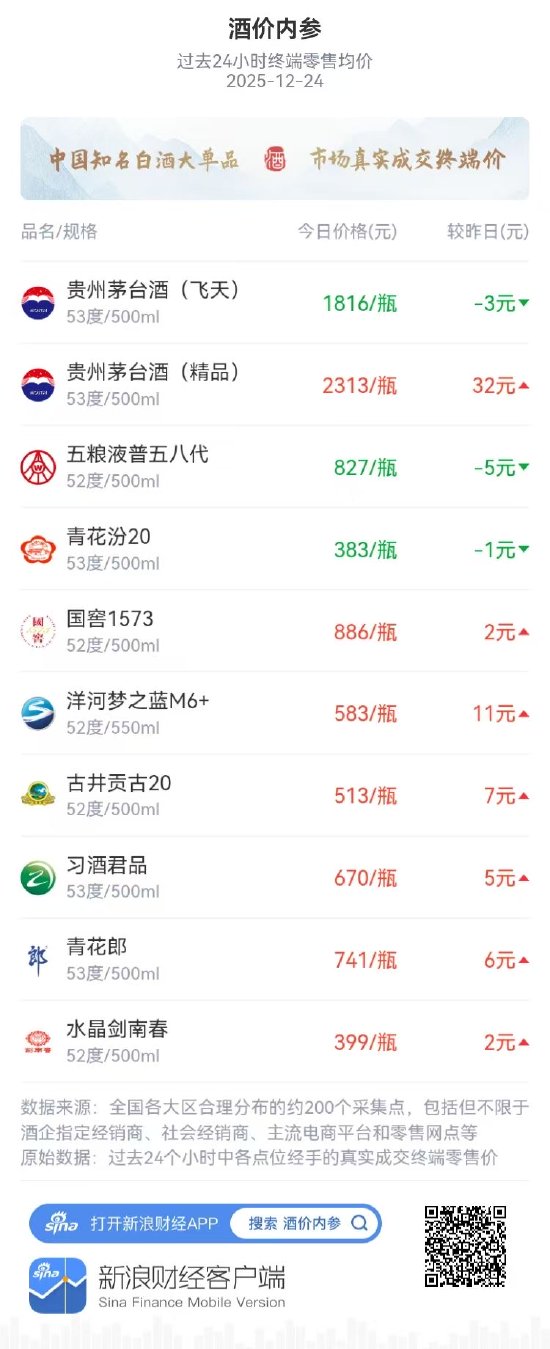
Core Insights - The Chinese liquor market has seen a significant increase in the retail prices of its top ten products, indicating a strong festive consumption atmosphere [1][2] - The overall price for a bundled sale of these ten products reached 9131 yuan, marking a daily increase of 56 yuan, the highest single-day rise recently [1] - The market is experiencing a broad upward trend driven by holiday demand, with premium products like Moutai leading the price increases [1][2] Price Movements - Moutai's premium product price increased by 32 yuan per bottle, reflecting strong demand for high-end gifts and banquet needs ahead of the holidays [1][2] - Other notable price changes include: - Yanghe Dream Blue M6+ up by 11 yuan per bottle - Gujing Tribute Wine up by 7 yuan per bottle - Qinghua Lang and Xijiu Junpin up by 6 yuan and 5 yuan per bottle respectively, with Qinghua Lang achieving three consecutive days of price increases [1] - Some products experienced minor price adjustments, such as Wuliangye down by 5 yuan and Feitian Moutai down by 3 yuan [1] Market Dynamics - The surge in Moutai prices is linked to recent news about the company's "quantity control" measures, which have led to a reduction in the supply of non-standard products by 30%-50% [2] - There is a noted shortage of certain Moutai products, leading to increased market speculation and consumer purchasing behavior, further driving up prices as the double festival approaches [2]

酒价内参12月24日价格发布 古井贡古20上涨7元
Xin Lang Cai Jing· 2025-12-24 01:26
Core Insights - The Chinese liquor market has seen a significant increase in the retail prices of the top ten products, indicating a strong festive consumption atmosphere, with the total price for a packaged set reaching 9131 yuan, up 56 yuan from the previous day, marking a recent single-day high in price increase [1][6][7] Price Movements - The price of premium Moutai increased by 32 yuan per bottle, leading the market surge, reflecting strong demand for high-end gifts and banquet needs ahead of the holidays [7] - Other notable price increases include: - Yanghe Dream Blue M6+: up 11 yuan per bottle - Gujing Gong 20: up 7 yuan per bottle - Qinghua Lang: up 6 yuan per bottle - Xijiu Junpin: up 5 yuan per bottle - Guojiao 1573 and Shuijing Jian Nan Chun: both up 2 yuan per bottle [7][9] - Some products experienced minor price adjustments, with Wuliangye Pu 58th generation down 5 yuan, Feitian Moutai down 3 yuan, and Qinghua Fen 20 down 1 yuan, which are considered normal fluctuations [7] Market Dynamics - The data for the "Liquor Price Reference" is sourced from approximately 200 collection points across various regions, including designated distributors, social distributors, mainstream e-commerce platforms, and retail outlets, aiming to provide objective and traceable market price data [2][7] - The recent price surge for premium Moutai is linked to supply control measures announced by the company, which have led to a reduction in the availability of non-standard products by 30%-50%, creating a sense of scarcity and driving up prices as demand increases during the holiday season [2][7]
2025年第51周:酒行业周度市场观察
艾瑞咨询· 2025-12-24 00:04
Industry Environment - The Chinese liquor industry faces three major challenges by 2025: demographic changes, deepening technological revolution, and internal industry adjustments. The shift from "scale expansion" to "structural optimization" is necessary due to population decline and a decrease in the main consumer demographic. AI technology is driving the smart transformation of the industry, reshaping production and marketing models. Solutions include returning to pragmatic values, upgrading technology and quality to meet diverse consumer demands, and enhancing brand IP and emotional connections to build a symbiotic commercial ecosystem [2][3] 1919 Strategic New Vision - The liquor distribution industry is transitioning from traditional inventory models to user operation and instant retail. 1919, as an industry leader, is implementing a "center store + front warehouse" model and a F2B2C supply chain, developing six core capabilities (brand, scale, online customer acquisition, offline fulfillment, supply chain, data sales) for efficient localized service. Collaborations with platforms like Taobao and Meituan have led to significant growth, with plans to expand to over 100,000 front warehouses by 2026. This strategy aligns with young consumer demands, potentially capturing 60%-70% of liquor retail market share [4] Insights from Cross-Industry Products - The introduction of cross-industry products like Mingren soda water has highlighted the collective anxiety within liquor channels due to high inventory and slow sales. Mingren's positioning as a beverage for both before and after drinking has penetrated liquor consumption scenarios, with over 3 million terminal outlets. This case emphasizes the need to shift from product selling to providing scene-based solutions and creating closed-loop experiential marketing [5] "Liquor + New Energy" Growth Potential - Several liquor companies are forming strategic partnerships with new energy giants to explore new paths for industry integration. Collaborations aim to reduce high energy costs in liquor production and build green supply chains, responding to carbon neutrality goals. Leading companies are leveraging these partnerships to expand high-end consumer bases and explore new growth points [6][7] E-commerce Tax Implications - New e-commerce tax regulations set to take effect in October 2025 will require platforms to report merchant data, eliminating tax ambiguities in liquor e-commerce. While small merchants are exempt, larger businesses will face stricter compliance, curbing practices like price dumping. This policy shift is expected to foster fair competition, pushing the industry towards value-based competition rather than price wars [8] New Survival Coordinates for Liquor Merchants - As competition intensifies and channels flatten, traditional profit models based on price differences are becoming obsolete. Merchants must enhance service capabilities, focusing on sales rates, user engagement, and data operations. Manufacturers are shifting from price support to funding market actions for distributors, creating a new formula of "price difference + service commission" [9] Transformation of Tobacco Shops - The traditional tobacco shop industry is undergoing significant transformation, facing challenges but not extinction. The industry is characterized by a "pyramid structure," with small shops leveraging low costs and new channels. Future directions include using digital tools to enhance efficiency and optimizing product offerings to stimulate repeat purchases [10][11] Insights on the Beer Industry - The Chinese beer industry is entering a phase of sustainable development and smart manufacturing, with a focus on high-end products and craft beers. The industry is shifting from scale expansion to value realization, emphasizing health and specialty in product development [12] Changes in Sichuan Banquet Alcohol Consumption - The Sichuan banquet alcohol market is witnessing a shift from traditional "white wine + red wine" combinations to "white wine + low-alcohol beverages," with over 50% of low-alcohol drinks being served. This trend reflects changing consumer preferences towards practicality and cost-effectiveness [12] New Trends in Liquor Chains - The liquor industry is experiencing structural changes driven by diversified consumption, fragmented channels, and personalized demands. The focus is shifting from "single-point breakthroughs" to "full-domain integration," emphasizing the importance of service value and user relationships [13] Brand Dynamics - The health-focused liquor market is rapidly growing, with brands like Zhenjiu leveraging technology and quality assurance to meet consumer demands. The market for health-oriented liquor is projected to reach 58.36 billion yuan by 2024 [14] Cultural Empowerment in Branding - Tiananmen Sauce Liquor emphasizes quality and cultural heritage during industry adjustments, showcasing its commitment to traditional craftsmanship and cultural transmission [15] Young Consumer Engagement Strategies - Wuliangye's collaboration with Pure K to target young consumers has resulted in significant sales growth, demonstrating innovative paths for integrating liquor into youth culture [16][17] Strategic Planning for Future Growth - Xifeng Liquor is focusing on brand youthfulness and internationalization, leveraging technology and cultural confidence to enhance its market position [18] Quality as a Competitive Edge - The liquor industry is transitioning from scale expansion to value enhancement, with quality and culture becoming key competitive factors. Companies like Congtai Liquor are emphasizing quality assurance and regional collaboration to drive growth [19] Evolution of Instant Retail - The liquor industry is moving towards "full-domain retail," emphasizing efficiency and value over price competition. Companies are encouraged to adopt a holistic approach to retail strategies [20] Low-Alcohol Product Success - The introduction of low-alcohol products like Guojiao 1573 has achieved significant market success, highlighting the trend towards healthier drinking options [21] Innovative Marketing Strategies - The collaboration between Wuliangye and FIFA for a new product launch demonstrates the effectiveness of sports marketing in engaging younger audiences [22] Cultural Exchange through Alcohol - The partnership between Chinese and French brands during a state visit symbolizes the cultural exchange and recognition of Chinese liquor on the international stage [28] New Consumption Scenarios - The launch of new products by JunTai Liquor targets both everyday celebrations and high-end collections, reflecting the evolving consumption landscape [29] Commitment to Quality and Development - Xifeng Liquor is reinforcing its commitment to quality and cultural heritage, aiming to lead the industry towards high-quality development [30]