
GUJING(000596)

Search documents
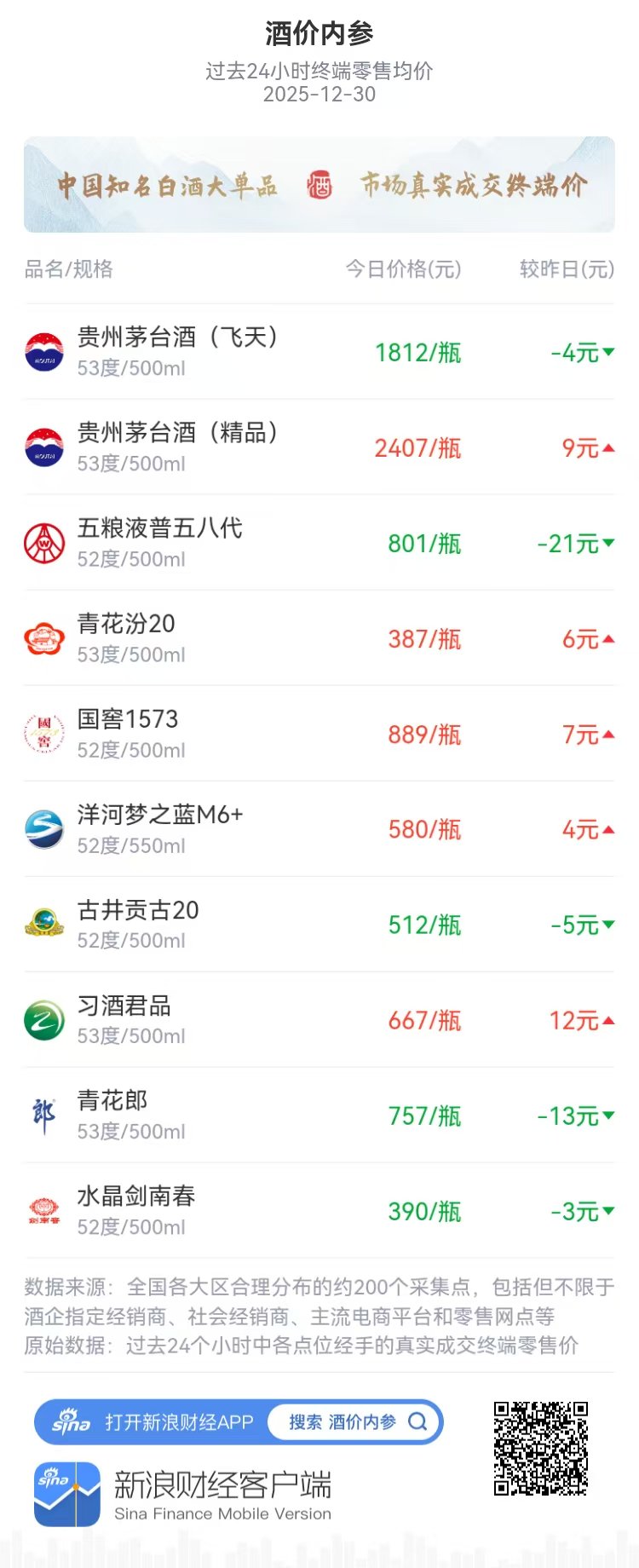
酒价内参12月30日价格发布,青花汾20上涨6元
Xin Lang Cai Jing· 2025-12-30 01:17
Core Insights - The core viewpoint of the article is that the Chinese liquor market, particularly for the top ten baijiu products, is experiencing a high-level consolidation with slight price adjustments, indicating a stable market as the year ends [1][6]. Price Trends - The average retail price for the top ten baijiu products is 9,202 yuan, down by 8 yuan from the previous day [1][6]. - Price fluctuations are noted, with some products increasing while others decrease, reflecting a typical year-end market behavior characterized by capital and emotional trading [7]. Product Performance - Notable price increases include: - Xijiu Junpin: up 12 yuan/bottle - Guizhou Moutai (Premium): up 9 yuan/bottle, reaching 2,400 yuan/bottle - Guojiao 1573: up 7 yuan/bottle - Qinghua Fen 20: up 6 yuan/bottle - Yanghe Dream Blue M6+: up 4 yuan/bottle [7][10]. - Significant price decreases include: - Wuliangye Pu 58th Generation: down 21 yuan/bottle, nearing the 800 yuan/bottle mark - Qinghua Lang: down 13 yuan/bottle - Gujing Gonggu 20: down 5 yuan/bottle - Feitian Moutai and Shuijing Jianan Chun: down 4 yuan and 3 yuan/bottle respectively [7][10]. Market Dynamics - The data for the "Liquor Price Reference" is sourced from approximately 200 collection points across major regions, including designated distributors and mainstream e-commerce platforms, aiming to provide objective and traceable market price data [2][6]. - In industry dynamics, Langjiu has announced a strategic focus on Jiangsu as a key development market, planning aggressive market penetration over the next three years, which may challenge Yanghe's traditional dominance in the region [3][8].





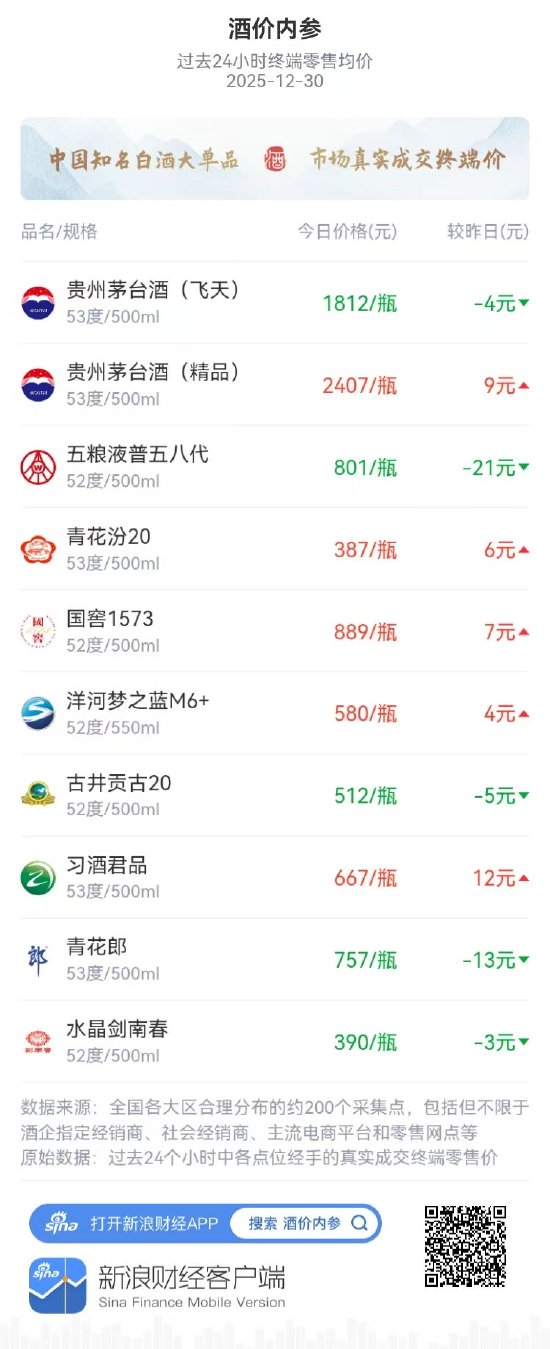
酒价内参12月30日价格发布 市场高位整理整体价格小幅回调
Xin Lang Cai Jing· 2025-12-30 01:12
Core Viewpoint - The Chinese liquor market is experiencing a high-level consolidation with slight price adjustments, indicating a stable end to the year after significant fluctuations in mid-December [1]. Price Trends - The overall retail price for the top ten liquor products is 9,202 yuan, down 8 yuan from the previous day [1]. - The market shows mixed performance with significant price changes among various products, reflecting typical year-end trading behaviors influenced by capital and sentiment [1]. Price Increases - Xijiu Junpin saw a price increase of 12 yuan per bottle, leading the market after three consecutive declines [1]. - Guizhou Moutai's premium product rose by 9 yuan per bottle, marking its third consecutive increase and surpassing 2,400 yuan per bottle [1]. - Other products with price increases include: - Guojiao 1573: up 7 yuan per bottle [1]. - Qinghua Fen 20: up 6 yuan per bottle [1]. - Yanghe Dream Blue M6+: up 4 yuan per bottle [1]. Price Decreases - Wuliangye Pu 58th generation experienced a notable decline of 21 yuan per bottle, barely maintaining the 800 yuan threshold [1]. - Qinghua Lang saw a decrease of 13 yuan per bottle after a previous increase of 45 yuan over eight days [1]. - Other products with price decreases include: - Gujing Gonggu 20: down 5 yuan per bottle [1]. - Feitian Moutai: down 4 yuan per bottle [3]. - Shuijing Jian'nan Chun: down 3 yuan per bottle [4].

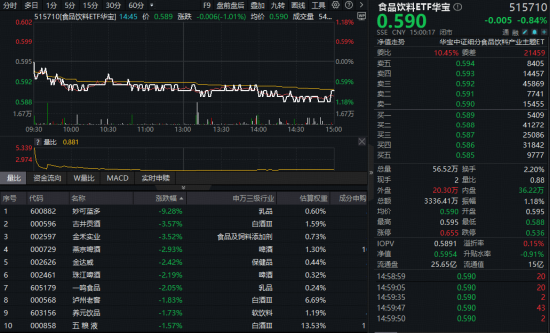
“茅五泸汾洋”重挫,食品饮料ETF华宝(515710)收跌0.84%!茅台董事长喊话“穿越周期”,配置时机渐显?
Xin Lang Cai Jing· 2025-12-29 14:18
Group 1: Market Performance - The food and beverage sector experienced a decline on December 29, with the Food and Beverage ETF Huabao (515710) opening lower and dropping over 1% during the day, ultimately closing down 0.84% [1][8] - Major consumer goods and some liquor stocks performed poorly, with Miaokelan falling by 9.28%, and both Gujing Gongjiu and Jinhai Industrial dropping over 3% [1][8] Group 2: Industry Insights - The chairman of Moutai Group announced at a conference that the primary marketing task for Moutai liquor in 2026 is to focus on consumer needs and promote market-oriented transformation [1][10] - The overall liquor industry is currently in a deep adjustment phase, facing challenges such as high channel inventory and slowing growth rates, but Moutai is optimistic about navigating these challenges [3][10] - The valuation of the food and beverage sector is at a historical low, with the PE ratio of the underlying index for the Food and Beverage ETF Huabao at 20.19, placing it in the 5.77% percentile of the last decade, indicating a potential opportunity for long-term investment [3][11] Group 3: Future Outlook - Analysts predict that the demand for liquor will remain subdued in 2025, continuing the trend of weak seasonal demand, which may lead to further declines in liquor prices [4][11] - The liquor sector is entering a more favorable configuration zone, with expectations that any improvement in supply and demand could act as a catalyst for recovery [5][11] - The Food and Beverage ETF Huabao is recommended for investors looking to allocate to core assets in the food and beverage sector, with a significant portion of its holdings in leading liquor stocks [5][12]

观酒 头部酒企集体押注低度化,白酒降度能让年轻人买账吗?
Nan Fang Du Shi Bao· 2025-12-29 07:29
Core Insights - The Chinese liquor industry is undergoing significant transformation in 2025, driven by high channel inventory and weak terminal sales, alongside new opportunities arising from changing policies, consumption patterns, and scenarios [1] - The trend towards "lower alcohol content" is becoming mainstream, with major liquor companies launching new low-alcohol products to attract younger consumers [3][4] Industry Trends - The low-alcohol wave in the liquor industry has evolved from sporadic attempts to a concentrated effort, with major brands like Wuliangye and Luzhou Laojiao leading the charge [4][10] - Wuliangye's launch of the 29-degree "Wuliangye·Yijianqingxin" has set a precedent, achieving over 100 million yuan in sales within two months [4] - Other companies, such as Shede and Gujing Gongjiu, are also introducing low-alcohol products targeting specific consumption scenarios, indicating a shift in marketing strategies [6][8] Consumer Behavior - The shift towards low-alcohol products is largely driven by generational changes in consumer behavior, with younger consumers preferring lighter, more comfortable drinking experiences [11][13] - The younger demographic, particularly those born between 1985 and 1994, now constitutes a significant portion of the liquor consumer base, leading to a demand for products that align with their lifestyle [11] Market Dynamics - The industry is facing challenges such as high inventory levels and sluggish sales, prompting companies to seek new growth avenues through low-alcohol offerings [13] - The trend towards lower alcohol content is also seen as a response to increasing health consciousness among consumers, who are more sensitive to the burdens of alcohol consumption [13][14] Strategic Implications - The low-alcohol trend is not merely about reducing alcohol content but involves a comprehensive restructuring of product offerings, including fruit wines and sparkling liquors [10][14] - Companies are exploring international markets for low-alcohol products, which may facilitate cultural export and align with global drinking preferences [14] Challenges Ahead - Despite the momentum, the industry faces the challenge of ensuring that lower alcohol products resonate with younger consumers, who may not be willing to pay for them if they lack flavor innovation [15][16] - The need for emotional connection and cultural relevance remains critical, as traditional liquor culture may alienate younger consumers [15][17]


观酒|“打酒铺”火了,散酒模式能成酒企的“压力出口”吗?
Nan Fang Du Shi Bao· 2025-12-29 05:37
Core Insights - The Chinese liquor industry is undergoing significant transformation in 2025, facing challenges such as high channel inventory and weak terminal sales, while also experiencing new opportunities driven by changing policies, consumer behavior, and market scenarios [2] Group 1: Industry Trends - The resurgence of "loose liquor" sales, a traditional model, has gained attention this year, with innovative pricing strategies attracting consumers [2][3] - New "liquor bars" are rapidly emerging, allowing consumers to purchase liquor by the cup, which has revitalized the loose liquor market and gained acceptance among younger consumers [3][4] - The market for loose liquor is projected to exceed 800 billion yuan in 2024 and reach a trillion yuan by 2025, indicating significant growth potential [14] Group 2: Consumer Behavior - Young consumers are particularly drawn to the novelty of purchasing premium liquor like Moutai at lower prices in these new liquor bars, leading to increased sales and curiosity [7][8] - The new liquor bars are designed to be visually appealing and cater to social media engagement, creating a "third space" for young consumers to enjoy [12] Group 3: Company Strategies - Major liquor companies are entering the liquor bar market, with brands like Gujing Gongjiu and Kuozi Jiu actively opening their own outlets to tap into community consumption [11] - Companies are leveraging the high-frequency sales model of liquor bars to alleviate inventory and cash flow pressures, especially as many face declining revenues [14] Group 4: Challenges and Concerns - Despite the excitement around new liquor bars, there are concerns regarding profitability, cost pressures, and the balance of interests with traditional distributors [15][16] - Food safety issues related to loose liquor have raised public concerns, with incidents of contamination affecting consumer trust [17]


“打酒铺”火了,散酒模式能成酒企的“压力出口”吗?
Nan Fang Du Shi Bao· 2025-12-29 05:36
Core Insights - The Chinese liquor industry is undergoing significant transformation in 2025, facing challenges such as high channel inventory and weak terminal sales, while also experiencing new opportunities driven by changing policies, consumption patterns, and scenarios [1] Group 1: Market Trends - The trend of "loose liquor" has resurfaced as a new phenomenon, with various new-style "liquor shops" emerging, allowing consumers to purchase liquor by the cup, which has gained recognition among younger consumers [2][3] - The "liquor shop" model has become popular, particularly in urban areas, with high demand observed in places like Guangzhou, where consumers are eager to try premium brands at lower prices [3][4] - The market for loose liquor is projected to exceed 800 billion yuan in 2024 and reach a trillion yuan by 2025, indicating a strong potential for growth [6] Group 2: Company Strategies - Major liquor companies are entering the "liquor shop" space, with brands like Gujing Gongjiu and Kuozi Jiu actively opening their own liquor shops to cater to community needs and alleviate inventory pressure [5][6] - The new liquor shops are designed to appeal to younger consumers, offering a social space that combines quality and affordability, thus addressing the evolving consumer preferences [6][7] Group 3: Challenges and Concerns - Despite the potential of the "liquor shop" model, there are concerns regarding profitability, cost pressures, and the balance of interests with traditional distributors [8] - Food safety issues related to loose liquor have raised public concerns, with incidents of contamination affecting consumer trust and potentially hindering the expansion of this model [9]
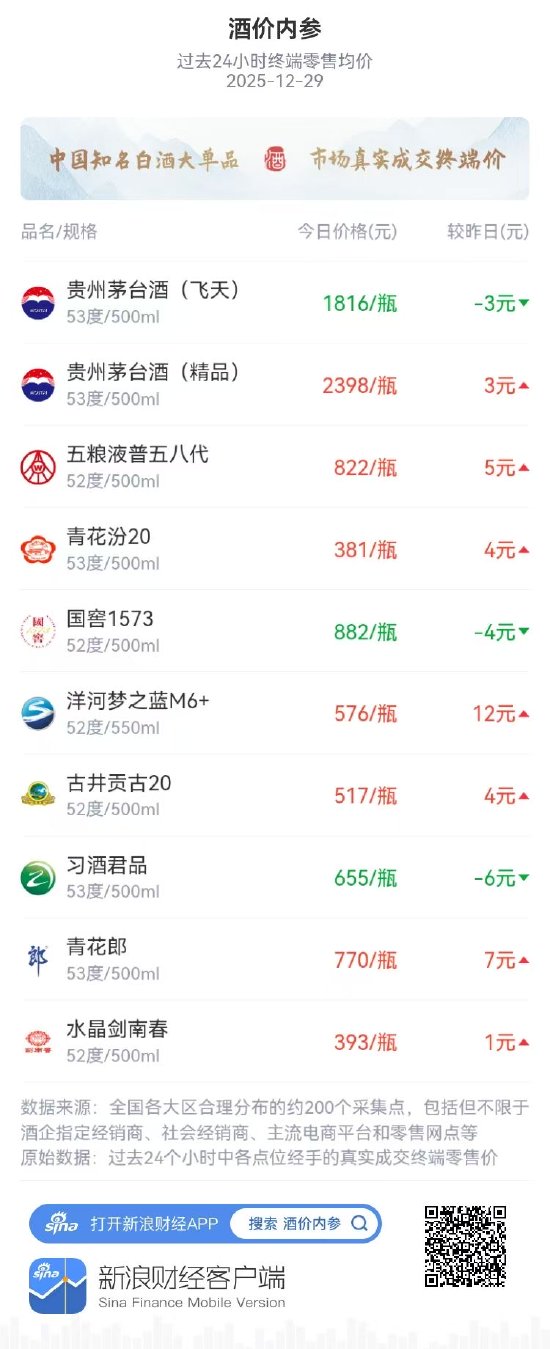
酒价内参12月29日价格发布,青花汾20上涨4元
Xin Lang Cai Jing· 2025-12-29 01:25
Core Insights - The core viewpoint of the article is that the Chinese liquor market, particularly the top ten liquor products, has shown signs of price recovery after a brief decline, with an overall increase in retail prices observed on Monday [1][6]. Price Trends - The average retail price of the top ten liquor products has stabilized and rebounded, with a total price of 9,210 yuan for a bundled sale of one bottle from each product, reflecting an increase of 23 yuan from the previous day [1][6]. - The market is experiencing a general upward trend, with most brands seeing price increases. Notably, Yanghe Dream Blue M6+ saw a significant rebound of 12 yuan per bottle, leading the market [1][7]. - Other notable price increases include: - Qinghua Lang up 7 yuan per bottle, marking its eighth consecutive day of price increases [1][7]. - Wuliangye Pu 58th generation up 5 yuan per bottle [1][7]. - Qinghua Fen 20 up 4 yuan per bottle [1][7]. - Guizhou Moutai premium up 3 yuan per bottle [1][7]. - Gujing Gong 20 and Shuijing Jian Nan Chun each up 1 yuan per bottle [1][7]. - Conversely, some products have seen price declines, including: - Xijiu Junpin down 6 yuan per bottle, continuing a three-day downward trend [1][7]. - Guojiao 1573 down 4 yuan per bottle [1][7]. - Feitian Moutai down 3 yuan per bottle [1][7]. Data Collection Methodology - The daily data for "Liquor Price Reference" is sourced from approximately 200 collection points across various regions, including designated distributors, social distributors, mainstream e-commerce platforms, and retail outlets, ensuring a comprehensive and objective representation of the market [2][7]. Industry Developments - On December 28, Guizhou Moutai held a national distributor conference, where the new management team emphasized respect and openness towards distributors and outlined a development strategy for 2026 [2][7]. - Moutai acknowledged its shortcomings in marketization and consumer reach while asserting the broad market potential for Moutai liquor [2][7]. - The core plan for the upcoming year includes preventing price speculation, promoting market-driven pricing, and establishing a pyramid product system centered around the 500ml Feitian Moutai as the main product [2][7]. - Moutai aims to enhance online and offline integration, encouraging compliant distributors to expand online business while focusing on consumer-centric marketing transformation [2][7]. - The chairman, Chen Hua, redefined the relationship with distributors, promising not to let them incur losses while urging a shift from passive to proactive consumer service [2][7].
中信建投:跨年行情成长先行 白酒蓄力静待春来
智通财经网· 2025-12-28 12:48
Group 1: Market Trends and Insights - The cross-year market trend is characterized by "growth leading, liquor accumulating," with funds favoring sectors like snacks and dairy that show clear momentum and higher elasticity, driven by policy support and industry trends [1][3] - The liquor sector is in a "bottoming accumulation" phase, with demand for inventory preparation increasing as the Spring Festival approaches, indicating a potential valuation recovery post-holiday [1][3] Group 2: Liquor Industry Developments - Major liquor companies such as Gujing Gongjiu, Xijiu, and Luzhou Laojiao are signaling positive developments, revealing strategic plans and annual results amidst industry adjustments and high inventory levels [1][2] - Gujing Gongjiu aims to optimize product structure and expand growth through new product launches and enhanced market strategies, while Xijiu reported a stable sales figure of approximately 19 billion yuan for the year, with significant inventory reduction [2][6] - Luzhou Laojiao is focusing on digital transformation and strategic upgrades, targeting younger consumers and enhancing brand value while maintaining price stability for its flagship product [2][8] Group 3: Performance Forecasts - As the 2025 annual report forecast period approaches, certain food and beverage sectors are expected to exceed performance expectations due to differentiated advantages, despite short-term revenue growth slowdowns [4] - The liquor sector is anticipated to see improved performance due to inventory control and channel optimization, while segments like prepared dishes and functional snacks are benefiting from consumer recovery and product upgrades [4] Group 4: Catalysts for Future Growth - Multiple catalysts are expected to drive better-than-expected Q1 results starting from late January, including the peak sales season for liquor companies during the Spring Festival and improved data from various consumer goods sectors [5] - The food and beverage sector is currently at historical low valuations, suggesting potential for significant upward movement as market sentiment improves [5] Group 5: Dairy and Processed Food Insights - The dairy processing industry is set to benefit from temporary anti-subsidy measures on EU dairy products, accelerating domestic processing and improving profit margins for upstream dairy producers [10] - The average price of raw milk has shown signs of stabilization, indicating a potential turning point for the dairy market in 2026 [10] Group 6: Snack and Beverage Sector Dynamics - As the Spring Festival approaches, snack companies are preparing for a peak sales season, with expectations for strong performance in Q1 due to extended inventory and sales timelines [12][13] - The beverage industry is currently focused on inventory reduction, with a more favorable competitive environment anticipated as seasonal activities ramp up [13]

湾区白酒半年图谱:名酒价格频频失守,行业陷深度博弈
Nan Fang Du Shi Bao· 2025-12-26 15:00
Core Insights - The Chinese liquor industry is undergoing significant transformation in 2025, facing challenges such as high channel inventory and weak terminal sales, while also experiencing new opportunities driven by changing policies, consumption patterns, and market scenarios [1][14] Market Trends - The white liquor market in the Guangdong-Hong Kong-Macao Greater Bay Area has seen a decline in retail prices, with a notable shift in consumer behavior and pricing strategies [2][3] - The market is characterized by overall price declines, with traditional peak seasons losing their effectiveness, and the penetration of instant retail channels impacting pricing dynamics [3][6] Price Dynamics - Over half of the monitored products in the Greater Bay Area have experienced price declines, including high-end brands like Moutai and Wuliangye, indicating a weakening of price defenses across various segments [4][6] - The price range for products priced at 1,000 yuan and above has collectively cooled, with significant discrepancies between listed prices and actual transaction prices [4][9] Consumer Behavior - Mid-range and mass-market products have shown relative price stability, reflecting their essential demand despite overall market contraction [5][9] - The impact of online channels on pricing is significant, with online prices often dropping while offline prices remain stable, particularly in Shenzhen [8][10] Regional Insights - In Dongguan, the white liquor market has shown structural price differentiation, with high-end products facing downward pressure while mid-range brands adopt varied pricing strategies to maintain market positioning [13][14] - In Foshan, the market is characterized by stable prices for certain products, with local brands influencing consumer preferences and sales dynamics [11][12] Future Outlook - The industry is expected to continue facing low-price conditions in the short term, with the upcoming Spring Festival seen as a potential opportunity for temporary sales improvement [16] - The competition is anticipated to shift from price wars to a focus on brand strength, product innovation, and refined channel management as companies seek to adapt to evolving consumer habits [16]
古井贡酒:截至2025年12月19日股东人数为48901户
Xin Lang Cai Jing· 2025-12-26 12:21
Core Viewpoint - The company, Gujing Gongjiu, reported that as of December 19, 2025, it has a total of 48,901 shareholders [1] Summary by Categories - **Shareholder Information** - As of December 19, 2025, the number of shareholders for Gujing Gongjiu is 48,901 [1]