
CHANGAN AUTOMOBILE-B(000625)

Search documents
15家中外车企联合“发车” 全球最大规模车路云协同演示落地重庆
Xin Lang Ke Ji· 2025-10-26 03:32
Core Insights - The event on October 23 marked a significant collaboration between domestic and foreign automotive companies in China, focusing on the integration of vehicle, road, and cloud technologies [1] - The initiative is seen as a strategic choice for China and a global consensus towards future smart transportation, addressing key industry challenges such as vehicle safety and traffic efficiency [1] - The demonstration involved 15 major automotive companies showcasing core applications of "vehicle-road-cloud collaboration," which includes various advanced driving support technologies [2] Group 1 - The event was held in Chongqing's Western Science City, emphasizing China's commitment to developing a unique path for smart connected vehicles [1] - The collaboration is described as a historic breakthrough in the automotive industry, enabling cross-border and cross-brand vehicle coordination on a unified cloud control platform [1] - The focus is on overcoming interoperability challenges between different vehicle brands and cloud systems, aiming for a unified technical standard and industry norms in the future [1] Group 2 - Participating companies included major players such as FAW, Dongfeng, Changan, Toyota, BYD, and others, demonstrating dynamic applications like cloud-supported automatic emergency braking and green wave speed guidance [2] - Specific scenarios showcased during the event included cloud-supported collaborative vehicle merging and virtual-physical integrated multi-agent testing [2]





长安汽车(000625):2025 年三季报点评:业绩略低预期,静待经营改善
Soochow Securities· 2025-10-25 15:22
Investment Rating - The investment rating for Changan Automobile is "Buy" (maintained) [1] Core Views - The Q3 performance of Changan Automobile was slightly below expectations, primarily impacted by foreign exchange losses and overseas inventory handling [9] - The company is transitioning towards becoming a smart low-carbon travel technology company, with significant advancements in new energy and intelligent technologies [9] - Despite the challenges, the company maintains a positive outlook due to the upward trajectory of its brands and ongoing globalization efforts [9] Financial Performance Summary - For Q3 2025, Changan Automobile reported total revenue of 42.24 billion yuan, with a year-on-year increase of 23.4% and a quarter-on-quarter increase of 9.6% [9] - The net profit attributable to shareholders for Q3 was 760 million yuan, reflecting a year-on-year increase of 2.1% but a quarter-on-quarter decrease of 18.6% [9] - The company achieved a consolidated sales volume of 471,000 units in Q3, representing a year-on-year increase of 26.8% and a quarter-on-quarter increase of 13.3% [9] Earnings Forecast and Valuation - The forecast for net profit attributable to shareholders has been adjusted downwards for 2025, 2026, and 2027 to 4.4 billion, 7.5 billion, and 10.2 billion yuan respectively [9] - The corresponding price-to-earnings (P/E) ratios are projected to be 29, 17, and 12 times for the respective years [9] - The company’s revenue is expected to grow from 159.73 billion yuan in 2024 to 214.32 billion yuan in 2027, with a compound annual growth rate (CAGR) of 6.07% [1][10]
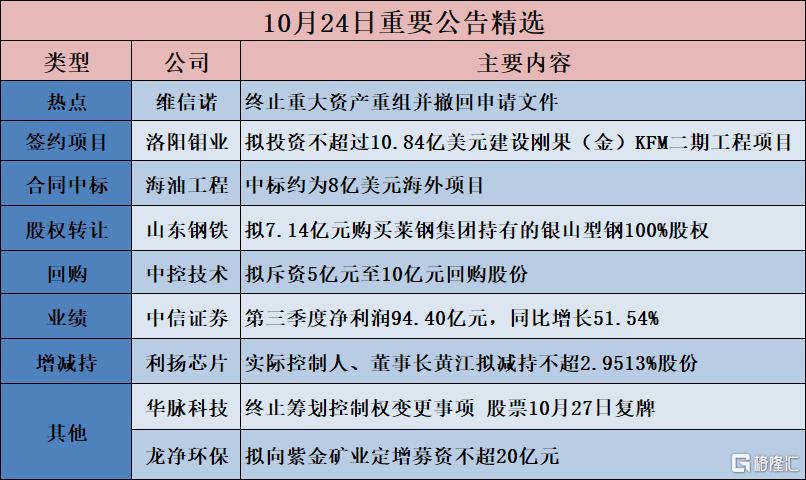
公告精选︱东方财富:前三季净利润90.97亿元 同比增长50.57%;华脉科技:终止筹划控制权变更事项 股票10月27日复牌





Ge Long Hui· 2025-10-25 10:43
Key Points - The article highlights significant corporate announcements and developments in various companies, including investment projects, asset restructuring, and financial performance [1][2][3] Company Developments - **Weixinno**: Terminated major asset restructuring and withdrew application documents [1] - **Shandong Steel**: Plans to acquire 100% equity of Yingshan Steel for 714 million yuan [2] - **Zhongkong Technology**: Intends to repurchase shares worth between 500 million to 1 billion yuan [1][2] - **Hua Mai Technology**: Terminated plans for a change in control; stock will resume trading on October 27 [1][3] Investment Projects - **Luoyang Key Industry**: Plans to invest no more than 1.084 billion USD in the KFM Phase II project in the Democratic Republic of Congo [1] - **Shan Gu Power**: Investing 532 million yuan in a 100,000 Nm3/h air separation project [1] - **Huitong Co., Ltd.**: Plans to invest 81 million yuan in a high-temperature nylon and PEEK polymer project [1] Contract Awards - **CNOOC Engineering**: Awarded an overseas project valued at approximately 800 million USD [1] Financial Performance - **CITIC Securities**: Reported a net profit of 9.44 billion yuan for Q3, a year-on-year increase of 51.54% [1][3] - **Dongpeng Beverage**: Achieved a net profit of 1.386 billion yuan in Q3, up 41.91% year-on-year [3] - **Sungrow Power**: Reported a net profit of 3.43 billion yuan for the first three quarters, a 20.47% increase year-on-year [2] - **Oriental Fortune**: Net profit for the first three quarters reached 9.097 billion yuan, a 50.57% increase year-on-year [2] - **Gaoer Co., Ltd.**: Reported a non-recurring net profit of 1.03 billion yuan in Q3, a 19.91% increase year-on-year [2]

长安汽车营销增五成,仍增收不增利
Shen Zhen Shang Bao· 2025-10-25 07:28
Core Viewpoint - Changan Automobile reported a revenue increase of 23.36% in Q3, but a decline in net profit for the first three quarters, indicating mixed financial performance amid rising sales costs and strategic investments [1][2]. Financial Performance - In Q3, Changan Automobile achieved a revenue of CNY 42.24 billion, up 23.36% year-on-year, and a net profit of CNY 764 million, up 2.13% year-on-year [1][2]. - For the first three quarters, total revenue reached CNY 114.93 billion, a 3.58% increase, while net profit was CNY 30.55 billion, down 14.66% year-on-year [1][2]. - The net cash flow from operating activities showed a significant decline of 64.61% for the first three quarters [2]. Sales and Market Position - Changan Automobile's sales volume for the first nine months was 2.07 million units, reflecting an 8.46% increase, with a notable 59.72% growth in new energy vehicle sales [4]. - The company reported a 56.25% increase in sales expenses, attributed to higher service fees from increased new energy sales and promotional costs for new products [2]. Strategic Investments - Changan Automobile plans to invest CNY 250 million (24.95% stake) in a private equity fund focused on smart projects in the automotive industry and new energy initiatives [5]. - A strategic cooperation agreement was signed with JD Group to enhance collaboration across various sectors, including retail and logistics [5]. Balance Sheet and Cash Flow - As of September 30, 2025, accounts payable decreased by 38.28%, while accounts receivable increased by 112.32%, indicating a shift in financial management strategies [3]. - Government subsidies accounted for CNY 508 million in the first three quarters, with CNY 48 million recognized in Q3 [3][4]. Market Performance - As of October 24, Changan Automobile's stock price rose by 2.75% to CNY 12.72 per share, with a total market capitalization of CNY 126.11 billion [6][7].

长安汽车Q3实现营收422.36亿元,净利润为7.64亿元
Ju Chao Zi Xun· 2025-10-25 07:00
Core Insights - Changan Automobile reported a revenue of 42,236,176,229.9 CNY for Q3 2025, representing a year-on-year growth of 23.36% [2][3] - The net profit attributable to shareholders was 764,004,922.30 CNY, showing a slight increase of 2.13% compared to the same period last year [2][3] - The net profit excluding non-recurring items was 541,594,337.92 CNY, which increased by 5.77% year-on-year [2][3] Financial Performance - For the first nine months of 2025, the total revenue reached 114,927,486,616.98 CNY, reflecting a growth of 3.58% year-on-year [3] - The net profit attributable to shareholders for the same period was 3,055,216,176.97 CNY, a decline of 14.66% compared to the previous year [3] - The net profit excluding non-recurring items for the first nine months was 2,018,300,852.87 CNY, marking a significant increase of 20.08% year-on-year [3] Cash Flow and Earnings - The net cash flow from operating activities for the first nine months was 1,554,807,049.25 CNY, which represents a substantial decrease of 64.61% year-on-year [3] - Basic and diluted earnings per share remained at 0.08 CNY for Q3, unchanged from the previous year, while for the first nine months, it was 0.31 CNY, down 13.89% year-on-year [3] - The weighted average return on equity was 1.04% for Q3, consistent with the previous year, but decreased to 3.96% for the first nine months, down 0.99 percentage points year-on-year [3] Asset and Equity Position - As of September 30, 2025, the total assets of the company were 185,630,444,877.38 CNY, a decrease of 10.83% from the end of the previous year [4] - The equity attributable to shareholders was 77,136,271,157.06 CNY, which increased by 0.73% compared to the end of the previous year, indicating stable equity size [4]

长安汽车:前三季净利润30.55亿元 同比下降14.66%
Ge Long Hui· 2025-10-25 01:15
Core Insights - Changan Automobile reported a revenue of 114.93 billion yuan for the first three quarters, reflecting a year-on-year growth of 3.58% [1] - The net profit attributable to shareholders decreased by 14.66% to 3.06 billion yuan [1] - The net profit excluding non-recurring gains and losses increased by 20.08% to 2.02 billion yuan [1] Financial Performance - Revenue for the first three quarters: 114.93 billion yuan, up 3.58% year-on-year [1] - Net profit attributable to shareholders: 3.06 billion yuan, down 14.66% year-on-year [1] - Net profit excluding non-recurring items: 2.02 billion yuan, up 20.08% year-on-year [1]
陆家嘴财经早餐2025年10月25日星期六
Wind万得· 2025-10-24 22:43
Group 1 - President Xi Jinping will attend the APEC informal leaders' meeting in South Korea from October 30 to November 1, with potential discussions on a meeting between the Chinese and U.S. leaders [1] - The Central Committee emphasizes addressing "three rural issues" as a priority, projecting an estimated market space of around 10 trillion yuan over the next five years [1] - The focus on new urbanization is expected to require over 5 trillion yuan in investment for underground infrastructure during the 14th Five-Year Plan [1] Group 2 - The U.S. September CPI rose 3% year-on-year, the highest since January, but below market expectations of 3.1% [2] - The market has fully priced in two 25 basis point rate cuts by the Federal Reserve for the remainder of the year [2] Group 3 - Premier Li Qiang will attend multiple ASEAN meetings in Malaysia from October 27 to 28 [3] - The central bank aims to enhance the effectiveness of monetary policy and maintain stability in financial markets [3] - The State Administration of Foreign Exchange emphasizes the need for high-level opening in the foreign exchange sector and promoting the internationalization of the renminbi [3] Group 4 - The central bank will conduct a 900 billion yuan MLF operation on October 27, marking a net injection of 200 billion yuan for the month [4] - Various provinces have reported GDP data for the first three quarters, with Guangdong's GDP reaching 10.52 trillion yuan, a 4.1% increase [4] Group 5 - The China Securities Regulatory Commission emphasizes risk prevention and high-quality development in capital markets [5] - A-shares saw significant gains, with the Shanghai Composite Index rising 0.71% to 3950.31 points [5] - Hong Kong's Hang Seng Index closed up 0.74%, with notable strength in the semiconductor sector [5] Group 6 - 712 listed companies have disclosed share repurchase or increase loan plans, totaling a maximum loan amount of 152.48 billion yuan [6] - Domestic GPU leader Muxi Co. successfully passed IPO approval on the Sci-Tech Innovation Board, aiming to raise 3.904 billion yuan for R&D [6] Group 7 - The China Logistics and Purchasing Federation initiated an "anti-involution" campaign to combat low-quality competition in the warehousing industry [8] - The China Nonferrous Metals Industry Association stressed the importance of maintaining industry confidence and preventing "involution" [9] Group 8 - The People's Bank of China reported a decline in real estate loans, with a balance of 52.83 trillion yuan, down 0.1% year-on-year [10] - Hangzhou is implementing "home purchase + consumption voucher" subsidy activities to stimulate the housing market [10] Group 9 - JD.com, Meituan, and other companies are under investigation by market regulators for food safety and operational compliance issues [11] - The narrow passenger car retail market is expected to reach around 2.2 million units in October, with a projected 60% penetration rate for new energy vehicles [11] Group 10 - Morgan Stanley plans to allow institutional clients to use actual holdings of Bitcoin and Ethereum as loan collateral [12] - Xiaomi Auto announced a tax subsidy plan for customers who complete orders by November 30 [13] Group 11 - Ford's Q3 adjusted EPS was 45 cents, with sales up 9.3% to a record $50.5 billion, exceeding expectations [21] - Procter & Gamble reported Q1 adjusted EPS of $1.99, with revenue of $22.39 billion, both surpassing market expectations [21]



重庆长安汽车股份有限公司2025年第三季度报告
Shang Hai Zheng Quan Bao· 2025-10-24 18:39
登录新浪财经APP 搜索【信披】查看更多考评等级 证券代码:000625(200625) 证券简称:长安汽车(长安B) 公告编号:2025-64 本公司及董事会全体成员保证信息披露的内容真实、准确、完整,没有虚假记载、误导性陈述或重大遗 漏。 重要内容提示: 董事、高级管理人员是否存在对季度报告内容存在异议或无法保证其真实、准确、完整的情况 □ 是 √ 否 1.董事会及董事、高级管理人员保证季度报告的真实、准确、完整,不存在虚假记载、误导性陈述或重 大遗漏,并承担个别和连带的法律责任。 2.公司负责人、主管会计工作负责人及会计机构负责人(会计主管人员)声明:保证季度报告中财务信息 的真实、准确、完整。 3.第三季度财务会计报告是否经过审计 □ 是 √ 否 4.审计师发表非标意见的事项 □ 适用 √ 不适用 一、主要财务数据 (一)主要会计数据和财务指标 公司是否需追溯调整或重述以前年度会计数据 □ 是 √ 否 ■ (二)非经常性损益项目和金额 √ 适用 □ 不适用 单位:元 ■ 其他符合非经常性损益定义的损益项目的具体情况 √ 适用 □ 不适用 因执行《公开发行证券的公司信息披露解释性公告第1号一一非经常性损 ...
上市公司动态 | 中国神华前三季度净利降10%,东方财富前三季度净利增51%,沐曦股份科创板IPO过会
Sou Hu Cai Jing· 2025-10-24 17:19
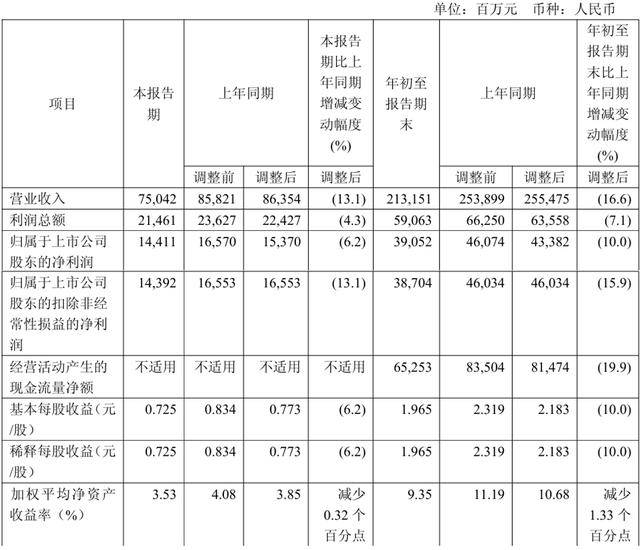
Group 1 - China Shenhua's net profit for the first three quarters decreased by 10% year-on-year, with total revenue of 213.15 billion yuan, down 16.6% [1][2] - Dongfang Caifu reported a 51% increase in net profit for the first three quarters, reaching 90.97 billion yuan, a 50.57% year-on-year growth [3][4] - Geer Co. achieved a net profit growth of 10.33% year-on-year, totaling 25.87 billion yuan, despite a 2.21% decline in revenue [5][6] Group 2 - Changan Automobile's net profit fell by 14.66% year-on-year, with total revenue of 1,149.27 billion yuan, up 3.58% [7][8] - Zhinanzhen reported a significant net profit increase of 205% year-on-year, reaching 1.16 billion yuan, driven by growth in financial information services [9] - Dongpeng Beverage's net profit grew by 42% year-on-year, totaling 37.61 billion yuan for the first three quarters [10][11] Group 3 - Ping An Bank's net profit decreased by 2.8% year-on-year, with total revenue of 1,006.68 billion yuan, down 9.8% [12][13] - Goldwind Technology reported a 171% increase in net profit for the third quarter, reaching 25.84 billion yuan for the first three quarters [15] - Yilong Co. achieved a net profit growth of 113.97% year-on-year, totaling 19.88 billion yuan in the third quarter [16][17] Group 4 - Tongwei Co. reported a net loss of 5.27 billion yuan for the first three quarters, with total revenue of 646 billion yuan, down 5.38% [18][19] - CITIC Securities' net profit increased by 52% year-on-year, reaching 231.59 billion yuan for the first three quarters [20] - Wanhua Chemical's net profit decreased by 17.45% year-on-year, totaling 91.57 billion yuan for the first three quarters [21] Group 5 - Luoyang Molybdenum's net profit increased by 96.4% year-on-year, reaching 142.80 billion yuan for the first three quarters [22] - Xiamen Tungsten's net profit grew by 41.54% year-on-year, totaling 5.52 billion yuan for the first three quarters [44] - Huazhong Cement's net profit increased by 76% year-on-year, reaching 20.04 billion yuan for the first three quarters [41]


长安汽车发布前三季度业绩,归母净利润30.55亿元,同比下降14.66%
智通财经网· 2025-10-24 17:09
Core Viewpoint - Changan Automobile reported a revenue of 114.93 billion yuan for the first three quarters of 2025, reflecting a year-on-year growth of 3.58% while the net profit attributable to shareholders decreased by 14.66% to 3.06 billion yuan [1] Financial Performance - The company's operating revenue for the first three quarters reached 114.93 billion yuan, marking a 3.58% increase compared to the previous year [1] - The net profit attributable to shareholders was 3.06 billion yuan, which represents a decline of 14.66% year-on-year [1] - The net profit attributable to shareholders after deducting non-recurring gains and losses was 2.02 billion yuan, showing a year-on-year increase of 20.08% [1]