CHANGAN AUTOMOBILE-B(000625)

Search documents
2025车企生存法则:对内做整合,在外找盟友
3 6 Ke· 2026-01-12 05:55
Core Insights - The Chinese automotive market is undergoing a significant consolidation wave in 2025, with major players like Geely and Changan actively restructuring to enhance efficiency and competitiveness [1][2][3] - New energy vehicles (NEVs) have reached a milestone, with sales hitting 1.715 million units in October 2025, achieving a penetration rate of 51.6%, indicating a deep market shift from traditional fuel vehicles [1] - The competition among automakers has evolved from price wars to a comprehensive battle over technology, configuration, and service, highlighting a growing disparity among companies [1][4] Internal Integration - Geely has initiated a series of internal integrations, including the merger of its Geometry brand into the Galaxy series and the strategic consolidation of Zeekr and Lynk & Co under the Zeekr Technology Group [2] - Changan and Dongfeng have also made strategic adjustments, with Changan's chairman emphasizing the need for restructuring to enhance competitiveness [3] - NIO and Li Auto have undertaken organizational changes to streamline operations and improve efficiency, aligning with their profitability goals for 2025 [4] External Collaborations - Huawei has emerged as a key player in the automotive ecosystem, expanding its partnerships with automakers like GAC and Dongfeng to create new brands and models [5][6] - The collaboration models with Huawei include standardized parts sales, full-stack smart vehicle solutions, and deep involvement in product design and sales networks [5][7] - As of now, Huawei has partnered with over 20 automotive brands, indicating its significant influence in the industry [8] Market Trends - The overall retail sales of narrow passenger vehicles in December 2025 were approximately 2.262 million units, reflecting a 14% year-on-year decline, attributed to policy changes and consumer sentiment [9] - For the entire year of 2025, cumulative retail sales reached about 23.744 million units, a 3.8% increase from the previous year, signaling a shift towards a more rational and high-quality development phase in the market [10] - The automotive industry's profit margin was around 4.4% in the first eleven months of 2025, indicating competitive pressures and the need for cost reduction strategies among automakers [10][11] Industry Consensus - The automotive industry is increasingly focused on cost reduction and efficiency improvements, with companies consolidating brands and integrating operations to enhance profitability [11] - The rise of core suppliers like CATL and Huawei has shifted the dynamics of the supply chain, prompting automakers to seek deeper collaborations rather than traditional procurement relationships [11][12] - Future competition will hinge not only on brand and product differentiation but also on the ability to collaborate within the ecosystem [12]


我们为什么还在拼命“造车”?
汽车商业评论· 2026-01-10 23:05
Core Viewpoint - The automotive industry is undergoing significant transformation driven by electrification, intelligence, and globalization, with new energy vehicles (NEVs) being a key focus in the Chinese market. [5][6] Group 1: Industry Trends - From January to November 2023, domestic sales of NEVs reached 12.466 million units, a year-on-year increase of 23.2%, with passenger vehicles at 11.715 million units (up 21.3%) and commercial vehicles at 750,000 units (up 62.4%) [5] - The penetration rate of NEVs in China is expected to exceed 40% by 2024, with some months reaching 50%, indicating rapid growth and opportunity in the sector [15] - The competition among domestic NEV manufacturers has intensified, leading to a prolonged price war that has lasted nearly four years, with companies employing price cuts and limited-time offers to capture market share [5][6] Group 2: Supply Chain Transformation - The traditional linear supply chain model is being replaced by a networked ecosystem that emphasizes co-creation among manufacturers, technology companies, and suppliers to enhance product quality and cost control [6][20] - Long-term strategies are being developed to address compliance pressures from EU battery regulations and carbon emissions, necessitating improvements in supply chain resilience and green compliance [6][20] - Changan Automobile has implemented a systematic supplier certification process and expanded its supplier base to over 1,500, including 100 overseas suppliers, to build a global supply chain resource system [25][27] Group 3: Technological Advancements - The integration of advanced technologies such as AI and smart driving systems is reshaping the automotive landscape, with a focus on enhancing user experience while maintaining safety standards [17][20] - Changan is pursuing a modular and platform-based approach to vehicle design, allowing for greater flexibility and adaptability in production processes [28][29] - The company is also focusing on digital transformation, improving procurement and supply chain systems to enhance efficiency and connectivity [43] Group 4: Strategic Partnerships - Collaborative efforts with suppliers and technology partners are being emphasized to create a win-win ecosystem, fostering transparency and mutual support in the supply chain [36][40] - Changan is exploring diverse cooperation models with traditional Tier 1 suppliers and ICT giants, aiming for strategic alliances that address technological challenges [35][36] - The company is committed to building a shared, open, and win-win networked ecosystem, transitioning from short-term transactional relationships to strategic collaborations [21][36]


2025年汽车以旧换新超1150万辆,全年乘用车零售2374.4万辆
Xinda Securities· 2026-01-10 11:06
Investment Rating - The industry investment rating is "Positive" [2] Core Insights - The report highlights that in 2025, over 11.5 million vehicles will be replaced under the vehicle trade-in program, leading to a total retail of 23.744 million passenger cars, with approximately 54% being new energy vehicles [20][3] - The report indicates a projected growth in the automotive market, with a U-shaped sales trend expected for passenger vehicles in 2026, maintaining overall sales levels similar to 2025 [20] - Key companies to watch include BYD, Geely, Great Wall Motors, and others in the passenger vehicle sector, as well as major players in commercial vehicles and auto parts [3][20] Industry Performance - The A-share automotive sector underperformed the market, with a weekly increase of 2.53% compared to the 2.79% rise in the CSI 300 index, ranking 24th among A-share industries [3][9] - The report notes that the passenger vehicle segment saw a 3.8% year-on-year increase in retail sales, while new energy vehicles experienced a 17.6% growth [20] Key Industry News - The Ministry of Commerce announced that the vehicle trade-in program will exceed 11.5 million vehicles in 2025, contributing to over 1.6 trillion yuan in new car sales [20] - Geely received the largest L3 autonomous driving test license in China, covering an area of 9,224 square kilometers [20] - Baidu's autonomous driving platform, "萝卜快跑," obtained the first full unmanned testing license in Dubai, paving the way for commercial operations [20] Upstream Data Tracking - The report includes tracking of key material prices such as steel, aluminum, and lithium carbonate, which are crucial for automotive manufacturing [23][24]




汽车“自主五强”的2025年:增长之下现战略分野
经济观察报· 2026-01-10 08:22
Core Viewpoint - The Chinese automotive market is entering a critical phase in 2025, with domestic brands collectively capturing nearly 70% of the passenger car market share, driven by the rise of new energy vehicles and international expansion [2][4]. Group 1: Market Dynamics - The "self-owned five strong" brands, including BYD, Geely, Chery, Changan, and Great Wall, have established a stable market presence, with total sales of 14.67 million units, accounting for over half of the overall passenger car market [2][4]. - BYD leads the global new energy vehicle sales with 4.6024 million units sold in 2025, marking a 7.73% year-on-year increase, while its pure electric vehicle sales reached approximately 2.257 million units, surpassing Tesla [4][5]. - Geely's total sales exceeded 3.02 million units in 2025, a 39% increase, with new energy vehicle sales reaching 1.6878 million units, reflecting a 90% growth [5][6]. Group 2: Strategic Developments - Geely has initiated a significant restructuring by merging with Zeekr Technology to enhance operational efficiency and resource integration, aiming to save billions in R&D costs annually [9][10]. - Chery has restructured its brand architecture to improve domestic market efficiency, establishing a new business group to streamline operations and enhance competitiveness [9][10]. - Changan has launched a 6 billion yuan capital increase plan to support the development of new energy vehicles and global R&D centers, reinforcing its strategic alignment with major shareholders [10][11]. Group 3: Technological Advancements - The competition among Chinese automakers has evolved from individual technological breakthroughs to a more systemic confrontation, with companies like BYD and Geely focusing on comprehensive technology integration and smart driving solutions [11][12]. - Great Wall has introduced a next-generation intelligent super platform that supports various powertrains, emphasizing its advancements in smart cockpit and driving technologies [12].


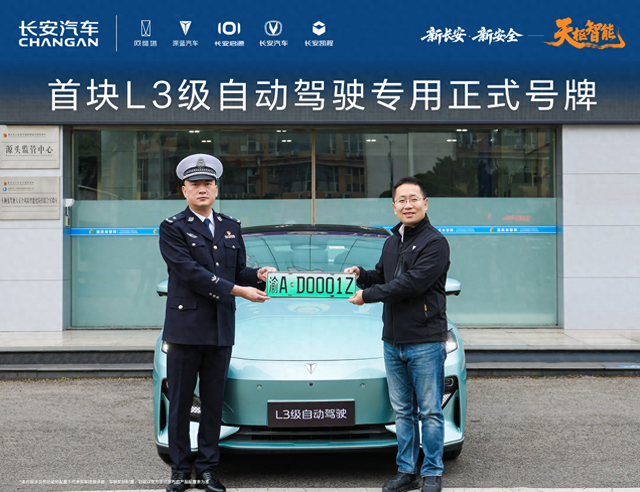
长安汽车L3级车型落地 重庆打造智能网联汽车第一城
Zhong Guo Jing Ying Bao· 2026-01-09 19:51
Core Viewpoint - The launch of L3 conditional autonomous driving vehicles by Changan Automobile in Chongqing marks a significant step towards the commercialization of smart connected vehicles in China, with the first dedicated license plate "渝AD0001Z" issued for such vehicles [2][3][4]. Group 1: Autonomous Driving Development - Changan Automobile has received approval for its L3 level conditional autonomous driving vehicles, becoming one of the first companies to do so in China [2][4]. - The first dedicated license plate for L3 autonomous driving was issued in Chongqing, allowing these vehicles to operate on specific urban roads known for complex traffic conditions [3][4]. - The current pilot program is limited to designated routes and vehicles, with the aim of gathering data to improve technology and regulatory frameworks before broader consumer access [4][5]. Group 2: Safety and Responsibility - The responsibility for driving remains with the driver, even with the introduction of L3 autonomous vehicles, as the system is only active under specific conditions [5][6]. - The transition from L2 to L3 involves a shift in responsibility, where the vehicle's control system assumes primary responsibility under defined conditions, but the driver must be ready to take over when prompted [6][7]. - Legal frameworks are being developed to clarify the responsibilities of manufacturers and drivers, ensuring safety while promoting the adoption of autonomous driving technologies [6][9]. Group 3: Industry and Policy Implications - Chongqing is positioning itself as a leader in the smart connected vehicle industry, supported by government policies aimed at fostering innovation and collaboration within the automotive sector [7][8]. - The development of smart connected vehicles is seen as a major technological breakthrough that will transform automotive usage and urban traffic management [9]. - The pilot program in Chongqing is expected to provide practical insights that will inform future legislative changes regarding autonomous driving, enhancing the legal framework to support industry growth [9].
长安汽车:2025年长安汽车总体销量291.3万辆,同比增长8.5%
Zheng Quan Ri Bao Wang· 2026-01-09 14:15
证券日报网讯1月9日,长安汽车(000625)在互动平台回答投资者提问时表示,2025年长安汽车总体销 量291.3万辆,同比增长8.5%,创9年新高;新能源方面,2025年销量突破百万大关,达到110.9万辆, 同比增长51%,成为驱动长安增长的新引擎;海外方面,2025年销量达63.7万辆,同比增长18.9%,海 外市场已成为长安稳健增长的新动能。2026年公司总体销量目标330万辆,同比增长13.3%;其中,新 能源140万辆,同比增长26.2%;海外75万辆,同比增长17.7%。 ...
长安汽车:公司主要业务涵盖整车研发、制造、销售以及发动机的研发、生产
Zheng Quan Ri Bao Wang· 2026-01-09 14:11
Core Viewpoint - Changan Automobile is actively advancing its core technologies in the automotive industry, including electric battery, motor, and control systems, while also exploring new business areas such as smart cockpit and assisted driving technologies [1] Group 1: Company Overview - Changan Automobile operates in the automotive manufacturing sector, focusing on the research, development, manufacturing, and sales of complete vehicles and engines [1] - The company is expanding its business into automotive life services, new marketing strategies, and battery swapping services [1] Group 2: Technological Advancements - The company is prioritizing the development of core technologies represented by "three electrics" (battery, motor, and electronic control) [1] - Changan is also investing in intelligent technologies such as smart cockpits and assisted driving systems [1] Group 3: Future Industry Exploration - The company is exploring future industries, including humanoid robots and flying cars, to build a comprehensive industrial ecosystem [1]
2026年车企销量目标出炉:增幅最高近70%
Jing Ji Guan Cha Wang· 2026-01-09 13:53
Core Viewpoint - The automotive market in China is expected to see a slight growth in 2026, with total sales projected at approximately 35.5 million units, a 2% increase year-on-year, while retail sales of passenger cars are estimated at around 24 million units, reflecting a 1% growth. Despite this modest growth forecast, several automakers have set ambitious sales targets, indicating an intensifying competition for market share as the industry transitions from expansion to competition for existing market segments [2]. Group 1: New Energy Vehicle Manufacturers - New energy vehicle manufacturers maintain optimistic growth expectations, with target growth rates exceeding 30%, significantly higher than the 13% forecasted growth for new energy passenger vehicles by the China Passenger Car Association [3]. - Leap Motor aims for a sales target of 1 million units in 2026, representing a growth rate of 67.5%. In 2025, Leap Motor sold 597,000 units, achieving a remarkable 103% year-on-year increase and becoming the sales champion among new energy vehicle manufacturers [3]. - NIO's growth target for 2026 is set between 456,000 and 489,000 units, reflecting a growth rate of 40%-50%. In 2025, NIO sold 326,000 units, marking a 46.9% increase but falling short of its 440,000-unit target [4]. - Xiaomi Auto has set a sales target of 550,000 units for 2026, with a growth rate of 34%. In 2025, it sold 410,000 units, exceeding its previous target of 350,000 units [4]. Group 2: Traditional Automakers - Traditional automakers are generally more cautious, with Changan Automobile setting a target growth rate of 13.3% for 2026, aiming for total sales of 3.3 million units, including 1.4 million new energy vehicles, which would require a 26.2% year-on-year increase [6]. - Geely Automobile has a target growth rate of 14%, with a total sales goal of 3.45 million units for 2026. In 2025, Geely sold 3.025 million units, achieving a 39% increase [6]. - Chery Group also targets a growth rate of 14%, aiming for total sales of 3.2 million units in 2026. In 2025, it sold 2.806 million units, reflecting a 7.8% increase [7]. - Great Wall Motors has set a relatively high target growth rate of 36% for 2026, with a sales goal of 1.8 million units. In 2025, it sold 1.324 million units, marking a 7.33% increase [7]. - Dongfeng Group has established a sales target of 3.25 million units for 2026, with a growth rate of 30%, including 1.7 million new energy vehicles, which would require a 63% increase [8].



固态电池供应商备战2027:目标定好了,路线还在争
Jing Ji Guan Cha Wang· 2026-01-09 12:33
Core Insights - The solid-state battery industry is experiencing renewed interest from investors due to clear profitability and order visibility in the supply chain, with a significant focus on achieving mass production by 2027 [2][3][6] - Major automotive companies are targeting 2027 for the application of solid-state batteries in vehicles, with many planning to complete product development or testing by 2026 [4][5] Industry Developments - Companies like Tian Shi Ke Feng have begun to engage with potential investors after overcoming initial funding challenges, with plans to expand production capacity significantly in 2026 [2] - The Ministry of Industry and Information Technology has identified solid-state batteries as a key area for development, aiming to establish 3-5 leading companies by 2027 [3] Technical Challenges - The path to mass production of solid-state batteries is fraught with challenges, including material technology discrepancies and shortages in core equipment [6][8] - The industry is divided on material technology routes, with significant competition between oxide and sulfide electrolytes, each having distinct advantages and challenges [10][12] Material Innovations - Solid-state batteries are recognized for their high energy density and intrinsic safety, making them suitable for various applications, although their cost-effectiveness in electric vehicles remains a concern [7][8] - The development of silicon-carbon and lithium metal anodes is ongoing, with companies reporting progress in small-scale trials [9][10] Equipment and Production - The lack of mature mass production equipment poses a significant barrier, with many companies resorting to self-developed solutions to meet production demands [14][19] - The production process for solid-state batteries requires high precision and specialized equipment, which increases costs and complicates the manufacturing process [20][21] Market Dynamics - The solid-state battery supply chain is characterized by a collaborative approach among suppliers and manufacturers, with a focus on meeting evolving technical requirements from cell manufacturers [23][24] - The competitive landscape is marked by a "race" among cell manufacturers to explore various material suppliers, emphasizing the need for continuous innovation and adaptation [24]




小米汽车销量创新高,华为鸿蒙月销逼近9万,12月国产新能源百花齐放
Xin Lang Cai Jing· 2026-01-09 11:54
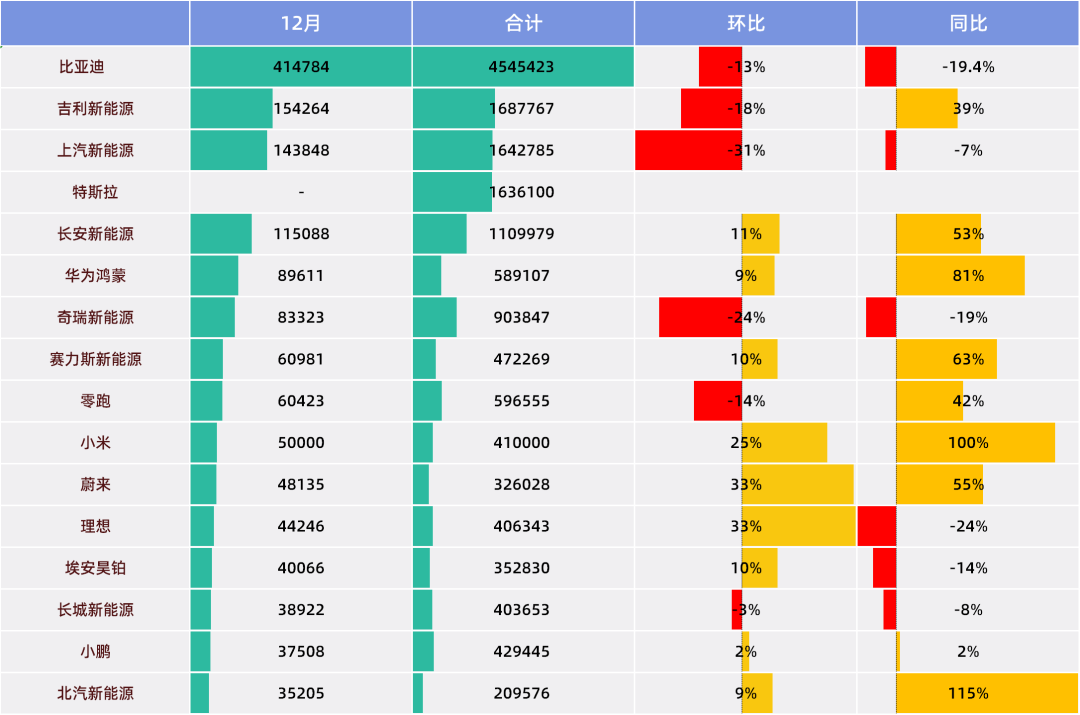
Core Insights - BYD's sales surged from 426,000 units in 2020 to 4.545 million units in 2025, achieving a compound annual growth rate of 60% [1] - Despite rapid growth, BYD faced intense competition from other automakers and did not meet its performance targets in 2025 [1] - The Chinese automotive market is undergoing significant changes, with many companies preparing for global expansion [1] Sales Performance - In December, BYD sold 414,784 units, a decrease of 13% month-over-month and 19.4% year-over-year [3] - Among 15 Chinese automakers, only five achieved both month-over-month and year-over-year sales growth [4] - The average sales volume dropped to 94,427 units in December, primarily due to declines in the first and second-tier companies [4] Market Dynamics - The Chinese government continues to support the automotive market with subsidies exceeding 1.1 billion yuan [2] - The competition is intensifying, with several brands achieving historical sales highs, particularly in the third tier [6] - The central economic work conference emphasized the importance of domestic demand, indicating ongoing support for the automotive sector [7] Company-Specific Developments - Only five out of 14 automakers met their sales targets for 2025, with companies like Li Auto and Aion falling short [8] - BYD's electric vehicle sales reached 2.2567 million units, surpassing Tesla's 1.636 million units for the first time [11] - The export volume of Chinese automobiles is expected to exceed 7 million units in 2025, with BYD emerging as a key player [14] Technological Advancements - The introduction of L3 autonomous driving technology is gaining momentum, with several companies, including BYD and Huawei, conducting road tests [17][18] - The competition for L3 autonomous driving capabilities is expected to intensify in 2026 [18] Brand Strategies - Huawei's HarmonyOS ecosystem has expanded, contributing to record sales for its vehicles [19] - Xiaomi's sales reached over 500,000 units in 2025, but the company faced a public relations crisis that may impact future products [21][23] - NIO and Xpeng have shifted to lower price segments to maintain competitiveness, with NIO achieving a record monthly sales of 48,135 units in December [24][27] Future Outlook - The automotive industry is expected to continue evolving rapidly, with companies focusing on both domestic and international markets [49] - The competitive landscape is shifting, with traditional automakers adapting to new market realities and consumer preferences [49]