
CHANGAN AUTOMOBILE-B(000625)

Search documents
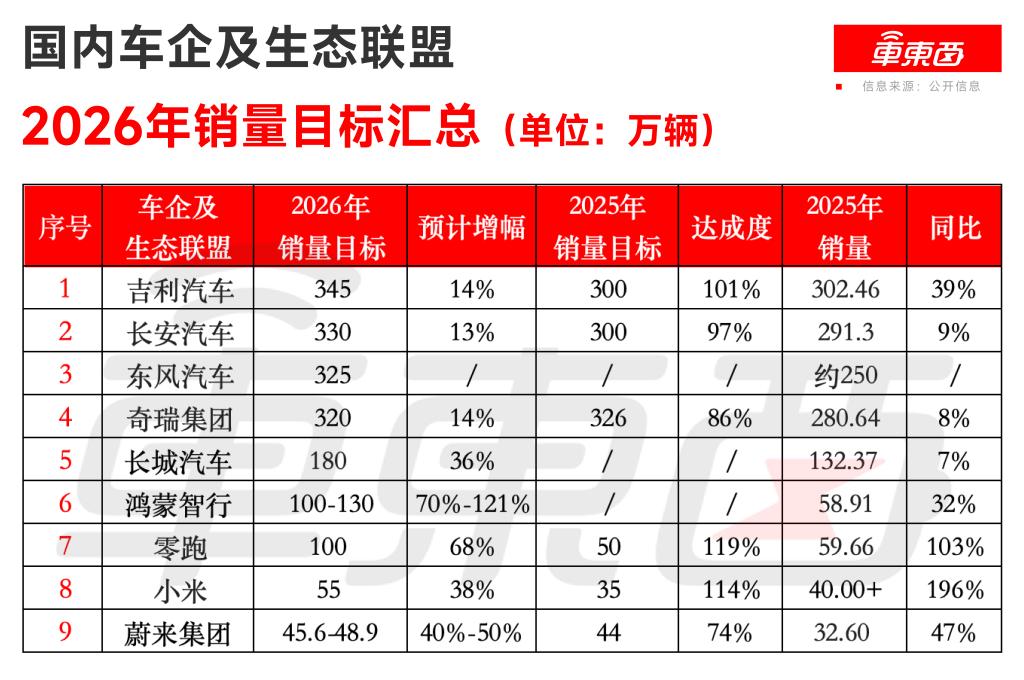
9大车企要卖超1800万台,鸿蒙智行冲刺销量翻番,四家车企瞄准300万年销
3 6 Ke· 2026-01-13 03:03
Core Viewpoint - The competition in the domestic automotive market is intensifying as major car manufacturers and alliances announce ambitious sales targets for 2026, totaling 18.339 million units, which exceeds the actual sales of 3.86 million units in 2025 [1] Group 1: New Energy Vehicle Manufacturers - New energy vehicle manufacturers such as Hongmeng Zhixing, Leap Motor, and NIO have set aggressive sales targets for 2026, with expected growth rates ranging from 40% to 121% [2][4] - Hongmeng Zhixing aims for sales between 1 to 1.3 million units, with a projected growth rate of 70%-121% [4] - Leap Motor targets 1 million units with a growth rate of 68%, while NIO's target is between 456,000 to 489,000 units, reflecting a growth of 40%-50% [2][12] - Xiaomi Auto plans to increase its sales target from 350,000 units in 2025 to 550,000 units in 2026, representing a growth of approximately 38% [8] Group 2: Traditional Automakers - Traditional automakers like Geely, Changan, and Chery have set more conservative targets, with Geely aiming for 3.45 million units, Changan for 3.3 million units, and Chery for 3.2 million units, reflecting growth rates of 14%, 13%, and 14% respectively [3][13] - Great Wall Motors plans to sell 1.8 million units in 2026, with a leading growth rate of 36% among traditional manufacturers [2][13] - Geely's target includes a significant focus on electric vehicles, aiming for 2.22 million units in 2026, up from 1.69 million in 2025, increasing its electric vehicle penetration from 56% to 64% [13][14] Group 3: Market Dynamics and Competition - The competition in the automotive market is shifting from mere scale expansion to a comprehensive contest involving technology, product offerings, and global strategies [18] - Market analysts predict that growth in the Chinese passenger car market may slow or even decline slightly in 2026, making every percentage point of growth critical and competitive [18] - The ability of companies to balance scale, profitability, and technological investment will determine their success in this increasingly fierce market [19]






资源整合,海外扎根,生态竞争——2026车企销量目标透视
Zhong Guo Qi Che Bao Wang· 2026-01-13 01:26
Core Insights - The automotive industry is setting ambitious sales targets for 2026, indicating a shift towards increased market concentration and strategic transformation among companies [2][3]. Group 1: Market Concentration - The sales targets set by leading automotive companies exceed 10 million units collectively, reflecting a significant concentration of market power among top players [3]. - The trend of market concentration is driven by resource integration, with leading companies leveraging economies of scale to invest in technology development, such as BYD's upcoming Blade Battery 5.0 and Changan's launch of 11 new models [3]. - Smaller companies lacking core competitiveness face immense pressure, with predictions of a 3% to 5% decline in China's automotive sales by Morgan Stanley, further squeezing their market space [3][4]. Group 2: Profitability Impact - The rise in market concentration is expected to have profound effects on industry profitability, as leading firms gain stronger pricing power and can maintain higher product prices through supply control [4]. Group 3: Global Strategy Shift - Companies are transitioning from "product export" to "ecosystem establishment," reshaping the global automotive landscape. BYD aims for overseas sales of 1.5 to 1.6 million units, focusing on building a complete ecosystem including battery factories and charging networks [5]. - Changan targets 3.3 million units, establishing its first overseas electric vehicle base in Thailand with a planned capacity of 200,000 units [6]. - Geely aims for 600,000 units in overseas sales, enhancing its global manufacturing network across various regions [6]. Group 4: Technological Ecosystem Competition - The competition in the automotive market is increasingly centered around technological ecosystems, with leading companies and new entrants focusing on this as a key competitive strategy [7]. - BYD's sales target of 4.5 million units is supported by its technological ecosystem, including the Blade Battery 5.0, which enhances its position in the new energy sector [7]. - The collaboration between tech companies and traditional automakers is deepening, leading to a redefinition of automotive products and service models [8].

乘用车2026 | 2025政策促需 2026高端发力+智能平权+出海提速
汽车琰究· 2026-01-13 00:05
Group 1 - The core viewpoint of the article emphasizes that the demand for automobiles is driven by the continuation of the trade-in policy, leading to an unexpected penetration of new energy vehicles (NEVs) and improved profitability through high-end products and overseas expansion [3][4][5][6][7][8] Group 2 - In 2025, the cumulative wholesale sales of passenger cars reached 24.119 million units, a year-on-year increase of 12.6%, with NEVs growing by 30.7% [3][8] - The penetration rate of NEVs in wholesale sales was 50.4%, up by 7.0 percentage points year-on-year, while the penetration rate for insurance reached 53.3%, an increase of 6.6 percentage points [3][46] - The share of domestic passenger cars in wholesale sales reached 69.3%, a year-on-year increase of 4.9 percentage points, with brands like Geely, Xiaomi, and Leap Motor showing significant growth [3][50] Group 3 - Looking ahead to 2026, the trade-in policy is expected to continue, supporting demand, with projected insurance sales of 22.32 million units, a decrease of 5.0% year-on-year, and wholesale sales of 30.10 million units, an increase of 1.0% [4][5] - The NEV insurance sales are expected to reach 13.8 million units, a year-on-year increase of 6.2%, while wholesale sales are projected to be 17.3 million units, up by 13.4% [4][15] Group 4 - The competitive landscape is shifting, with joint ventures declining and domestic brands accelerating their rise in the mid-to-high-end market [5][10] - In the 5-15 million price range, price-sensitive consumers are expected to drive competition, while brands like Geely, BYD, and Leap Motor are anticipated to gain higher sales growth due to their advantages in intelligence and cost-effectiveness [5][10] Group 5 - The article highlights the acceleration of intelligent driving technology, with major players like Huawei and BYD pushing for the democratization of advanced driving features [6][10] - The L3 commercial deployment is expected to gain momentum in 2026-2027, with various automakers launching new high-level driving systems and models [6][10] Group 6 - The export of passenger cars is projected to reach 6.64 million units in 2026, a year-on-year increase of 15.5%, driven by the technological advantages of domestic NEVs and the expansion of overseas manufacturing [7][11] - Companies like BYD and Geely are expected to increase their export efforts, with BYD establishing overseas factories and Geely accelerating NEV exports [7][11]



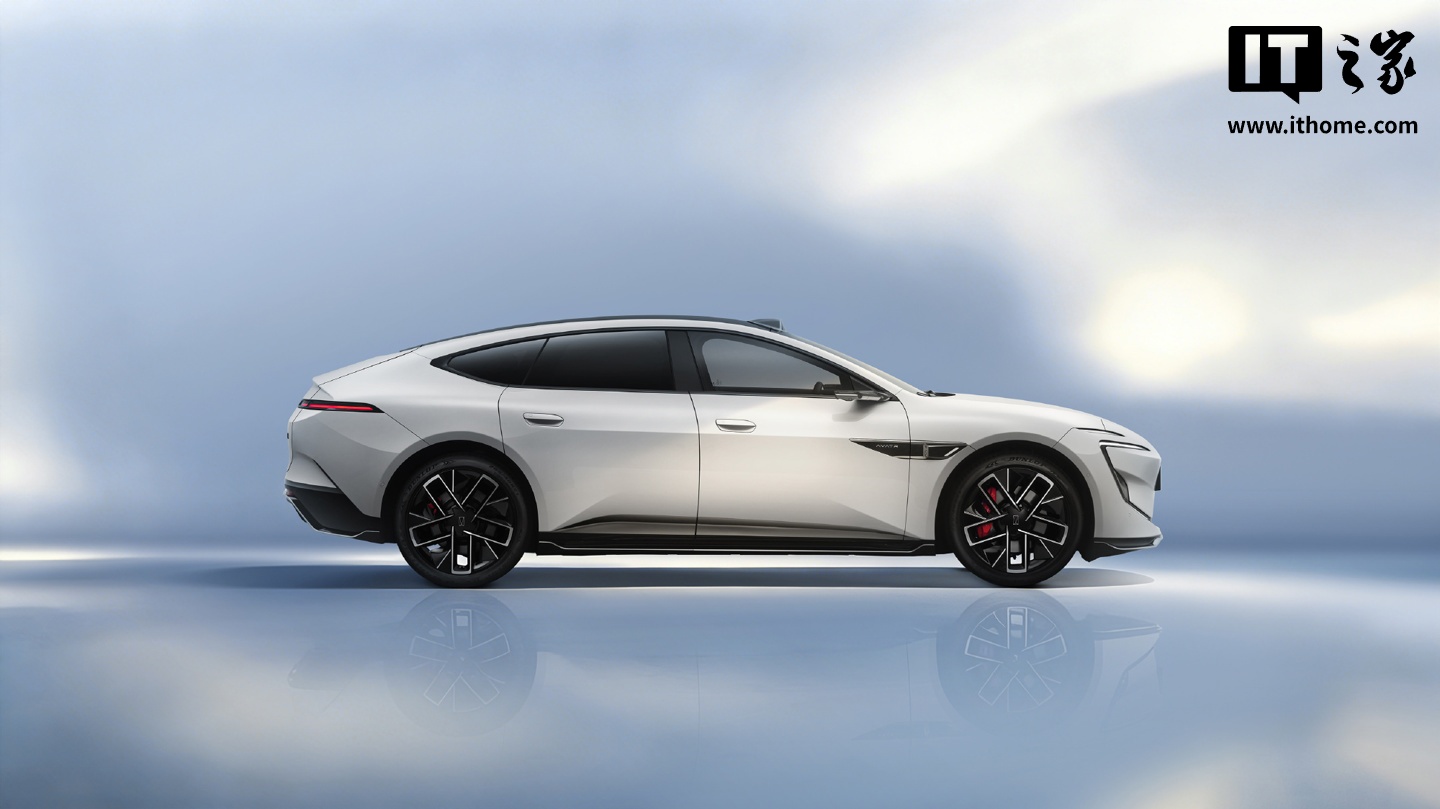
消息称新款阿维塔 12 车侧 B 柱带有“乾崑智驾 ADS”LOGO
Xin Lang Cai Jing· 2026-01-12 12:28
Core Viewpoint - The new Avita 12 has been officially unveiled, showcasing upgrades in design, power, handling, and intelligent driving, positioning it as a luxury flagship model [18]. Group 1: Product Features - The Avita 12 offers both pure electric and range-extended power options, with dimensions of 5020mm in length, 1999mm in width, and a height of either 1470mm or 1460mm, and a wheelbase of 3020mm [11][28]. - The pure electric version is equipped with three motors, with peak power ratings of 210kW for the front motor and 251kW for both rear motors [11][28]. - The vehicle can be fitted with various optional features including an ETC device, different wheel rims, glass, exterior mirrors, sport kits, two-tone body colors, roof decorations, and door handles [11][28]. Group 2: Technical Specifications - The Avita 12 has a maximum speed of 230 km/h and a total mass ranging from 2755 kg to 2810 kg, with a curb weight between 2410 kg and 2430 kg [32]. - The vehicle is designed with a two-axle configuration and can accommodate up to five passengers [32]. - The battery system is a ternary lithium-ion battery produced by CATL, indicating a focus on advanced energy storage technology [32].
中国汽车流通协会:2025年12月国内狭义乘用车市场零售销量达226.1万辆 同比下降14.0%
Zhi Tong Cai Jing· 2026-01-12 12:11
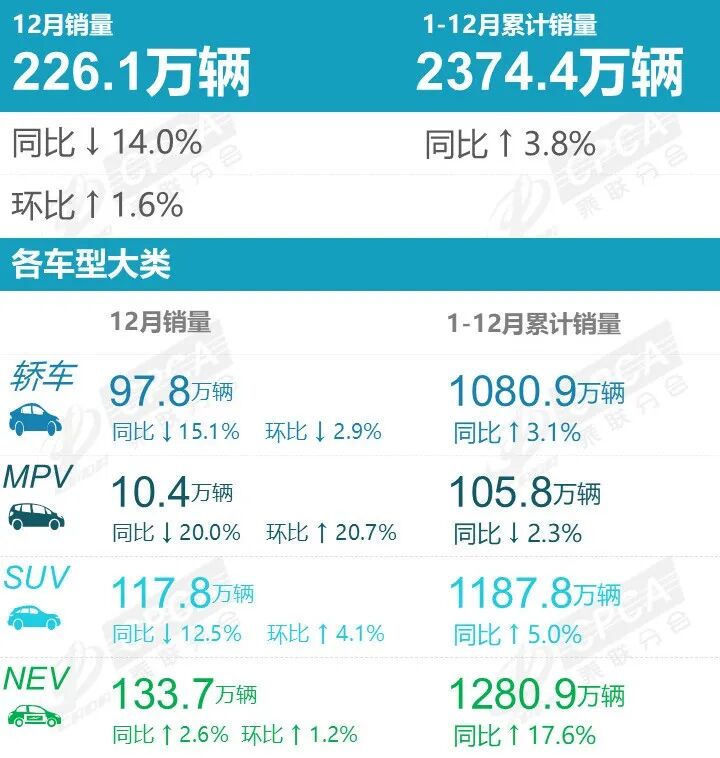
Core Insights - The domestic narrow passenger car market in China saw a retail sales volume of 2.261 million units in December 2025, representing a year-on-year decline of 14.0% but a month-on-month increase of 1.6%. Cumulatively, the sales for the year reached 23.744 million units, marking a year-on-year growth of 3.8% [1]. Market Overview - December 2025 successfully achieved the growth expectations set for the "14th Five-Year Plan" in the automotive market. Despite a challenging environment with significant regulatory measures, the highlights were observed in the new energy vehicle (NEV) market and export market. The expiration of the tax exemption policy for NEVs at the end of December was expected to stimulate demand, although the depletion of subsidy funds across provinces limited the purchasing momentum [2]. Manufacturer Performance - December 2025 - BYD Auto led the sales with 414,784 units, experiencing a month-on-month decrease of 12.7% and a year-on-year decline of 18.6%, holding a market share of 14.9% [4]. - Geely Auto sold 236,817 units, down 23.7% month-on-month but up 12.7% year-on-year, with a market share of 8.5% [4]. - Chery Auto reported sales of 234,736 units, a month-on-month decrease of 10.6% and a year-on-year decline of 19.1%, capturing 8.4% of the market [4]. - Tesla China saw an increase in sales to 97,171 units, up 12.1% month-on-month and 3.6% year-on-year, with a market share of 3.5% [4]. Annual Manufacturer Performance - 2025 - For the entire year of 2025, BYD Auto sold 4.545 million units, a year-on-year increase of 6.9%, securing a market share of 15.4% [5]. - Geely Auto's sales reached 3.025 million units, reflecting a significant year-on-year growth of 39.0% and a market share of 10.2% [5]. - Chery Auto achieved sales of 2.698 million units, up 7.3% year-on-year, with a market share of 9.1% [5]. - Tesla China sold 851,732 units, down 7.1% year-on-year, holding a market share of 2.9% [5]. NEV Market Performance - December 2025 - In December 2025, BYD Auto led the NEV wholesale sales with 414,784 units, down 12.7% month-on-month and 18.6% year-on-year, capturing 26.5% of the market [8]. - Geely Auto followed with 154,264 units, a month-on-month decrease of 17.9% but a year-on-year increase of 38.7%, holding 9.9% market share [8]. - Tesla China sold 97,171 units, marking a month-on-month increase of 12.1% and a year-on-year increase of 3.6%, with a market share of 6.2% [8]. NEV Annual Performance - 2025 - For the year 2025, BYD Auto sold 4.545 million NEVs, a year-on-year increase of 6.9%, with a market share of 29.7% [9]. - Geely Auto's NEV sales reached 1.688 million units, reflecting a remarkable year-on-year growth of 90.0% and a market share of 11.0% [9]. - Changan Auto sold 937,460 NEVs, up 40.7% year-on-year, with a market share of 6.1% [9].
汽车行业周报:如何展望2025Q4业绩?-20260112
Changjiang Securities· 2026-01-12 11:22
Investment Rating - The investment rating for the automotive industry is "Positive" and maintained [9] Core Insights - The wholesale sales of passenger vehicles in Q4 2025 are expected to be approximately 8.76 million units, a year-on-year decrease of 1% but a quarter-on-quarter increase of 14%. The profitability in Q4 may show differentiation compared to the same period last year, with expectations for a quarter-on-quarter improvement [2][5] - The revenue from automotive parts is anticipated to grow steadily quarter-on-quarter, but profitability may face pressure due to factors such as raw material costs and exchange rates [2][5] - The wholesale sales of heavy trucks are projected to be 314,000 units in Q4 2025, representing a year-on-year increase of 43.6% and a quarter-on-quarter increase of 11.5% [2][5] - The overall sales of buses are expected to see a significant quarter-on-quarter increase during the peak season, with sales of large and medium buses reaching 44,000 units, a year-on-year increase of 8.8% and a quarter-on-quarter increase of 42.2% [2][5] - The total sales of motorcycles are estimated to be around 4.73 million units in Q4 2025, reflecting a year-on-year increase of 11.0% but a quarter-on-quarter decrease of 6.2% [2][6] Summary by Sections Passenger Vehicles - Q4 2025 wholesale sales are expected to be about 8.76 million units, down 1% year-on-year but up 14% quarter-on-quarter. New energy vehicle sales are projected at 4.84 million units, up 13% year-on-year and 21% quarter-on-quarter [5] Automotive Parts - Revenue is expected to grow steadily quarter-on-quarter, but profitability may be pressured by raw material and exchange rate factors [5] Heavy Trucks - Q4 2025 wholesale sales are projected at 314,000 units, with a year-on-year increase of 43.6% and a quarter-on-quarter increase of 11.5% [5] Buses - Large and medium bus sales are expected to reach 44,000 units in Q4 2025, with a year-on-year increase of 8.8% and a quarter-on-quarter increase of 42.2% [5] Motorcycles - Total motorcycle sales are estimated at 4.73 million units in Q4 2025, reflecting an 11.0% year-on-year increase but a 6.2% quarter-on-quarter decrease [6]


年终盘点2025汽车市场的“龙门一跃”:油退电进,全球登顶
3 6 Ke· 2026-01-12 10:37
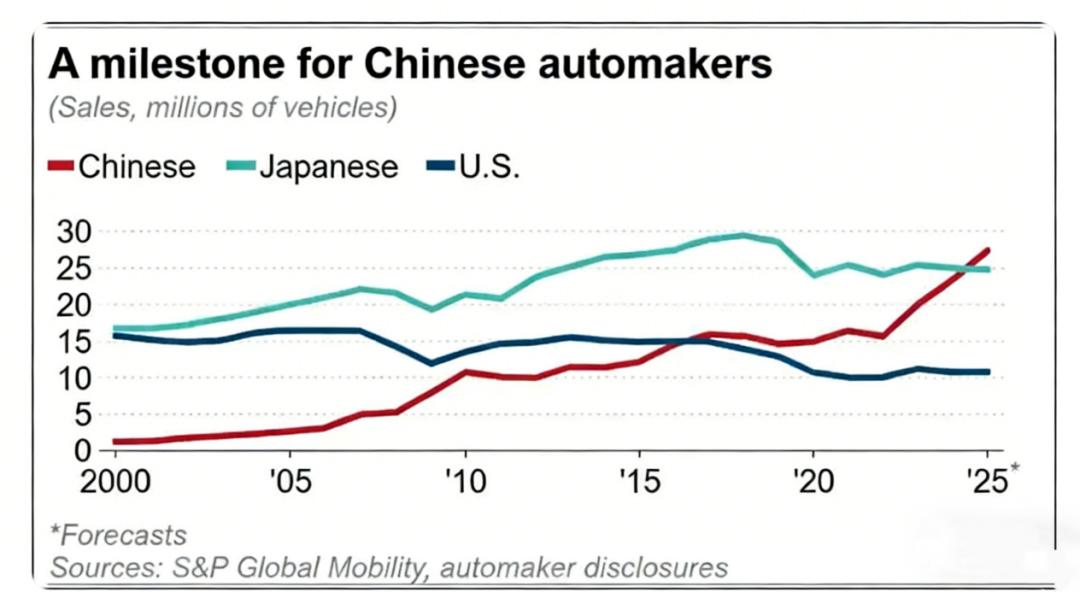
Core Insights - The penetration rate of new energy vehicles (NEVs) in China has surpassed 50%, marking a significant shift in the automotive market dynamics, transitioning from a "policy-driven" to a "product-driven" model [1][10] - The year 2025 is seen as a pivotal moment for the Chinese automotive industry, with the market experiencing a fundamental transformation akin to a "Nokia moment" [1] - The competition is evolving from price wars to value wars, emphasizing technology and product quality over mere volume [11] Industry Overview - In 2025, China's automotive manufacturers are projected to achieve global sales of 27 million vehicles, securing the top position in the global new car sales rankings for the first time [2] - China has overtaken Japan to become the world's largest automobile exporter, with NEVs accounting for a significant portion of this growth [4] - The domestic market's NEV sales are nearing 60%, reflecting a structural change in consumer preferences [4] Sales and Market Penetration - By November 2025, the retail penetration rate of NEVs reached 53.6%, with projections for the full year estimating a rate of 54.0% [6] - The rapid increase in NEV penetration is attributed to a combination of policy support, technological advancements, infrastructure development, and market demand [7] Policy and Technological Developments - The exit of purchase subsidies in 2023 has been offset by continued tax exemptions and various local incentives, which have helped maintain consumer interest in NEVs [7] - 2025 is expected to be a year of technological breakthroughs in NEVs, with advancements in high-voltage platforms, solid-state batteries, and smart driving technologies [8] Infrastructure and Consumer Experience - The expansion of charging infrastructure is crucial for alleviating consumer concerns about range anxiety, with projections of 20 million charging stations by the end of 2025 [9] - The cost advantages of NEVs are becoming increasingly apparent, with electric vehicles offering significantly lower operating costs compared to traditional fuel vehicles [9] Competitive Landscape - The shift from price competition to value competition is reshaping the industry, with companies focusing on technological innovation and profitability [11] - Some companies, like Leap Motor, have emerged as strong competitors, achieving significant sales growth and profitability [13] Global Expansion - In 2025, China's automotive exports are expected to exceed 7 million units, with NEV exports alone projected to reach 2.315 million units, marking a 102.9% increase [21] - Chinese automakers are transitioning to a "global + local" model, emphasizing localized production and R&D to better penetrate international markets [22] Challenges and Future Outlook - Despite rapid growth, challenges such as trade protectionism and compliance costs remain significant hurdles for Chinese automakers in global markets [24] - The automotive industry is expected to continue evolving, with a focus on sustainable growth and value creation as it navigates the transition from a subsidy-driven to a market-driven environment [25]


【月度排名】2025年12月厂商销量排名快报
乘联分会· 2026-01-12 09:28
Core Viewpoint - The article highlights the performance of the Chinese automotive market in December 2025, noting a decline in retail sales for traditional vehicles while emphasizing growth in the new energy vehicle (NEV) sector and exports. The market is expected to transition into 2026 with a focus on new energy vehicles and a recovery in demand [4]. Sales Performance - In December 2025, the domestic narrow passenger car market retail sales reached 2.261 million units, a year-on-year decrease of 14.0% but a month-on-month increase of 1.6%. Cumulative sales for the year totaled 23.744 million units, reflecting a year-on-year growth of 3.8% [2]. - The wholesale sales ranking for December 2025 shows BYD leading with 414,784 units sold, followed by Geely and Chery with 236,817 and 234,736 units, respectively. Notably, BYD's sales decreased by 12.7% month-on-month and 18.6% year-on-year [5]. - For the entire year of 2025, BYD also topped the wholesale sales with 4.545 million units, marking a 6.9% increase year-on-year, while Geely's sales surged by 39.0% to 3.025 million units [6]. New Energy Vehicle Market - In December 2025, the NEV wholesale sales ranking was led by BYD with 414,784 units, despite a month-on-month decline of 12.7% and a year-on-year drop of 18.6%. Geely followed with 154,264 units, showing a year-on-year increase of 38.7% [9]. - The retail sales for NEVs in December 2025 also saw BYD at the forefront with 339,854 units sold, a month-on-month increase of 10.9% but a year-on-year decrease of 15.7% [13]. - For the full year, BYD maintained its dominance in the NEV sector with 3.485 million units sold, although this represented a year-on-year decline of 6.3% [14]. Market Trends and Future Outlook - The article notes that the end of the year typically sees a surge in vehicle purchases, but the depletion of subsidy funds across provinces has tempered this effect, leading to a more stable demand outlook heading into 2026 [4]. - The performance of various manufacturers indicates a competitive landscape, with traditional automakers facing challenges while NEV manufacturers like BYD and Geely continue to show resilience and growth potential [6][9].



乘用车板块1月12日涨0.34%,北汽蓝谷领涨,主力资金净流出4.12亿元
Zheng Xing Xing Ye Ri Bao· 2026-01-12 09:04
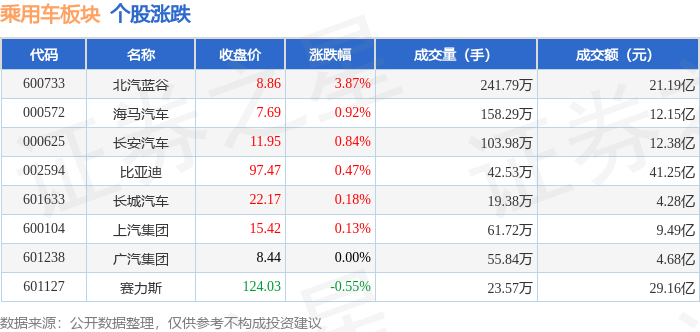
Market Overview - The passenger car sector increased by 0.34% compared to the previous trading day, with Beiqi Blue Valley leading the gains [1] - The Shanghai Composite Index closed at 4165.29, up 1.09%, while the Shenzhen Component Index closed at 14366.91, up 1.75% [1] Individual Stock Performance - Beiqi Blue Valley (600733) closed at 8.86, with a rise of 3.87%, trading volume of 2.4179 million shares, and a transaction value of 2.119 billion [1] - Changan Automobile (000625) closed at 11.95, up 0.84%, with a transaction value of 1.238 billion [1] - BYD (002594) closed at 97.47, up 0.47%, with a transaction value of 4.125 billion [1] - Great Wall Motors (601633) closed at 22.17, up 0.18%, with a transaction value of 428 million [1] - SAIC Motor (600104) closed at 15.42, up 0.13%, with a transaction value of 949 million [1] - GAC Group (601238) remained unchanged at 8.44, with a transaction value of 468 million [1] - Seres (601127) closed at 124.03, down 0.55%, with a transaction value of 2.916 billion [1] Capital Flow Analysis - The passenger car sector experienced a net outflow of 412 million from institutional investors and 218 million from retail investors, while retail investors saw a net inflow of 629 million [1] - Beiqi Blue Valley had a net inflow of 106 million from institutional investors, while retail investors contributed a net inflow of 12.5965 million [2] - Great Wall Motors had a net inflow of 10.2787 million from institutional investors, with retail investors contributing a net inflow of 21.3553 million [2] - BYD experienced a net outflow of 559.3 million from institutional investors, with retail investors contributing a net inflow of 14.6 million [2] - Seres faced a significant net outflow of 344 million from institutional investors, while retail investors had a net inflow of 26.97 million [2]


长安汽车发展大事记
Zhong Guo Jing Ying Bao· 2026-01-12 08:18
Core Insights - The company has a rich history in the automotive industry, starting from self-funding in the early 1980s to becoming a significant player in the market with various innovative products and initiatives. Group 1: Historical Milestones - In the early 1980s, the company self-funded 35 million yuan to enter the automotive sector, marking the beginning of its entrepreneurial journey [1] - In 1984, the company launched the first batch of microcars in China, including the SC1 12 micro van and SC1 10 micro truck [2] - The first "Aotu" model from Changan Suzuki was produced in 1995, becoming China's first national car due to its affordability and fuel efficiency [2] - In 1999, the Changan Star completed crash tests at Tsinghua University, significantly impacting the microcar market in China [3] Group 2: International Expansion and R&D - In 2001, the company began international R&D efforts by establishing a presence in Turin, Italy [4] - By 2003, it set up an overseas technology sub-center and representative office in Italy, laying the groundwork for global R&D [5] - In 2010, the first national key laboratory for automotive noise, vibration, and safety technology was established at the company [8] Group 3: Product Innovations - The first self-branded sedan, the Benben, was launched in 2006, creating a significant market impact [6] - In 2007, the company introduced its first hybrid vehicle, the "Changan Jiexun HEV" [7] - The first generation of the global strategic model, the Yidong, was launched in 2011, achieving over 100,000 sales in its first year [9] Group 4: Technological Advancements - In 2016, the company completed a 2000-kilometer autonomous driving test from Chongqing to Beijing, paving the way for smart driving technology [10] - In 2017, the company launched the "Shangri-La" plan to accelerate its layout in the new energy vehicle sector [11] - In 2018, the "Beidou Tianshu" plan was introduced, establishing three global smart new energy brands [12] Group 5: Future Plans and Achievements - In 2023, the company announced the "Haina Baichuan" plan for global expansion, targeting five overseas markets [13] - By 2024, the Blue Whale powertrain will be upgraded to New Blue Whale power, achieving international leading technology levels [14] - The company is set to reach a historic milestone of producing its 30 millionth vehicle by December 10, 2025, becoming the fastest Chinese automotive company to achieve this feat [14]